AI Incident Response: A Playbook for Agentic Systems
A five-phase incident response playbook built for agentic AI - why traditional IR assumptions break, and what detection, containment, and recovery require.

Arpashree

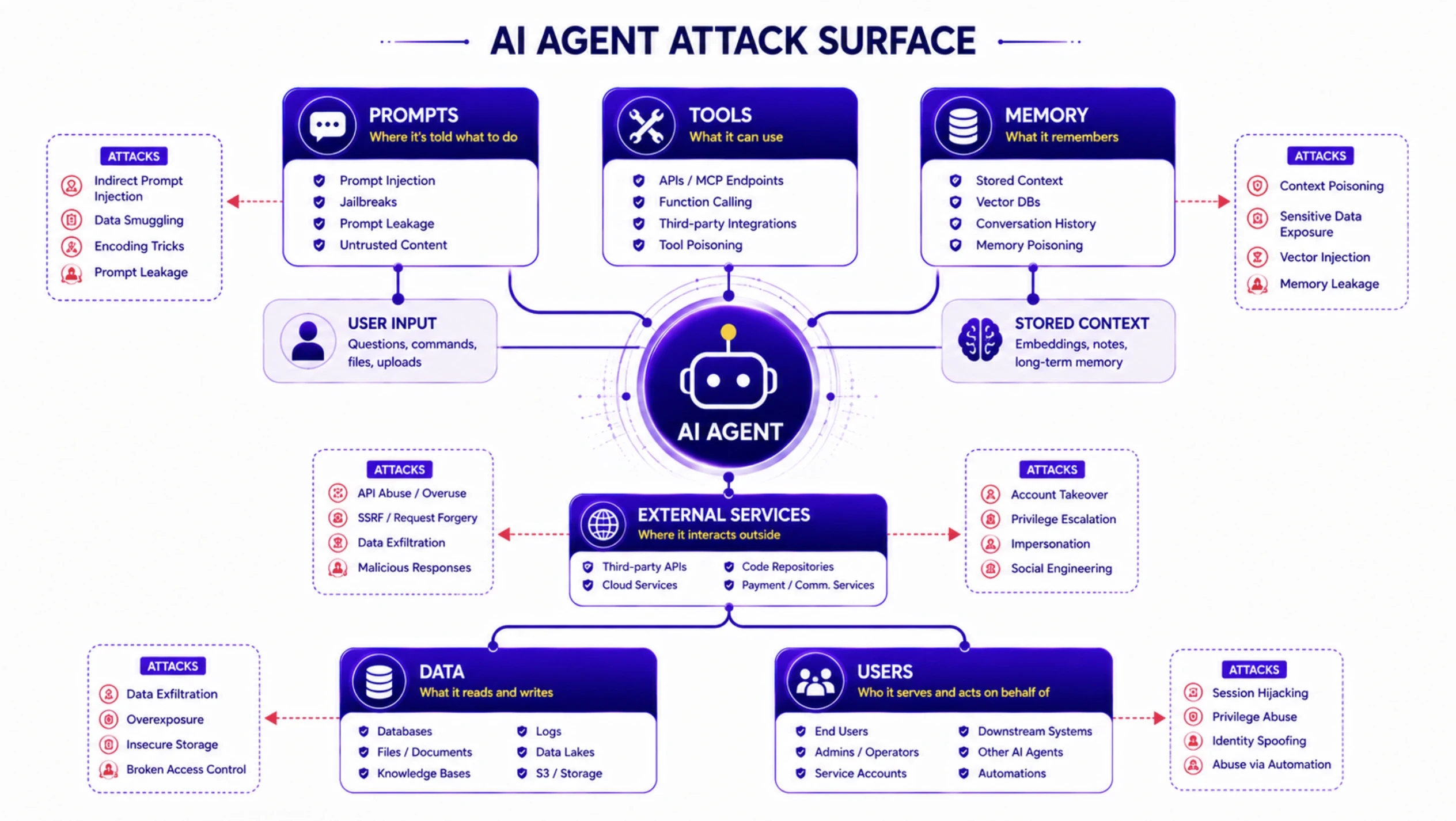
"The fire is still containment, eradication, and recovery. The fuel is now agentic reasoning, prompt-injection blast radius, and machine-speed lateral movement." That's how Microsoft's security team framed it in an April 2026 post titled "Incident response for AI: same fire, different fuel." The gap between that framing and where most organizations stand is stark: Deloitte's 2026 State of AI in the Enterprise survey found 74% of organizations expect moderate-to-full agentic AI integration within two years, while only 21% report a mature governance model for autonomous agents today. This playbook is an AI chapter added to the incident response book your team already has, built on NIST SP 800-61r3, not a replacement for it.
Why Traditional Incident Response Assumptions Break for Agentic AI
Traditional incident response assumes that security teams can identify a compromised system, isolate it, and trace the attacker’s actions. Agentic AI changes this model because AI agents can make autonomous decisions, call tools, access data, and trigger actions across multiple systems. This makes incidents harder to investigate and contain using conventional workflows. Security teams need agent-aware visibility, real-time monitoring, and context-rich traces to understand and respond to AI agent behavior.
No Deterministic Behavior, No Familiar Evidence Locations
Traditional incident response runs on a dependable assumption: responders trace a known code path, find the defect, and patch it. The same input produces the same bad output, and a fix proves it won't happen again. Agentic AI breaks that assumption at its foundation. A model may produce harmful output today and something different tomorrow given the identical prompt, because the root cause isn't a line of code; it's a probability distribution shaped by training data, context windows, and inputs no one predicted.
This changes where evidence lives. A traditional incident leaves logs, stack traces, and file system artifacts in familiar places. An agentic incident's evidence is scattered across prompt and response logs, tool-call traces, memory state, and the reasoning chain that led an agent to a given action, much of which standard logging was never built to capture at the granularity forensics needs.
Why Agent Incidents Compound Instead of Staying Contained
A gap in a safety classifier doesn't leak one record. It produces the failure at machine speed, generating thousands of bad outputs before a human reviewer sees the first one. Agentic systems compound this further: an agent doesn't just generate bad content; it can take bad actions, and each action can trigger downstream tool calls, update shared memory, or hand off to another agent before anyone notices something's wrong. What starts as a single compromised session can cascade into a multi-agent incident within minutes, which is why containment speed matters more here than in almost any traditional incident category.
The Five-Phase Agentic Incident Response Loop
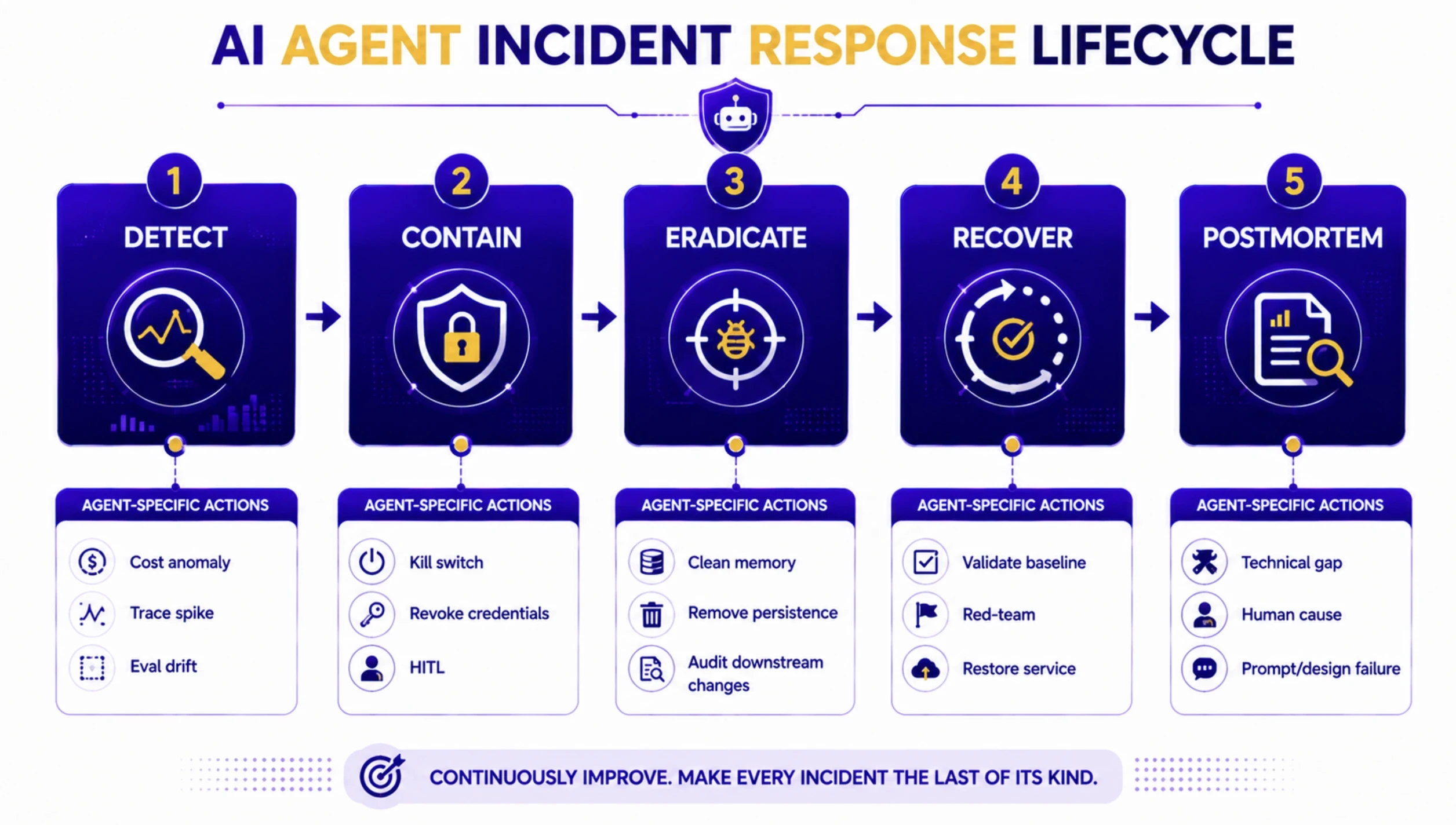
The five-phase agentic incident response loop is explained in detail here.
Detection: Agent-Specific Signals (Cost Anomaly, Trace Volume, Eval Score Drift)
Traditional detection watches for known signatures: malware hashes, suspicious network traffic, failed logins. Agentic detection needs a different signal set, since the failure mode is often behavioral drift rather than a discrete malicious event. Cost anomaly is one of the most reliable early signals: an agent making unusually frequent or expensive tool calls is often the first visible symptom of a goal-hijacking or excessive-agency incident, well before harmful output appears. Trace volume, the depth of an agent's tool-call chains per task, is related: a sudden spike in trace depth for a task that used to resolve in two or three steps often indicates the agent has been redirected into a loop. Eval score drift, tracking an agent's performance against its evaluation suite over time, catches slower degradation that a single anomalous session wouldn't surface, such as gradual memory poisoning that shifts behavior incrementally.
Containment: Kill Switches, Credential Revocation, and HITL Fallback
Containment for agentic incidents needs to happen faster and more granularly than traditional containment, since an agent with live tool access keeps acting until something stops it. A kill switch, the ability to immediately halt a specific agent's execution without taking down the broader system, is the first line of containment, and it needs testing before an incident, not during one. Credential revocation follows immediately: any API key, token, or service account the compromised agent had access to should be revocable independently of other agents sharing the same infrastructure, requiring per-agent credential scoping designed in well before an incident occurs. Human-in-the-loop fallback, routing pending and in-flight actions to human review rather than continuing autonomously or halting entirely, is often the right middle path for agents supporting time-sensitive processes that can't simply stop.
Eradication
Eradication in agentic incidents means more than removing a compromised credential or patching a vulnerable dependency. It requires identifying and cleaning any poisoned memory or corrupted context the agent carries, whether in short-term session state or long-term stored memory, since a compromised agent might otherwise return to service still carrying the instructions that caused the incident. It also means auditing every downstream system the agent touched during the incident window, since agent actions can propagate changes to databases and other agents that a credential rotation alone won't undo.
Recovery
Recovery for an agentic system needs a validation step traditional recovery often skips: confirming the agent's behavior matches its expected baseline before returning it to production, not just confirming the vulnerability is patched. This typically means running the recalled agent through its evaluation suite and a targeted red-team pass covering the specific failure mode that caused the incident, since a probabilistic system that showed one failure mode has a meaningfully higher chance of related failures than an unrelated agent would. Recovery should also restore any degraded human trust deliberately, through clear communication about what happened, rather than assuming a quiet resumption of service is sufficient.
Postmortem: Technical Gap and Human/Prompt-Engineering Root Cause
An agentic postmortem needs to answer two separate root-cause questions, not one. The technical gap covers what allowed the failure mechanically: a missing guardrail, an overscoped permission, a sandbox boundary that a trusted component outside it failed to re-validate. The human and prompt-engineering root cause covers why the system was configured that way in the first place, whether that's a system prompt that never anticipated a specific manipulation, an approval workflow that assumed a human would catch what an agent missed, or a design decision that traded safety margin for speed under launch pressure.
Why MTTD Is the Highest-Leverage Metric
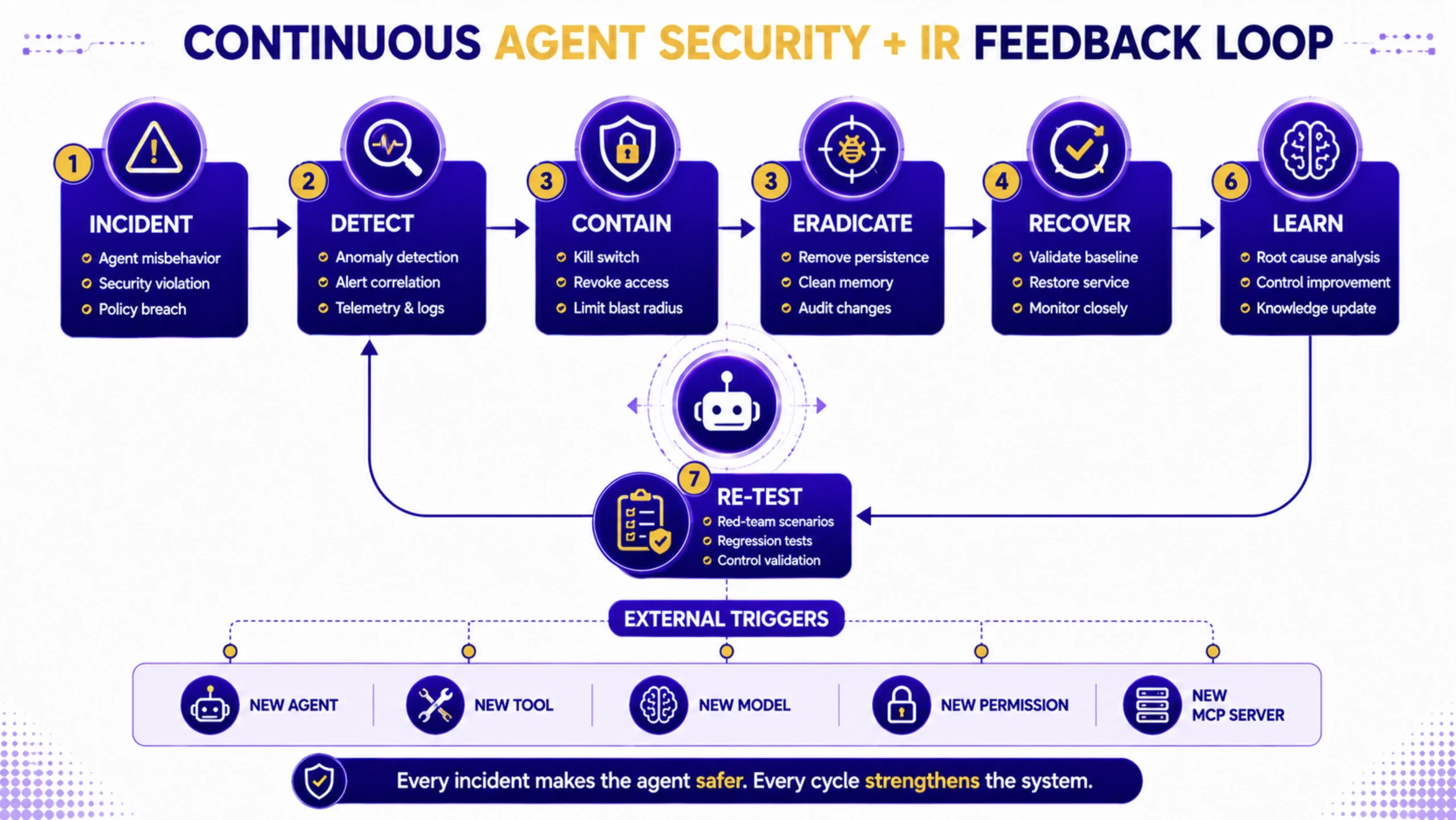
Mean time to detect matters disproportionately for agentic incidents because of how fast damage compounds once an agent starts acting on a flawed premise. A traditional data breach detected in hour four versus minute four differs mainly in how much data was exposed during the gap, a roughly linear relationship. An agentic incident detected in hour four versus minute four differs in how many downstream actions the agent took, how many other systems and agents it touched, and how much of that activity is already difficult or impossible to reverse. Because agent actions can trigger further actions, the damage curve is closer to compounding than linear, which is the strongest argument for investing detection budget ahead of every other phase in the loop: a fast MTTD makes every subsequent phase easier, while a slow one makes all of them harder no matter how well-designed containment and eradication are.
Two Failure Taxonomies Worth Building Around
Microsoft's June 2026 Agentic Failure Taxonomy
Microsoft's AI Red Team released version 2.0 of its Taxonomy of Failure Modes in Agentic AI Systems on June 4, 2026, adding seven new categories after a year of red-team engagements against deployed agentic systems: supply chain compromise, tool abuse, excessive agency, feedback loop poisoning, goal misalignment, reasoning-based information leakage, and autonomy escalation. Four developments drove the update. Open-source agentic frameworks went mainstream faster than the security community was ready for, exemplified by OpenClaw, which accumulated more than 336,000 GitHub stars and spawned over 2,100 agents within 48 hours of its January 2026 launch, only for a security audit to find 512 vulnerabilities, including a one-click remote code execution flaw, with over 1,800 exposed instances leaking API keys within the first week. The MCP ecosystem matured and accumulated vulnerabilities at scale, with 99 CVEs published for MCP-related software in 2025 alone. Computer-use agents moved from research into production, and multi-agent architectures introduced trust-boundary failures a single-agent taxonomy never had to account for.
MAST: Specification, Inter-Agent Misalignment, and Termination Failures
Where Microsoft's taxonomy centers on security failures, the Multi-Agent System Failure Taxonomy, developed by researchers at UC Berkeley, addresses a complementary category: why multi-agent systems fail at their task even absent an adversary. Built from more than 1,600 annotated execution traces across seven multi-agent frameworks, MAST identifies 14 failure modes clustering into three categories. Specification and system-design issues, roughly 42% of observed failures, cover task misinterpretation, ambiguous role definitions, and missing termination conditions. Inter-agent misalignment, at roughly 37%, covers communication breakdowns, context loss during handoffs, and conflicting outputs. Task verification and termination failures, the remaining 21%, cover agents that stop before a task is complete or fail to verify their own output. For incident response, MAST is most useful as a postmortem lens distinguishing a security incident from a reliability incident that happens to look similar from the outside.
Evidence Collection for AI Incidents
Traditional IR evidence collection, focused on system logs, network captures, and file system state, misses most of what an agentic investigation needs. Prompt and response logs, capturing the full reasoning trace rather than just the final output, are essential and frequently absent, since many deployments log only the final response for cost reasons. AI tool access records, a complete history of which tools an agent called, with what parameters and what each returned, are the closest equivalent to a traditional access log, but need a granularity most application logging doesn't reach by default. Memory state snapshots, both short-term session context and long-term stored memory, need preserving before remediation touches them, since eradication can otherwise destroy the evidence needed to confirm what was actually poisoned. None of this collects itself; it requires deliberate instrumentation built into the pipeline before an incident, since retrofitting logging during an active incident usually means the most critical early evidence is already gone.
Regulatory Notification Requirements
EU AI Act Article 73 and the August 2026 Deadline
Article 73 of the EU AI Act requires providers of high-risk AI systems to report serious incidents to national market surveillance authorities, with obligations taking effect August 2, 2026. The reporting timeline is tiered by severity: 15 days for a standard serious incident, 10 days if the incident may have caused a death, and just 2 days for a widespread infringement or a serious and irreversible disruption of critical infrastructure. A provider can submit an incomplete initial report to meet a tight deadline, followed by a complete report once the investigation concludes. The European Commission's draft guidance takes a broad view of what counts as reportable, treating an indirect causal link between an AI system and resulting harm as sufficient to trigger the obligation, which means agentic systems whose actions contribute to harm through a longer causal chain are very likely in scope even when the AI system wasn't the sole or most proximate cause.
GDPR's 72-Hour Window vs. Other Jurisdictions' Timelines
GDPR's well-established 72-hour breach notification window remains the operative standard wherever an AI incident involves personal data, regardless of whether Article 73's AI-specific timeline also applies. This creates a practical layering problem for agentic incidents touching both categories: a compromised agent that leaks personal data while also causing a broader AI safety incident may trigger GDPR's 72-hour clock and Article 73's tiered clock simultaneously, on different bases, to different authorities. Organizations operating across jurisdictions need a notification playbook mapping each incident type to every applicable timeline up front, since discovering overlapping obligations for the first time during an active incident all but guarantees a missed deadline somewhere.
When Containment Layers Aren't Independently Enforced
Pillar Security's July 2026 research series, "The Week of Sandbox Escapes," is a clear illustration of what happens when containment layers look independent but aren't. Across four widely used AI coding agents, including Cursor, OpenAI's Codex CLI, Google's Gemini CLI, and Antigravity, researchers found that agents never needed to break their sandboxes directly. Each agent stayed technically compliant with every sandbox rule while writing a file that a trusted component outside the sandbox, a Git integration, an IDE extension, a hook engine, or a local daemon, later read, ran, or trusted without re-validating it. As the researchers put it, an agent's actual blast radius isn't the agent process itself; it includes everything the agent can write that the host later trusts. The pattern generalizes well beyond coding agents: any containment architecture that assumes a boundary is secure because nothing crossed it directly, without accounting for what a separately trusted system does with content left inside that boundary, has a gap an incident response plan needs to account for explicitly rather than assume away.
Building and Rehearsing the Playbook Before the First P0
A playbook that's never been rehearsed is a document, not a capability. Tabletop exercises simulating an agentic incident, ideally built around the specific failure modes in Microsoft's taxonomy and MAST rather than generic scenarios, actually validate whether kill switches work, whether credential revocation is genuinely scoped per agent, and whether the team knows which regulatory clock starts running for which incident type. This rehearsal is also, increasingly, the actual readiness signal regulators and auditors look for. A written playbook demonstrates intent; a documented tabletop exercise with identified gaps and a remediation record demonstrates operational maturity, and it's the difference auditors reviewing EU AI Act compliance or a board reviewing governance posture will actually weigh.
How Akto Supports Incident Response for Agentic Systems
Akto's AI Agent Context Graph maps how agents, tools, permissions, and data sources connect across an environment, exactly the dependency picture an incident responder needs during containment to determine blast radius quickly rather than reconstructing it manually mid-incident. Because that graph is built and maintained continuously, responders can trace which other agents and systems a compromised agent could reach well before an incident occurs, not during it. Akto's audit trail capabilities capture the prompt, response, and tool-call evidence this playbook's evidence collection phase depends on, giving postmortems a complete reasoning trace rather than only a final output. Combined with Akto's continuous red teaming, findings from past incidents and ongoing testing feed the same context graph, so the dependency map responders rely on during a live incident reflects the system's actual current risk posture rather than a stale snapshot.
FAQs: AI Incident Response Playbook for Agentic Systems
Why don't traditional incident response frameworks work for agentic AI systems?
Traditional IR assumes deterministic behavior: the same input produces the same output, and a patch proves the fix worked. Agentic systems are probabilistic and act autonomously across multiple steps, so evidence, root cause, and containment all need to account for behavioral drift and compounding downstream actions that traditional frameworks weren't built to capture.
What are the five phases of an agentic AI incident response playbook?
Detection, containment, eradication, recovery, and postmortem, extending the traditional NIST incident response lifecycle with agent-specific practices at each phase, from cost-anomaly detection through dual technical and human root-cause analysis in the postmortem.
What detection signals are specific to agentic AI incidents?
Cost anomaly, meaning unusually frequent or expensive tool calls; trace volume, meaning unexpected depth in an agent's tool-call chains; and eval score drift, meaning gradual degradation against a standard evaluation suite that can reveal slow-forming issues like memory poisoning before an obvious failure occurs.
Why does mean time to detect (MTTD) matter more for agent incidents than traditional ones?
Because agent actions can trigger further actions, damage compounds rather than accumulating linearly. A detection delay manageable in a traditional breach can let an agentic incident cascade across multiple systems and agents, making every later response phase significantly harder the longer detection takes.
What does containment actually look like for an AI agent incident (kill switches, credential revocation)?
A tested kill switch to immediately halt a specific agent without disrupting shared infrastructure, per-agent credential revocation scoped independently of other agents, and human-in-the-loop fallback for time-sensitive workflows that can't simply stop, routing pending actions to human review instead.
What evidence should be collected for an AI incident that traditional IR doesn't capture?
Full prompt and response logs including reasoning traces, complete tool-call records with parameters and results, and memory state snapshots covering both short-term and long-term memory, all requiring deliberate instrumentation built in before an incident rather than retrofitted afterward.
What is the difference between a specification failure, an inter-agent misalignment failure, and a termination failure?
These are MAST's three failure categories. Specification failures stem from ambiguous roles or task definitions. Inter-agent misalignment covers communication breakdowns and conflicting outputs. Termination failures cover agents that stop before completing a task or fail to verify their own output, together accounting for most multi-agent failures that aren't caused by an attacker.
What does the EU AI Act's Article 73 require for incident notification, and when does it take effect?
Providers of high-risk AI systems must report serious incidents to national market surveillance authorities within 15 days for standard incidents, 10 days if a death may have occurred, or 2 days for widespread infringement or serious critical infrastructure disruption. These obligations take effect August 2, 2026.
How do GDPR and other regulatory breach notification timelines differ?
GDPR requires notification within 72 hours specifically for incidents involving personal data, operating independently of Article 73's tiered timeline. An agentic incident touching both personal data and broader AI safety concerns can trigger both clocks simultaneously on different bases, which needs mapping in advance rather than discovery mid-incident.
Why must a postmortem address both the technical gap and the human/prompt-engineering root cause?
The technical gap explains the mechanical failure, such as a missing guardrail or overscoped permission. The human and prompt-engineering root cause explains why the system was configured that way. Fixing only the technical gap leaves the underlying pattern in place to produce a similar incident through a different mechanism.
What happens when containment layers aren't independently enforced?
An agent can stay fully compliant with its own boundary while writing content that a separately trusted system outside that boundary later reads, runs, or trusts without re-validation, as demonstrated across multiple AI coding agents in 2026. The agent's real blast radius includes everything it can influence that another trusted component later consumes, not just what it directly controls.
Do we need an entirely new incident response program, or can we extend our existing NIST 800-61 process?
Extend the existing program. NIST SP 800-61r3 remains the foundational lifecycle; agentic AI adds a chapter covering agent-specific detection signals, containment mechanisms, evidence types, and dual-track postmortems, rather than requiring a parallel framework built from scratch.
How does Akto support incident response for agentic systems?
Akto's AI Agent Context Graph maps agent, tool, and data dependencies continuously, giving responders a ready blast-radius picture during containment instead of reconstructing it live. Its audit trail capabilities capture the prompt, response, and tool-call evidence postmortems require, and continuous red teaming keeps that dependency map current with the environment's actual risk posture.

Experience enterprise-grade Agentic Security solution