MCP Gateway vs MCP Proxy: Key Differences and Use Cases
Learn the differences between an MCP gateway and MCP proxy, including security, traffic control, policy enforcement, monitoring, and MCP server protection.

Arpashree

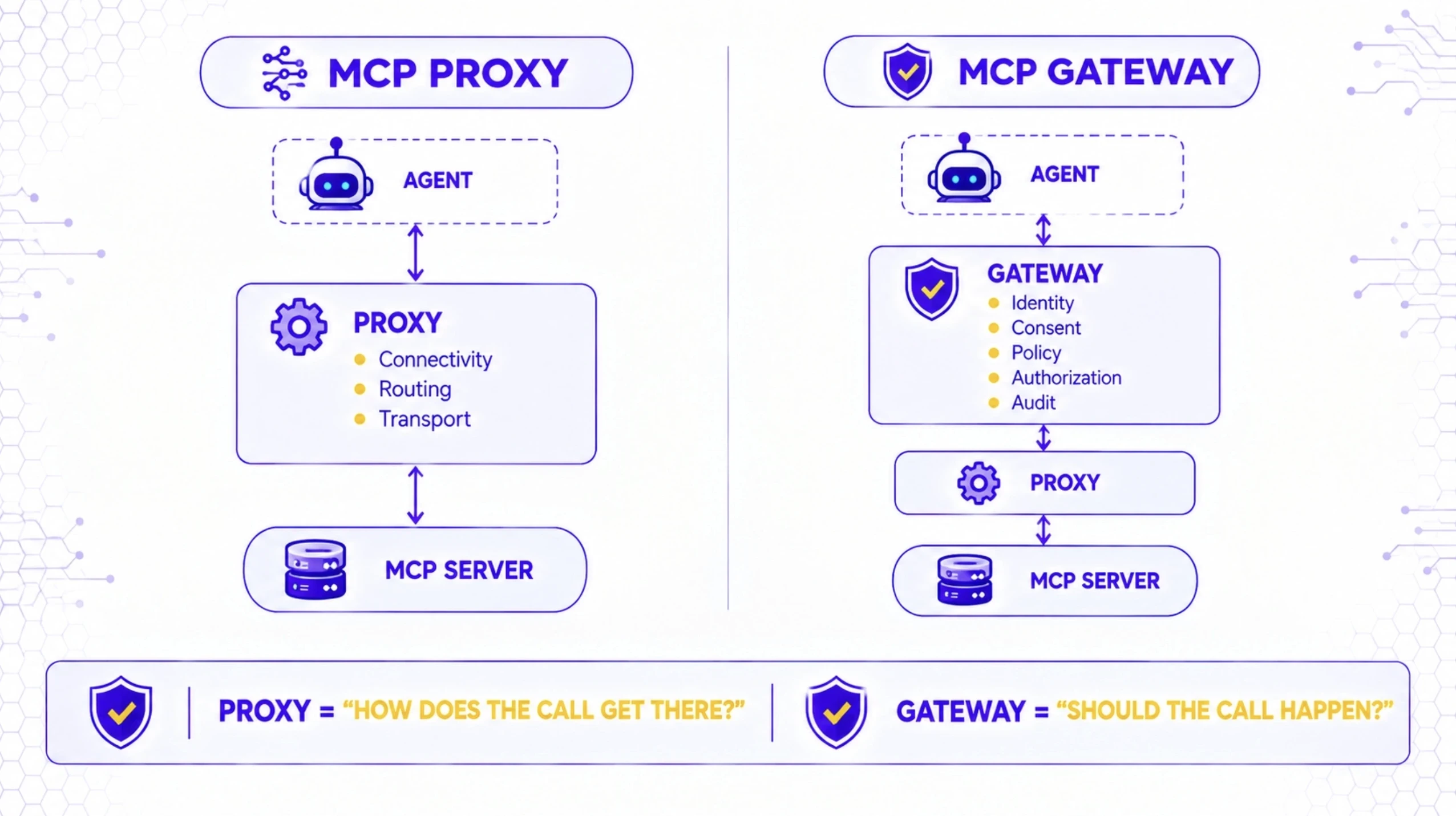
A proxy moves traffic. A gateway governs trust. An MCP proxy connects an agent to one or many MCP servers, handling transport differences and connection management so the agent doesn't have to. An MCP gateway sits on top of that same connectivity layer and answers a different question entirely: should this specific action, from this specific person, be allowed right now, and can we prove that decision later. Most confusion in the MCP gateway vs MCP proxy debate, or the MCP proxy vs MCP gateway framing depending on which term someone leads with, comes from treating the two as competitors rather than as different layers of the same stack. Understanding MCP gateway vs proxy architecture at this level, connectivity versus governance, is the foundation everything else in this comparison builds on.
What Is an MCP Proxy?
An MCP proxy server sits between an agent and one or more backend MCP servers, presenting itself as a single MCP endpoint while relaying calls to whichever actual server handles them.
Transport Mediation and Connectivity
Transport mediation is the proxy's core job: MCP servers speak over stdio, Streamable HTTP, or SSE depending on how they're deployed, and a proxy normalizes that into one consistent connection an agent can rely on regardless of what's running underneath. Stdio-to-HTTP bridging specifically lets a locally-run server, built for a single process talking over standard input and output, become reachable the same way a remote HTTP-based server is, without the agent needing to know the difference.
What a Proxy Does Well (TLS Termination, Endpoint Aggregation, stdio-to-HTTP Bridging)
A proxy earns its place through connectivity, not judgment. TLS termination handles encryption at one point rather than requiring every backend server to manage its own certificates. Endpoint aggregation lets an agent see one unified tool catalog drawn from several connected servers instead of managing separate connections to each. Health-based routing keeps traffic away from a backend server that's failing or slow, and connection pooling and credential injection handle the operational overhead of keeping many server relationships alive at once. All of this is genuinely valuable engineering, and none of it requires the proxy to understand who's calling or why.
There's also a cost dimension worth naming: once an agent connects to more than a couple of MCP servers, every request to the underlying model ships the full set of available tool definitions along with it, burning tokens on schemas the model rarely touches in any given turn. A well-built proxy can rewrite or compress that tool surface before it ever reaches the model, which is a connectivity-layer optimization with a direct effect on latency and cost, entirely separate from anything a policy or identity layer would add.
What a Proxy Doesn't Do (No Identity, Consent, or Policy Layer)
A proxy by itself has no concept of policy. It doesn't know which human a given agent is acting on behalf of; it doesn't check whether that person consented to this specific action, and it doesn't maintain a queryable record of who did what and when beyond whatever raw connection logs happen to exist. A proxy that hands over every tool a backend exposes because the connection exists is making a scoping mistake one layer down from where a gateway makes the same mistake by granting broad roles instead of specific actions. The absence of an identity, consent, or policy layer isn't a flaw in a proxy's design. It's simply outside the problem a proxy was built to solve.
What Is an MCP Gateway?
An MCP gateway is the enforcement point where governance actually happens: every call routes through it, and every call gets evaluated against a policy before it's allowed to proceed.
Governance and Runtime Control on Top of Connectivity
An MCP gateway takes the connectivity a proxy already provides and adds a decision layer above it. Where a proxy asks "how do I get this call to the right backend," a gateway asks "should this call happen at all, given who's asking and what they're allowed to do." That distinction, connectivity vs. governance, is the entire difference this comparison is built around.
Identity Binding, Consent Scope, and Authorization Enforcement
Identity binding ties every tool call to a specific human and the specific agent acting on that person's behalf, rather than attributing activity to a shared, anonymous service account. This matters more than it might first appear: without it, an audit trail can show that "an agent" performed an action, but not which employee's authority it was acting under, which is close to useless the moment an incident needs to be traced back to a specific accountable person. Consent scope defines exactly what that person authorized an agent to do, and authorization enforcement checks every individual call against that scope in real time, evaluating the agent's trust level, the human's own permission ceiling, and the tool's risk classification before the call is ever allowed through.
Audit Trail and Per-Call Policy Decisions
Every decision a gateway makes, allow or deny, gets logged as its own auditable record, not just the fact that a call occurred. For the full architectural breakdown of what a production MCP gateway needs to enforce this consistently at scale, see our dedicated MCP gateway security guide.
Is an MCP Proxy a Type of MCP Gateway?
Not quite, but the relationship is closer than "proxy" and "gateway" being two separate categories suggests. The cleanest mental model: a gateway is typically built using one or more proxies underneath it, plus a policy and identity layer on top. The proxy is the execution mechanism. The gateway is what that mechanism becomes once it needs a shared identity model, a shared policy layer, and one place to look when something goes wrong. Asking whether a proxy is a type of gateway is a bit like asking whether an engine is a type of car: one is a necessary component of the other, not a competing alternative to it.
Side-by-Side Comparison Table
Dimension MCP Proxy MCP Gateway
Primary role Connectivity and transport mediation Governance and policy enforcement
Identity awareness None by default Binds every call to a human and an agent
Policy enforcement None Per-call, evaluated in real time
Audit logging Raw connection logs, if any Structured, per-decision audit trail
Typical deployment Single team, small server count Multiple teams, tenants, or compliance scope
Latency/operational overhead Minimal, adds one network hop Slightly higher, offset by centralized policy management
Where a Proxy Alone Is Enough
Single Team, Small Number of Trusted MCP Servers
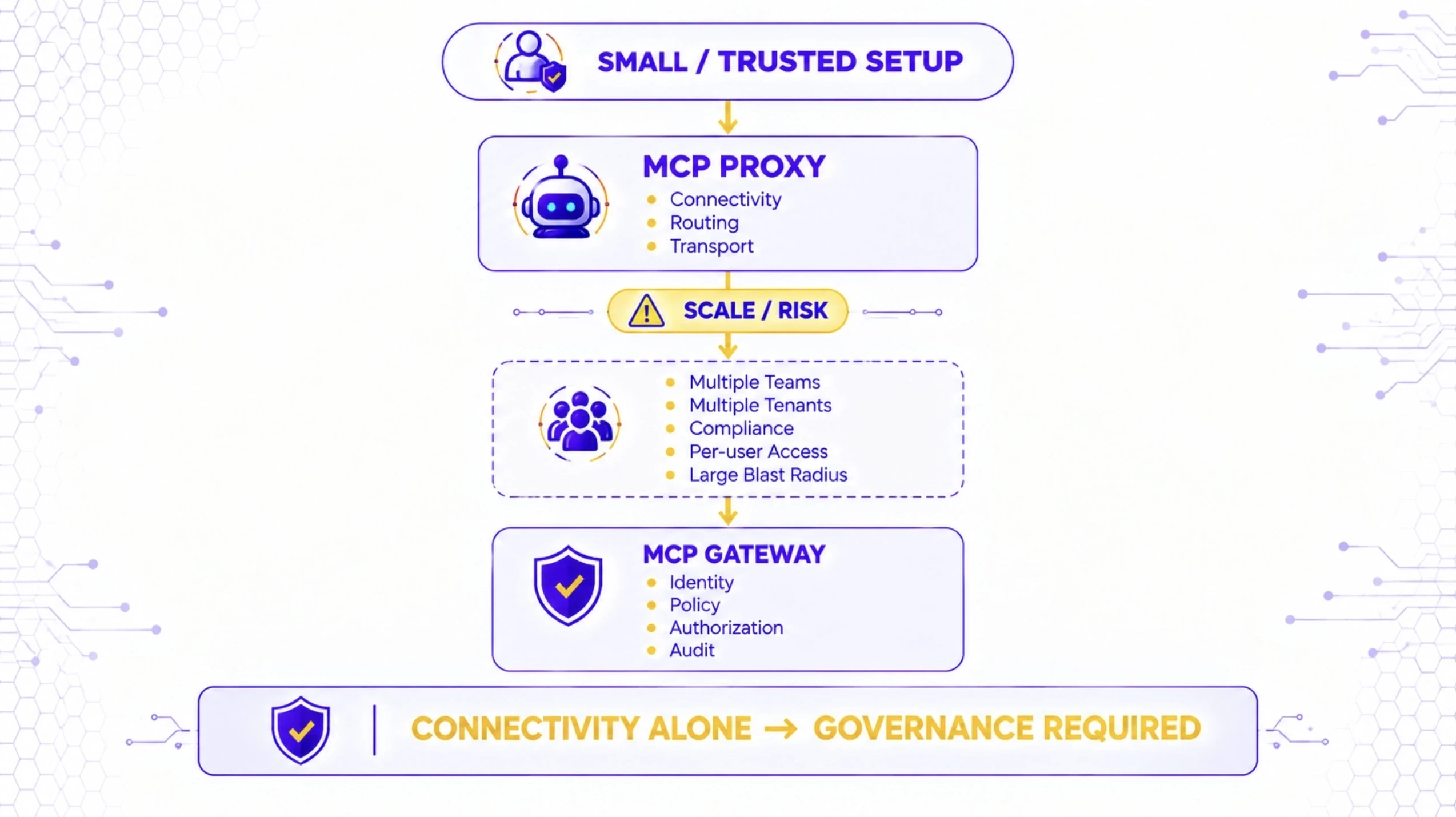
A single team running a handful of MCP servers it built and trusts internally rarely needs a full identity and policy layer on day one, since the trust boundary in that setup is small and already well understood by everyone involved.
Engineers Directly Supervising Their Own Agents
When the engineers running an agent are the same people who can immediately see and correct its behavior, a proxy's connectivity and basic logging is often sufficient, since human oversight is effectively happening in real time already.
When You Need a Gateway Instead
Multiple Teams or Tenants Sharing MCP Servers
The moment more than one team or tenant shares the same set of MCP servers, the question stops being how many servers exist and becomes whether you can answer "should this specific action have been allowed" as more than a hope. A shared proxy with no policy layer can't answer that question for any of the teams relying on it.
Compliance Requirements for Auditability
Any environment with a compliance obligation to demonstrate who accessed what, and under what authorization, needs a gateway's structured audit trail specifically, since a proxy's raw logs rarely satisfy an auditor asking for evidence of a specific access decision.
Per-User or Per-Tenant Access Isolation
Per-tenant isolation, keeping one customer's or team's agent activity fully separated from another's even when they route through the same infrastructure, is a gateway-level control. A proxy has no native concept of a tenant boundary to enforce in the first place.
How They Work Together in Production
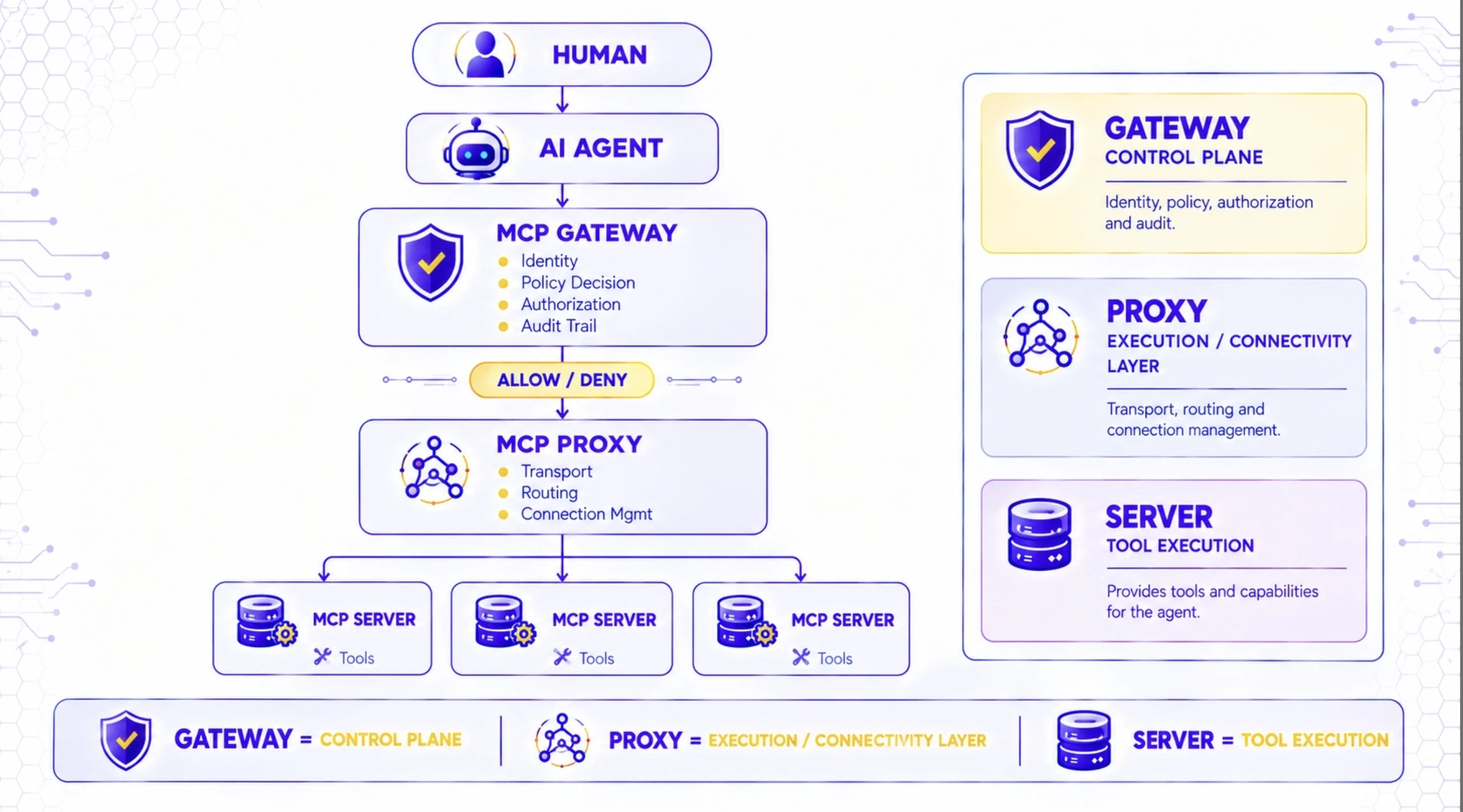
Gateway as the Policy Decision Point, Proxy as the Execution Layer
In practice, this is the normal shape of a mature deployment: a gateway sits in front, making the policy decision, then hands the approved call off to the proxy that actually talks to the backend tool. The gateway is the control plane; the proxy is the inline checkpoint doing the mechanical work of actually routing traffic once a decision has already been made. Neither replaces the other, and most production MCP architectures running at any real scale end up with both, whether or not the team building them originally set out to have two distinct layers.
MCP Gateway vs. Proxy vs. Server: Clarifying All Three
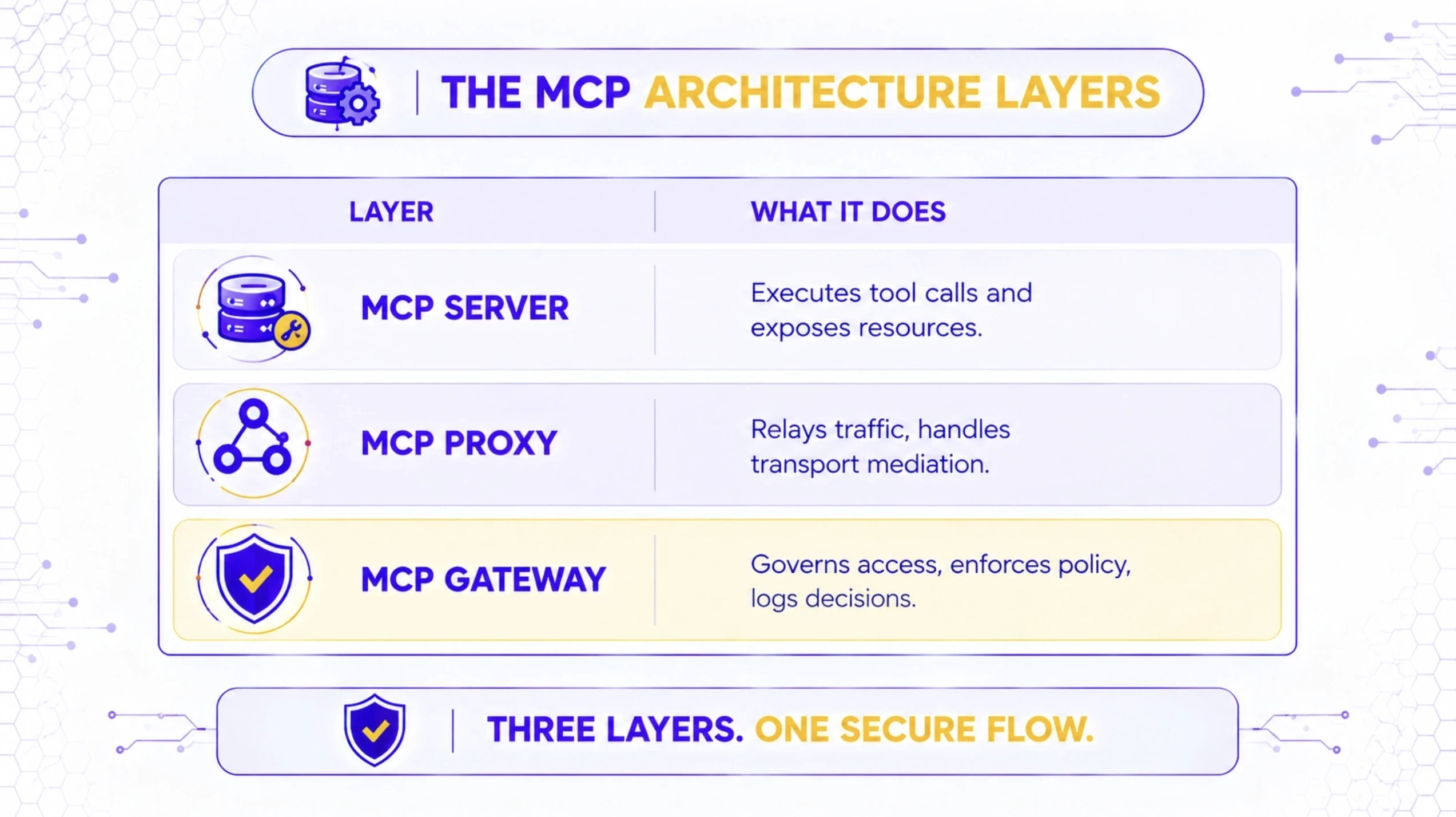
The confusion in this MCP gateway vs MCP server vs MCP proxy comparison often traces back to a third term getting mixed in. A server executes: it's the actual MCP implementation exposing tools, data, or resources to whatever connects to it. A proxy relays: it sits between a client and one or more servers, handling transport and connectivity without making policy decisions. A gateway governs: it sits in front of that same traffic, deciding whether a given call should be allowed and recording that decision for later review. A mature gateway deployment typically layers in rate limiting and session-aware routing on top of these basics, throttling abusive call volume and keeping a stateful agent session correctly routed to the same backend across a multi-step task.
How to Decide What Your Architecture Needs
Signals You Need a Gateway
Multiple teams or external tenants sharing infrastructure, a policy-as-code requirement that access rules apply consistently and get version-controlled, a compliance mandate for auditability, or agents whose blast radius, the scope of damage a single compromised session could cause, is large enough that trust can't be assumed by default.
Signals a Proxy Is Sufficient
A small, single-team setup with a handful of internally trusted servers, engineers who can directly observe and correct agent behavior, and no regulatory requirement to produce a structured audit trail of individual access decisions. For implementation depth once you've made this call, see our MCP security best practices guide.
How Akto Fits Into This Picture
Security and Testing Layer Regardless of Proxy or Gateway Choice
Akto's continuous red teaming and runtime guardrails apply the same underlying security testing whether an organization has deployed a bare proxy, a full gateway, or both together, since the underlying MCP risks, prompt injection, tool poisoning, token passthrough, exist regardless of which architectural layer sits in front of them.
Discovery Across Both Architectures
Akto's continuous discovery maps every MCP server, proxy, and gateway connection across an environment, closing the visibility gap that shows up identically in a proxy-only setup and a fully governed gateway deployment: a connection nobody has inventoried is a connection nobody is actually protecting, no matter how sophisticated the architecture sitting around it looks on paper.
Final Thoughts on MCP gateway and an MCP proxy
The MCP gateway vs MCP proxy question isn't really about which one is better. A proxy solves connectivity; a gateway solves governance, and most organizations that scale past a single trusted team end up needing both, layered rather than chosen between. Start with what your actual trust boundary requires: a small, internally supervised deployment can run on a proxy alone, while multiple teams, tenants, or a real compliance obligation for auditability means the policy and identity layer a gateway provides stops being optional.
FAQs on MCP gateway and an MCP proxy
1. What is the difference between an MCP gateway and an MCP proxy?
A proxy handles connectivity and transport mediation between an agent and MCP servers. A gateway adds identity binding, consent enforcement, and policy decisions on top of that connectivity, evaluating and logging whether each specific call should be allowed.
2. Is an MCP proxy a type of MCP gateway?
Not exactly. A gateway is typically built using one or more proxies underneath it, plus a policy and identity layer on top, making the proxy a component of a gateway rather than a lesser version of one.
3. What does an MCP proxy do that a gateway doesn't?
A proxy handles the mechanical work of transport mediation, TLS termination, and endpoint aggregation. A gateway typically delegates that same mechanical work to a proxy underneath it rather than duplicating it.
4. What does an MCP gateway add on top of proxy functionality?
Identity binding tying calls to a specific human and agent, consent scope defining what was actually authorized, real-time authorization enforcement per call, and a structured, per-decision audit trail.
5. Do I need an MCP gateway, or is a proxy enough for my use case?
A proxy is enough for a single team with a small number of trusted, internally built servers under direct human supervision. A gateway becomes necessary once multiple teams or tenants share infrastructure, or a compliance requirement demands auditable access decisions.
6. Can an MCP gateway and MCP proxy work together in the same architecture?
Yes, and this is the normal shape of a mature deployment: the gateway makes the policy decision, then hands the approved call to a proxy that handles the actual routing to the backend server.
7. How does an MCP proxy handle transport mediation (stdio to Streamable HTTP)?
The proxy maintains connections to each backend server over whatever transport it uses, stdio for local processes, Streamable HTTP or SSE for remote servers, and presents a single, consistent connection type to the agent regardless of what's running underneath.
8. What is the difference between MCP gateway, MCP proxy, and MCP server?
A server executes tool calls and exposes resources. A proxy relays traffic between a client and one or more servers. A gateway governs that traffic, deciding whether a call should be allowed and logging the decision.
9. Does an MCP proxy support identity, consent, or authorization enforcement?
No. A proxy by itself has no concept of policy, identity, or consent. Those capabilities are what define a gateway rather than a proxy.
10. What signals indicate an organization has outgrown a simple MCP proxy?
Multiple teams or tenants sharing the same servers, a growing need to answer "should this action have been allowed" with actual evidence rather than assumption, and any compliance requirement to produce an auditable record of access decisions.
11. How does audit logging differ between a proxy and a gateway?
A proxy typically produces raw connection logs at best. A gateway produces a structured, per-decision audit trail recording who made a call, what they were authorized to do, and whether the call was allowed or denied.
12. Does adding an MCP gateway introduce latency compared to a proxy?
Slightly, since a policy check adds processing time that a bare proxy doesn't need. In practice, this overhead is small relative to the model inference time already involved in an agent's request, and it's offset by the consistency of having one centralized policy layer instead of none.
13. How does an MCP gateway enforce per-tenant or per-user access isolation?
By binding every call to a specific identity and evaluating it against that identity's own scope, a gateway can keep one tenant's or user's access fully separated from another's even when both route through shared infrastructure.
14. Is the terminology (gateway vs. proxy) standardized across MCP vendors?
Not fully. Some vendors use "gateway" and "proxy" interchangeably, and a few introduce a middle "router" tier that knows which tool a request targets but not who's calling. The functional distinction, connectivity versus governance, holds regardless of which label a given vendor uses.
15. How does Akto help secure MCP deployments regardless of proxy or gateway architecture?
Akto applies continuous discovery, red teaming, and runtime guardrails across MCP connections regardless of whether they sit behind a bare proxy or a full governance gateway, since the underlying protocol-level risks exist independent of which architectural layer is deployed in front of them.

Experience enterprise-grade Agentic Security solution