Shadow AI Discovery Tools: Best Options Compared for 2026
Compare the best shadow AI discovery tools for 2026 - browser, identity, SaaS, and network-based options - to find unsanctioned AI across your org.

Bhagyashree

Employees are embracing artificial intelligence tools faster than IT departments can keep up. According to Microsoft’s 2025 WorkLab AI at Work report, around 75% of employees use unauthorized AI tools that pose serious risks to organizations, unaware that their activities expose the company to significant risks. From browser-based chatbots to rogue coding assistants and embedded AI within applications, shadow AI leaves companies vulnerable to data leaks, compliance issues, and inadequate oversight, leaving security teams in the dark about its true impact on the business.
Shadow AI discovery tools help organizations detect and address unauthorized AI use, ensuring employees use only approved, secure tools for productivity and collaboration. This blog explores the impact of shadow AI discovery tools and how to choose them effectively based on the gap.
What Are Shadow AI Discovery Tools
Shadow AI discovery tools are software designed to uncover AI applications, models, and services being used within an organization that have not been formally sanctioned or approved by the IT department, also known as “shadow IT.”
With employees across the globe using generative AI tools such as ChatGPT, Claude, Midjourney, and GitHub Copilot daily, in addition to a growing number of browser extensions and SaaS features that make use of AI, much of this activity takes place outside the purview of the company’s IT and security teams.
Core Capabilities of Shadow AI Discovery Tools
Core capabilities typically include:
Network and traffic monitoring: Analyzing DNS requests, proxy logs, or firewall data for connections to known AI service domains
Browser extension and SaaS scanning: Detecting AI-powered plugins, integrations, and standalone applications installed on managed browsers
API and CASB integration: Utilizing Cloud Access Security Broker (CASB) data or API connectors to identify AI tools embedded within shadow SaaS applications (e.g., an AI writing assistant embedded within a CRM)
Endpoint detection: Scanning devices for locally installed AI applications or command-line utilities.
Usage pattern analytics: Detecting anomalous data transmission patterns such as unusually large file uploads to AI endpoints.
Risk quantification and classification: Prioritizing the risk posed by identified AI tools based on their potential to expose sensitive data, regulatory implications, or vendor reliability.
Why No Single Tool Can See the Whole Picture
Shadow AI isn't exposed in one place but across networks, devices, browsers, and within SaaS; each method only captures a part of the issue, leaving organizations typically needing to layer multiple approaches.
Network monitoring can't track encrypted or mobile traffic: DNS and proxy scanning can flag communications with AI domains, but it can miss traffic that goes over personal devices, cellular networks, or unsecured VPNs outside of the corporate network footprint.
CASB and API approaches only see what's intended: While they can spot AI features embedded in SaaS applications they are meant to monitor, they can't identify standalone applications or browser extensions, which aren't necessarily registered with corporate IT.
Endpoint scanning detects only the browser: Agents monitoring the device can spot locally installed AI software; most AI interactions occur within a browser tab, at a level below what an endpoint agent can see.
Browser extensions can't detect native web applications: Scanning browser extensions can find AI-powered extensions; it can't find users visiting AI sites directly.
And none of them can access unmanaged devices such as contractors' or personal devices, which may also be used to access shadow AI applications. As a result, while enterprises typically employ a combination of the above methods to detect and govern shadow AI usage, any given approach is likely to only identify a fraction of the overall issue. A given enterprise is likely to employ more than one method to detect and govern shadow AI, layering network scanning, browser telemetry, endpoint scanning, and SaaS API approaches, in order to get a complete picture of their shadow AI landscape, rather than relying on any single solution.
Categories of Shadow AI Discovery Tools
Below are categories of shadow AI discovery tools:
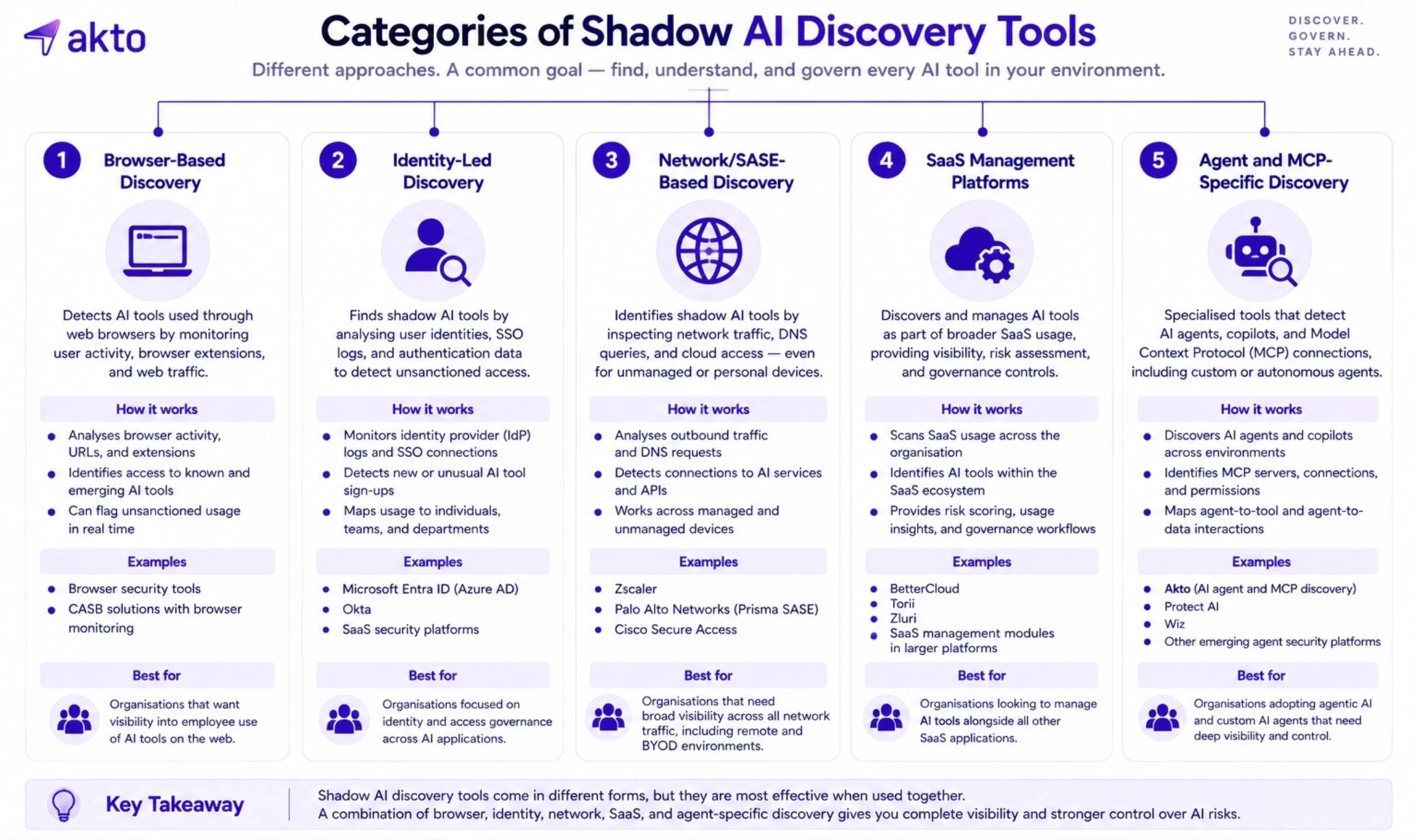
Browser-Based Discovery
Browser-based discovery tools are extensions or devices that run inside the browser. They can examine the contents of the prompt, as opposed to only the destination domain of the request. Tools that use this approach are unique in that they can discover data exposure at the point of exposure, for instance, when a user inputs sensitive data into an AI chat.
This method has two main limitations. The first is that it only covers whatever browser has the extension or device on it, as opposed to, say, desktop apps, IDEs, or the command line. The second is that it can be turned off, since it requires a browser extension to be present and running.
Identity-Led Discovery
Identity-led discovery finds shadow AI tools by looking at SSO and OAuth authentication data. If an employee logs into an AI application with an identity provider or grants it access to their email, files, or messaging application, that activity will be present in the SSO or OAuth logs.
This method has the advantage of being able to use out-of-the-box tools that most companies already use and trust. Its main disadvantage is that it cannot find unauthenticated uses of AI applications, or applications that do not integrate with any sort of identity.
SaaS Management
SaaS management tools typically have the ability to inventory application usage through their own set of data sources, like expense reports, browser access, and OAuth grants. These can be used to inventory AI applications as well, by using the same methods the SaaS management platform uses to find all the products a company is using.
This method is ideal for companies that want to inventory AI tools as part of their general SaaS inventory, as opposed to using a separate tool. However, it has the same limitations as the general SaaS discovery method.
Network/SASE-Based Discovery
Network and SASE-based discovery tools inspect the request at the level of the DNS, proxy, or firewall, and look for requests to any known AI service domains coming from any hosts on the corporate network, again, regardless of browser or device.
Network-based discovery has the advantage of being able to find all shadow AI tools that traverse the corporate network, but it has a few key limitations. One is that it cannot see encrypted or mobile traffic, which could contain AI tool traffic. Another is that while it can confirm that an AI tool was accessed, it cannot see what information was shared with it or by it.
Agent and MCP-Specific Discovery
Agent- and MCP-specific discovery tools are the least mature and often do not appear in general market conversations. As autonomous agents and Model Context Protocol (MCP) servers become more common in the enterprise, the discovery problem changes. Instead of only finding websites, we need to be able to find exactly which agents have elevated permissions to which systems, with what identities, and with what credentials.
The importance of this kind of discovery is shown by IBM's 2025 Cost of a Data Breach Report. Per the report, 97 percent of organizations that experienced a data breach involving an AI model or application had not implemented appropriate access controls for AI, and about two-thirds did not have an AI governance policy at all.
How to Choose Based on Where Your Gap Is
Choosing a shadow AI discovery tool should be driven first by identifying what gap within your environment presents the highest risk. Each of the categories below solves against a particular gap - this section explains what each gap is and which tools solve against them.
Multi-Source SaaS Inventory Gaps
If the greatest concern is an inventory of AI-related SaaS applications (tools purchased through expense reports, department budgets, or through independent employee procurement), the appropriate solution is a SaaS management platform that consumes multiple signals about SaaS application usage, inventory, and cost.
The risk of this particular gap arises most frequently in environments where there is no centralized software purchasing function, or where business units have historically been able to freely adopt tools without technology oversight. In these cases, discovery tool selection should be driven more by breadth of coverage than depth of inspection at the prompt level.
Identity / OAuth Blind Spots
Where an enterprise has reasonable visibility into network traffic but lacks insight into which AI applications have been granted access to enterprise ID stores represents another form of blind spot. This differs from the SaaS inventory blind spot in that it focuses on permissions rather than mere presence: the ability of an application to access email, files, and collaborative tools through an enterprise identity.
This particular gap tends to appear most frequently after the deployment of CASB or network-based visibility tools, which are generally ill-suited to follow OAuth grants or identify abnormal permission patterns granted by AI applications. Identity-focused discovery tools plug this particular gap by virtue of being able to consume SSO and OAuth activity directly.
Prompt-Level Data Exposure
An organization that is most concerned about the contents of prompts rather than the presence of shadow applications per se has a different set of needs. This is the most significant concern in environments where employees are likely to input highly sensitive, proprietary, or customer-facing data directly into an AI application.
This particular use case cannot be addressed by network or identity layer discovery tools, which are inherently ill-suited to analyze the contents of an encrypted HTTPS conversation. The problem this represents is particularly acute in highly regulated industries or among organizations that handle significant amounts of customer or proprietary data. This should always be considered a priority even if other forms of discovery have been implemented.
Native Desktop AI Apps
Some AI applications run natively on the desktop rather than in the browser, presenting a separate class of discovery challenge. These applications (including ChatGPT Desktop, Cursor, and Claude Desktop) are not visible to browser extensions, and may also be undetectable at the network layer depending on their architecture.
This capability should be considered a priority in any enterprise with a significant population of developers or other technically inclined staff, as these applications represent the dominant mode of shadow AI usage within this user group. This particular gap cannot be closed by browser extensions or network-based inspection tools due to the out-of-band nature of desktop application networking.
Unmanaged Agents and Shadow MCP Servers
The final category of discovery gap relates to fully autonomous AI agents and Model Context Protocol (MCP) servers that have no clear owner or documentation regarding their purpose or data access. This use case is distinct from the other described gaps, as the concern is not the mere presence of a shadow application, but rather the potential for an unmanaged, possibly undetectable MCP server to possess unauthorized data access or sit in production with no established governance or auditing process.
Enterprises that have begun to see the deployment of agentic AI applications (either via developer tools, internal development, or through vendor-provided applications) should consider this capability a priority even if other forms of shadow AI risk have been addressed. This particular gap can only be closed by an agent-focused discovery and inventory tool, which will typically involve a different approach than the selection of a SaaS or network-focused visibility product.
Shadow AI Discovery Tools Compared
Here are some of the top tools and what they are ideal for:
Tool | Layer Covered | Best For |
|---|---|---|
Akto.io | Full-stack - browser and endpoint (Atlas) plus cloud, homegrown agents, and MCP servers (Argus) | Security teams that need unified shadow AI and shadow agent discovery combined with red-teaming and runtime guardrail enforcement in one platform |
Harmonic Security | Data flow / SaaS + AI Integrations | Real time sensitive data masking with less upfront rule writing |
Torii | Multi-source SaaS inventory (expense, OAuth, browser) | Combining AI Discovery into existing SaaS management program |
Nudge Security | Identity / OAuth trace + SaaS discovery | Tracing AI Adoption through SSO and OAuth grants |
Sola | Cross-correlated; identity, SaaS, endpoint, cloud and code. | Aggregates signals across multiple layers into a single severity scored finding. |
LayerX | Browser (extension + desktop agent) | Prompt-level DLP and Gen AI data loss prevention at the browser |
Palo Alto AI Access Security | Network/SASE traffic inspection | Organizations have already standardized on Palo Alto’s network security stack. |
Netskope | Network inline traffic + endpoint + server (eBPF) | Enterprises that want inline, endpoint, and infrastructure level AI discovery in one console. |
Reco / Grip | SaaS + identity, OAuth app to app mapping | Mapping AI to SaaS integrations and permission scopes. |
Auvik | Endpoint collectors + SaaS / Identity | MSPs and IT Teams that want a 30-day usage snapshot |
Why Layering Detection Methods Works Better Than a Single Tool
Here is why layering detection methods work efficiently:
No layer sees the whole story: Network tools miss prompt content, browser extensions miss desktop apps, identity tools miss anything outside SSO, and none are built to see autonomous agents or MCP servers (which is the layer Akto focuses on discovering and inventorying separately).
Layering turns fragments into findings: A network log showing "connection to an AI domain" is more valuable when correlated with browser data showing what was pasted and identity data showing what access was subsequently granted.
The market is converging on correlation, not point solutions: Akto, for instance, correlates signals across API gateways, Kubernetes, and browser endpoints specifically to map agent-to-tool relationships, not as separate products.
Access governance needs identity data that network or browser tools don't have: A tool can flag that AI traffic occurred without knowing what permissions or system access that AI tool was subsequently granted; this is the same gap Akto addresses for agents by mapping which MCP servers and tools an agent can actually reach.
Correlation turns noise into findings: A domain was contacted" is low signal; "sensitive data was pasted into an unsanctioned tool that then received an OAuth grant" is a finding a security team can act on, and at the agent layer, Akto's discovery of unregistered MCP servers turns "an agent exists somewhere" into "this agent has standing access to these specific tools and resources.
From Shadow Discovery to Governance
Discovery solves a narrow but important problem: which AI tools, agents, and integrations exist within the organization. Discovery itself doesn't directly lower risk. An unactioned inventory of unapproved tools in a dashboard creates a false sense of understanding. The companies that derive the most value from discovery tooling are the ones that use it as a starting point for governance, rather than an endpoint.
Triage and risk classification
Having discovered a list of tools, agents, or integrations, the next step is to evaluate each against a common set of criteria, such as what data it has access to, whether it receives persistent permissions via OAuth, whether it operates under a known identity or an anonymous account, and whether it touches any regulated data category. Not all discovered tools represent the same degree of risk, and lumping everything together creates confusion and analysis paralysis for the security team.
Decision and disposition
The discovered tools, agents, and integrations will generally fall into a small set of categories such as formally approved tools that will be governed, approved with restrictions (for example, disallowing access to certain data categories), migrated to a similar tool that can be governed, or removed/access revoked entirely. Importantly, this should not default to the last option: blocking tools without providing a sanctioned alternative typically creates more problems than it solves by encouraging shadow IT.
Ownership and accountability
A strong governance program will create ownership for every sanctioned AI tool or agent, similarly to how organizations have to govern SaaS application ownership at a systems level. The difference is especially acute at the agent and MCP layer: an unowned agent with access to internal systems can be much more dangerous than an unowned browser tab, as it might take actions on its own.
Policy enforcement, not visibility
Effective governance programs will combine discovery with enforcement, data loss prevention rules that take effect for AI-bound traffic, access rules that prevent utilization of unapproved tools, and guardrails that dictate what governed tools discovered agents may use. Discovery provides the inventory of tools. Enforcement dictates what those tools can do.
Continuous re-discovery
The rate of adoption of AI tools, agents, and integrations is high and growing. Most organizations lack the resources to keep up with discovery as a one-time project: it has to be continuous, using the same tooling as the initial discovery, but applied to new tools as they appear. These new discoveries then feed back into triage, disposition, and the rest of the governance program as appropriate.
Discovery and governance are not phases but a continuous cycle. The insights from discovery fuel governance decisions, which in turn drive enforcement, which finally informs discovery by adding new data points as the governed environment evolves.
How Akto Approaches Shadow AI Discovery
Every organization today has an AI adoption challenge - they just don't know the full scale yet. People are leaking sensitive data into browser-based tools. Engineering teams are standing up MCP servers at a rate faster than they can track. Homegrown agents are creeping into production with no owner, no review, and no kill-switch. This is shadow AI, and it's growing increasingly prevalent.
Akto solves this challenge and has done so since day one. While the market is beginning to understand the fundamentals of visibility into AI usage, Akto has been protecting the agentic layer - MCPs, AI agents, and the tools they connect to- since the dawn of the Model Context Protocol.
One Platform. Every Surface.
Shadow AI is not a one-sided problem, and neither is Akto's solution. Our platform spans the gamut of potential attack surfaces, both inside your data center and in the wild.
With Akto Atlas, we provide visibility into the AI usage of your employees. Every browser session, locally deployed coding assistant, and prompt that leaves an unsanctioned tool is captured and surfaced into a single pane of glass, while also supporting deep inspection into the prompt, tool calls, and responses from within the tools your developers use every day. Atlas has visibility into the local models running in vLLM, Ollama, and Docker model runner, and the prompts that developers send to them, as well as into the enterprise-grade models exposed through the Codex CLI and Neovim.
Meanwhile, Akto Argus tackles the second half of the shadow AI challenge: agents and MCP servers that your team develops. Argus discovers agentic assets across API gateways, Kubernetes, eBPF, and cloud infrastructure to build out a map of your home-grown AI tools, without the need for any manual inventory spreadsheet.
Atlas and Argus together give security teams a critical advantage not found elsewhere: unified, always-up-to-date visibility into every agent, every MCP server, and every AI-powered tool touching your organization, across 80+ integration points.
From "Unknown" to "Understood".
Discovery has value only so long as it remains a list of findings, not an actionable insight into real-world exposure. That's why Akto doesn't stop at mere discovery: We classify each agent according to its risk score, expose every abandoned integration as a Zombie Agent prior to removal, and reveal every shadow agent according to its relationship with sanctioned channels (or lack thereof) via Akto's AI Agent Context Graph.
Not only can you see risky agents, but you can also see exactly what they are doing and, in turn, how they are being used. Discovery without classification and containment is theater. We turn your findings into findings of fact.
Don't Just Discover Risk. Prove It - And Take Action
Finding a shadow MCP server is one thing. Knowing it is not a problem is another. Akto goes the extra mile in order to classify every discovered agent and MCP server according to its ability to be exploited to simulate prompt injection, tool poisoning, context leakage, and memory poisoning prior to any human interaction.
Once you have located and classified a risky agent, you have several options for next steps. With Akto, you can take action at the component level, rather than across an agent's entire toolset - selectively applying guardrails and reducing blast radius. Least-privilege access, recursive-loop prevention, and dynamic sensitive-data masking all happen in real-time, only where needed, without impacting the broader use of the agent.
Built For The Speed Of AI Adoption
New agents, new servers, new people using new tools every week. Shadow AI won't wait for you to complete a discovery scan, nor should you have to. That's why Akto is always watching across every layer of the agentic stack.
Trusted by 100+ forward-looking AI security teams. Akto is how enterprises everywhere turn shadow AI from a vague existential concern into a governed and well-understood security posture.
See what's really going on in your agentic environment. Book a demo with Akto today!
Final Thoughts on Shadow AI Discovery Tools
Across this piece, the throughline has been consistent: shadow AI discovery is not one problem, but several distinct ones like browser exposure, identity sprawl, network traffic, and now agentic infrastructure, and no single tool covers them all. Layering methods, correlating signals across them, and treating discovery as the start of governance rather than the end goal is what separates programs that reduce risk from ones that just produce dashboards. The agent and MCP layer, where Akto operates, is the newest and least mature part of this landscape, reflecting where shadow AI itself is heading: from chat tabs toward autonomous systems with standing, unreviewed access.
FAQs on Shadow AI Discovery Tools
1. What's the difference between browser-based and identity-led shadow AI discovery?
Browser-based discovery products work as an extension or on-device agent in the browser context, giving them access to whatever text the user inputs into an AI tool or receives from it as a response. Identity-led discovery products do not run in the browser, but analyze SSO and OAuth logs to find out when an employee has authenticated to use an AI tool, or given it access to systems such as email or cloud storage. The key difference is that a browser-based discovery tool cannot detect AI use that does not involve a browser, while an identity-led tool is blind to any AI use that does not involve SSO/OAuth.
2. Can shadow AI discovery tools detect native desktop AI apps like Cursor or Claude Desktop?
Not with standard browser extensions or network-layer detection, since desktop applications typically operate outside a browser session and can obscure their network traffic from inspection by a cloud-based proxy. Native desktop applications would typically be detected by an endpoint inspection product, if one is deployed. Netskope's AI Discovery product scans applications installed on managed endpoints and explicitly mentions being able to detect Claude Desktop, Claude Code, and ChatGPT Desktop as examples. Akto's Atlas product also includes endpoint inspection and, as mentioned in their April 2026 release notes, is capable of inspecting applications such as Codex CLI.
3. How do shadow AI discovery tools determine or score priority after finding a tool?
This varies from product to product, but several factors are typically considered: the sensitivity of data that the tool has been used with, whether it has installed persistent OAuth access, whether it's been used with a corporate identity or anonymously, and whether it's been seen across different signal types. Akto, for its agent and MCP layer, assigns a Risk Score to each discovered component, and classifies it based on its authorization type and access type, making a distinction between what it terms "Shadow Agents" and "Zombie Agents".
4. What's the difference between a shadow AI discovery tool and a shadow AI governance platform?
The discovery tool provides an inventory of the different tools, integrations, and agents that are being used without approval, while governance is the process by which these are evaluated and prioritized for action. A discovery-only tool typically requires a separate process to be established and executed by people, while a governance platform will often incorporate techniques from discovery and combine them with automated triage and remediation actions. Some products, such as Akto, include both discovery and governance components - with the latter provided by automated red teaming and runtime guardrails.

Experience enterprise-grade Agentic Security solution