Shadow AI Management Platforms: Key Capabilities to Look For
Learn what shadow AI management platforms do beyond discovery - policy enforcement, remediation, and governance - and what capabilities to look for.

Bhagyashree

Shadow AI describes the use of Artificial intelligence (AI) by employees that is not sanctioned or visible to IT. By enabling the use of unapproved AI tools, such as chatbots, coding assistants, and browser extensions, shadow AI creates security and compliance risks for enterprises and exposes sensitive data to outside entities. Shadow AI Management solutions can help organizations by scanning traffic in private and public clouds, endpoints, or software-as-a-service (SaaS) logs to detect and govern the use of AI tools by employees.
These platforms track the use of shadow AI within the enterprise, identify sensitive data at risk of being entered into or exposed to AI models, evaluate the detected risks, and allow actions to either stop unauthorized AI tools or configure their use. The main purpose of shadow AI management platforms is to balance the risks and opportunities of using AI tools at work.
While allowing employees to use AI applications that may boost productivity, shadow AI use creates compliance, data security, and third-party risk challenges. This blog explores shadow AI management platforms and their impact on organizational security teams.
What is the Shadow AI Management Platform?
A shadow AI management platform is a software product designed to provide organizations with visibility and control over the use of artificial intelligence by employees, including unauthorized or unsanctioned tools such as ChatGPT and Claude accessed through personal accounts, browser extensions containing AI models, and third-party enterprise applications containing AI features. Unlike traditional enterprise security software, shadow AI management tools are optimized to keep up with the distributed and rapidly evolving nature of emerging AI technologies. These products typically provide visibility, risk quantification, and control or enforcement capabilities for shadow AI.
Shadow Management Platforms vs. Shadow Discovery Tools
This is the question most buyers should ask when considering new technology to address the risks posed by AI. This one distinction is frequently overlooked when comparing vendors, and it’s often more important than it seems.
Shadow Discovery tools
Discovery tools that seek to answer just one question: “Which AI tools are currently being used in the company? These tools scan networks, cloud environments, or endpoints and return a list of tools found, along with their frequency and users (if any). Discovery tools are purely for reconnaissance; they simply seek to understand the nature and extent of the exposure.
Shadow Management platforms
These platforms seek to answer another question: “What do we do about it? Such tools typically take the raw data from discovery tools (but sometimes use proprietary data collection methods) and supplement it with features that govern the environment. This includes enforcing policies (removing unauthorized tools, throttling traffic), protecting data (preventing models from accidentally transmitting sensitive information out of the company), implementing approval workflows (for adding new tools), and collecting evidence (for regulatory compliance audits).
Why Shadow Discovery Alone Isn't Enough
Organizations frequently invest in discovery capabilities on the assumption that it's an adequate risk management strategy, but that assumption isn't supported by how the category has evolved. Industry analysis of shadow AI programs always finds that detection that provides only a list of unauthorized tools, without tying it to risk assessment, compliance mapping, and enforcement, creates awareness without action. Finding unauthorized AI usage is a necessary first step, but it's not a governance outcome.
Findings Without Action Just Become More Alerts
Discovery tools are good at producing output, inventories of unsanctioned applications, usage volumes, and departmental breakdowns of AI adoption, but if there's no integration with enforcement, it's just another item on the to-do list for security and IT teams, compounding a problem that most security operations have.
This is not specific to shadow AI, security teams often operate in environments in which disconnected tools create more duplicated alerts for the same event, require constant context-switching between dashboards, and can't correlate what's happening to find which alerts actually matter. A discovery tool that finds a new unsanctioned AI application doesn't answer the question of what should happen next, and that decision still takes manual triage, cross-referencing against policy, and coordination with the tool's users. If that isn't automated, every new finding just goes onto a list. Broader research into this space has found that a significant portion of security professionals blame past misses of a breach in the last year on alert fatigue and tool complexity, and that's a warning to any entity that has shadow AI discovery as an end-state rather than a governance input.
Fragmented Tools Create Governance Gaps
Another deficiency in discovery capabilities is seen when they are operating independently or with limited integration to an organization's policy management and enforcement infrastructure. Shadow AI visibility is often gathered from multiple partial sources, such as secure web gateways, CASBs, identity platforms with OAuth data, and endpoint detection tools; all collect different slices of AI usage, and none of them provide complete coverage on their own. If signals aren't tied into a unified system of record, organizations are reconciling inconsistent, siloed views of the same underlying risk.
That fragmentation has governance consequences beyond inefficiency. Similar findings from broader security operations research show that having fragmented and overloaded dashboards inhibits enterprise-wide visibility and alert correlation, making it harder to spot multi-stage risks that touch several systems. If applied to shadow AI, it would mean that a browser extension flags one interaction, a network tool flags a related data transfer, and an identity system flags an unusual access pattern, but they wouldn't be linked as a single incident if they're in different platforms with no shared enforcement layer. The practical impact is inconsistent policy application, slower response, and audit trails that have to be reconstructed after the fact rather than maintained as a matter of course. Shadow AI management platforms are built to close this specific gap, not by adding another detection source but by consolidating signals into one governance layer where a finding can produce consistent action regardless of where it was found.
Core Capabilities of Shadow AI Management Platforms
Effective shadow AI management relies on a specific set of technical capabilities, which together convert visibility into governable actions. The following capabilities are the functional core around which mature platforms in this category are built.
Cross-Source Aggregation
There is no single telemetry source that provides visibility into all AI usage, and industry analysis indicates that no single discovery method provides complete visibility; the objective is not to identify one perfect tool but to correlate enough signals across sources to build out a useful AI asset inventory. This means combining browser-level activity, network traffic analysis, identity provider and OAuth data, source code repository scanning, and cloud service logs into a single dataset. Many organizations have visibility into their existing infrastructure: a secure web gateway may capture AI domain traffic, a CASB may expose SaaS usage, and an identity platform may have OAuth grant data; without this aggregation, these become disconnected fragments rather than a coherent inventory.
Data Flow and Sensitive Data Monitoring
Knowing which AI tools are in use is different from knowing what data those tools are receiving. Data flow monitoring looks at content submitted to AI apps (via direct prompts, file uploads, or API calls) to identify sensitive information (personal data, source code, financial records, intellectual property) before it reaches an external system. Vendors in the space report substantial volumes of sensitive material passed through unmonitored prompts; for example, a single deployment surfaced thousands of instances of regulated data (e.g., routing numbers) entered directly into prompts across customer environments. This capability is usually provided via browser extensions or endpoint agents that can intercept data in real time, not just auditing after the fact.
Identity and Access Context
The ability to attribute activity to a specific identity is the fundamental capability that enables governance, and this now extends to AI. Platforms map discovered usage to user identities, service accounts, and permission scopes, exposing how a given tool interacts with enterprise data and which access rights it holds. This becomes materially more complex with autonomous agents: an AI agent acting on a user's behalf may have its own effective access to enterprise systems while remaining invisible to conventional identity and access management, since standard authorization frameworks often only authenticate the human's delegated consent, not the agent itself. Closing this blind spot requires treating agents as identities in their own right, assigning ownership, scope, and accountability, rather than as an extension of the human who configured them.
Automated Policy Enforcement
Having identified risk has limited value without the mechanism to act upon it. Automated policy enforcement allows organizations to codify acceptable-use rules and apply them when usage is occurring, including blocking unauthorized applications, tiered workflows for tools of intermediate risk, and controls based on data sensitivity or role. This is the capability that most distinguishes a management platform from a discovery tool: it acts on a violation automatically, rather than routing it to a queue to be reviewed.
Risk Prioritization and Scoring
Not all discovered AI usage has the same consequences, and it represents a misallocation of governance capacity to treat every instance with the same urgency. A composite risk score (typically weighted by data sensitivity, access scope, usage volume, and vendor security posture) allows governance teams to be able to review a triaged queue rather than an undifferentiated list. As a governance framework puts it, a developer's internal productivity script is a different priority than a customer-facing tool processing sensitive data, and scoring is what allows an organization to tell them apart at scale rather than reviewing both with the same attention.
Automated Remediation and Ticket Routing
To avoid findings becoming a backlog of unresolved items, mature platforms route identified risks directly into existing operational systems (IT service management platforms, ticketing queues, or access management tools) with severity, context, and a recommended action already attached. Established practice in adjacent security disciplines treats this as a tiered response: the highest-risk findings are addressed via automatic remediation, medium-risk findings generate a ticket for human review rather than a raw alert. Applied to shadow AI, this closes the gap between detection and resolution that was mentioned earlier: a finding does not sit in a dashboard waiting to be triaged, but is entering a workflow with a defined owner and next step already assigned.
Agent and MCP Connection Visibility
The introduction of the Model Context Protocol (MCP) and similar standards that enable agents to connect directly to enterprise tools, databases, and APIs has extended the shadow AI surface to include a new class of largely invisible machine-to-system activity. Traditional security monitoring tools do not have visibility into MCP interactions, and each MCP connection is a trust decision: a poorly secured or unauthorized server can be exposing data or executing actions without any human in the loop. Developers can, and routinely do, download open-source MCP servers from public registries to extend an agent's capabilities, often without any security review.
Platforms addressing this gap discover MCP servers and agent connections across the environment, mapping each to an owning agent, application, and set of accessible systems, and producing transaction-level records of what was accessed, by which agent, and through which server. This is materially different from standard shadow AI discovery platforms, which are oriented towards human-initiated browser and network activity; agent and MCP visibility governs autonomous machine-initiated connections that can operate continuously and at a scale much larger than manual review processes can manage. As agentic AI adoption continues to grow in enterprise environments, this capability is likely to move from being a differentiator into becoming a baseline expectation of any shadow AI management platform.
From Shadow AI to Governed AI: Workflow
Shadow AI management is not a discrete activity, but part of an ongoing cycle. Finding an unauthorized tool is the beginning of the process, not the end, and the value of a management platform is found in the defined sequence of steps that come next as new tools and new patterns of use emerge.
Detect
Discovery is iterative, using browser, network, identity, code, and cloud logs to find AI usage across the enterprise that has not been reviewed or procured through sanctioned channels. The emphasis at this stage is on simply finding what exists; judgment about the potential impact of a tool is deferred until later in the process. The consensus among governance practices in the space is that no single technique will capture every potential instance, and the emphasis is on finding enough information across sources to build a defensible inventory, as opposed to relying on any one detection method to identify every potential instance.
Assess
All identified tools or agents are scored according to their risk profile: the sensitivity of the data they can access or process, the range of available actions within their capabilities, whether there is an explicit business justification for their use, and whether it is possible to bring them into the company's governed management ecosystem as opposed to simply removing them.
This step serves to distinguish between the discovery of an employee who has downloaded the public interface of an approved model on their own time and the discovery of an autonomous agent with write access to a critical data repository, both of which would be categorized as shadow AI, but with vastly different downstream implications.
Prioritize
A triage process prioritizes findings based on an overall risk score, focusing resources on those instances with the potential to cause the greatest harm if left unaddressed. A discovery queue that uses uniform urgency across all findings will see the largest impacts addressed while lesser ones fall by the wayside, and prioritization scoring actively works to avoid that outcome, ensuring that the risks are seen in context rather than as isolated incidents. One example of this principle in practice is the differentiation between a finding that represents a developer's personal script and a finding that represents a production-facing tool with access to sensitive data.
Remediate
Assessment and prioritization lead to action, which can take many forms depending on the tool, its impact, and the likelihood of future recurrence: migration to a governed instance, restricted access permissions, formal deprecation, or, in cases where risk is low enough, approval of continued use by an owner. It is important to note that this step is not inherently about blocking a remediation process that only considers removal misses an opportunity to migrate a risky instance or restrict its capabilities in a way that reduces risk without eliminating utility.
Monitor
Tools that have been migrated, restricted, deprecated, or approved for continued use are returned to the system for ongoing monitoring in their new state. With sanctioned instances, this means ensuring that they continue to operate in a manner consistent with their approval; in other words, that the parameters of access and use have not been expanded beyond what was reviewed and authorized. This serves to close the loop, and the next steps are determined by whether and how the parameters of a given tool have changed, potentially introducing new risks, or if it has remained in a stable state.
Turning Unauthorized Tools into Approved, Governed Assets
Finding unauthorized tools and agents can be thought of as the beginning of a broader process, one that ultimately transforms ad-hoc usage into a set of governed assets. An AI system is considered sanctioned once it has been discovered, documented, and placed under continuous monitoring, at which point its access, capabilities, and data interactions are subject to ongoing review. This reframes the objective of a shadow AI program around turning these instances into assets as opposed to merely eliminating them.
The ability to do this rests on two essential factors. The first is that the process of assessment and remediation should be capable of capturing more than just a choice between allowing or disallowing a particular instance; it should be able to capture a third potential outcome, which is bringing a tool into the company's ecosystem as an approved, governed asset with an owner who can make changes and extensions moving forward. The second requirement is that the process of migrating an instance to this sanctioned status should be quick enough that employees do not feel it is worth looking for other options. Programs that use a streamlined approval and risk assessment process (measured in days as opposed to weeks) and which begin with a default position of enabling a tool as opposed to disabling it report significantly fewer instances of employees continuing to use unauthorized tools as a workaround.
In this model, discovery and enforcement are no longer endpoints in themselves; they serve as the beginning of a broader process, and the next steps are focused on transforming these instances into a formal asset inventory with increasing levels of governance at each stage of the workflow.
Governing Non-Human Identities Within Shadow AI
Shadow AI governance has traditionally focused upon human behaviors, an employee pasting a data set into a public chatbot, or a team adopting an unreviewed tool, but this framing misses what shadow AI has evolved to encompass: autonomous agents and non-human identities that act independently of any individual user, and a governance approach that must be centered upon identities rather than the individuals who happen to be configuring a given system.
Why Non-Human Identities Are a Distinct Governance Problem
AI agents, service accounts, API keys, OAuth tokens, and workload identities are the credentials through which AI systems authenticate and access enterprise data, and these have outnumbered human identities in most environments. In cloud-native and DevOps settings, non-human identities have been reported to outnumber human identities by a ratio as high as 144:1, and this has grown sharply year over year as AI adoption accelerates. Each of these identities represents a potential access path that conventional identity and access management was never designed to govern. This is not just a gap in tooling, but a structural gap: non-human identities do not log in and out on a predictable schedule, do not fit neatly into existing role models, and can accumulate permissions over time as they connect to new systems, often without triggering the periodic access reviews that would flag equivalent risk in a human account. Long-lived API keys and OAuth tokens frequently outlive the projects or agents that they were originally created for, and identity sprawl across SaaS environments makes it difficult for security teams to have an accurate inventory of what currently holds access to what.
How Shadow AI Compounds the Non-Human Identity Problem
Shadow AI intersects with this identity gap in a particular way: agents and integrations that are deployed outside of formal review can introduce new credentials, service accounts, and data connections that do not have a corresponding entry in an identity registry. A developer testing an AI coding assistant, a business team activating an AI feature embedded in existing SaaS software, or an agent granted access to a database for a specific task could each generate a non-human identity that no one is explicitly responsible for governing. These frequently carry direct access to sensitive systems and operate continuously rather than on demand; unlike shadow IT, unmanaged access accumulates quietly and without the kind of behavioral pattern that would allow security teams to establish a meaningful baseline.
The consequence is a widening gap between the pace of AI-driven identity creation and the organization's capacity to track it. One industry survey found that a majority of security teams considered their identity security posture prepared for AI adoption at scale, even as nearly half separately acknowledged that their AI identity governance was deficient a disconnect that reflects how unfamiliar this category of risk still is relative to conventional identity management.
What Governing Non-Human Identities Requires
Closing this gap requires treating every AI agent, service account, and API credential as an identity in its own right, with an assigned owner, a defined scope of access, and a lifecycle that includes onboarding, periodic review, and offboarding the same discipline long applied to human accounts, adapted to non-human behavior. In practice, this requires several specific capabilities: continuous discovery of unmanaged credentials and service accounts rather than periodic manual audits; mapping of each non-human identity to the systems and data it can reach, and identifying excessive or unused permissions; matching the type of credential to the nature of the work, using delegated, user-scoped access for actions performed on a person's behalf and dedicated, tightly-scoped identities for autonomous or continuous tasks; and monitoring of behavior over time to detect deviations from an established baseline and, for an agent, actions that are ultimately determinant of risk.
This identity-centric approach is what allows shadow AI governance to extend beyond human-initiated usage into the machine-to-machine and agent-to-system activity that now represents a growing share of unmanaged AI risk. Network and application-layer controls cannot govern agents that operate across multiple systems and providers; identity is the one control plane that is consistent enough to span both human and non-human activity, and it is increasingly the layer upon which shadow AI management platforms are being built to close this gap at enterprise scale.
How to Evaluate a Shadow AI Management Platform
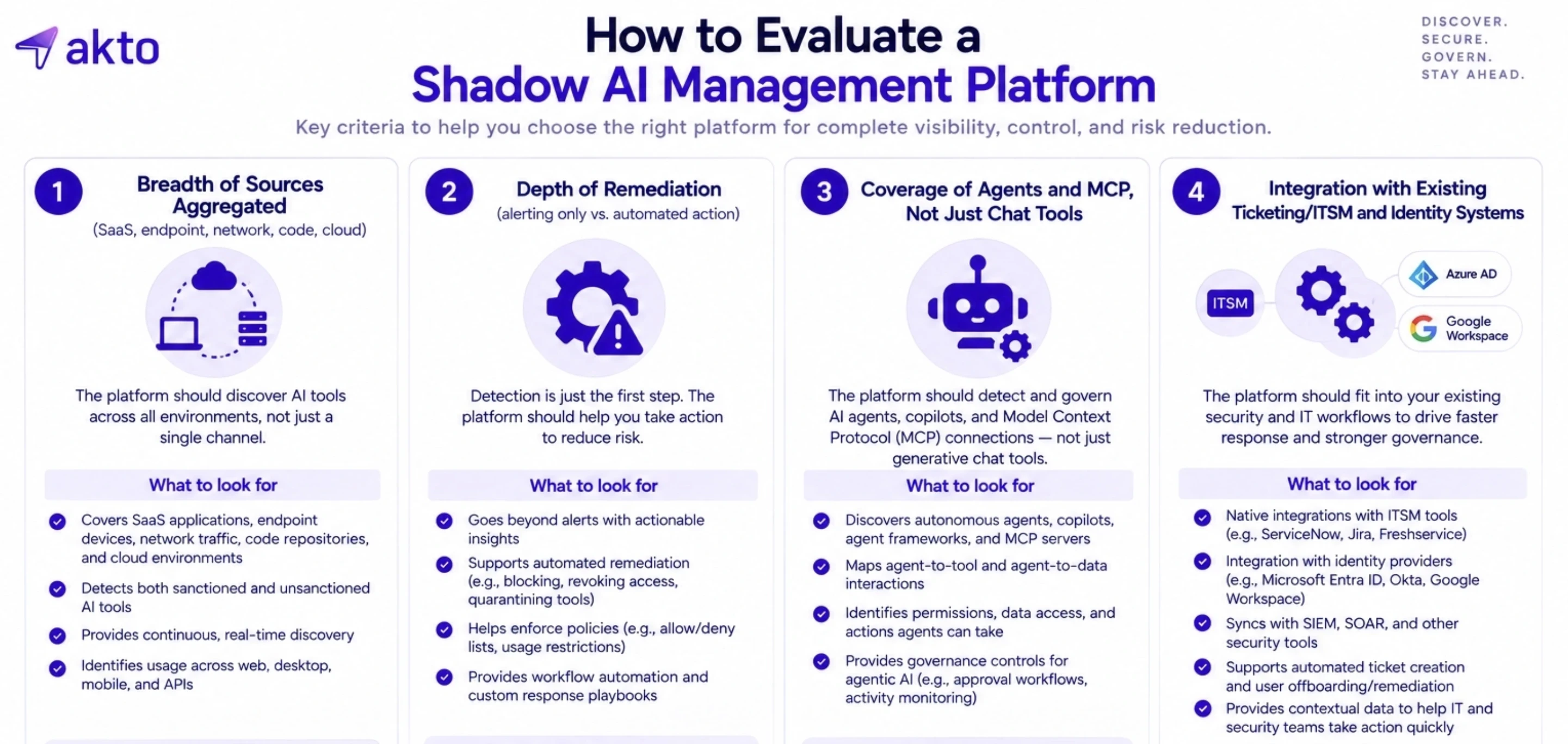
Vendor evaluation in this space is complicated by the fact that most platforms can produce an impressive feature list, dashboard demo, or integration count, while varying significantly in what they actually accomplish when deployed, and criteria that distinguish a truly capable platform from one that simply looks comprehensive tend to fall back to four questions.
Breadth of sources aggregated.
How completely does the platform see AI usage, and does that visibility rely on a single detection method, which misses any shadow AI activity that goes uncollected through it? Platforms using a single signal source such as network traffic, or a fixed integration library, miss out on the portion of shadow AI activity that takes place outside that channel (personal account and hotspot traffic, or browser use, respectively). Platforms that excel instead detect activity across SaaS applications, endpoint/browser activity, network traffic, source code repositories, and cloud environments, then correlate the findings into a single inventory.
Similarly, how does a platform detect tools it does not already recognize? Vendors relying on a pre-built, hard-coded integration library often require months to add support for a newly popular application, during which time that tool is invisible to the platform regardless of how many sources are being monitored. Evaluation, then, should directly ask how coverage works, rather than asking how many applications a vendor currently supports on paper, and whether it relies on OAuth monitoring, behavioral analysis, and API-level tracking capable of surfacing a tool the vendor has never seen before.
Depth of remediation
What does a platform do once it identifies a risk, and is it capable of automatically taking action as well as detecting? A platform that alerts or flags permission or policy violations without a corresponding action pathway simply shifts remediation responsibility to overwhelmed security teams, replicating the alert-fatigue problem it is meant to solve under a new label. Evaluation should distinguish platforms that stop at notification from those capable of automated action, such as real-time blocking of unauthorized access, revoking credentials automatically, or routing a finding directly to a remediation workflow with an assigned owner and next step already attached.
This is the space where discovery-oriented tools and true management platforms diverge most visibly, and is worth testing concretely: for a given class of finding, does the platform take action, or simply create another item for a security analyst to triage?
Coverage of agents and MCP, not just chat tools
A platform's usefulness is increasingly determined by whether its detection model extends beyond public chatbots and browser tools to cover autonomous agents and Model Context Protocol connections, and whether it can discover every agent and MCP server in the environment. Buyers should ask directly whether a vendor can discover every agent and MCP server in the environment, including those deployed without any security review, since teams now stand up agents and connect them to MCP servers considerably faster than most security review cycles can track. A platform built around chat-interface monitoring will not surface an agent that was never used interactively by a human, even though it may have direct, continuous access to sensitive systems.
Evaluation at this layer should examine whether the platform treats agent risk with criteria suited to how agents behave (short-lived, high volume, often over-privileged, and capable of taking actions that are technically valid but logically inappropriate) rather than applying static, chatbot-era risk models to a fundamentally different category of activity.
Integration with existing ticketing and identity systems
The final criterion concerns how well a platform fits into infrastructure the organization already operates, rather than requiring a parallel governance stack. Findings that cannot be routed into an existing IT service management or ticketing system tend to be siloed in a vendor dashboard, disconnected from the workflows a security team actually uses day to day. Strong integration should allow a finding to generate a ticket with context and severity already attached, assign it to the appropriate owner, and track its resolution status without manual re-entry into a separate system of record.
Equally important is integration with existing identity infrastructure. Because a substantial share of shadow AI risk is now expressed through non-human identities (service accounts, API keys, OAuth tokens, and agent credentials), a platform that cannot connect its findings to the organization's identity provider will struggle to answer basic governance questions, such as which owner is accountable for a given credential or whether a flagged identity's access is consistent with least-privilege policy. Platforms that integrate cleanly with both ticketing and identity systems reduce the operational overhead of adoption and make it more likely that discovered risk is actually resolved, rather than simply documented.
How Akto Approaches Shadow AI Management
Shadow AI deployment is rampant, with employees embedding AI agents into critical workflows, spinning up MCP servers, and adopting copilots at a faster rate than security teams can audit; by the time they are discovered, the tool is already deeply integrated into the production environment.
Akto is a dedicated control plane for AI agents, agentic ecosystems, and the LLMs that power them. With continuous discovery across browsers, endpoints, IDEs, and cloud infrastructure, Akto finds what traditional tools miss while delivering an additional layer of defense by analyzing the Agentic Context Graph, the connections between agents, tools, prompts, and permissions that provide insight into risky orchestration, prompting, and permissions practices.
The findings are prioritized based on the level of exposure of the risky asset, with suggested runtime guardrails instead of queued-up remediation for faster response times. Because AI deployment is continuous, Akto secures the ecosystem with continuous discovery, red-teaming, and enforcement - providing visibility and control without impeding productivity.
See your AI attack surface for what it really is. Get a Agentic AI Security demo of Akto and turn shadow AI into governed AI before the next agent gets deployed without you.
Final Thoughts on Shadow AI Management Platforms
Shadow AI is not an end but rather a beginning, as new agents, tools, and MCPs are continually created and connected, resulting in more shadowy activity. Simply detecting and compiling a list of unauthorized tools will have little effect on the problem. Instead, the most successful organizations will focus on accelerating the entire lifecycle: discovery, assessment, prioritization, remediation, and monitoring, extending it to non-human agents and identities, aiming to transform shadow AI into governed AI so that users do not resort to unauthorized methods in the first place.
FAQs on Shadow AI Management Platforms
1. Do shadow AI management platforms include coverage for AI agents and MCP connections?
While it is becoming more common for leading platforms to do so, it is far from universal, and an important differentiator: many platforms were initially focused on browser and chatbot detection, and require significantly different detection algorithms to spot autonomous agents and Model Context Protocol servers. Buyers should look for platforms that can detect agents and MCP connections deployed without security review, not just AI usage initiated through a human interface.
2. How do shadow AI management platforms aggregate findings across browser, network, identity, and cloud sources?
Since no single source will provide complete visibility on its own, platforms will typically pull in signals from multiple layers, such as browser and endpoint activities, network traffic, identity provider and OAuth logs, code repositories and cloud service inventories, and correlate them into a unified inventory. It is this aggregation that enables a platform to identify patterns across disparate areas and tie them to a common root cause, rather than presenting them as unconnected findings.
3. What's the difference between alerting on shadow AI and actually governing it?
When it comes to shadow AI, alerting only goes so far: a true governance solution will not only identify risks but also enact appropriate policy enforcement, such as automatically adding the risk to a ticketing system or identity governance workflow with an assigned owner and remediation task. While alerting helps reduce risk, it tends to result in a larger volume of tickets and unresolved findings over time.
4. Can these platforms manage shadow AI without banning tools outright?
Many mature platforms offer a middle ground between outright banning and allowing potentially risky shadow AI tools to proliferate unabated: assessing each instance based on risk, with options to enforce conditional restrictions or a tiered approval process for specific use cases, and the option to allow sanctioned use of a tool under specific circumstances.
5. What role do AI agents play in automating shadow AI remediation?
AI agents are playing an increasing role in helping organizations both identify and remediate shadow AI: evaluating each finding against corporate policies, and either recommending or automatically executing a remediation script or policy change, or escalating the issue to human operators with suggested actions for review.

Experience enterprise-grade Agentic Security solution