
Best Crowdstrike AIDR Alternatives and Competitors
Looking beyond CrowdStrike AIDR? Compare the top AI security platforms for agent governance, shadow AI control, MCP security, and runtime protection.

Krishanu

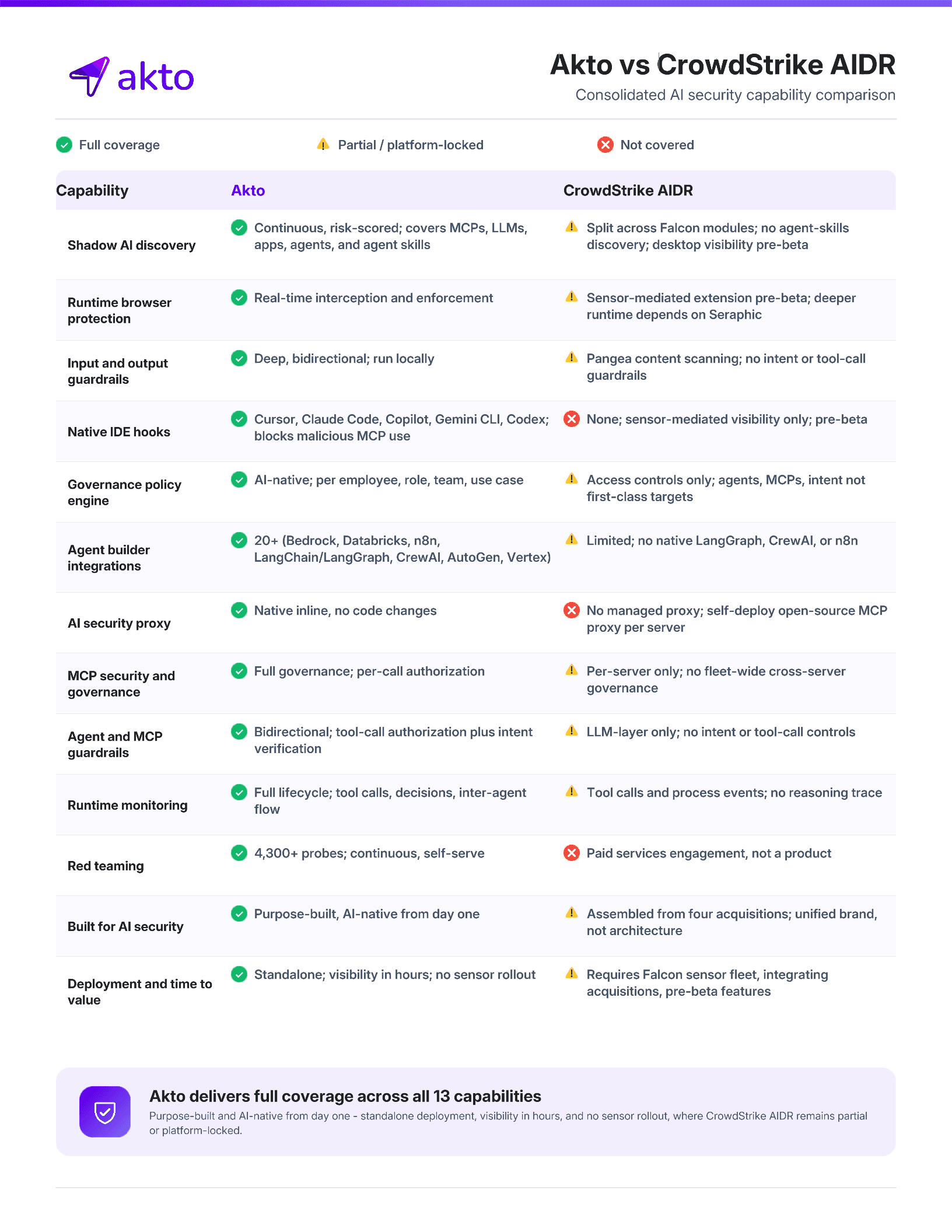
CrowdStrike AIDR is one of the fastest-growing products in AI security, and for teams already standardized on Falcon, it is a natural extension of a platform they already trust. But its acquisition-assembled architecture, its dependence on the Falcon sensor, and the way its AI capabilities are packaged push a lot of teams to look at alternatives before they commit. Here is what is worth evaluating.
Why teams look for CrowdStrike AIDR alternatives
CrowdStrike helped bring AI Detection and Response into the mainstream. Its real strength is correlation: an AI signal can be tied back to endpoint, identity, and threat-intelligence data already flowing through the Falcon platform, which is genuinely useful when you are trying to work out whether a suspicious prompt is part of a larger attack. But as teams weigh AIDR against purpose-built AI security tools, a few patterns keep coming up.
Assembled through acquisitions, not built as one platform. AIDR's AI stack was stitched together from several deals: Pangea for the prompt-layer engine, Seraphic for browser runtime, SGNL for identity authorization, and Onum for the telemetry pipeline. The brand is unified. The underlying architecture is still being integrated.
Full coverage assumes a Falcon sensor fleet. Endpoint AI visibility rides on the Falcon sensor, so the complete picture means rolling that sensor out fleet-wide. If you are not already a Falcon customer, the value proposition weakens sharply, and the switching cost is high.
Several marquee capabilities are still pre-beta. Some of the headline features shown at RSAC 2026, including the sensor-mediated browser extension and deeper browser-runtime protection, were announced as pre-beta with general availability targeted later.
Red teaming is a services engagement, not a product. CrowdStrike's AI Red Team is a paid consulting engagement rather than a continuous, self-serve probe library your team runs on its own schedule.
MCP coverage is a self-deployed proxy. AIDR ships an open-source MCP proxy that customers deploy in front of each MCP server. There is no managed inline control plane, which limits fleet-wide, cross-server governance.
Guardrails are interaction-layer. The guardrail engine inherited from Pangea is strong on content scanning (prompt injection, PII, malware, content moderation), but it does not do agent intent verification or tool-call authorization.
If any of these are dealbreakers for your environment, here are seven alternatives worth a look.
The alternatives at a glance
Tool | Focus | Deployment |
|---|---|---|
Akto | Holistic Agentic AI Security including discovery, red teaming, runtime guardrails, MCP governance, Agent identity governance | Browser extension, IDE hooks, agent integrations, inline proxy |
HiddenLayer | Model scanning, AIDR, red teaming, AIBOM | Non-invasive, artifact and inference based |
Lakera | Prompt injection and jailbreak API guardrails, Lakera Red | API |
Pillar Security | Discovery, RedGraph red teaming, runtime guardrails, governance | Agentless integrations with repos, data platforms, endpoints |
AIM Intelligence | Red teaming and guardrails across text, image, audio, video, physical AI | Cloud or on-premise, proxy-level guardrails |
Pluto Security | AI workspace and builder security across no-code and coding tools | Endpoint and workspace, tool integrations |
Lakera | Prompt injection and jailbreak API guardrails, Lakera Red | Inline runtime, agent and MCP telemetry |
1. Akto
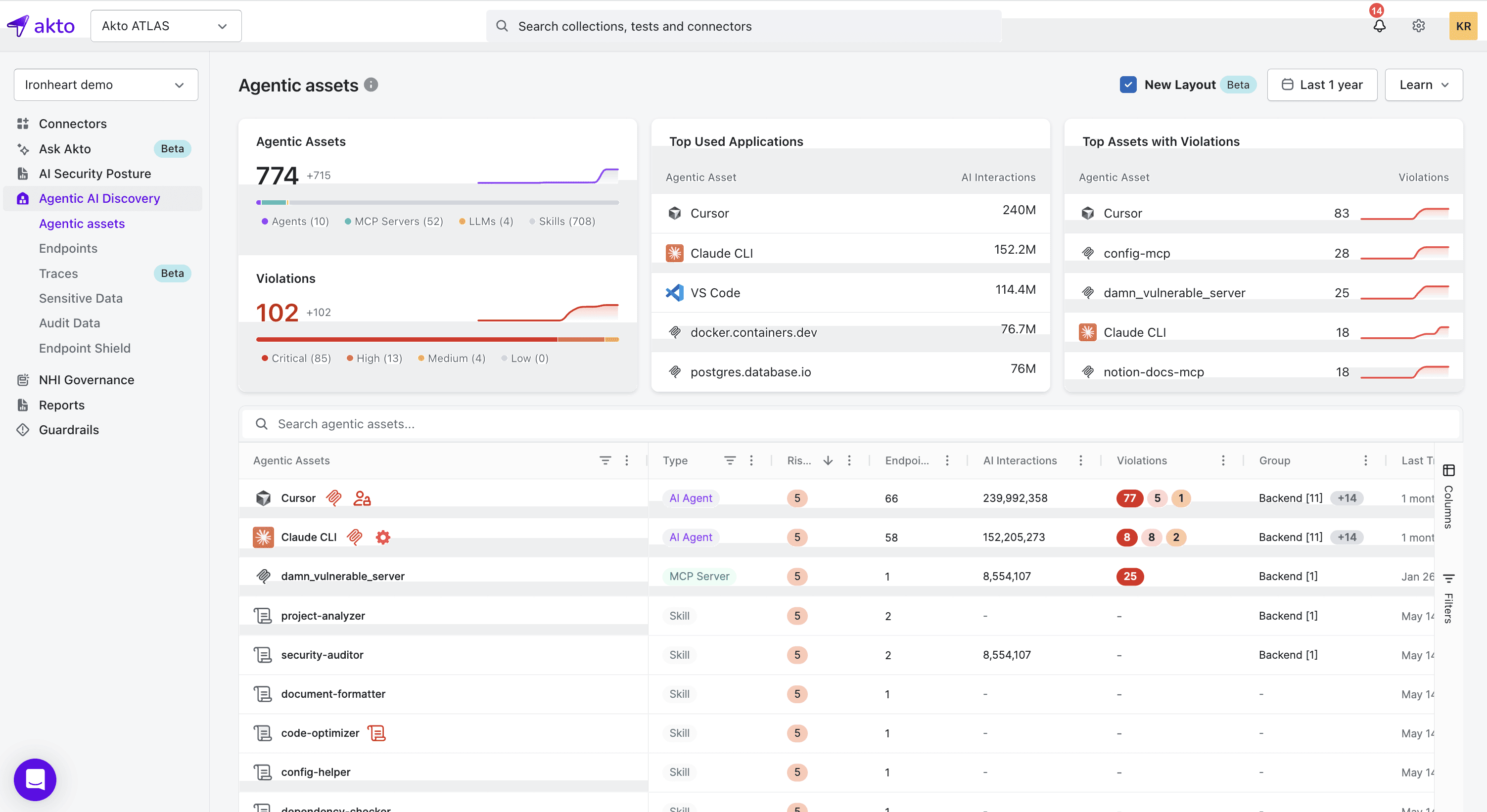
Akto is a purpose-built AI security platform (Atlas for employee AI usage, Argus for homegrown agents and MCPs) designed for the agentic threat surface from day one rather than being ported from an endpoint product. It continuously discovers the AI tools, LLMs, agents, MCP servers, and agent skills across SaaS, browsers, IDEs, and endpoints, then layers bidirectional AI guardrails on both input and output, tool-call authorization, and Agent Intent Verification. Argus runs 4,300+ offensive probes mapped to the OWASP Top 10 for agents, MCPs, and LLMs, and its inline proxy inspects agent-to-MCP traffic in real time without code changes. Native IDE hooks cover Cursor, Claude Code, Copilot, Gemini CLI, and Codex. Teams get full agent visibility in hours.
Where it fits: strongest when your priority is deep AI agent and MCP security with continuous red teaming as a standalone product, not a module you unlock by first adopting a broader endpoint platform.
2. HiddenLayer
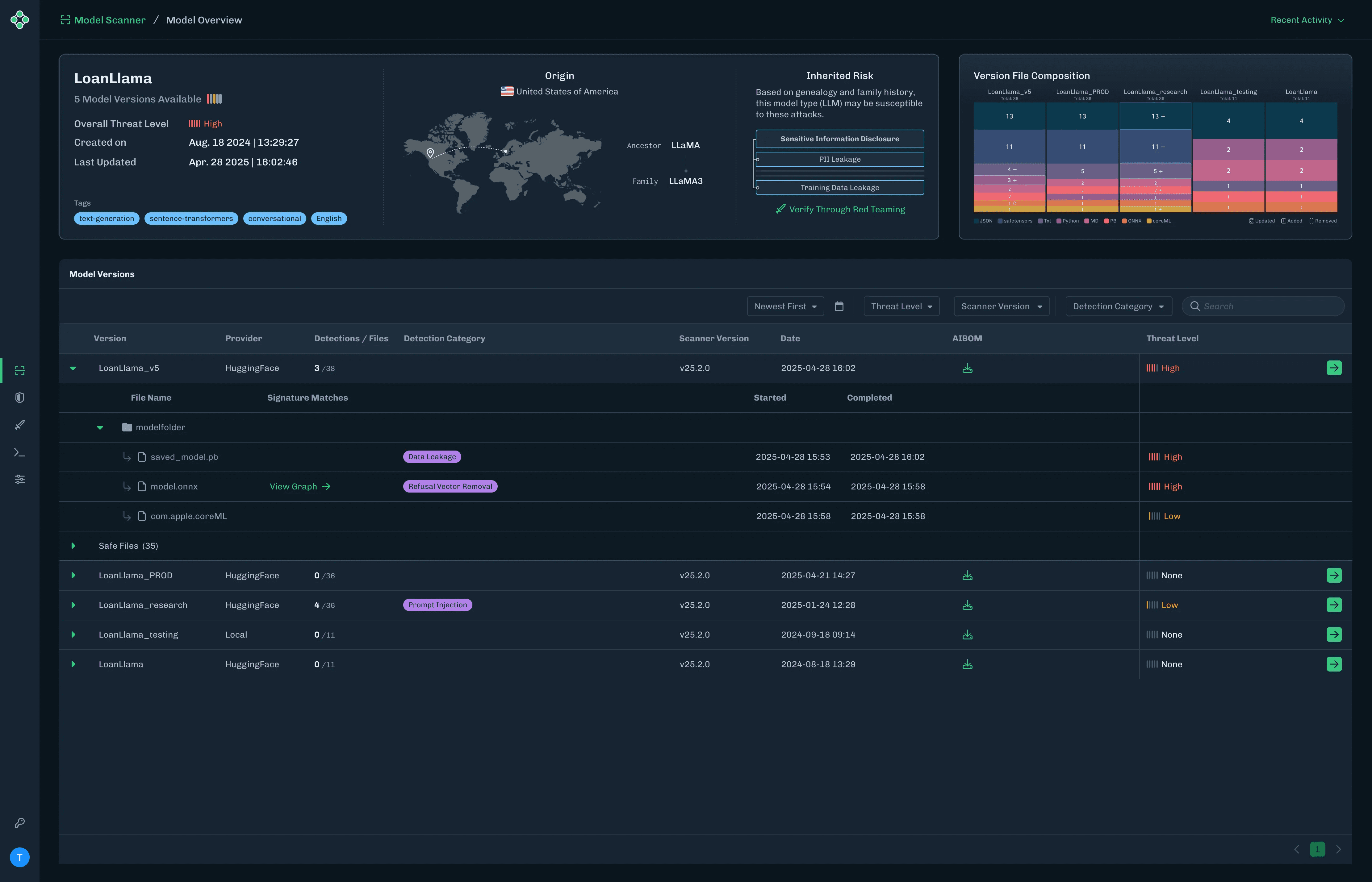
HiddenLayer's AISec Platform combines model integrity scanning (35+ formats), AI detection and response at runtime, and adversarial red teaming aligned to MITRE ATLAS. It auto-generates an AI Bill of Materials and tracks model genealogy for compliance frameworks like ISO 42001 and the EU AI Act, and it operates non-invasively on model artifacts and inference behavior without needing access to weights or training data. It is a Gartner-recognized vendor in the space.
Where it falls short: prompt-level guardrails for chat-style apps and runtime agent or MCP governance are not the core strength, so teams often pair it with a runtime tool. It is strongest when the risk center is model artifacts and ML pipelines rather than autonomous agents and tool calls.
3. Lakera
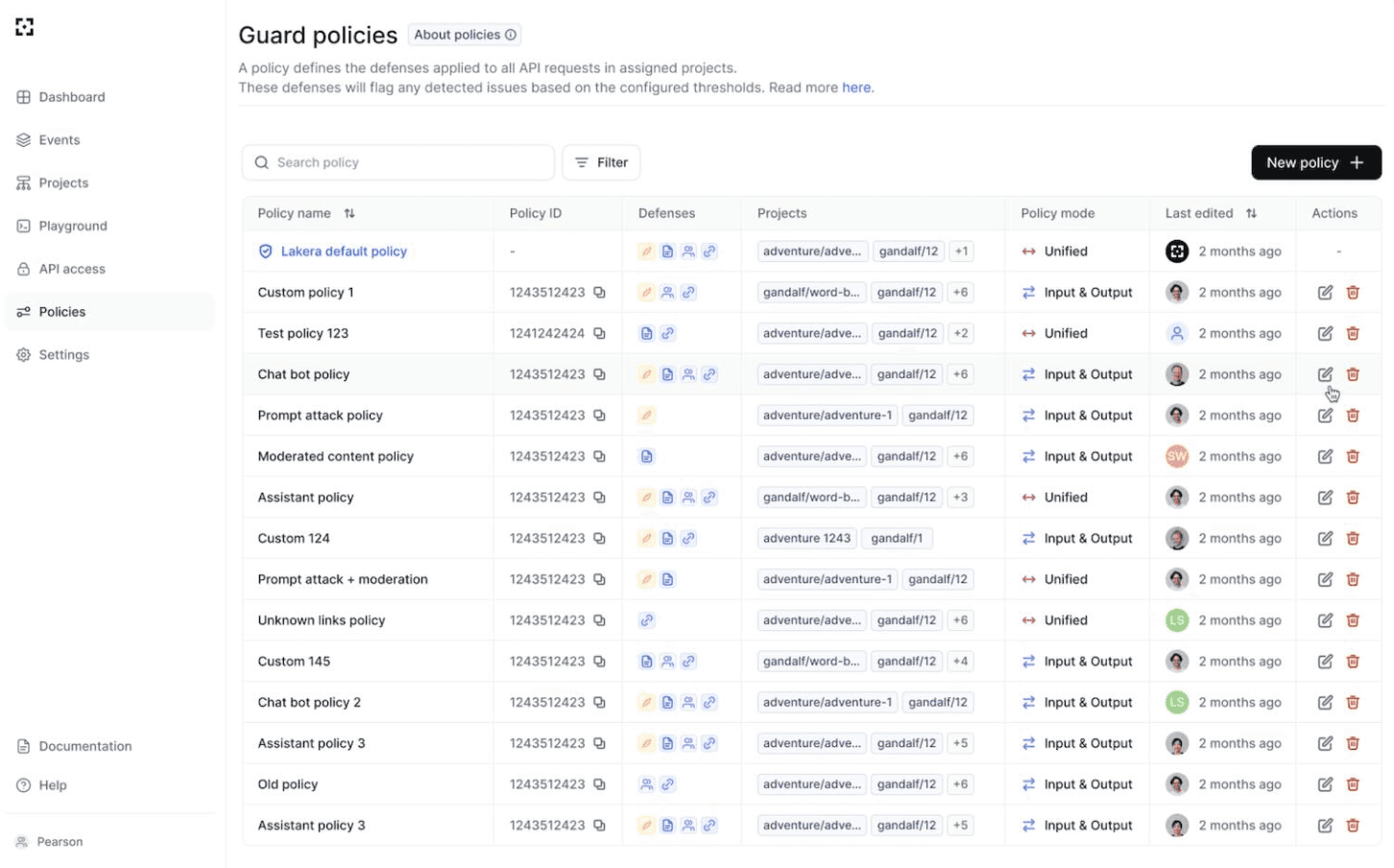
Lakera provides runtime AI guardrails through a low-latency API focused on prompt injection and jailbreak detection, alongside Lakera Red for adversarial testing before deployment. It is a good fit when latency budget is the binding constraint, and you want a focused guardrail layer rather than a full platform.
Where it falls short: it is a focused guardrail and testing layer, not a discovery-to-governance platform. Teams that need agent and MCP inventory, posture management, and runtime enforcement across the whole stack will need more than this.
4. Pillar Security

Pillar structures its platform as a closed loop across four areas: AI Discovery and Posture (agentless cataloging of agents, models, prompts, tools, MCP servers, and coding agents, plus shadow AI detection), RedGraph red teaming (which maps the live environment as an attack graph and runs black-box, multi-turn adversarial tests against tool orchestration and permission escalation), adaptive runtime guardrails that evolve from red-team insights, and governance and compliance. Gartner named it a 2026 Cool Vendor in AI Software Security and a Representative Vendor for Guardian Agents.
Where it falls short: the value is the integrated feedback loop, so teams that only want a single capability (guardrails alone, or red teaming alone) may find focused tools cheaper. Its discovery leans on agentless integrations with repos, data, and cloud rather than a browser or IDE-hook footprint for employee AI usage.
5. AIM Intelligence
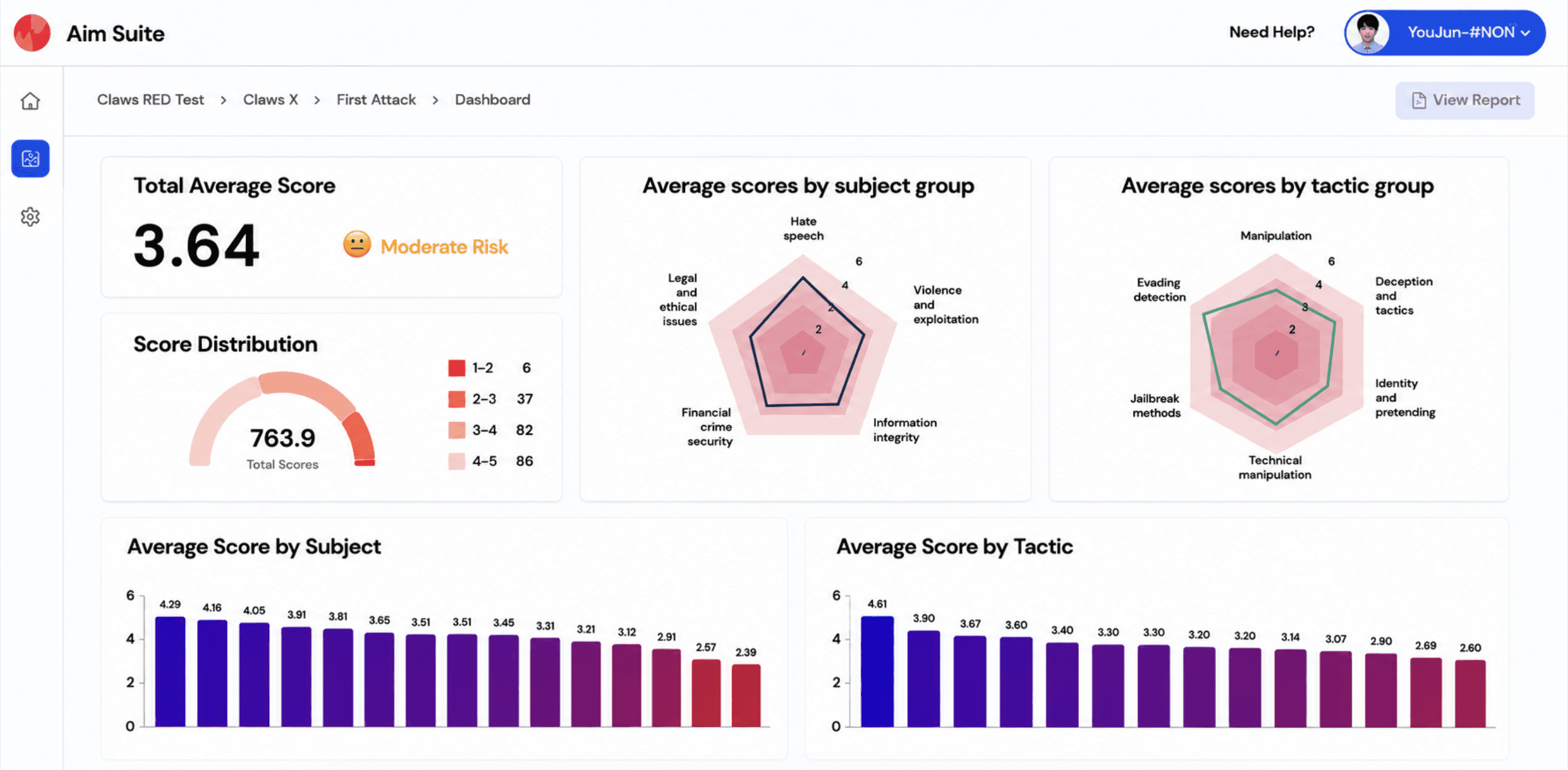
AIM Intelligence pairs two products: Stinger, an automated red teaming engine that generates large volumes of attack scenarios and runs agentic, multi-modal tests beyond the prompt level, and Starfort, a proxy-level real-time guardrail with ultra-low latency, sensitive-data detection, and control over abnormal agent API calls. Its solutions map cleanly to employee AI usage, homegrown AI apps, and agentic AI, it deploys as cloud or on-premise, and it counts OpenAI, Microsoft, Meta, and major enterprises among its partners.
Where it falls short: its strongest suits are red teaming and guardrails rather than full discovery, posture, and fleet-wide MCP governance. It has a deep presence in Korea and the wider APAC region, so buyers elsewhere may find enterprise references earlier stage.
6. Pluto Security
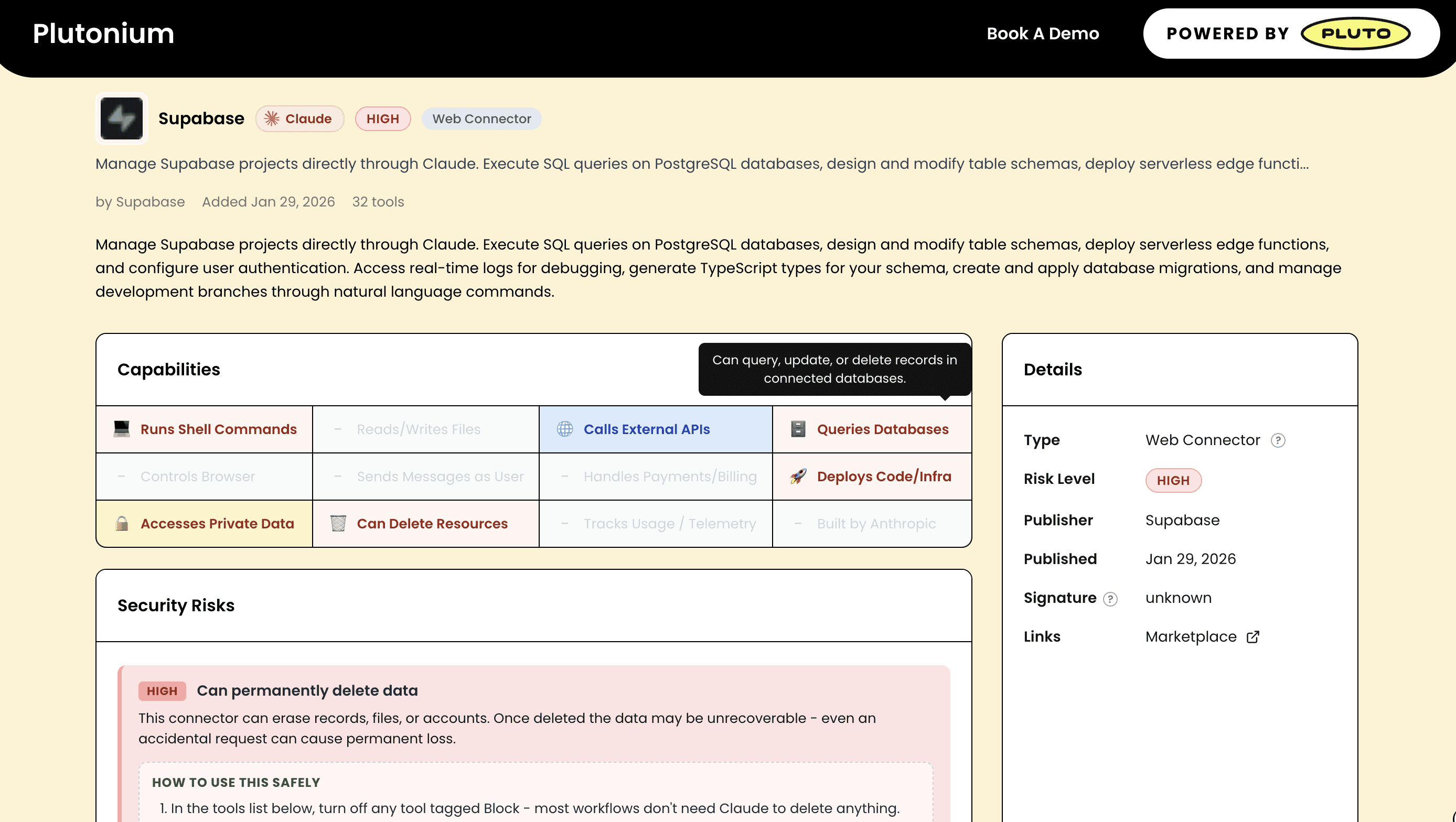
Pluto is an AI workspace and builder security platform aimed at the sprawl of AI building tools employees now use, including Cursor, Claude Code, GitHub Copilot, Lovable, Replit, n8n, Make, Retool, v0, and Windsurf. The pitch is to let CISOs enable building rather than block it, with oversight across every AI building venture in the organization. It ships focused products like ClaudeSec and CopilotSec, runs a strong security research team known for MCP and supply-chain vulnerability disclosures, and holds SOC 2 Type 2 and ISO 27001.
Where it falls short: its center of gravity is employee-side AI building and workspace governance. It is not aimed at securing production homegrown agents and MCP servers at runtime the way an inline agent-security platform is, and it is an early-stage company.
7. Straiker
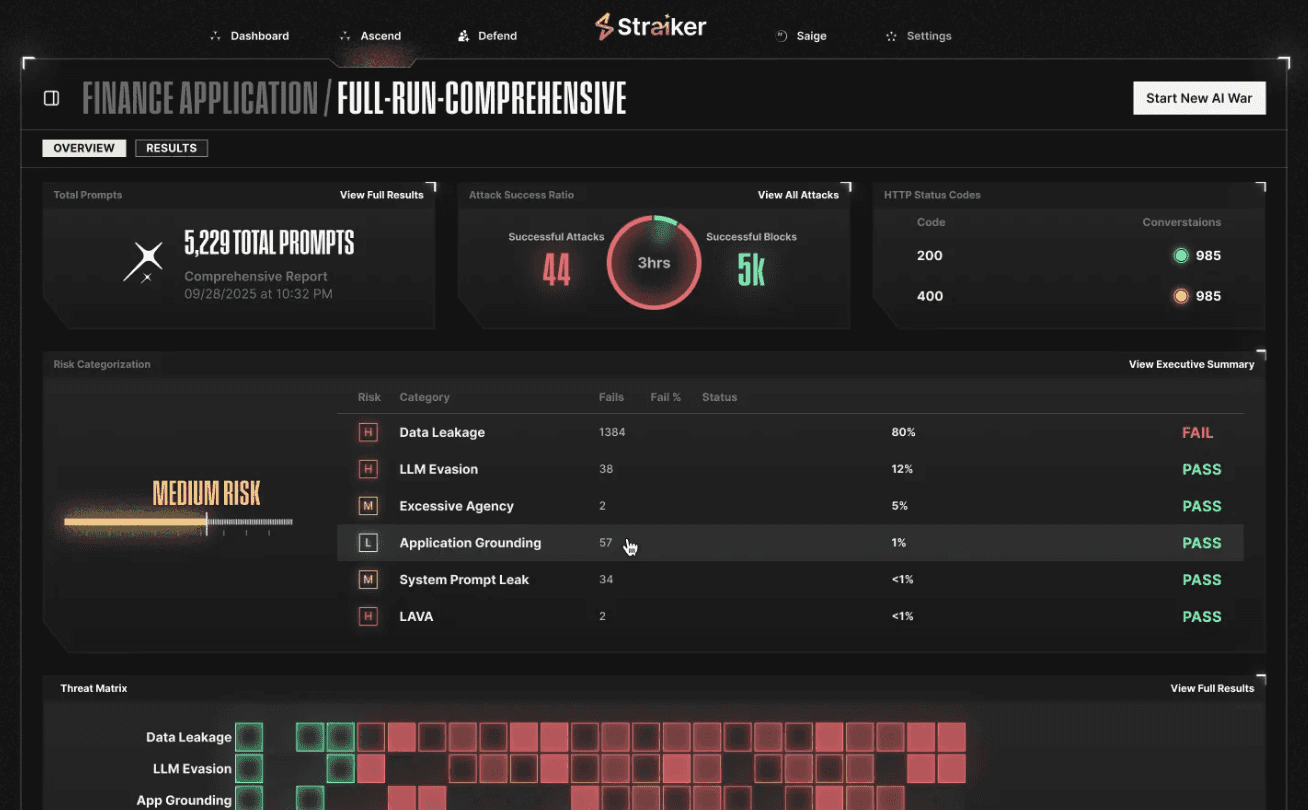
Straiker is built specifically for agentic AI. Discover AI maps every agent, MCP server, and agentic workflow with continuous posture monitoring; Ascend AI runs adversarial testing for prompt injection, goal hijacking, tool misuse, and inter-agent manipulation; and Defend AI provides runtime detection trained on real agent traces, covering the LLM Top 10 and the Agentic Top 10 with full-chain telemetry across tool calls and MCP traffic. The company publishes 98.1% detection accuracy at sub-300ms p95 latency, and treats MCP tool poisoning as first-class coverage.
Where it falls short: it is strongest as a detection-and-response engine and typically pairs with a separate operational control plane, so teams that want discovery, red teaming, runtime, and governance in a single product may need additional tooling.
Why teams choose Akto
Each of these tools is strong in its lane. HiddenLayer goes deep on the model layer, Lakera and AIM Intelligence on guardrails and red teaming, Pluto on employee AI building, Straiker on agent runtime detection, and Pillar on lifecycle testing. The catch is that AI risk does not stay in one lane. A single organization is usually exposed across employee AI usage, homegrown applications, and autonomous agents at the same time, so a point tool tends to leave two of the three surfaces uncovered and pushes you toward running three or four products at once.
That is the case for a complete platform, and it is where Akto separates itself. A few questions make the gap concrete:
Do you need to cover employee AI usage, homegrown apps, and agents, or just one? If it is more than one, Akto covers all three in a single platform, where most tools here address a single surface.
Do you want discovery, red teaming, and runtime enforcement to work together? Akto's discovery feeds its 4,300+ probes, and those findings feed its guardrails, so offense and defense compound instead of living in separate tools.
How deep is your MCP and agent footprint? Akto governs MCP per call and fleet-wide, with tool-call authorization and agent intent verification, where most alternatives stop at discovery, detection, or a single-server proxy.
How fast do you need value? Akto deploys through browser extensions, IDE hooks, and native agent integrations in hours, with no endpoint sensor fleet and no broader ecosystem to buy into first.
Do you need it in production today? Akto is GA across all of the above, not gated behind a preview or a services engagement.
If your needs are narrow, a focused tool from this list may be enough. But if you want one platform that covers the full AI attack surface and is ready to run in production now, Akto is the strongest choice, which is why it leads this list. Whichever way you lean, run a short proof of concept against your own agents and MCP servers and measure real detections, false positives, latency, and time to value.