AI Agent Guardrails Solutions: Choosing the Right Approach for Your Stack
Compare AI agent guardrails solutions and approaches for securing autonomous agents. Learn how to evaluate guardrails for your AI stack, tools, data, and workflows.

Rushali

Typical teams begin their guardrails search with the question of "which vendor should we buy?" That's not the right initial question. The correct answer is "which part of our stack actually requires enforcement?" All three deployment points are addressing a different problem, and each and every risk cannot be addressed by just one.
This piece is a decision framework, not a ranked list. We're not going to relitigate named, feature-by-feature vendor comparisons here; if that's what you need, compare specific tools side by side or swap out one vendor for its closest competitors on the pages built for exactly that. What follows is how to reason about deployment point, team structure, and build-vs-buy before you ever sit through a demo, so the vendor conversations that follow are shorter and more useful.
The Real Decision Isn't "Which Vendor" - It's "Which Deployment Point"
The typical sales script for guardrails is that it's a universal layer. In actual use, each guardrails implementation resides in one of a few places in the request path, and each of these places receives a different portion of risk:
Gateway or proxy layer - This is the layer between your application and the model provider, or between a model provider (agent) and the tools/MCP servers which it connects to. It is able to see every request and every response, and can perform policy determination deterministically at one point, but it can only see what passes through it.
Endpoint layer: Device-based: Developer laptops, employee browsers. It catches everything that never goes to a cloud gateway, such as a prompt that is typed into a personal ChatGPT tab or a server that is locally spun up, running MCP.
IDE hook is a narrower version of endpoint enforcement, which is integrated into tools such as Cursor, Copilot, or Claude Code and runs before a tool is executed on the developer's machine.
Network layer - broader perimeter controls (DNS, proxy, CASB-style inspection) that catch AI traffic as a category, without necessarily understanding prompts, tool calls, or agent behavior.
The decision tree is not as complicated as it appears. First, ask yourself: Where does the traffic you are concerned about really come from? If it is generated by systems you created and deployed, agents, MCP servers, LLM-powered features in your cloud, then it is only natural that enforcement should be in the gateway/proxy layer, as that is the only place all of that traffic converges. When it is generated by human beings, such as employees working independently with ChatGPT, Claude, Cursor, or Copilot, only endpoint and IDE-level enforcement measures will be the first to see it outside the building. Underneath both are network-layer controls that are a coarser backstop, an effective way to get visibility, but generally not accurate enough to be your only control.
This corresponds very much to how the vendor markets itself. For a more detailed explanation of why vendors tend to converge on these same layers (MCP/gateway, identity/runtime, endpoint/browser), check out this look at where the agentic AI security market is headed for more background. The lesson to take away from this article is much simpler: choose your deployment location where traffic comes from, rather than where the vendor's logo appears on their home page.
Matching Solution Type to Team and Environment
Enforcement has to be deployed at a specific point, which you can see on the Deployment point. The next is which set of deployment points your specific environment truly requires - which hinges a lot less on your industry and a lot more on how your teams actually build and use AI day-to-day in practice.
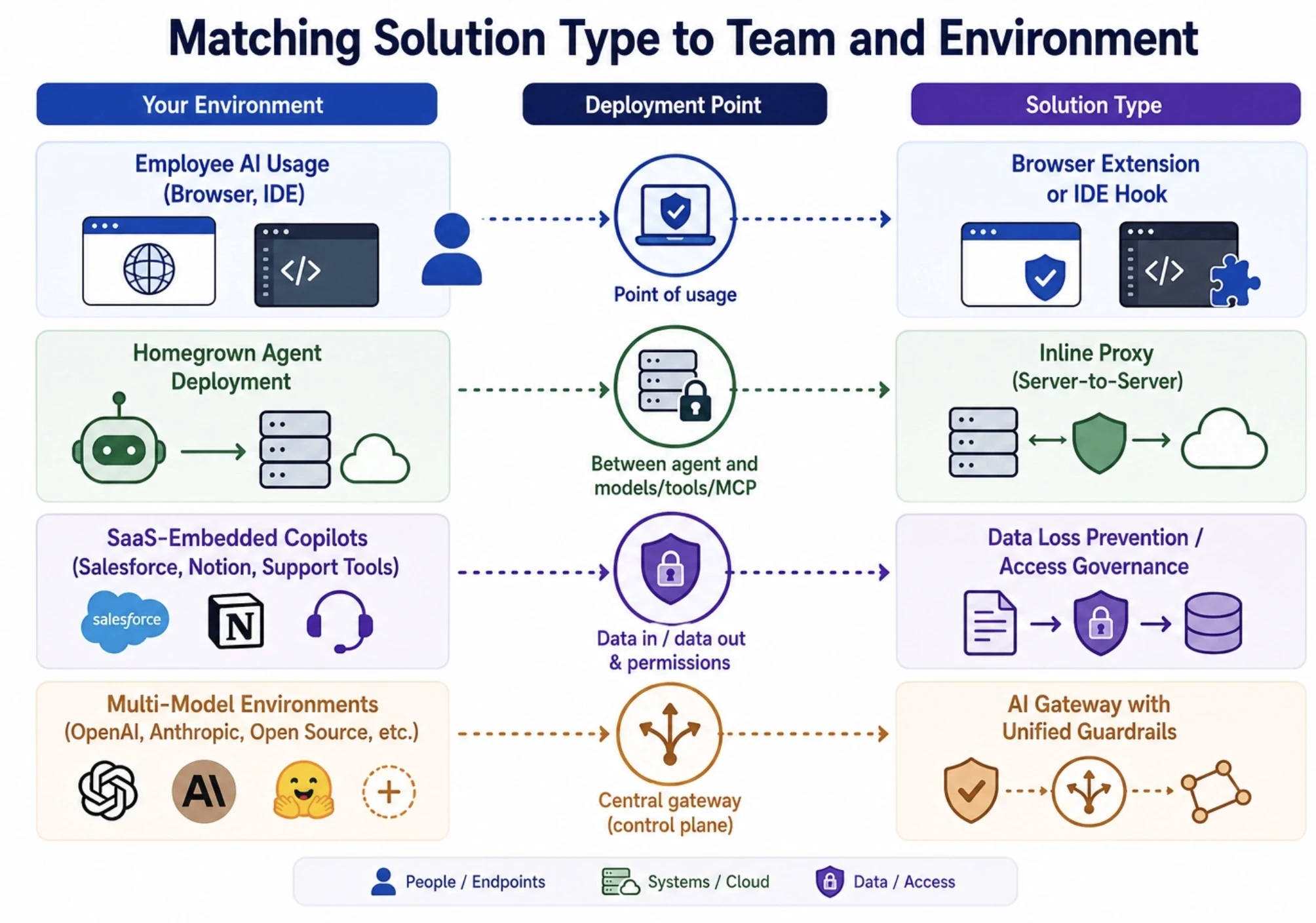
Employee AI Usage (Browser, IDE) vs. Homegrown Agent Deployment
These are two issues that are always mixed up together. But most of all, employee AI use is about people: when someone inputs a customer record into a chatbot, when a developer lets an AI coding assistant execute a shell command it shouldn't, when a team registers under a personal email address which no security official ever signed off on. Homegrown agent deployment is more about systems: your engineering team's built systems, running within your cloud, accessing tools and APIs that your engineering team builds, and generally with far more standing access than any one employee.
The controls don't transfer between the two. Enforcement of employee usage should be enforced at the point of usage; either by a browser extension that intercepts a prompt before it's sent, or by an IDE hook that prevents a problematic tool call from running on the laptop. All traffic will never pass through a cloud-side filter since it resides outside of your infrastructure. Whereas a homegrown agent will require the reverse: enforcement that sits between the agent and the models, tools, and MCP servers that it calls, no browser tab or IDE to hook into; it's server-to-server. This is what Akto is designed around; Atlas provides controls for the employee layer via browser extensions and IDE hooks, and Argus provides controls via an inline proxy for homegrown agents and traffic to and from MCP, instead of one control being used for both.
SaaS-Embedded Copilots vs. Custom-Built Agents
Unlike your team's agents, a copilot integrated within Salesforce, Notion, or your support system is a different creature. The model, system prompt, and the integrations of the tools are controlled by the SaaS vendor, not you; your power lies mostly in what you paste in, what you pull out, and what permissions the copilot gets from the connected account. It's very rare to be able to put a proxy in front of someone else's product.
But that's all turned upside down by custom-built agents. You have control of the model calls, the tool definitions, the memory, and the execution path; there's no vendor-provided safety net to fall back on. That's a sizable enough area to cover prompt injection using content that isn't trusted, to cover tool misuse, and to cover multi-step actions that multiply a few mistakes into larger mistakes. In practice, SaaS copilots are more commonly a data-loss-prevention/access-governance issue, whereas custom agents are more of a runtime-inspection/policy-enforcement issue, and one solution does not easily fit the other.
Single-Provider vs. Multi-Model Environments
If you're using the same model provider throughout your entire stack, enforcement can be fairly straightforward, as you can rely on the safety features specific to the model provider and build a thin layer on top with your own policy. Not many teams remain in that spot for long. At some point, routing across OpenAI, Anthropic (an open-source model because of costs), and perhaps a fine-tuned model for a particular task renders provider-native controls inadequate: each provider has different guardrails, no provider has a single definition of its policy, and you have to maintain the same rule in three or more places.
It's where AI gateways, such as Portkey and TrueFoundry, were designed for: One control plane for centralizing routing, fallbacks, and observability across providers. As your environment becomes more heterogeneous, it becomes more important that the guardrail is located at this same layer, since it is important that it is checked the same way no matter which model has responded to the prompt. If you now add a second model to your stack and the guardrails approach can only understand one provider's request format, then it becomes a liability.
Build vs. Buy vs. Open-Source
This is a distinct aspect from the deployment point or a team's structure, and is not to be lumped in with vendor comparison.
It is easy to build your own: a set of regex filters, some prompt-based classifiers, a proxy made up of your own parts, it seems quick and completely in your hands. As a rule, it is quick for the initial one. Teaming that up with prompt injection techniques, jailbreak patterns, and tool-poisoning tactics, all of which change constantly, the cost is not immediately apparent: someone has to be dedicated to keeping track of that evolution, and to shipping updates. Most security teams are not blessed with that number of people, and a guardrails system that is not continually improving after month three is a guardrails system that is quietly falling behind.
Open-source guardrails frameworks address part of the cost issue: detection rules are community-driven, and there is no license fee; however, you also take on integration and operations tasks: setting up the infrastructure, integrating with all the applications and agents that need it, and keeping up with updates as they come along on your own timeline. They are excellent at the easier problem of understanding whether a string contains forbidden words or matches a pattern for PII, but poorer when it comes to the harder problem of understanding whether a string represents a legitimate customer-support tool call or is manipulated.
There is always an ongoing engineering effort to purchase a platform, a vendor lock-in, and a cost, but what better way to keep pace with a weekly changing threat landscape? The right test isn't “can we build this?” - most engineering teams can build a first version of almost anything. It's "can we keep up this pace of attackers, in addition to everything else that we have planned. The honest answer for most teams beyond the prototype phase is no, hence the common practice of a combination of fast, open source or built-in checks for the cheaper and deterministic tests, and a platform designed for detection that requires actual judgment.
A Decision Checklist Before You Evaluate Vendors
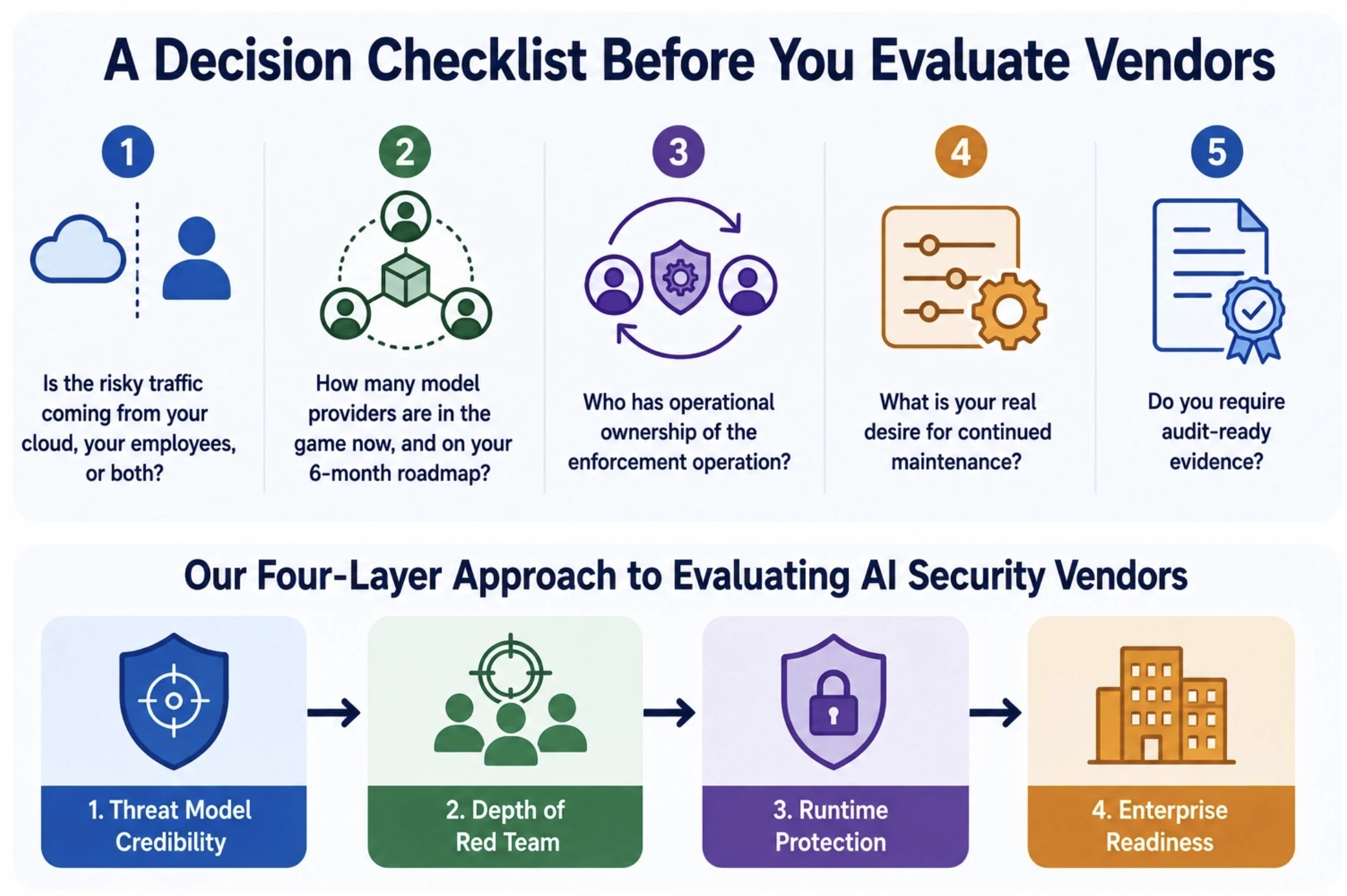
Prior to making the first call to a vendor, you will need to have straightforward responses to these questions:
Is the risky traffic coming from your cloud or your employees or both? Before considering any one product, you need to know whether you're looking for endpoint enforcement, gateway enforcement, or both.
How many model providers are in the game now, and on your 6-month roadmap? No single provider answer now should be considered a single provider answer in 6 months.
Who has operational ownership of the enforcement operation (security, platform engineering, or both), and is the sidecar, browser extension, or gateway plugin the right deployment model for that team?
What is your real desire for continued maintenance – create and tune detection rules yourself vs. having to consume a platform that does it for you?
Do you require audit-ready evidence (rather than blocking)? Without an available log to use for enforcement, it's a gap in compliance that will show itself during the next audit.
So, when you're able to respond to those five questions, you're ready to enter the vendor conversation, and with a structured framework, that conversation can go sooner. We have a four-layer approach to reviewing the security vendors of agentic AI, which we won't go into detail here, but which includes assessing threat model credibility, understanding the depth of the red team, evaluating runtime protection, and assessing the enterprise readiness of the AI security technology.
How Akto Fits Across Deployment Points
The above split does not form the basis of a single deployment model that Akto follows, but rather the key concept of the split. The platform is delivered as two distinct offerings, Atlas for the employee AI layer, and Argus for the homegrown agent and cloud layer.
Akto Atlas protects the use of AI by employees using both a browser extension that blocks prompts and responses in web-based AI tools, and by using native IDE hooks, such as Cursor, Claude Code, Copilot, Gemini CLI, and Codex, which can prevent a malicious MCP tool call from running on the developer's machine. It comes with over 20 built-in guardrail policies that can be applied to scenarios such as exposure of sensitive data, prompt injection and jailbreak attempts, and sign-ins via personal accounts not approved by the organization, all of which are evaluated locally on the device and reported to a central dashboard for auditing.
Akto Argus takes care of the other 50%, agents and MCP servers that your team builds and runs. It is an inline proxy - a sidecar container along with your agent infrastructure - that is able to inspect request and response traffic in real-time to apply policy on prompts, tool calls, and agent responses before it even reaches production or leaves the organization. Moreover, Akto integrates seamlessly as a native guardrail provider within AI gateways such as Portkey and TrueFoundry such that the same enforcement is carried out with your traffic regardless of which model provider responds to a call, directly solving the multi-model problem outlined above.
It is under both products that lies a common discovery layer, Akto, that automatically catalogs MCPs, AI agents, tools, and connected resources across your infrastructure, cloud, and employee laptops, supported by an attack matrix of over 10,000 test probes mapped to the OWASP LLM Top 10 and MITRE ATLAS. This common visibility is what keeps Atlas apart from Argus, from being two separate tools, one platform, one policy model, two deployment points.
Final Thoughts on AI Agent Guardrails Solutions
There is no one right location for guardrails, just the right location for where your risk actually exists, and it's rarely just one place. If you've gone through deployment point, team structure, build vs. buy, the vendor conversation becomes much shorter at this point.
That's how Akto was designed: Atlas to use employee AI in browsers and IDEs, Argus for homegrown agents and MCP traffic in your cloud, and a unified discovery layer to keep coverage from becoming disjointed as your stack expands. Once you've reached the framework stage and you're ready to explore what that looks like in your setting, book an AI Agent Guardrails demo, and we'll walk through it together.
FAQs on AI Agent Guardrails Solutions
What's the difference between a guardrails "solution" and a guardrails "vendor"?
A vendor is a firm that sells a product. A solution is the mix of deployment points, policy design, and operational ownership that is suitable for your environment, and it can be more than one vendor's product, or more than one deployment point from the same vendor to complete the solution.
Should guardrails be deployed at the gateway, endpoint, or network layer?
It depends upon the place that the visitors are coming from that you're attempting to control. Traffic from systems that you have created (agents, MCP servers) is most likely to be caught at the gateway or proxy layer, as that is the one point that everything has to go through. The traffic from people (the people who use AI tools directly) has to be caught at the endpoint, as a lot of it doesn't touch the cloud gateway at all. Network-layer controls are helpful as a layer of visibility and are typically not specific enough.
Does the right guardrails approach differ for employee AI usage vs. homegrown agents?
Yes, substantially. Where a paste or a prompt or a tool call is actually taking place, the use of dangerous tools needs to be enforced in the browsers and IDEs themselves. For homegrown agents, there is no device-level interaction to hook into, and enforcement inline must be done between the agent and the tools or models that the agent calls. One of the most common mistakes in evaluating is considering them as the same problem.
Should we build our own guardrails, buy a platform, or use open source?
It's not about which is the best; it's about your ability to maintain it going forward. Fast, deterministic detection (known patterns, regex-based PII) works well with open-source and homegrown checks, but these must also be maintained to stay current with new attack methods. A platform runs at the expense of maintenance, but it is likely the best option once your service goes beyond the prototype stage of use and into traffic.
How do guardrails needs differ for SaaS copilots vs. custom-built agents?
The SaaS-embedded copilot gives you limited ability to choose the model and/or tool integrations; your power is largely limited to what data you provide it and what permissions it has. Put the entire execution path in your hands, and so do the entire guardrails responsibility - prompt injection, misuse of tools, risk of multi-step action – responsibility falls on you as well.
Where can I find a named comparison of specific guardrails vendors?
This isn't an exhaustive list of what you can do with this. To compare feature by feature, look at our AI security tools breakdown, or to do a head-to-head vendor comparison, browse alternatives by name.
How does Akto's guardrails approach cover multiple deployment points at once?
Atlas enforces guardrails at the employee endpoint (browser and IDE), and Argus enforces guardrails inline for homegrown agents and MCP traffic, including as a native guardrail provider within AI gateways such as Portkey and TrueFoundry. They both share the same discovery and policy engine, and as your environment grows at more points of deployment, coverage does not split.

Experience enterprise-grade Agentic Security solution