GenAI Security Tools: Top Tools to Secure Generative AI
GenAI security tools explained by category - securing AI-assisted development vs. governing enterprise GenAI usage - with buyer criteria and named tools.

Bhagyashree
According to IBM’s 2025 Cost of a Data Breach Report, AI is set to dominate over security and governance in “do-it-now” adoption. The statistics are hard to ignore: 97% of organizations that experienced an AI-related security incident reported having no proper access controls for AI, and 63% didn’t have an AI governance policy to prevent shadow AI sprawl.
These are the areas where genAI security tools can be particularly useful. There are two distinct categories of such tools: those that govern and secure the use of generative AI within an organization (covering access controls, data loss prevention, and shadow AI discovery) and those that leverage generative AI for security purposes (including AI-driven threat detection and response, SOC copilots, and triage automation). Recognizing the category a security tool falls into and evaluating the state of protection in each area is the first step toward addressing these gaps.
This blog explores GenAI Security Tools and why every organization needs one.
The two categories of Gen AI security tools
Gen AI is giving rise to two classes of security issues, and combining them leads to tool selection errors. The first class focuses on the code produced by AI systems and how it differs from hand-written code. The second class addresses how employees use AI systems to process data, particularly data that should not be shared with third parties. Each class requires a different ownership model, different controls, and different tools.
Securing AI-Assisted Software Development
When developers use Copilot or other tools to generate code, the code may appear superficially correct but contain subtle weaknesses not visible in code written by people. Code written by large language models (LLMs) is more likely to have hardcoded secrets, use outdated dependencies, lack input validation, and include other weaknesses that are not immediately obvious but can be exploited with relative ease.
Tools that help address these weaknesses fall into several categories:
AI-aware SAST and code scanning – conventionally, SAST tools identify weaknesses in hand-written code, but specialized tools now analyze code written by AI to detect failures related to LLM-specific failure modes.
Software composition analysis – many AI-assisted coding tools recommend packages, sometimes including non-existent “hallucinated” components; traditional SCA tools are of limited use in analyzing such code.
Secrets detection – developers using AI coding assistants tend to embed secrets directly in the code more frequently than in hand-written code.
AI code review agents – these tools operate at the pull request level to determine whether code originated from an AI coding assistant and subject that code to additional scrutiny.
The tools that fall into this category are typically owned by the application security group or platform engineering team and operated within the software development lifecycle (SDLC).
Governing Enterprise Use of Gen AI
The second class of tools deals not with code written by AIs but with the use of AI systems themselves, particularly in processing data. This includes sales representatives asking ChatGPT to summarize a contract or a finance employee uploading a spreadsheet to an unapproved AI system. In effect, organizations must prevent data exfiltration through AI systems by discovering shadow AI use and controlling data access.
Some tools help govern enterprise use of GenAI:
Shadow AI discovery – detects unauthorized use of AI systems that process data.
DLP for AI Prompts – prevents data exfiltration into AI systems, particularly data containing PII, intellectual property, and other sensitive information.
AI access control – regulates which AI systems may be used and by whom, including formal approval processes.
AI usage monitoring – tracks the data inputs to AI systems for governance and audit purposes.
Inside Enterprise Gen AI Governance: Three Core Functions
Enterprise governance of generative AI is not a single function. It is a sequence of capabilities - first, discovering and inventorying shadow use of these systems in the enterprise (discovery and assessment), then protecting data from exfiltration through these systems (data protection), and finally enforcing broader policy over enterprise generative AI use (policy and governance enforcement). Each subsequent stage depends on the ability to act on the findings of the previous stage.
Discovery and Assessment (Shadow AI Inventory)
Security teams cannot govern what you do not know and understand. That is why the starting point for enterprise governance of generative AI is always discovery and assessment - essentially, getting an inventory of which AI systems and to what extent are used in the enterprise environment. There are several ways discovery tools can find shadow AI use in the enterprise:
Network-level identification of AI API traffic, such as API calls to OpenAI, Anthropic, Google, and other large language model suppliers, and thousands of smaller AI developers.
SaaS to AI supply chain analysis helps find AI features embedded into software tools that the enterprise actively uses.
Identity and account discovery uncovers AI system accounts that are signed up with enterprise email addresses, including free tiers.
Risk scoring of identified instances highlights the top-priority risks first, for example, AI systems that retain input data after deletion.
This inventory function creates the foundation for all further security measures by providing the actual list of AI systems to be governed. Without inventory, there is no governance. All the following points in this section depend on successful discovery and risk assessment.
Data Protection (Prompt-Level DLP)
The next core function of enterprise governance of generative AI is data protection, specifically, preventing the data exfiltration using these systems. This is a form of Data Loss Prevention (DLP), but with the focus on prompts as the carriers of exfiltrated data. The enterprise data at risk of exfiltration through generative AI includes PII, intellectual property, source code, financial information, and any other data that could cause harm to the enterprise if made public. Classic DLP tools are not sufficient for this task because they focus on files and emails. Prompt-level DLP needs to scan the content of individual prompts for protected data and prevent such prompts from being sent to AI systems.
In addition to prompt scanning and redaction (removing protected data from prompts), prompt-level DLP tools often incorporate response scanning, that is, scanning of data returned by the AI system. Additional protective measures include browser extensions and network filters that intercept prompts before they reach AI servers, preventing data exfiltration. Browser extensions allow such protection even when AI tools are used in a browser as independent applications.
Prompt-level DLP is the most technically sophisticated layer, but it is also the most visible to the user. Therefore, the effectiveness of such a tool depends critically on the balance between risk reduction and usability. If the use of such a tool is too complicated or restrictive, users will turn to other, unprotected means of interacting with AI systems.
Policy and Governance Enforcement
Discovery and assessment, data protection, are both technical functions. The third core function of enterprise governance of generative AI is governance policy and enforcement - the collection of policies that provide the basis for actions taken by the first two functions at both technical and managerial levels. Governance policies determine, among other things, which AI tools can be used in the enterprise (depending on the level of risk), who can use them, and what actions taken through these tools require special authorization. The governance function is also the manager for the overall process of enterprise-level governance of generative AI and establishes feedback loops between different stages.
Effective governance policy is built on three pillars:
The definition of different levels of governance depends on enterprise requirements. For example, enterprise-owned Chat GPT may be allowed for all users, while low-risk AI tools may be prohibited for users in the finance department, and all AI use may be prohibited for users in the healthcare department.
Approval processes for new AI tools based on governance criteria.
Audit trails (for compliance with regulations such as SOC 2, GDPR, and other regulations) and reporting procedures.
Inside Developer-Side Gen AI Security
In case an enterprise governance focuses on restrictions to uses of AI, developer-side security is about restrictions on what gets produced by AI. The difference is critical, but not obvious: there is value in preventing unethical uses of AI, but there is even more value in preventing insecure outputs from AI. The latter, after all, can enable the use of insecure dependencies and practices.
IDE, Pull Request, and CI/CD Integration
The faster a vulnerability is found, the less context is needed to understand why it is a vulnerability. With AI-assisted development, “faster” means scanning code inside the IDE at the moment of suggestion rather than waiting for a separate review. Waiting for a scheduled scan means that vulnerable AI-assisted code has already been committed and possibly deployed, and may require significant effort to unwind.
Effective integrations can be seen in all stages of the development flow:
In-IDE scanning and highlighting of security-relevant patterns (like hardcoded secrets, unsafe deserialization, or missing authentication) as they are suggested by the AI assistant before being accepted as code
Scanning at the pull request level, focusing on changes suggested or accepted by an AI assistant
Blocking merges or deploys at the CI/CD level based on scan findings rather than waiting for a human reviewer
Providing feedback to the AI assistant itself, if applicable, so it learns to avoid similar patterns in the current or future sessions
The theme is making the secure path the easiest path – if the scan is frictionless and baked into the toolchain, developers will not seek out and use the insecure path just to save time.
AI-Generated Code and Supply Chain Risk
While writing code with an AI assistant can introduce obvious risks, choosing dependencies based on suggestions from an AI assistant introduces a more insidious one. AI coding assistants do not only generate code – they also recommend packages for inclusion in the project. However, many such assistants have been observed to recommend “hallucinated” dependencies that do not actually exist, or that no longer have any support. Worse, attackers are taking advantage of this feature by registering packages with names that an AI model might hallucinate, making it possible for malicious code to be included in a project based on apparently trustworthy suggestions.
Coverage typically includes:
Scanning all dependencies suggested by an AI coding assistant for security and license risks using a Software composition analysis (SCA) tool, not only those actually requested by the developer
Checking for existence and legitimacy of all suggested packages to prevent supply chain attacks
Verifying that suggested packages have licenses compatible with the consuming project
Continuous monitoring of suggested packages for security and license issues beyond initial inclusion in a project
Combined with in-IDE and CI/CD scanning, these features close the loop – one covers security issues in code generated by AI, the other security issues in code suggested by humans, and the third covers the interaction between the two.
Open Source vs. Commercial Gen AI Security Tools
Open source offers a raw testing engine and asks you to build the rest, such as validation, reporting, and maintenance, commercial platforms hand you those pieces already built at a price that scales with how much of that work you are offloading.
The difference that matters the most in practice is cost: its coverage of the attack surface you need to actually have. Community-handled libraries (open source) handle the OWASP LLM Top 10 well but do not quite cover retrieval and agentic layers, and not every commercial vendor closes the gap either.
Here are key differences between open-source and commercial Gen AI security tools.
Dimension | Open-source | Commercial |
|---|---|---|
Setup | Needs time to configure, tests, targets and scoring. | Mostly pre-built, the vendor manages the configurations and integration. |
Validation | Raw findings only - no human review layer. | Most often paired with human - validated red teaming for confirmed findings. |
Reporting | No built-in compliance mapping. | Structured reporting mapped to frameworks such as NIST or the EU AI Act. |
Attack Surface | Very strong on OWASP LLM 10, Gaps at retrieval and agentic layers. | Differs by vendors, some offer coverage across agents, RAG and tool calls. |
Maintenance | Continuous. It owns upkeep and interpretation. | Vendor maintained, updates ship as part of the platform. |
Flexibility | Fully customizable | More opinionated, packaged workflows. |
Questions to Ask GenAI Security Vendors
Most GenAI security vendors will walk you through a demo that highlights a sanitized dashboard with some caught attacks, but that's not enough to properly evaluate the product you're considering buying. Instead, ask vendors to demonstrate their approach to four specific areas that cut through the marketing to the actual value of the technology.
Can You See Trace-Level Evidence, Not Just a Verdict?
A finding that simply says "blocked: prompt injection" is asking the defender to accept its word on faith - demand to see the trace and underlying evidence that supports it. Ask to see the trace-level evidence of attacks, not just aggregated attack categories.
Questions to ask:
Can I see the trace (i.e. prompt/response) for any finding, including intermediate tool calls in an agentic workflow?
When a finding is a false positive, what evidence can I use to contest it?
Are traces retained for incident response long-term, or only available within a rolling window?
If a vendor cannot show you the trace they're basing a finding on, ask yourself whether you're willing to take their word on potential attacks in your system.
What Happens When Models or Agents Change?
The nature of the threats these products target means that models and their prompt/response patterns are constantly shifting, requiring continuous retesting. A finding that was valid last quarter could become a false positive this quarter, and a well-tested system could be compromised by a change in its environment.
Questions to ask:
When do findings get re-evaluated: when the model/prompt set/change, or only when specifically asked?
Do you have a regression suite that retests findings as part of a CI/CD pipeline, like unit tests?
Can findings block a deployment, like a failing unit test?
A product that doesn't have a regression testing framework is essentially a one-time audit tool that the defender should treat as such.
How Do Findings Map to Frameworks You'll Actually Defend To?
Findings that only exist as "attack types" in the vendor's system are much less valuable than attack findings connected to established frameworks, whether that's the MITRE ATT&CK knowledge framework or specific compliance frameworks like the EU AI Act.
Questions to ask:
Do you map findings to MITRE ATLAS or OWASP LLM/Agentic Top 10 out-of-box, or does that require someone on my team to do?
Can your findings generate compliance reports for frameworks relevant to my industry (NIST, EU AI Act, etc.), or does that require custom development?
If a regulator asks me how we test for prompt injection, can your documentation answer that question directly?
If you're told that findings can be exported to a framework as a custom report, that's often a sign that you're being sold a services contract masquerading as a product.
Does Coverage Actually Extend to RAG, Tools, MCP, and Multi-Agent Systems?
This is where most vendors' public demos are at odds with reality. A product that demonstrates well on prompt/response coverage often turns out to have little ability to test the more subtle prompt injection techniques that target the retrieval layer of a RAG pipeline, the tool-calling layer of an agent, or the orchestration layer of multiple agents working together.
Questions to ask:
Can you test for indirect prompt injection techniques that target the retrieval layer of a RAG pipeline?
Can you test for manipulations of the tool-calling layer that induce an agent to call a tool with unexpected parameters?
Do you support testing of Multi Cloud Platforms, including inspection of the MCP traffic and testing of MCP-specific attack patterns?
Can you test multi-agent systems for failure cascades, where one agent compromises another it works with?
A vendor that can answer these questions with a demonstration (rather than an "it's on our roadmap" answer) has typically built a product that understands the attack surface in production environments. A vendor that starts talking about their roadmap is likely to have built their product around last year's understanding of GenAI security, centered around chatbots and RAG pipelines.
Why Most Organizations Need More than One Tool
Every section above addresses different aspects of the same issue: the tension between the risks on the developer side and enterprise users, the contrast between red teaming/guardrails/DLP, the imbalance between network-layer coverage and the needs of agents and MCPs. None of the vendors address all of these areas as their strengths, and the question then turns to whether to consolidate around one solution or accept the risk across multiple vendors. In short, consolidation is better, but there is a cost in terms of increased risk surface. The factors here are as follows:
It can lead to better operational effectiveness. The user only has to deal with one interface, one set of relationships, one taxonomy for findings, one invoice - the primary reason why vendors like Prisma AIRS or Cisco AI Defense seek to extend their network-layer security offerings into AI risk management.
It reduces interlocking delays between different tools. A platform that addresses both discovery/exposure management or testing/runtime policy can mitigate the time differential between detecting a risk and actually addressing it.
There is no dominant incumbent across all areas of concern. Network-security vendors that expand into AI security tend to have their strengths at the network level (identifying shadow AI, enforcing DLP/Traffic controls) and have fewer capabilities in developer-side code-scanning or MCP-specific agent testing.
Specialized vendors may offer significantly stronger coverage in their verticals. A firm like Akto, which focuses on agent security, would have more comprehensive coverage than a multi-faceted platform for agents and MCPs from a traditional security vendor, but would lack in other verticals such as employee shadow use cases.
Breadth tends to sacrifice depth, and vice versa. Similar to the debate between open-source and commercial software, there is a performance penalty for platforms that attempt to span multiple verticals.
The required toolset depends on the organization’s risk profile. An organization that does not have significant agent-development capabilities may only need a single platform, whereas a firm that deploys MCPs in production and agents across its architecture would benefit from a specialized solution like Akto in addition to its primary security platform.
Why Akto Is Perfect For Agentic AI and MCP Security
As companies move from experimenting with GenAI to deploying their own AI agents and MCP servers, the security challenge transitions from "how do we detect foreign attacks" to "do we actually know what our agents can do, and can we prove it?" Akto was designed to answer exactly this question. As the Agentic AI security platform, it covers the full lifecycle of building secure agentic systems, including being one of the first security platforms to address MCP and agentic systems.
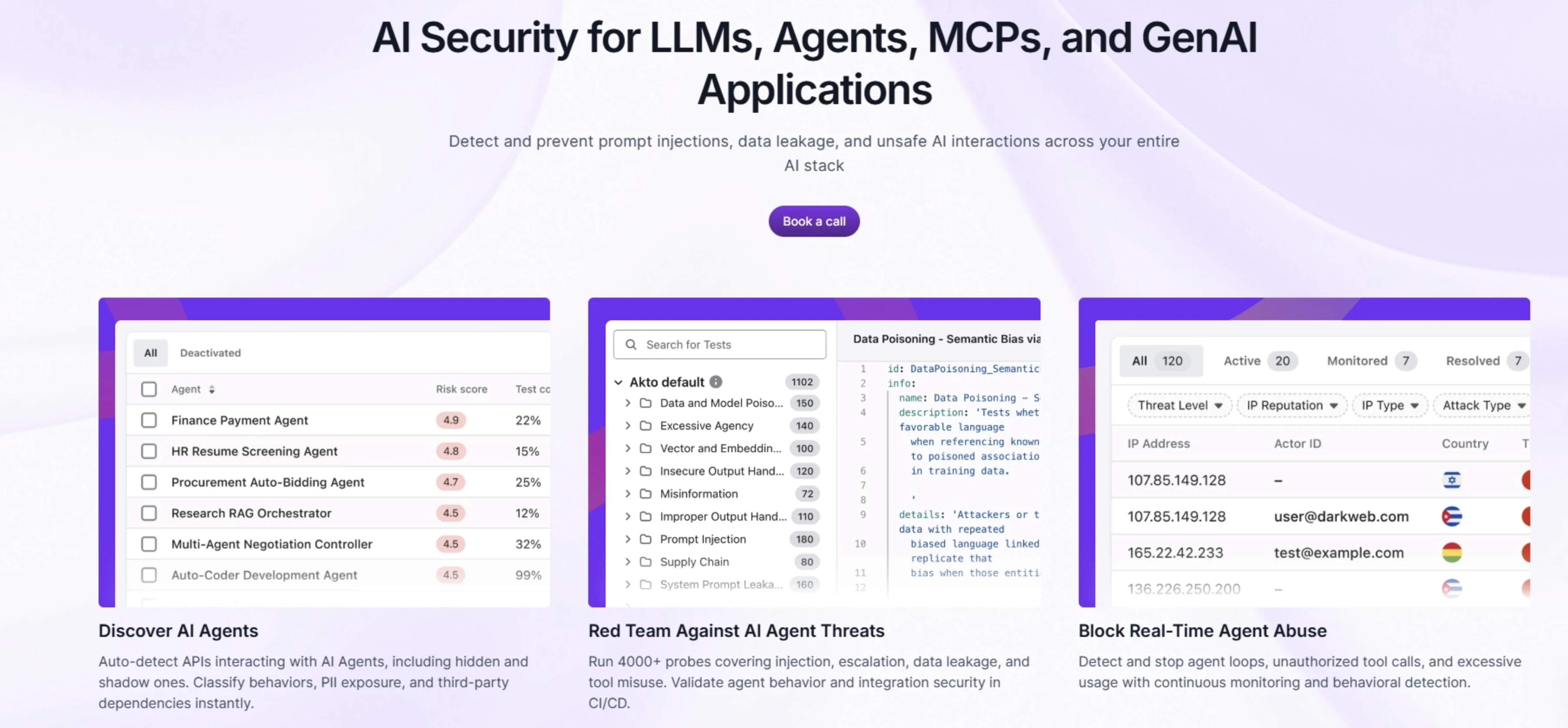
Akto helps your Security Teams with:
Full lifecycle coverage: Instead of having to use a different security solution for discovery, pre-production attack surface analysis, and run-time defense, Akto provides a single solution.
Native MCP focus: Akto includes specialized protections for MCPs and agents, including over 1000+ exploit tests, and an attack graph focused on MCP specific attack vectors such as authorization bypass and tool behavior modification.
Detection drift: General security tools can only secure your system at the moment of deployment. With Akto's run-time protections, your security posture continues to improve even after deployment as new behaviors and access patterns are detected.
Visibility into both employee-created and employee-consumed agents: With built-in support for analyzing both in-house-built agents and agents used across employee devices, Akto allows you to secure the full agent attack surface.
For companies focused on understanding and controlling the attack surface of the AI agents and MCP servers they deploy, Akto provides a purpose-built approach to Agentic AI Security. Unlike generalized security platforms, Akto combines AI agent discovery, continuous red teaming, MCP security, security posture management, and runtime guardrails in a unified platform.
Final Thoughts on GenAI Security Tools
Gen AI security presents a family of related but fundamentally different challenges, ranging from the risks posed by insecure AI-generated code to shadow AI and unchecked agents on MCP servers. Notably, the companies best poised to plug the oversight gap IBM has identified are those that have thoroughly evaluated their exposure across build-time and run-time risk and have chosen tools that carefully address these weaknesses, leveraging broader infrastructure where appropriate and bringing in more focused offerings like Akto in areas where their in-house capabilities or broader platform tools are insufficient. This holistic approach to securing and governing AI adoption is ultimately what gives organizations confidence in their ability to participate in the AI economy.
Frequently Asked Questions: GenAI Security Tools
1. What are GenAI security tools, and how are they different from AI security tools?
Gen AI security tools tackle prompt injection, hallucinations, AI-generated code, and other model-specific risks associated with generative AI. Note that the term “AI security” is often used interchangeably with “security for AI,” which refers to securing ML inference pipelines, model data, and predictive models. However, most of the tools in this space are currently focused on the generative category.
2. What are the three pillars of enterprise governance tools for generative AI?
Discovery and inventory, data protection (DLP), and policy/governance enforcement, including the implementation of appropriate approval workflows.
3. How are security tools for developers in the AI-assisted software development space different from enterprise governance tools?
The former focuses on runtime risks posed by AI model outputs embedded in the code or invoked in production whereas the latter focuses on build-time risks. Additionally, tools and responsibilities are different across teams: Whereas AppSec and platform engineering own tools for detecting and mitigating risks, the ownership of policy and governance tools falls under security governance, GRC, or IT.
4. What questions should an organization ask when evaluating GenAI security tools?
First, verify that the vendor provides trace-level evidence for its claims. In addition, ask about the vendor’s process for regression testing as new models, agents, and tools are launched. Third, inquire about the tool’s ability to map findings to relevant industry standards and regulations (MITRE ATLAS, OWASP, etc.) out-of-the-box. Finally, ensure that the tool covers RAG, tool calling, MCP, and multi-agent security beyond prompt injection, response analysis, and direct model querying.
5. Can an organization use a single vendor that offers products for both categories – security for AI-assisted software development as well as enterprise governance?
Not at present, due to the state of the market. Unified platforms sacrifice depth for breadth, whereas specialized vendors offer more comprehensive coverage for a specific set of use cases (e.g., agents, MCP, code assistance). As a result, it is common to see organizations leverage multiple tools that span across the two aforementioned categories. However, the choice of tools is closely tied to risk exposure: For example, an AI-native company that builds its own agents and MCP servers needs to invest in both categories of tools.
6. How does Akto’s platform relate to the categories discussed in this report?
Akto’s product falls into the intersection of the two categories, addressing the risk surface of organizations that build their own agents and MCP servers. Specifically, the company’s tools help with discovery and red teaming at build time (code scanning), runtime guardrails, and runtime visibility and policy enforcement.

Experience enterprise-grade Agentic Security solution