AI Governance Guardrails: Closing the Ownership Gap Between Policy and Enforcement
Why AI governance policies fail without enforced guardrails - the ownership gap between Legal, Security, and Compliance, and how to close it.

Rushali
2026 State of Agentic AI Security
How ready is your organization to secure AI agents?
3 quick questions. See how you compare to other security leaders.
Legal creates an acceptable-use policy. Security will be expected to whitelist what the models are doing. A product team, under a shipping deadline, wires an agent into a production system and ships. They all did their job, but nothing was linking the document to the deployment; no one was owning the handoff. That's the failure mode in most AI incidents, and that's why AI governance guardrails become either real guardrails or simply fade away. Governance without guardrails is a vision, not a reality: A policy that no system is required to follow is a memo, not a control. In this article, we'll discuss who owns that gap and how to close it. The technical aspects of each half can be found in Akto's agentic AI guardrails and AI governance, risk, and compliance guides.
Why Policy and Enforcement Keep Drifting Apart
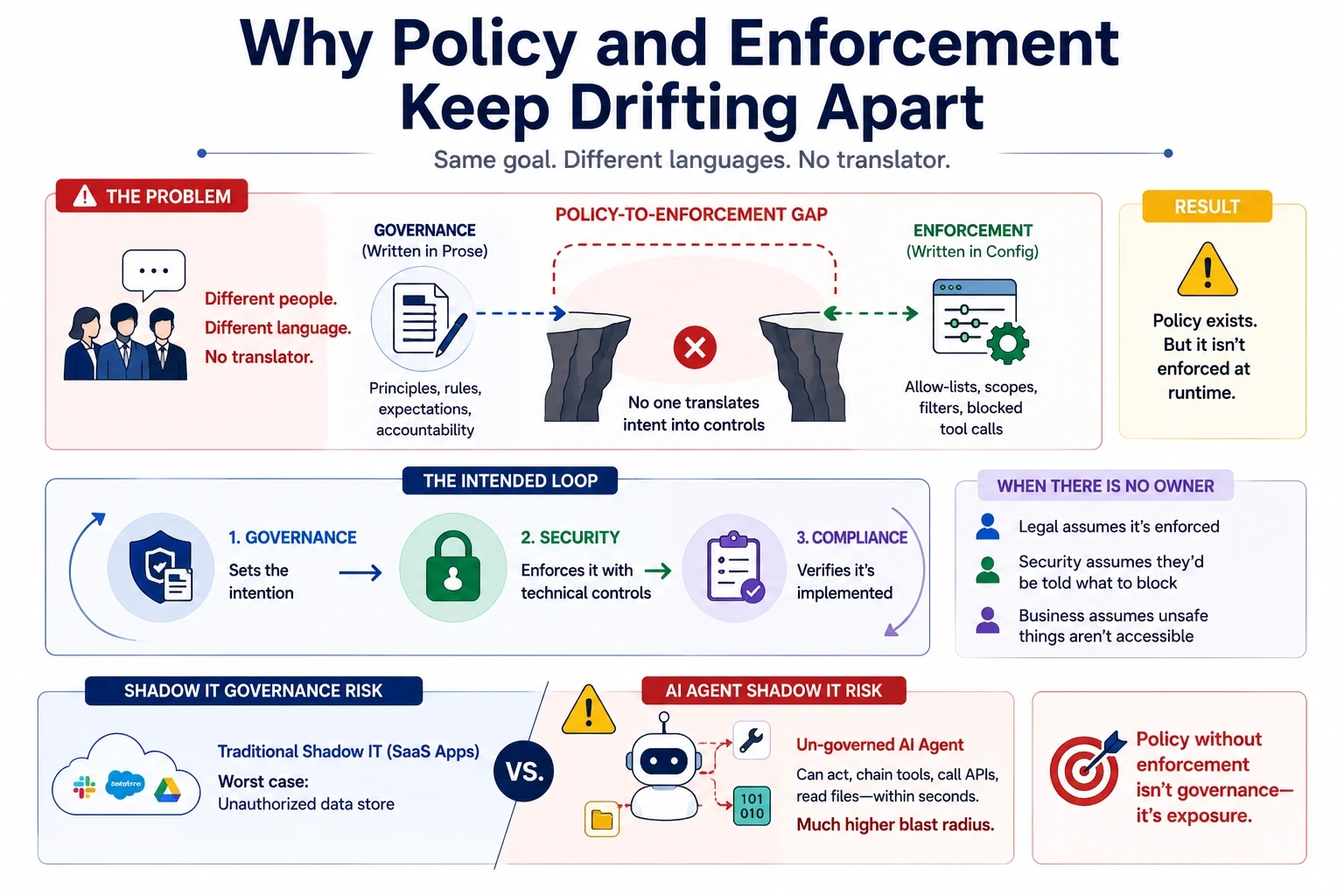
Governance and enforcement are written in different languages by different people, and no one is appointed to translate between them. Legal or Compliance writes governance as prose: principles, forbidden uses, data-handling expectations, accountability statements. Security and Engineering apply or don't apply that intent as configuration: allow-lists, scopes, filters, blocked tool calls. Between those two artifacts, there's a policy-to-enforcement gap because those that set the intent are not the ones that implement it, and those that implement it were not in the room when the intent was set.
The mechanic is simple when you say it: Governance sets the intention, the security teams make sure it is enforced with technical controls, then the compliance teams determine if it is being implemented as intended. If there is no single owner for that loop, each function assumes that another function is holding the other end in a reasonable manner. Legal assumes that the policy it published is in effect. Security assumes the following: If something is not allowed, Legal would tell them exactly what and where to block it. The business makes the assumption that if there were something dangerous, it wouldn't be available to connect with, since it's connected.
This is the essence of the shadow IT governance ownership issue, and it differs from common shadow IT. The most common problem is that policy and enforcement become separated in the case of SaaS apps – the worst outcome is an unauthorized data store. If the ungoverned thing is an AI agent, it can act on a live system, chain tools, call APIs, and read files in the seconds between prompt and response if they are separated from each other. The "Policy vs. Enforcement" argument over AI is not really philosophical but practical; either there's no policy at runtime, or there's a policy, and the policy isn't enforced at runtime.
The Cost of Governance That Stays on Paper
Operational governance now comes up directly in breach data as the cost of governance on paper. Address how few organizations have gotten into enforcement in the first place. Ivanti's 2026 State of Cybersecurity Report reveals that 50% of organizations report that they have no formal guardrails in place to guide them on how to use AI systems and agents – half of organizations use AI on intent alone.
This visibility below that number is not as great as one would think from the guardrail gap. 71% of security leaders report that AI systems have access to the core business platforms (ERP, CRM and financial systems) and only 16% control that access effectively, finding that 92% have no visibility into AI system identities. You can't police what you can't see.
It's here that the invisible nature of Shadow AI focuses. According to Kong's 2026 AI governance analysis, based on Microsoft's Work Trend Index, 78% of all AI users in the workplace use their own private tools without authorization, while only 34% of organizations have a formal shadow-AI detection program. The majority of AI use occurs outside of regulated pathways, and the typical organization doesn't have a systematic approach to identifying it.
The breach data then completes the circle. IBM's 2025 Cost of a Data Breach Report revealed that 97% of organizations impacted by an AI security incident hadn't implemented AI access controls, while 63% had no AI governance policy whatsoever; of those that did have an AI governance policy, just 34% audited for unsanctioned AI. Shadow AI estimated that it contributed about $670,000 to the average breach, and was responsible for one in five breaches. Combined, this data about an AI access control breach says something specific: it is not just about missing policies; it's about a policy that was never connected to an enforced control at the point where data and actions are leaving the organization.
Where Governance Actually Has to Operate
Enforcement lives between policy and agents: policy is written in a document, and agents are in production. The point-of-action principle is simple: If a control is not on the path the agent takes, it doesn't count. If there's a "do not expose customer PII to third-party models" clause that regulates nothing until something inspects the outbound request and stops it. Point-of-action enforcement is when the call, prompt, and response are made, not during the quarterly review of what has already occurred.
There are two enforcement surfaces, and governance needs to go to both of them. The first is the approval process: who is allowed to go live by the agent, model, or MCP server, and what it can access, and what scope it can. The second is runtime: during runtime, a guardrail checks every prompt, response, and tool call against policy and prevents them. Approval chains with runtime enforcement create agents that are safe at launch and drift, while runtime enforcement without approval chains creates controls without any policy behind them.
The benefits of decentralizing the governance to the point of action can be quantified. Those that integrated controls directly into their AI systems were 25% less likely to have incidents compared to those with manual governance, according to IBM's Institute for Business Value. The reason is mechanical – manual governance implies someone should look, and more things to look at mean more people should be looking. Machine-speed runtime guardrail policy enforcement checks are automatic on each call. That's what the layer platforms like Akto work with, checking violations and unsafe actions for each prompt, response, and tool call as they are happening, not after they've finished.
Defining Ownership Across Four Roles
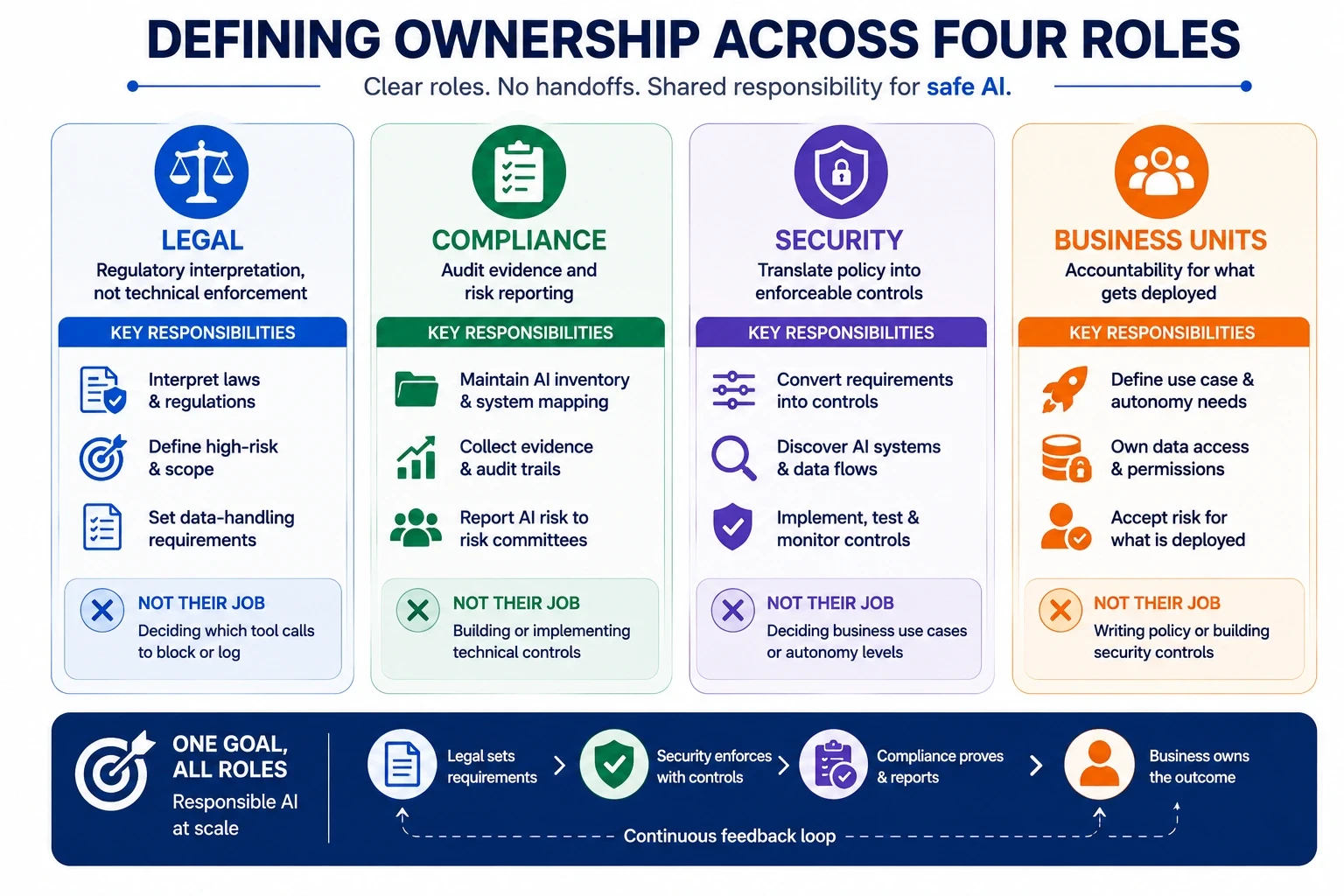
It's not just about finding a single "AI owner" that would be able to close the ownership gap. It ends by explicitly outlining what the four functions that impact all AI deployments are responsible for doing, eliminating handoffs. The beauty of a framework of governance guardrails based on Legal, Security, and Compliance ownership is that each of these roles does what they can, and no one is secretly responsible for tasks that they can't do.
Legal: Regulatory Interpretation, Not Technical Enforcement
Legal's responsibility is to make the external requirement become an internal requirement: which regulations are applicable, what "high-risk" means for this system, which data-handling clause does what. It is the responsibility of legal to determine the scope of the EU AI Act and to determine whether a particular use case is subject to a fundamental rights assessment. It is not the person's responsibility to make the decision on whether or not a specific tool call is to be blocked or logged by a guardrail; it's up to the enforcement officer. The mode of failure is one that is like a law. Retaining personal data is NOT a control as part of the system, but rather an input to Security. Ownership here means that the requirements are so accurate that Security can implement them without having to guess.
Compliance: Audit Evidence and Risk Committee Reporting
Compliance owns proof. It is not the control itself, but the evidence that the control exists, is applied, and is demonstrable to a regulator, auditor, or the board. In reality, it involves having to keep the AI stock, tracking each system to its duties, and creating audit trails that will stand up to the test. Compliance is also the department that brings AI risk into risk committee AI governance conversations, from "the agent can call this tool" to "this is an exposure the board can consider". Sixty-two percent of boards reported having regular discussions about AI within their meetings, but just 27 percent reported having AI governance in the charters of their committees; most boards discuss AI without a committee oversight. Compliance is responsible for filling that void.
Security: Translating Policy into Enforceable Controls
Where intent turns to configuration is security. It owns the mapping of a written requirement to a specific testable control: this scope, this allow-list, this guardrail set to block rather than log, this tool disabled for this agent. Security also owns discovery; you can only apply a control to a system you've discovered, and that's what happened at the bottom of IBM's announcement that 97 percent of those breached with AI were missing access controls. The discipline is do not allow intent as an implementation. When it comes to “minimize sensitive-data exposure,” Legal delivers that as a handout to Security, which translates it into enforcement at a named point on the request path, and being straight with them about what it can't yet enforce. This role can most directly make or break a policy's AI risk ownership accountability since it is the only role that can do any actual work.
Business Units: Accountability for What Gets Deployed
The team that sends the agent carries the risk that it introduces. Governance is what becomes of a deployment if business-unit accountability is missing. In reality, when the product owner joins an agent to a production system, he/she assumes responsibility for scope, data access, and behavior and cannot shift this responsibility by submitting a ticket to Security. Gartner's advice is to remember it's not governance versus "trusted" or "blocked," but to differentiate by how autonomous they are, since a summarization tool and an action-executing agent have very different risk. Knowing for any specific business unit what a given agent will be used for and how much autonomy it requires is a business unit's sole prerogative.
A Cross-Functional Guardrail Review Process
Even if ownership is assigned across four roles, it still fails if the roles have yet to meet before the start of the game. It's a single shared sign-off process, a pre-deployment review of the guardrails that simultaneously conducts governance and enforcement, rather than two processes. The answer to whether it helps is simple. Would the incident have been caught if it had been shipped before this review? If the answer is no, the review is theater.
A viable cross-functional AI governance review will have some gates, and one rule: no output to production until every owner crosses their t's and d's. Business states its purpose and its needs for autonomy. The rules are confirmed by law. Security is the measures that have been implemented, not the ones that were envisioned, but the ones that were set up and stress-tested under real attack scenarios. Compliance verifies that an evidence trail is present. The beauty of the review is, that it brings the authors of the policy and the person configuring the guardrail to the same conversation, to the same person, in the same place, at the same time before it gets deployed into a live system.
This is not a governance track that is slotted into a governance track. So many organizations execute them independently, as two have two distinct tools: governance is in a GRC tool while enforcement is in a security platform, and they only reconcile during an audit, which is much after deployment. Suddenly, that distance is cut down, and a pre-deployment guardrail review will also generate the artifact Compliance demands: a dated, signed record that the controls were reviewed and enforced prior to launch, the evidence regulators are starting to demand.
The Regulatory Pressure Making This Non-Optional
No longer a maturity nicety, this becomes a requirement, as regulators and buyers now require enforced controls, rather than documented intentions. The EU AI Act went into general application on 2 August 2026, meaning that the transparency obligations, enforcement powers for general-purpose AI and full penalty regime are now in effect. The Digital Omnibus (Regulation (EU) 2026/1744, which will enter into effect on 2 December 2027) will push the most stringent obligations, those that are separate from the product, to 2 December 2027, and product-integrated systems will be forthcoming in 2028. The practitioner point is not for the work itself, but for the deferral of the deadline. The documentation that may be required in 2027 will be of designs that are being designed (ie, being developed) in the system currently being shipped and will cost several times as much to recreate as to record as it is being designed. Penalties are higher than GDPR's – up to €35 million or 7% of global turnover for prohibited practices, €15 million or 3% of most other breaches.
The second form of pressure is commercial instead of legal pressure, as ISO/IEC 42001, the first certifiable AI management system standard, does. As SOC 2 became table stakes to SaaS 10 years ago, it is expected to become a procurement signal in the coming years. Financial services and healthcare buyers were leading the way in the EU, with 40% of enterprise AI vendor RFPs including the requirement “Are you ISO 42001 certified?” by mid-2026, while buyers across North America were following at a distance with 25% of RFPs mentioning the certification, according to the data ExamCert compiled. A certificate provides proof to the procurement that the supervision of AI is systematic – without auditing the vendor, that is, the vendor loses it silently in the dark.
It is also pressure from within. By 2027, Gartner estimates that 40% of enterprises will be demoting or decommissioning autonomous AI agents because of governance gaps that appear after they are deployed, but should have been identified in a pre-deployment review. With a live penalty system, a procurement filter, and a predicted ramp-up of agent rollbacks, it's more expensive to leave it on paper now.
How This Differs From Your Guardrails and GRC Guides
This page is designed to focus on ownership and accountability, who is responsible for putting policy into practice as a compulsory control, and where the handoffs fall. It is not a guide to the construction of guardrails, or to the organization of a GRC program. Those are other issues, if they were covered here then the argument at stake would be lost, the reason the mechanics don't work is nobody owns the seam between the policy and the control.
Read the agentic AI guardrails guide to learn how content, tool, PII, and code-execution guardrails are used to prevent prompt injection, jailbreaks, and data leakage in the technical half. Read the AI GRC guide for the program half: governance, risk, compliance, and a continuous feedback loop. This article is the glue between them: the layer of accountability that determines whether they are in operation.
How Akto Operationalizes Governance as Enforced Guardrails
All of the issues discussed in this article- invisible shadow AI, no access controls, no policy at runtime are signs of a lack of governance to get to action. That gap can be bridged by operationalizing AI governance, and Akto is designed to do so, as the sole AI agent security platform with a single loop: discover, map, test, govern, and enforce.
It begins with a missing visibility that is assumed in the ownership model, which is not held by most organizations. Akto automatically identifies and catalogs AI agents, LLMs, and MCP tools across infrastructure, cloud, and employee endpoints, including shadow AI endpoints, and maps the relationship between agents, tools, prompts, permissions, and resources. That inventory makes a policy enforceable, and it addresses the 97% of people who aren't finding access to systems: You can't scope access to systems you haven't found. On enforcement, Akto runs the guardrails inline at runtime, at both the content and policy level (prompt injection, intent violation), PII and secrets filtering, tool guardrails (misuse, malicious invocation), and code-execution controls, all of which can be configured to either block or log. The pre-deployment review gets teeth with continuous red teaming, a cross-functional review that confirms controls hold up under real-world attack scenarios prior to launch, and posture management brings to the fore the over-permissioned tools and policy gaps that the review should include. Reporting and audit trails that correspond to regulatory pressure frameworks such as MITRE ATLAS, CIS Controls, and CMMC provide evidence that Compliance owns.
Final Thoughts on AI Governance Guardrails
The one change that needs to be made is to stop running governance and guardrails as separate tracks running on separate teams and to designate one accountable owner of the handoff point between written policy and enforced control (enforced when agents act). All the failures that this article pointed out go back to that seam. Discovery was not governed in the Kong and IBM data, since no one owned it; the 97 percent without access controls had intent but no enforcement, and agents that Gartner hopes to be rolled back will be missing governance in production. Automatic discovery of agents, LLMs, and MCP tools like shadow AI and runtime guards that block violations before they are completed, posture management that validates controls before launching, and red team and audit-ready reporting for Compliance make seam operation as Akto. That is a guardrail on AI governance, rather than a desire to be one. To see it on your own stack, book an Agentic security demo with Akto.
FAQs: AI Governance Guardrails
What's the difference between AI governance and AI guardrails?
Governance is the policy layer, the structure of who is responsible for the development of AI, its deployment, how it's managed and supervised, and the like. Guardrails are the runtime layer – technical controls that ensure the system remains within the boundaries. Governance establishes the intent, and guardrails ensure that it follows it. Without guardrails, governance is a document no system has to follow.
Why does AI governance often fail even when a policy exists on paper?
There is no policy wired to an enforced control at the point where AI acts. The data is never exposed until a written rule is implemented that inspects each outbound request and blocks any violations. According to IBM's 2025 data, 97% of those who were victims of an AI breach didn't have adequate AI access controls, which is an intent, but without enforcement. The failure is at the seam between policy and control.
Who should own AI governance - Legal, Security, Compliance, or the business unit?
All four; each has a different role. Legal clarifies which rules apply and translates them into the requirements. Audit evidence and board reporting is the responsibility of compliance. Security maps requirements and turns them into enforced and tested controls. The business unit that is going to send the agent carries the risk that it creates. The gap narrows when each role performs only their role, and someone is responsible for the handoffs.
What percentage of organizations currently have formal AI guardrails in place?
About half. Only 50% reported having formal guardrails for the deployment of AI systems and agents, as per the Ivanti 2026 State of Cybersecurity Report, with the rest using AI based on written intent only.
Why do shadow AI tools proliferate even when a governance policy exists?
Policies don't provide visibility, and you can't govern what you can't see. According to Kong's 2026 analysis, 78% of AI users in the workplace are unauthorized users, while just 34% of organizations run a formal shadow-AI detection program. So employees are quicker to adopt AI than the approvals go, and in the absence of discovery tooling, the policy never makes it to the tools the people use.
What does it mean for governance to "operate where AI systems actually run"?
Enforcement occurs at the moment of action, the moment of reaction, or the moment of the tool call, in real time, as this is happening, not at a document or in a periodic review. A control counts if it is located on the path that the agent is taking. Organizations that intentionally integrate controls into their AI systems have 25% fewer incidents than those that can only review AI systems at runtime, as runtime checks happen automatically on every call, not post-hoc with human eyes.
What should a cross-functional guardrail review process look like before deployment?
One sign-off gate prior to production: each owner signs off for their responsibility: the business states what the agent is doing and what it is in control of; Legal confirms obligations; Security confirms configured and tested controls; Compliance confirms evidence trail. The question to consider is, would the review have detected an existing incident prior to flight?
How does the EU AI Act's August 2026 deadline affect AI governance requirements?
The Act came into general application on 2 August 2026, which meant that the transparency obligations, the enforcement powers of the GPAI and the full penalty regime (up to €35 million or 7% of turnover worldwide for prohibited practices) were triggered. The Digital Omnibus postponed the heaviest standalone high-risk work to December '27, but the documents due at the time are for systems shipping today, so no activity has shifted.
Is ISO 42001 certification becoming a requirement for AI vendors and buyers?
More or less yes, it is commercial, not legal. Just like SOC 2 became a signal for SaaS, ISO/IEC 42001, the first certifiable AI management system standard, is gaining traction as a signal for procuring AI systems. The number of financial services and healthcare buyers leading the pack is estimated by ExamCert to be around 40% of EU enterprise AI vendor RFPs and approximately 25% in North America by mid-2026.
How does Akto turn governance policy into enforced, runtime guardrails?
Akto is an AI Agent Security platform that operates the discover-map-test-govern-enforce loop. It automatically identifies AI agents, LLMs, and MCP tools on infrastructure, cloud, and endpoints, such as shadow AI, and connects their relationships. Then it applies guardrails inline (at the proxy via an MCP and at the endpoint) to prevent prompt injection, PII and secrets, misuse of tools, and code execution, with each of these guardrails being blocked or logged. Continuous red teaming and posture management ensure controls are validated prior to launch; audit-ready reporting provides the evidence for Compliance.

Experience enterprise-grade Agentic Security solution