What is AI Governance, Risk and Compliance (AI GRC)? Frameworks and Best Practices
Learn AI Governance, Risk, and Compliance (AI GRC), including frameworks, controls, regulations, risk management strategies, and implementation best practices.

Bhagyashree
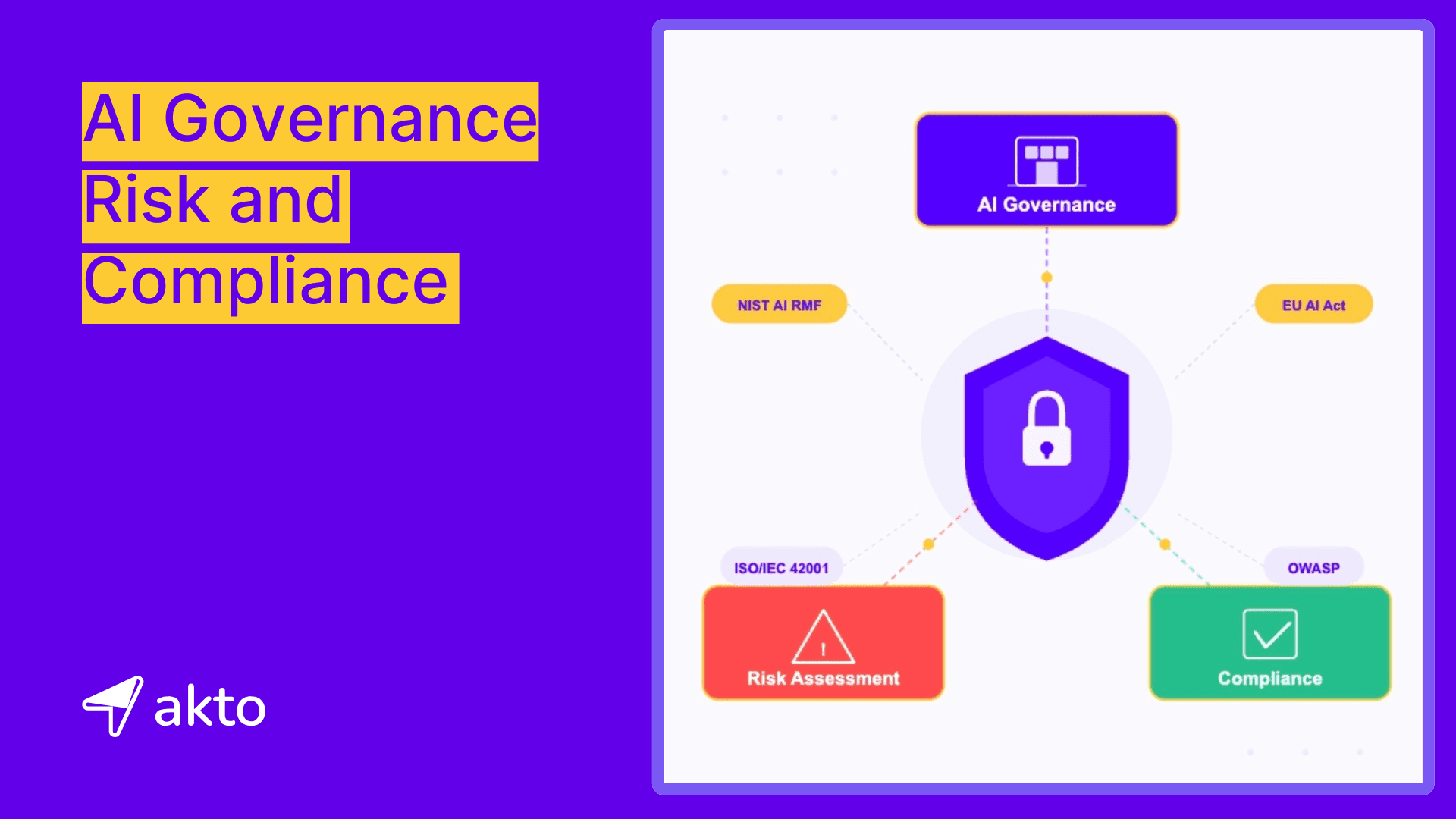
AI Governance risk and compliance is a framework for developing and deploying AI systems in a most ethical and responsible way. Governance defines the policies and accountability. Risk captures and mitigates AI-specific threats. Compliance ensures AI regulatory standards are met with documented proof.
Furthermore, governance establishes the intent and security teams implement them through technical controls and compliance validates if the intent matches or not. If compliance finds a gap, it spirals back into governance to improve policies and vice versa. Together they form a synergy of continuous feedback loop and never a one time checklist.
In this blog, we will explore what is AI governance risk and compliance and best practices to integrate AI GRC into SDLC and DevOps.
What are the Core Concepts of AI Governance, Risk, and Compliance (AI GRC)?
Here’s an overview of core concepts of AI Governance, Agentic AI Risk mangement and Compliance.
AI Governance
AI Governance refers framework of processes, policies and oversight mechanism that guides how AI systems are designed, developed and used within an organization. It allows accountability by properly defining who is responsible for the decisions made by AI systems, while also integrating ethical principles like fairness, transparency and reliability. Governance covers entire lifecycle right from data collection to to deployment and monitoring that ensured systems functioned as intended and match with organizational goals and societal expectations. Overall, it creates a structured environment where the AI can work responsibly and consistently.
AI Risk Management
AI Risk management aims at finding, analyzing and mitigating risk that comes from the use of AI systems. These risks can include prompt injections, biased outputs, wrong predictions, data privacy breaches and unintended actions that could impact users or businesses. The process involves systematically analyzing potential threats, to implement controls or minimize their impact and continuously monitor systems to identify new or evolving risks. Unlike traditional risk management, AI risk management must also address the challenge like model drift, lack of Explainability, and dependency on data quality. In then, it ensures AI systems stay safe, reliable and aligned with expected outcomes.
AI Compliance
AI regulatory compliance includes ensuring that AI systems follow applicable laws, regulations and industry standards throughout their lifecycle. This includes following the data protection frameworks such as GDPR and evolving AI-specific regulations like the EU AI Act. Compliance needs proper documentation, audit trails and transparency in how the AI models are built and used along with a mechanism to showcase accountability. It also makes sure that organization meets ethical and legal expectations, to avoid penalties and reputational damage. In easy terms, AI compliance ensures that AI systems are not just effective but also ethically and legally accepted.
Why AI GRC is Different from Traditional GRC?
Now that we know the core concepts, here is a breakdown on why AI GRC is different and has an edge over traditional GRC.
From periodic to real-time governance: traditional GRC depends on scheduled audits and retrospective reviews. AI changes this into continuous, real-time oversight where the risks, anomalies and control failures are captured quickly rather than on quarterly basis.
Reactive to predictive risk management: traditional GRC systems mainly document controls, compliance and audits status. AI-powered predictive capabilities, capturing early signals of new risks before they cause consequences.
Static risk models to adaptive systems: traditional GRC assumes stable, rule-based environments. AI systems continuously learns and keep changing which requires continuous validation and adaptive governance frameworks.
Systems of record to insight: traditional GRC systems primarily documented controls, audits and compliance status. AI-driven GRC systems analyze large data sets to generate actionable insights, to allow faster and smarter decisions.
Manual mapping to intelligent automation: mapping regulations to controls in traditional GRC is manual and time-intensive. AI uses the techniques such as NLP to automatically interpret regulations and match them with the controls which accelerates speed and the accuracy.
Siloed oversight to integrated intelligence: traditional GRC often operates in silos across the risk, audit teams, and compliance. AI-driven GRC embeds data across functions, which lets enterprise-wide visibility and co-ordination.
Deterministic systems Vs dynamic outputs: In traditional GRC, deterministic systems allow predictable, rule - based compliance decisions, dynamic outputs utilize probabilistic AI, adapting to context but requiring governance, monitoring and risk controls for auditability and consistency.
How to Build an AI Governance, Risk and Compliance (AI GRC) Framework
AI GRC definitely edges out the traditional frameworks. But implementing them needs a right strategy. Here are some of the effective ways to create a solid AI Governance frameworks to maintain AI security posture for security teams.
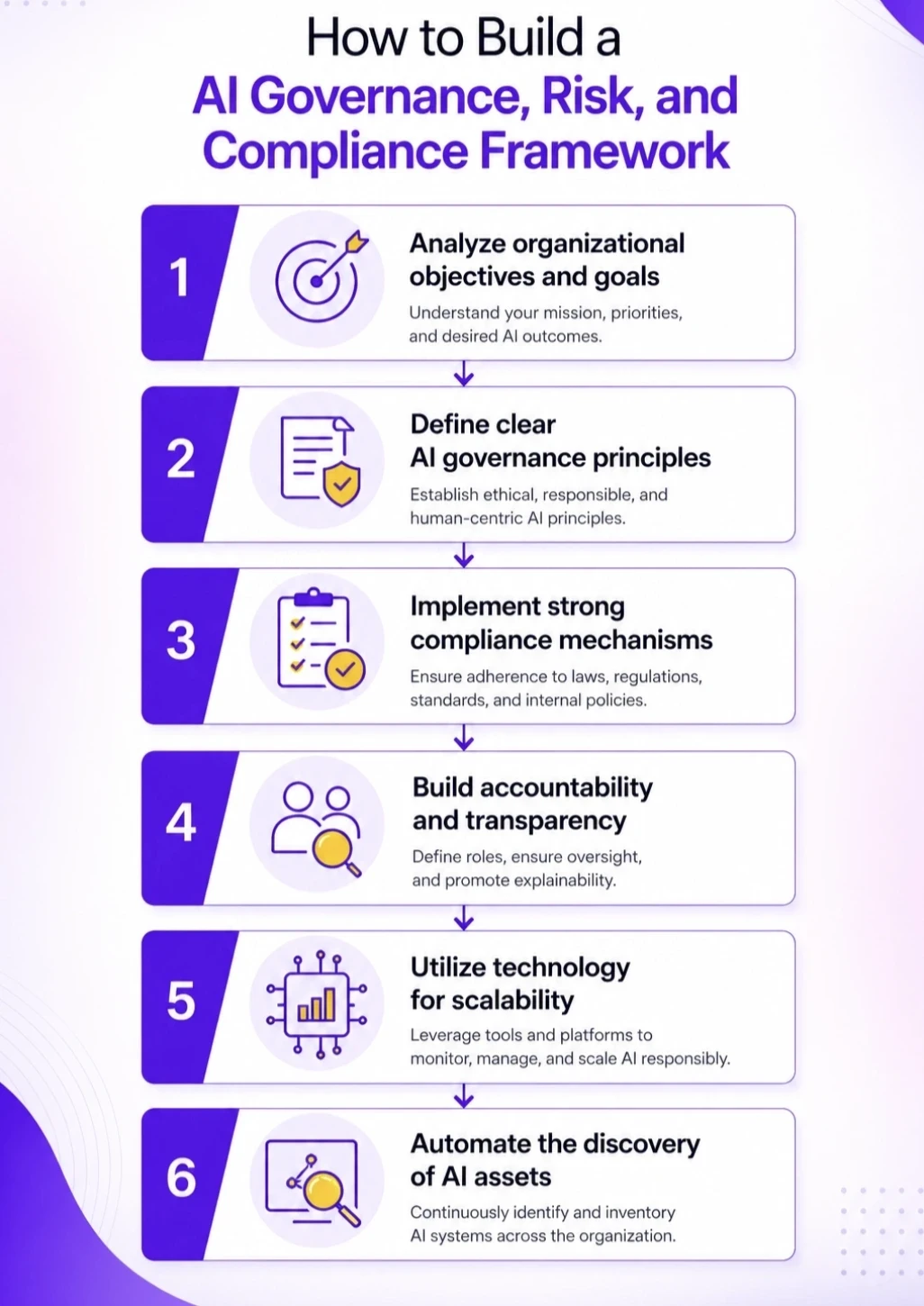
Analyze Organizational Objectives and Goals
Align the GRC framework with company’s goals by knowing its risk appetite, business processes and compliance obligations. Perform a risk assessment to identify and prioritize vulnerabilities by impact and likelihood. Prepare a KPIs to measure how well the framework conducts against business objectives.
Define Clear AI Governance Principles
Start by setting a governance structure that describes roles, responsibilities and decision making processes for AI initiatives. Create a principles which addresses fairness, transparency, accountability and privacy. For example, ensure AI systems avoid bias and respect user data.
It includes cross-functional leaders from IT, legal, compliance and businesses units to constantly oversee AI strategy and match with organizational objectives. Create clear policies on AI development, deployment and monitor to provide a consistent framework for teams.
Implement strong compliance mechanisms
Compliance is an essential part of AI GRC framework. To remain ahead utilize tools such as explainable AI (XAI) to make model decisions transparent and auditable. Deploy the systems to continuously monitor AI performance, flagging malicious patterns or non-compliance in real time.
Regularly train employees on AI ethics, compliance requirements and risk management to encourage culture of responsibility.
Build accountability and transparency
Create trust by making accountability and transparency core to your framework. Maintain detailed records of AI model development, training data and decision making process for audits and reviews. Properly communicate AI’s main goal, features and challenges to employees, customers and regulators. Create channels for stakeholders to report concerns on AI systems to enable continuous improvement.
Utilize technology for scalability
Use technology to simplify and scale AI GRC efforts. Implement tools that can automate risk assessments, compliance checks, and performance monitoring. Align with industry standards such as ISO/IEC 42001 for AI management systems to ensure scalability and consistency. Continuously refine the framework to adapt to new AI innovations and regulatory updates.
Automate the discovery of AI assets
Automated discovery continuously identifies AI models, datasets, tools and agents creating a centralized real-time inventory. It also maps dependencies across the systems, infrastructure and data pipelines which ensures complete visibility. This allows risk tracking, impact analysis and proper governance that helps organization manage compliance, control and accountability.
Operationalizing AI GRC with Technical Controls
Here’s a breakdown of operationalizing AI GRC with technical controls.
Automatic Guardrails and Red Teaming
AI red teaming should be performed to identify vulnerabilities, biases and malicious behaviors. Along with this, prompt injection testing should be done to find manipulation risks in inputs and model responses. We should deploy runtime guardrails for agents to ensure outputs remain safer, compliant and aligned with defined policies in real time.
Security Controls for AI systems
Enforce role based access and least privilege, and ensure only authorized users interact with AI systems. Implement data protection mechanisms like masking, encryption and safeguard pipelines and sensitive data. We implement policy enforcement directly into AI workflows which enables real time compliance, auditability and controls the model behavior.
AI Governance Risk Compliance Frameworks and Regulations
AI compliance comprises of more than just new regulations. Comprehensive compliance means maintaining security with regulations and frameworks such as GDPR even as AI innovations emerge.
NIST AI Risk Management Framework
The NIST AI Risk management framework assist in organizing AI governance into 4 main functions such as Govern, Map, Measure and Manage. It helps security teams enable a proper balance of innovation with risk and prepare documentation of trustworthy AI practices.
OECD AI Framework
The OECD AI Framework is an inter-governmental standard for human based trustworthy AI and to address safety and misinformation. They guide security teams to embrace AI that respects human rights, democratic values and sustainability. Besides this, it also helps in promoting transparency, innovation and accountability.
The US AI Bill of Rights
The US AI Bill of Rights provides guidance to prevent AI systems from compromising privacy and civil rights which highlights 5 fundamental principles for responsible technology such as safety, transparency, algorithmic protection, data privacy and human alternatives.
The European Union AI Act
The act applies to organizations that are marketing, developing or using AI within European Union. This framework classifies AI systems as high risk, prohibited, limited-risk or minimal risk and implements obligations accordingly. It is also used to categorize cases by risk, standup conformity assessment evidence, map supplier and system controls and prepare incident reporting.
General Data Protection Regulation (GDPR)
The GDPR demands that for any specific purpose, only the minimal and necessary data should be used. AI mechanisms need to stringently follow this to avoid any manipulation or over collection of unnecessary data. Besides this, data collect for one purpose should not be repurposed without additional consent.
How to Effectively Integrate AI GRC into the SDLC and DevOps
Here’s a breakdown on how to implement AI governance risk framework into software development lifecycle and DevOps.
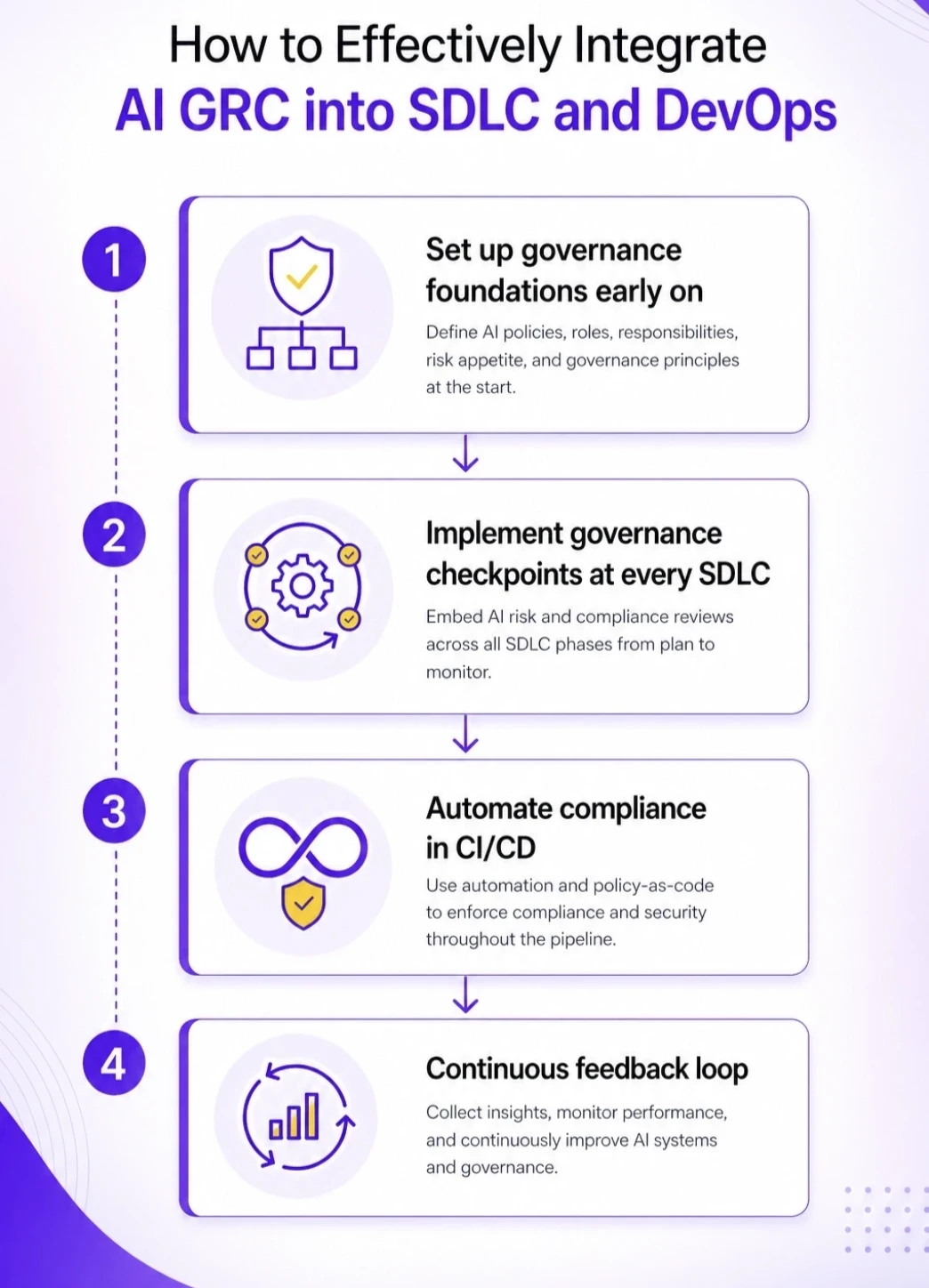
1. Set up governance foundations early on
The common mistake is attempting to automate compliance before governance is present. Before touching any pipeline, these 3 things should be in place; An AI risk register is a inventory of every AI system or use case in the company with a risk classification, the data it processes and residual risk tracking. An AI policy library documented rules covering the recognized and approved use cases, restricted patterns, data handling requirements and third party usage constraints. Besides this, a clear ownership of all AI systems and AI agents which needs a risk owner, GRC liaison and developer.
2. Implement governance checkpoints at every SDLC
Governance should not just be a single audit at the end of the lifecycle. Each phase change should need require a documented compliance checkpoint before work progresses. At plan, the team should assign a risk class to AI use case and obtain approval to proceed. At design, a threat model needs to be completed and data lineage mapped where does training data come from, where does the output go. Then develop secure coding review and dependency scanning needs to pass. Furthermore, test bias and fairness tests, adversarial testing, and explainability verification should be documented. Finally during the release a formal compliance sign off is required before the promotion to production.
3. Automate compliance in CI/CD
Every governance rule need to run automatically on every commit and build. Besides this, these four checks matter the most they are policy as code enforcement, using OPA/Rego, SBOM and dependency scanning for model supply chains, data lineage tracking and automated regulatory mapping against the EU AI Act, NIST AI RMF and ISO 42001. Furthermore, failed checks need to block the pipeline with an clear reason where warning only checks create false assurance and get ignored.
4. Continuous feedback loop
Governance does not end at deployment. Monitor the live systems for model drift, false outputs, and policy violations in production. Automatic alerts need to trigger risk register updates and re evaluate when the thresholds are breached. For high risk systems create automatic rollback so a drifting model reverts without any manual deployment process closes the loop between documented real time performance and governance.
Future of AI Governance, Risk, and Compliance (AI GRC)
Looking ahead, here is what the future looks like for AI in GRC
Real time compliance monitoring - AI may enable continuous compliance monitoring, detecting and addressing non-compliance issues instantly.
AI-powered compliance automation - Organizations could implement AI-driven compliance solutions on a large scale to ensure effortless regulatory compliance across multiple regions.
AI governance and regulatory advancements - AI governance continues to evolve with regulatory bodies implementing stricter AI compliance laws. Business need to stay proactive in aligning and adapting to theses.
Final Thoughts: Bridging Governance, Risk and Technical Controls
AI governance, risk and compliance really effective, you need tight alignment between policy, engineering and everyday operations.
Governance cannot just live in the documentation, it has to translate into enforceable technical controls and measurable workflows. Regular AI risk management becomes very important as models improves, the data shifts and new threats start coming into the picture.
By implementing security, compliance and monitoring into the development and deployment lifecycle, you create systems which are not only compliant but also resilient. The goal is to build a scalable AI GRC frameworks which can adopt to production environments where the automation , real time visibility and proactive risk mitigation are important. This is how Akto. io helps bridge the gap in governance intent into actionable enforceable controls.
Important Links

Experience enterprise-grade Agentic Security solution