AI Red Teaming Coverage Matrix for Vendor Evaluation
Use this AI Red Teaming Coverage Matrix to compare security vendors across attack coverage, AI agent security, runtime guardrails, compliance, and testing.

Rushali

All AI security vendors promise to perform red teaming these days. After a while, the pitches start to merge together: Once and for all, it is sure to be the solution for prompt injection, jailbreaking, and securing your agents. The trouble is, a product with the same claim can have a difference of 10-fold in the measurements it actually tests. One is a collection of a few canned prompt-injection strings. Another simulates multi-step agent takeovers throughout the MCP-connected tools. Both refer to it as AI red teaming.
But that's expensive when you're signing a contract. An AI Red Teaming Coverage Matrix eliminates that jargon by presenting the data in a matrix format: coverage of which attack categories, depth of coverage, whether the platform validates controls at runtime, and how it reports findings. The matrix provides you with one consistent yardstick when you're comparing one AI red team platform or selecting a handful of LLM red teaming tools. In this guide, you'll find the categories, a template matrix that you can use again and again, a scoring model, the 12 questions you should ask, and the things that lie behind a well-crafted list of features.
What is an AI Red Team Coverage Matrix?
An AI red team coverage matrix is a tool that helps to assess AI security vendors by analyzing the testing breadth and depth. It covers prompt injection, jailbreaks, agentic AI attacks, MCP security, tool abuse, guardrail validation, and compliance needs.
Why AI Red Teaming Vendor Evaluation Is Getting Harder
The Expansion of Agentic AI
Two years ago, landing an LLM involved trying out a chatbot's responses. Today they read the tickets, ask questions of the databases, call the APIs, and run the various tools to complete the task on their own. New ability equals new attack surface, and testing to cover that surface grows quicker than most testing processes have kept up. AI red teaming vendor evaluation is now a different game, one that requires more than the traditional checklist; autonomous behavior now matters, too.
New AI Attack Surfaces
Threat catalog grew with the technology. The first was prompted injection. Indirect Prompt Injection through Poisoned Documents, Tool Abuse, Agent-to-Agent Escalation, MCP Authorization Failure, and Retrieval Poisoning all came later. Most of these exist in the interconnections between the components and not in any one component's output; therefore, a platform designed to test one model at a time can't observe them.
Why Feature Lists Are Not Enough
If a vendor has a checkbox for prompt injection, they're telling you about what it does. It doesn't explain what it means that it's for three test strings or three thousand testing strings or whether the testing is for the testing attack of an agentic AI that is going to compromise production systems. Vendors are increasingly touting very general capabilities under the umbrella of “broad” AI red teaming, while only addressing a limited number of categories of attacks, and the feature list is used to camouflage this. A list can't express coverage depth, and it's the thing that matters.
What Is an AI Red Teaming Coverage Matrix?
Definition and Purpose
A coverage matrix is a matrix that shows all the attack types that should be tested across the dimensions that make an attack valuable in the real world: depth, automation, runtime validation, and reporting. It makes a sales interaction a quantifiable comparison. Rather than asking a vendor about red teaming, you inquire about how extensive they are in each category, and then you can compare answers by vendor.
Coverage vs Capability
Capability is whether or not a platform can conduct a type of test. Coverage refers to the extent that it accomplishes this for the entire repertoire of techniques in that category. A tool may be able to test jailbreaks, but only the more common ones. The matrix is there to bring that difference to the fore-the capability without coverage provides a false sense of security until that attacker uses the technique your vendor didn't test for.
Why Security Teams Need a Structured Evaluation Framework
If there is no framework, it will be demo polish and the biggest claims. This is where an AI Red Teaming assessment comes in to take the edge off such bias. It requires all vendors to go through the same filter; it identifies their weaknesses and creates something you can present to leadership and auditors. In order to meet third-party evaluation scrutiny, it's a question of structure or guesswork for an AI security vendor evaluation that must stand the test of time. The only way a like-for-like comparison of AI red teaming platforms is possible is by measuring AI security testing coverage the same way for all.
Core Categories Every AI Red Teaming Platform Should Cover
The rows of this matrix are the following 10 categories. A platform covering just the first two or three is testing a fraction of actual exposure.
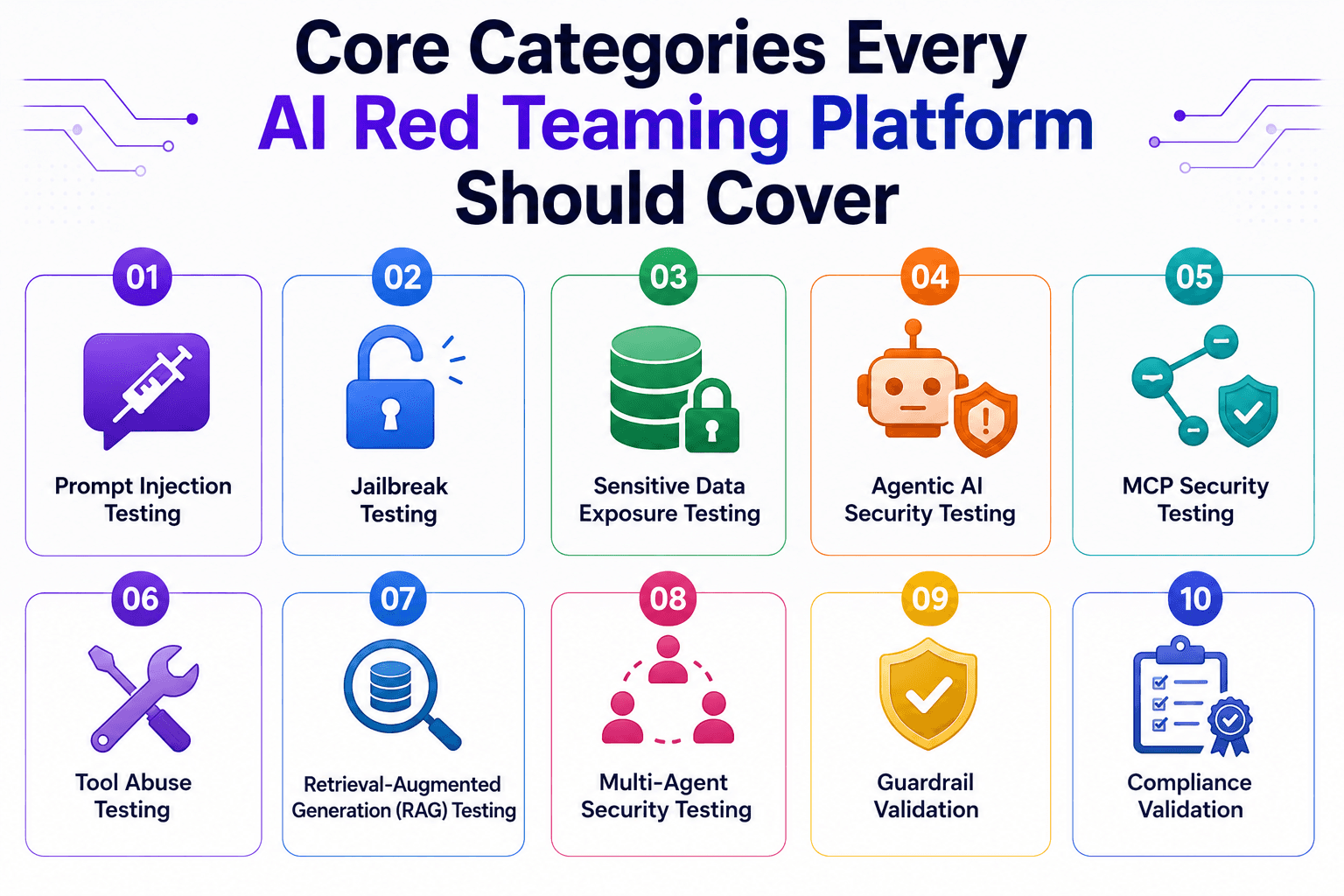
Prompt Injection Testing
Prompt injection is the prevalent type of attack for an AI system, and prompt injection testing cannot be limited to direct attempts. Strong coverage includes:
Direct prompt injection, which is an attempt by the user input to supplant the system prompt.
Indirect prompt injection: Documents, web pages, or data that the agent processes and contain malicious instructions.
Multi-turn prompt manipulation, which involves an attacker working toward a goal over several exchanges, instead of just one.
The majority of platforms neglect this aspect, as there is a need to test the agent's entire data flow and not only its chat input, which is a feature called indirect prompt injection.
Jailbreak Testing
The testing of jailbreak is the heart of model security testing, which checks if a model's safety controls can be bypassed. Safety bypass attempts are attempts to play with the system to get non-approved content; policy evasion attempts are attempts to use a request in a different way to bypass a policy, and adversarial prompting involves encoding or role-playing the request to trick the system around guardrails. The platform testing a set number of known jailbreaks fails to account for the variants that attackers create every day.
Sensitive Data Exposure Testing
Agents work with sensitive and controlled information; leakage testing is crucial. Coverage should include PII leakage (exposures of personal data in the model), secrets exposure (when credentials or keys are exposed in the output), and context leakage (where data from one user or session leaks into another). Data exfiltration testing verifies if an attacker can get any of this by sending specially designed inputs.
Agentic AI Security Testing
That's the one that most legacy tools fail to address. Agentic AI security testing looks at what an agent does, rather than what it says. Coverage is of attacks against the agent's decision loop, such as unauthorized use by the agent outside the intended use, changing the goal of the agent to an attacker's goal, and conditions where the attacker takes control of the agent's decision loop. It is a crucial element of autonomous agent security, and it is a critical missing link.
MCP Security Testing
Model Context Protocol servers are an easy target because they act as brokers for access to tools and data by an agent. The security testing of a tool in MCP should include: Poisoning the tool description with a malicious one that fools the agent, allowing the server to give an agent access it wouldn't give to another one, giving the agent more reach than their task requires, and confusing the agent into using its legitimate access on an attacker's behalf.
Tool Abuse Testing
If agents have access to tools, then those tools are an attack vector. Tool abuse testing tests for unauthorized calling of tools (tool invocations outside of the tool's scope of function), excessive privilege (using privileges beyond what's supposed to be used by the agent), and workflow manipulation (a sequence of tool calls that leads to a harmful action by the attacker). This falls under the category of MCP testing, although it is applicable to any tool utilizing an agent.
Retrieval-Augmented Generation (RAG) Testing
RAG systems integrate external knowledge into the context of the model, and that pipeline can be poisoned. Retrieval poisoning, knowledge base manipulation, and context contamination are malicious content inserted where it would be retrieved, manipulation of the knowledge base, and contamination of the context. The absence of RAG testing leaves one of the most direct paths for indirect prompt injection unblocked.
Multi-Agent Security Testing
Testing in single-agent systems does not detect the risks of systems that coordinate multiple agents. Multi-agent security testing includes such issues as agent-to-agent abuse (when multiple agents abuse each other); trust boundary violations (when an agent trusts the input of a second agent too much); and cross-agent escalation (when an attack on one agent cascades through the others). This category becomes required as multi-agent architectures proliferate.
Guardrail Validation
AI guardrails are only as effective as how they are enforced, so it's important to test whether they're actually effective. Policy enforcement testing verifies that rules prevent actions that they should, runtime control validation validates rules against guardrails in running systems, and action restrictions ensure that an agent is not allowed to perform actions that are forbidden. If a guardrail is in theory but not in practice, it is worse than none, since it gives false confidence.
Compliance Validation
Evidence is becoming more and more required for regulators in testing. Compliance validation maps red teaming findings to controls: EU AI Act controls for high-risk systems, ISO 42001 controls for AI management systems and NIST AI RMF controls for risk governance. This changes the nature of adversarial testing to evidence of compliance, instead of a separate work stream.
AI Red Teaming Coverage Matrix Template
Each category is ranked on four dimensions in the matrix. Coverage Depth: reflects how much of the category is covered. The concept of automation is a continuous or manual setup test. Runtime Validation – Does the platform validate controls in production? The quality of the evidence produced is reported. Score each cell Good, Fair, Poor for each vendor.
Category | Coverage Depth | Automation | Runtime Validation | Reporting |
Prompt Injection | ||||
Jailbreaks | ||||
MCP Security | ||||
Agentic Security | ||||
RAG Security | ||||
Guardrails | ||||
Compliance |
The matrix has been used for the two vendors, making thin coverage virtually impossible to hide. A vendor that is very good with prompt injection and blank in all the other columns mentioned is a prompt-injection scanner with an AI red teaming label. The most valuable tool you can take to a vendor comparison is this AI testing coverage matrix.
12 Questions to Ask AI Red Teaming Vendors
Do You Support Agentic AI Testing?
Do they test agent decisions and loops on the platform, or only their model output? The solution differentiates between real agentic coverage and chatbot testing.
Can You Test MCP-Based Systems?
When the vendor's agents use MCP, the vendor is responsible for testing the paths of tool poisoning, authorization, and confused deputy. Many cannot.
How Many Attack Categories Are Covered?
Be specific, not a headline number, in your push for the above 10 categories. When questioned by category, answers to breadth collapse.
Do You Validate Runtime Controls?
Identifying a weakness is one thing. Another is to confirm it is blocked by guardrails in Production. Ask which they do.
Is Testing Continuous or Point-in-Time?
You can only assess once, and that age no longer applies when your agents and prompts change. Inquire if testing is scheduled or it's done when it's necessary.
How Deep Is Your Prompt Injection Coverage?
Deny direct, indirect, and multi-turn. An honest signal of depth is indirect injection coverage.
Do You Test Multi-Agent Systems?
If you have coordinating agents, inquire about agent-to-agent abuse and cross-agent escalation specifically.
How Do You Handle False Positives?
The team can't hear each other if there's too much noise. Inquire about the platform's prioritization and validation of results.
What Does Your Reporting Look Like?
Ask to see a sample report. An auditor/executive could read about matters more than the testing itself.
Do You Map to Compliance Frameworks?
Do you have findings that relate to the EU AI Act, ISO 42001, or NIST AI RMF, or do you gather those on your own?
How Do You Integrate With Our Stack?
If you don't test in your CI/CD and cloud environment, it will not be used. Verify the integrations required.
How Often Is Your Attack Library Updated?
There are new attack methods emerging all the time. Inquire about updates to the vendor's probes against new threats.
Common Gaps Found in AI Red Teaming Platforms
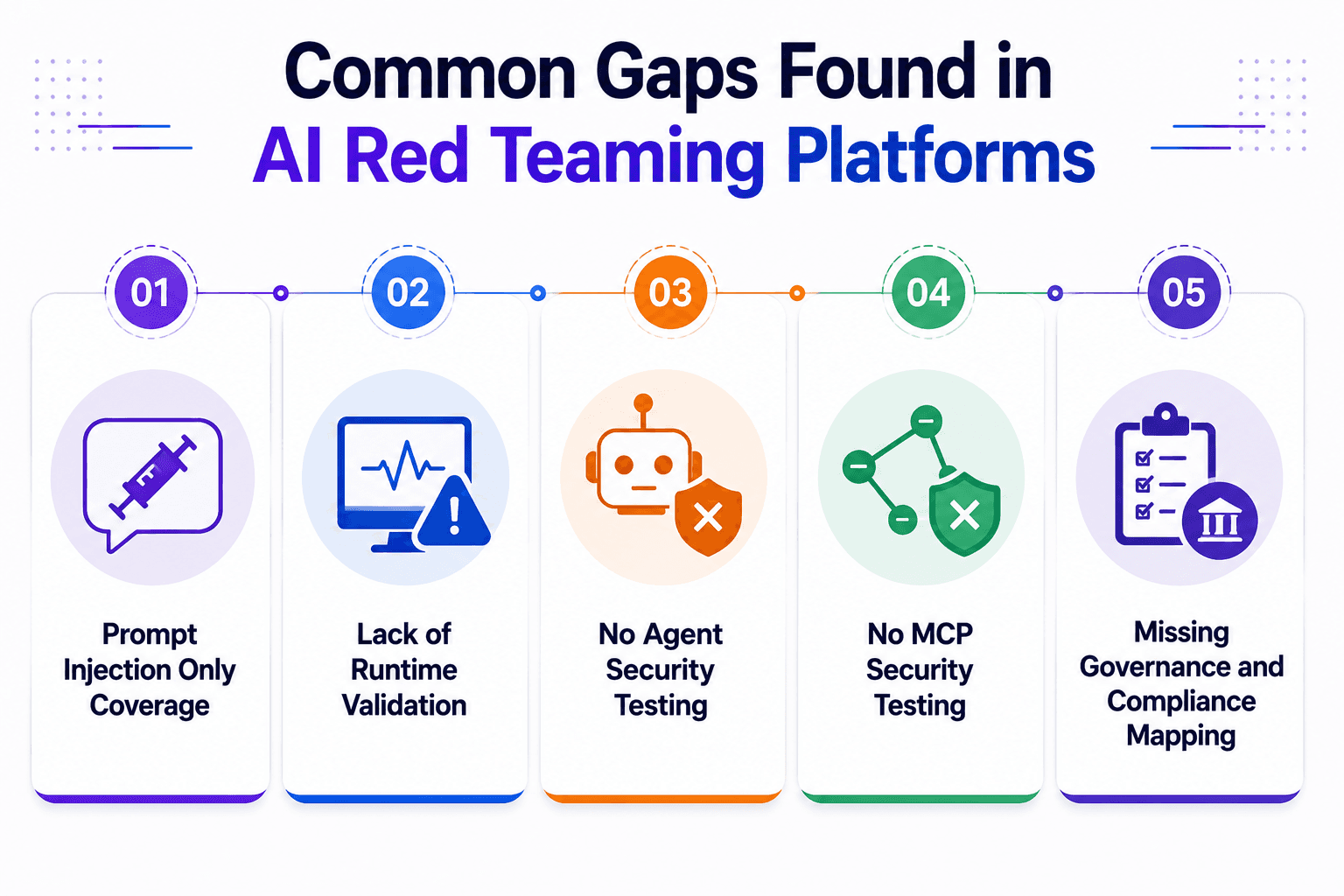
Prompt Injection Only Coverage
The most common deficiency is a platform that only does prompt injection. It seems at least viable in demo, due to the fact that none of the agentic or MCP categories are populated.
Lack of Runtime Validation
There are many tools that can detect flaws in a test harness, but fail to verify if a production control is interfering with such flaws. If there's no runtime security testing, you only discover a vulnerability, not if you are vulnerable to it today.
No Agent Security Testing
Platforms designed for the LLM era typically lack an understanding of agent actions. They test what a model says but halt there and never test anything else: unauthorized actions, agent takeover.
No MCP Security Testing
MCP is fairly new and therefore has not received coverage by many vendors. With an architecture that's based on MCP servers, this hole essentially exposes the broker to all your agent access.
Missing Governance and Compliance Mapping
Other platforms generate results that aren't related to your frameworks. The testing might be correct, but you've got to pass it on to translation into compliance evidence, and that's a time-consuming process for every audit.
How to Score AI Red Teaming Vendors
A weighted score converts the matrix into one comparable score, but retains the priorities. Modify the weights according to your environment and rate each vendor from 1-5 on each area and multiply.
Area | Weight |
Attack Coverage | 25% |
Agentic AI Testing | 20% |
Runtime Validation | 15% |
Automation | 15% |
Compliance Mapping | 10% |
Reporting | 10% |
Integrations | 5% |
The most important ones are attack coverage and agentic testing since they are the main sources of actual risk for agent-based systems. Runtime validation and automation indicate whether the test continues to safeguard you following sale. A vendor that performs very well on attack coverage and very poorly on agentic testing and runtime validation is working on last year's issue, and that will be reflected in the weighting.
AI Red Teaming Coverage Matrix for Enterprise Requirements
Each team reads the matrix through a different lens, and a good evaluation takes these all into consideration.
Security Teams
Attack coverage is the most critical factor to security teams, as is runtime validation. They must be certain that all of the tools are tested and that any known tools that are weak are tied to controls they can address. Depth within both the agentic and MCP categories is a given for them.
AI Governance Teams
Governance teams ask questions around the oversight of autonomous systems to be supported by testing. They desire coverage that shows that agents work within policy and evidence that the program is in place and operates on an everyday basis, and not just once a year.
Compliance Teams
The compliance teams read the matrix for the purpose of framework mapping. They focus on whether findings can be easily translated into EU AI Act, ISO 42001, and NIST AI RMF evidence, and therefore audits are based on existing artifacts rather than new projects.
Platform Engineering Teams
Automation and integrations are considered by platform teams. Without manual overhead, testing should be a part of the CI/CD pipelines and cloud environments or it will not be used. They may consider a platform's fit with the current stack more important than getting a bit more coverage.
Beyond Red Teaming: Why Runtime Validation Matters
The red teaming of a program and runtime validation are different questions, and they are needed together to complete a program. Red teaming exercises vulnerabilities by attacking your system, informing you what can go wrong. When it counts, runtime security confirms that your controls are indeed effective at preventing those attacks in the real world. The first is discovery. The second is proof.
Continuous testing completes the loop, measuring continuous risk in the changing environment. The AI adversarial testing experiment of January tells little of March because agents change, prompts change, and new tools link in. An adversarial testing + runtime validation + continuous execution platform provides an up-to-date AI risk assessment. This is the boundary where the testing tool ends and the security platform begins, and it's where the toughest evaluation should be done.
Building a Comprehensive AI Security Testing Program
Red teaming is not the building block of AI security. The suite of capabilities in a program that protects agents in production reinforces each other. Runtime monitoring monitors agent activity in real-time and detects misuse that is not handled by pre-deployment tests. AI guardrails take effect when the action is performed, preventing the prohibited action from going through. Agent discovery keeps track of all agents and MCP servers: You can't test or protect what you don't know. MCP security allows you to control access to the layer brokering agent. Compliance validation connects all of it to the frameworks upon which you report.
This system is fed by "red teaming", which is the process of searching for the weaknesses that the other layers must handle, while "runtime validation" is the process used to determine that those layers do handle the weaknesses. If red teaming is given as a standalone activity, it will create a report. It is integrated into a program and provides continuous security control coverage that is updated alongside your agents.
How Akto Supports Comprehensive AI Security Testing
Akto, recognized by Gartner as a representative vendor for AI agent security, created its platform around these categories and launched one of the first integrated MCP security solutions. It is meant to fill the agentic and runtime columns, which most tools lack.
Agentic AI Security Testing
Run automated red teaming against AI agents, MCP servers, and LLMs with Akto's Agent Probe, simulating prompt injection, tool poisoning, context leakage, and privilege escalation. This is testing of the actions of an agent and decision loops, not just the model output.
MCP Security Validation
As Akto was designed to run with MCP, it tests the broker layer directly – tool poisoning, denied permissions, etc., in the path of connected tools. It finds MCP servers and agents on cloud infrastructure, employee endpoints, and even in the shadow deployments that are not captured by manual inventories.
Continuous AI Security Testing
Akto does not perform tests at a single point in time, but continuously, so that coverage can be updated with agents, prompts, and tools. Turning a static report into a continuous measure of risk, reflecting the environment today, requires continuous execution.
Runtime Guardrail Validation
An agentic proxy of the guardrails is implemented by Akto, which applies least-privilege controls and blocks risky actions before execution with the help of the MCPs and agents. Combining adversarial testing with runtime enforcement ensures that guardrails are effective at runtime when under attack, bringing together the discovery of a vulnerability and the confirmation that you are safe.
Compliance Reporting
Results map to governance structures; Save security and compliance teams the time they would otherwise spend compiling compliance evidence for EU AI Act, ISO 42001, and NIST AI RMF reviews.
Final Thoughts
A coverage matrix is the quickest method to recognize beyond the exact same sounding pitches to the testing that really safeguards your agents. Score each vendor on each of the 10 categories and four dimensions, and then determine what is important to your environment, and the thin players will become thin. The vendors that make sense within your budget include agentic AI, runtime control validation, constant operation, and providing you with compliance evidence as opposed to a laundry list of findings.
Designed for that standard, Akto integrates agentic and MCP red teaming, testing all the time, enforcing runtime guardrails, and reporting compliance in a single platform. If you're comparing the matrix with your shortlist, check out how Akto scores by scheduling an AI Security demo.

Experience enterprise-grade Agentic Security solution