AI Risk Assessment Tools: How to Identify, Evaluate, and Mitigate AI Risks in 2026
Discover how AI risk assessment tools evaluate AI security, compliance, governance, privacy, and operational risks for enterprise AI systems.

Bhagyashree
General purpose AI can assist in enabling security threats by identifying vulnerabilities and writing code to exploit them. Attackers are proactively using AI in their sophisticated operations. This is how AI has shifted security risk from more attacks to more advanced attacks at large scale.
An AI Risk assessment is designed to be highly dynamic exercise that keeps evolving to the AI landscape and its unique needs of the business themselves. It not only helps identify the relevant risks an organization may be subject to but helps in the development of strategies meant for mitigating these risks.
This blog explore what is risk assessment tool, how to evaluate them and best practices.
“AI risks is ranked #2 with adoption going rapidly than governance, regulation and workforce readiness can keep up.” - Allianz risk barometer
What is a Risk Assessment Tool
AI Risk assessment tool is a structured methodology which analyzes AI systems not just for technical bugs, but the whole set of risks they introduce such as discriminatory outputs, regulatory non-compliance, safety incidents, data privacy failures and reputational damage.
This tool maps what is source of the data, how it flows, audits models outputs for bias and consistency which identifies issues in governance documentation, compliance with regulatory exposure such as GDPR, EU AI Act, HIPAA etc., and generates audit-ready reports for stakeholders.
Security testing asks “can this model be exploited ?” Risk assessment asks more exhaustive question “should this be deployed”, and under what conditions?” Security is just one input into risk assessment and not a replacement for it. A model can pass all the security tests and can still experience compliance, fairness or societal risks.
Why AI Risk Assessment Matters in 2026
AI risk assessment has moved from a mere technical concern to a fundamental business and governance. Here is why AI risk assessment matters:
Evolving Regulatory Requirements: Governments across the world are adopting much more stricter AI rules and regulations at present. These rules and regulations mandate security teams to capture, document and remediate AI-related risks before any implementation.
Safeguards Against Security Threats: AI applications experience risks like data leakage, prompt injection, model manipulation and unauthorized access which makes proactive risk assessment essential.
Increase of Autonomous Agents and Its Risks: AI systems are rapidly making decisions and performing actions independently which results in increase of vulnerabilities related to security, reliability and accountability.
Prevent Harmful Outputs: Risk assessments help security teams to find potential risks such as bias, misinformation, toxicity, and unsafe recommendations before they impact users.
Helps Maintain Trust: AI failures can significantly hamper customer trust if their outcomes result in security threats. Thus, continuous risk assessments helps ensure responsible AI behavior and secures organizational credibility.
Enables Stable and Reliable Business Operations: Capturing operational risks at the early stage reduces downtime, inaccurate outputs, workflow disruptions and expensive incidents that affects business performance.
Assists in Responsible AI Implementation: Risk assessment offers a structured framework to implement AI securely and enable innovation while maintaining compliance, security and ethical standards.
Protects Sensitive Data: AI systems often process business and customer information. Assessing risks helps in preventing privacy violations and compliance failures.
How Does an AI Risk Assessment Tool Work?
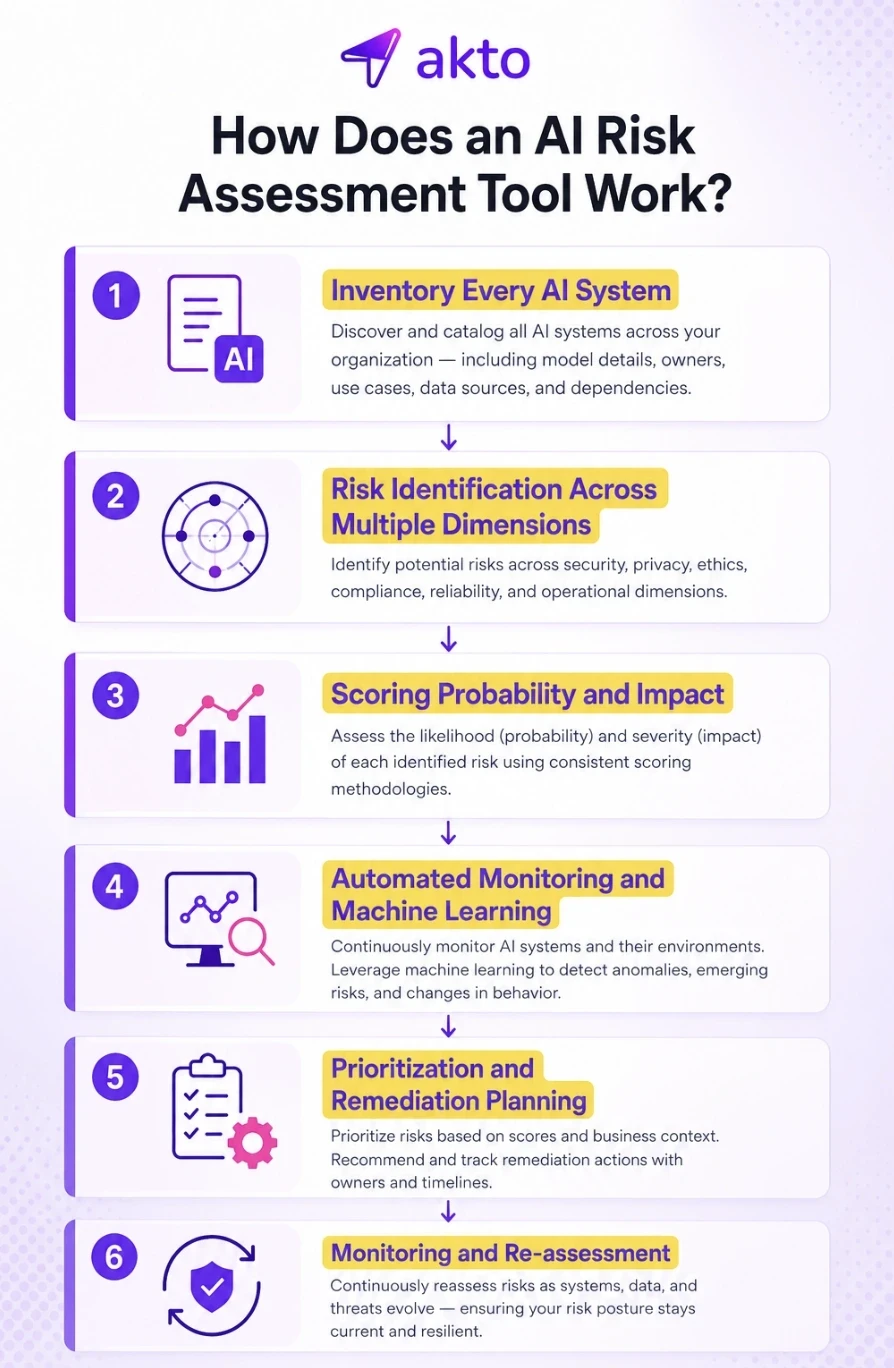
AI Risk Assessment tool is not just a button you press, it is a systematic and continuous system that moves through so many steps. Here’s a breakdown on how it works:
Inventory Every AI System
Security teams starts by listing all the AI systems in use, which includes those that might be hiding in shadow IT setups. The next step consists of mapping stakeholders and areas of effect, to document everyone’s role in the Responsible accountable consulted informed (RACI) matrix to show how they communicate with the systems being reviewed.
Identify Risks Across Multiple Dimensions
AI Risk assessment evaluate ethical, technical and regulatory dimensions simultaneously - it assesses not only whether a model performs accurately, but also whether it behaves responsibly when faced with ambiguous or adversarial input. Teams capture potential risks such as regulatory violations, cybersecurity incidents, contract disputes, operational failures or financial misrepresentation.
Scores Probability and Impact
Teams analyze the probability, risk level and potential impact of each issue often using qualitative scales, quantitative models, or machine learning based methodologies. This stage may involve reviewing training data, datasets and outputs from AI models to identify high-risk patterns. AI risks must not be assessed in isolation as they communicate with each other. A technically accurate system can create reputational risk if it functions opaquely and legally compliant system can still create risk if nobody understands how to use it properly.
Automatically Monitors and Deploys Machine Learning
Risks assessment tools often implement machine learning algorithms to evaluate historical data and predict future security events, which allows for dynamic risk assessments. They allow organizations to identify critical assets, anticipate how threats could impact AI functions and prioritize remediation efforts based on severity of risks.
AI systems can improve over time through machine learning which allows for continuous refinement of risk models based on historical data and real-time assessments. As algorithms analyze more incidents and results, they start to become effective at predicting potential risks and recommend mitigation measures.
Prioritize and Plan for Remediation
Risks are prioritized based on business impact and remediated through technical or procedural controls. This process should be dynamic and not static - models change, environments change, and risks pops up. A model that is safe is one context may not be safe when combined with another system or exposed to unexpected input.
Remediation has multiple forms where it includes accuracy monitoring, adversarial testing, and fallback mechanisms, human-in-the-loop reviews, output verification and fallback mechanisms.
Continuously Monitor and Re-assess
When metrics breach thresholds, they ask for re-assessment. Lessons learned from incident reviews are applied back into the framework to ensure it evolves with organizations use of AI. The best platforms keep automating workflows, process real-time data, quantify risks, create reports and predict trends along with continuous monitoring.
What Risks Does AI Risk Assessment Tool Evaluate?
AI Risk Assessment tools evaluates the below category of risks namely:
Compliance and Regulatory Risks
Compliance and regulatory risks are significantly growing. AI systems have cybersecurity, privacy and regulatory compliance vulnerabilities, but they also introduce ethical concerns such as unintentional consequences like lack of trust, bias and discrimination.
Data Risks
Data risks spans across the entire data lifecycle. All the data that is processed by AI systems should have privacy, integrity and security built in from very beginning. If input is biased, skewed or distorted it follows through into results, which creates false or inaccurate information that can damage security teams performance.
Operational Risks
Operational risks are most often underestimated. Model drift is one of the most common performance degrades as real-world data digress from training data and this degradation goes undetected without the continuous monitoring. Other operational risks comprise of integration failures, lack of explain ability which affects debugging and reliance on external AI services.
Security Risks
Security risks are the most technically acute. These contain data leakage, adversarial attacks and model manipulation. But modern assessments go further, which covers prompt injection, model inversion attacks, and supply chain threats such as malicious ML models integrated in open-source dependencies.
How to Conduct an AI Risk Assessment Step by Step
Here’s a breakdown of 5 steps to conduct AI Risk assessment framework:
Step 1: Define the Scope and Objectives
Define what the AI systems are being evaluated for, why they are critical and who is responsible. A clearly defined objectives and scope focuses on monitoring high-risk systems, prevents wasted resources and sets up accountability across governance, technical and operational stakeholders.
Step 2: Inventory AI Systems and Risks
Create a centralized inventory of all AI systems that document goals, origin of data, ownership, lifecycle stage and dependencies. This visibility supports in identifying hidden risks, prioritize high risk systems and create a solid foundation for AI governance.
Step 3: Mitigate Risks based on Severity
Mitigate risks in order of high severity by assigning teams, mitigation plans and timelines. Add controls like access restrictions, audits, monitoring and encryptions while tracking progress through risk and performance indicators.
Step 4: Rank Risks
Analyze and focus risks based on the probability and impact including ethical and consequences related to reputation. Risk scoring and matrices can help identify issues exceed risk tolerance and guide resource allocation towards most critical AI vulnerabilities.
Step 5: Continuously Monitor
Implement continuous monitoring to find model drift, security threats, data exposure and bias. The continuous oversight lets risks to be found at the earliest, support governance and maintains long-term compliance, resilience and trust in AI systems.
“1% of organizations recognize they need to do put more efforts to reassure their customers that their data is being used only for intended and legitimate purposes in AI. “
- Cisco's 2024 Data Privacy Benchmark Study
AI Risk Assessment Frameworks and Standards
AI risk assessment frameworks are the basis for stringent adherence to effective implementation of AI security. Some of the important frameworks are:
Google's Secure AI Framework (SAIF)
Google's all round security framework is designed to handle AI system security through an extensive operational approach. SAIF integrates security measures across the entire AI pipeline, from data ingestion and model training to inference and monitoring phases. The framework focuses on secure-by-design principles which incorporates sophisticated encryption protocols, strong access controls, and real-time threat detection features. It manages system resilience through fault-tolerant architectures that maintain operational integrity even during security incidents or component failures. SAIF's adaptive security model keeps advancing the threat response mechanisms based on emerging attack patterns and performance metrics.
OWASP Top 10 for Large Language Models Framework
The Open Web Application Security Project (OWASP) has designed a specialized Top 10 list that focus on Large Language Model threats. It addresses new type of LLM security issues such as data poisoning, prompt injection attacks, model denial of service, and sensitive information disclosure through training data exposure. Apart from this, it acts as an extensive security audit platform which allows developers to systematically analyze LLM implementations against pre-established threat patterns. It prioritizes proper security integration throughout the development lifecycle, starting from initial model training to production deployment. Security teams can take advantage of this standardized approach to identify potential attack vectors and implement proper stringent security measures before vulnerabilities are exploited in live systems.
Framework for AI Cybersecurity Practices (FAICP)
Framework for AI Cybersecurity Practices (FAICP) is developed by the European Union Agency for Cybersecurity (ENISA). It offers lifecycle-oriented approach to AI security management. The framework starts with all round pre-deployment security risk assessment that analyzes potential security threats across different operational conditions and use cases. FAICP aims at integrating governance which requires security teams to set up dedicated oversight structures for AI security management.
The framework demands vigorous data quality checks, to discover potential bias sources and security vulnerabilities in training datasets. During the development phases it requires strict compliance to international security standards like ISO/IEC 23894. These standards makes sure there is consistent implementation of security controls across different development teams and projects. After the deployment, FAICP mandates to perform continuous security monitoring and regular security posture assessments to maintain system integrity.
NIST AI Risk Management Framework
The National Institute of Standards and Technology mandates a structured methodology for AI risk governance that goes above the conventional cybersecurity concerns. This framework addresses the various AI security risks such as fairness, accountability, transparency, and explainability along with security considerations.
The NIST strategy aims at stakeholder engagement and cross-functional team work in risk assessment activities. It offers systematic practices to document AI system behavior, establish performance baselines, and implement continuous monitoring protocols. Besides this, it also assists in regulatory compliance efforts while maintaining flexibility for wide spectrum of organizational contexts and AI application domains.
What Features Should an AI Risk Assessment Tool Include?
Here are the key features of an AI risk assessment:
Risk Identification and Cataloging
The tool automatically tests data pipelines, model outputs and system dependencies to identify risks. It organizes them into systematic taxonomy which includes ethical, technical, legal, operational and reputational categories with assistance for industry specific risks classifications.
Regulatory and Compliance Mapping
The AI risk assessment tool checks AI system behavior against frameworks such as EU AI Act, NIST AI RMF, ISO 42001 and GDPR. Automated gap analysis identifies gaps and suggests remediation steps, whereas a jurisdiction aware rules engine manages multi-region compliance obligations effectively.
Bias and Fairness Auditing
The tool detects demographic differences in model outputs using fairness metrics like equalized odds and demographic parity. Counterfactual analysis reveals hidden vulnerabilities by testing how the outputs change when protected attributes like age, gender, race are varied.
Risk Prioritization and Scoring
Risks are quantified using a likelihood versus the impact matrices and assigned severity tiers like critical, high, low, medium. Visual dashboards showcase scores whereas benchmarking against industry standards helps security teams understand their risk profile relative to regulatory thresholds.
Continuous Monitoring
Real time monitoring tracks data drift, and model performance decay that trigger alerts when thresholds are breached. Historical trend data and audit trails help the teams distinguish temporary fluctuations from systemic deterioration which informs timely decisions about retraining or decommissioning the models.
Best Practices for AI Risk Assessment
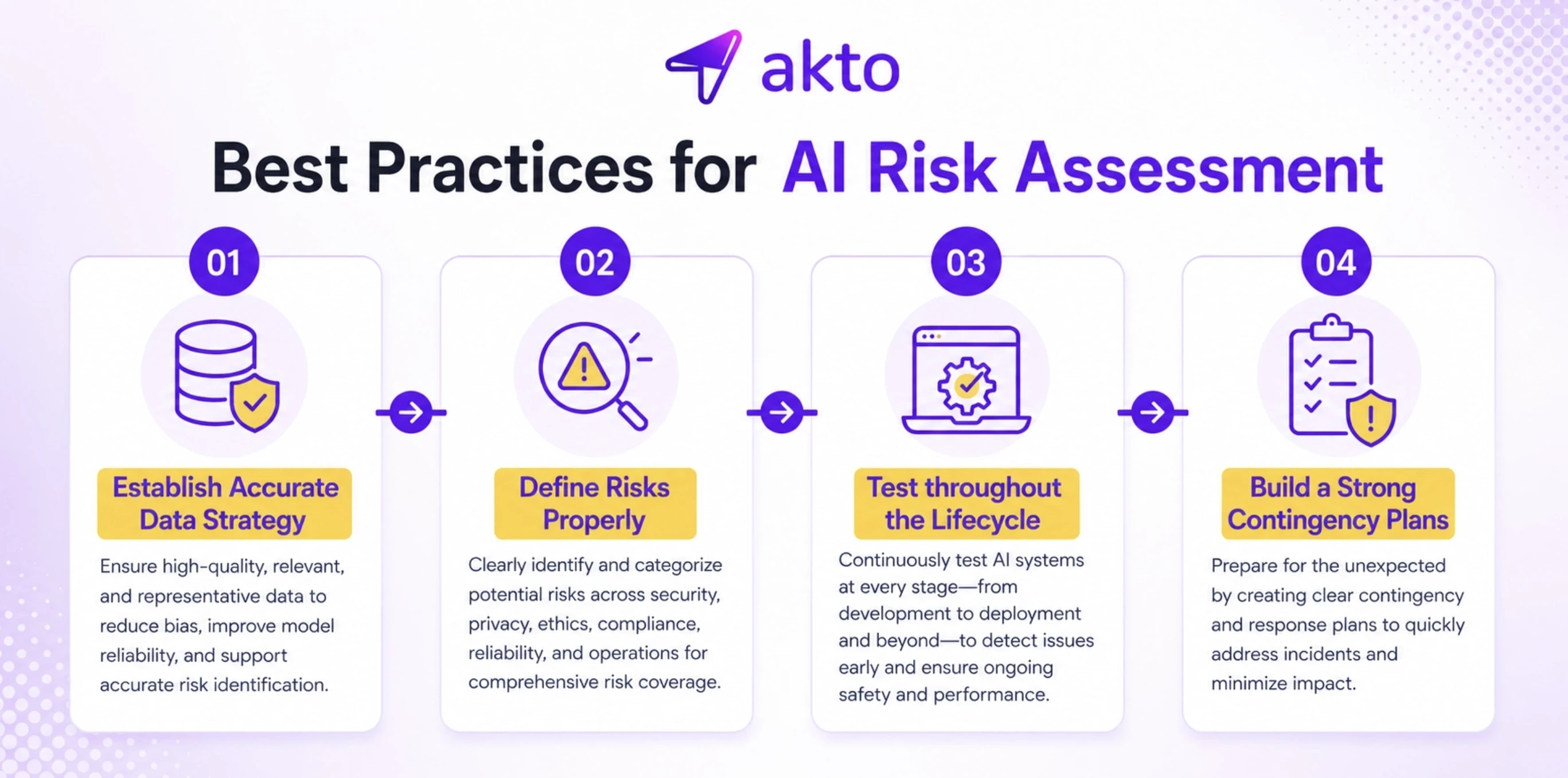
Here’s a breakdown of best practices for effective AI risk assessment.
Establish Accurate Data Strategy
Highly quality, accurate and current data is the foundation for any reliable AI system. An exhaustive data strategy with clear ownership and validated policies is very crucial. AI risk assessments should incorporate through the data reviews to ensure decisions stay trustworthy and actionable.
Define Risks Properly
Define what risk means for your security team. Each risk unique to every use case and it cannot be generalized. Contextualize how a model and decision strategy applies to your specific environment by engaging relevant stakeholder and validating models before any deployment. AI risk assessment must clearly articulate expectations and risks for every specific use case.
Test throughout the Lifecycle
Testing is a continuous process across the entire AI lifecycle. A formal test plans helps in identifying how much testing is enough to build confidence in your solution. AI risk assessments need to include both systematic initial test plan and continuous testing strategy.
Build a Strong Contingency Plans
Models grow more complex, edge case and unexpected failures become inevitable. A strong contingency plan consists of human-in-the-loop mechanisms and kill switch features should be established early. AI risk assessments need to evaluate if risk control, mitigation and response plans are sufficient for intended use case.
Final Thoughts on AI Risk Assessment Tool
Overall, AI Risk Assessment framework lets security teams to implement structured approach to cybersecurity that improves the ability to predict, detect, and respond to adversary behaviors effectively and stay ahead to prevent organizations from future threats and vulnerabilities.
Akto's real-time threat detection and blocking capabilities ensure that AI Agents remain protected throughout their lifecycle. With these groundbreaking features, Akto is paving the way for new generation AI-Agent security solutions to assist security teams ability to detect, prevent, and respond to API-related threats.
Book AI Agent Security demo right away to explore more on Akto's Agentic AI security and MCP security.

Experience enterprise-grade Agentic Security solution