Generative AI Security Risks: Threats, Attacks, and Defenses
Learn the top GenAI security risks in 2026, including prompt injection, AI agent threats, MCP risks, data leakage, and runtime security defenses.

Rushali
Generative AI is no longer a "pilot project," spanning the enterprise, and the vulnerabilities are now being felt at scale. Applications and AI agents that use LLM's access sensitive data, call internal APIs, and, more and more, act on their own, exposing themselves in ways that conventional application security simply didn't anticipate. The security risks of GenAI extend across the entire stack: the prompts that are sent, the models that process them, the tools that the agents use, and the data that passes through them. This guide provides security teams with a comprehensive view of those risks in 2026, along with the attack surfaces and methods that attackers will exploit, and why these alone are not enough to guard against risks – and how discovery, guardrails, runtime protection, and continuous testing can do the job.
What are GenAI Security Risks?
GenAI security risks are threats that are unique as a result of the creation, deployment, and use of generative AI systems, such as LLMs and AI agents. It is important to provide an idea of how generative AI is changing the security landscape, the implications of its departure from the “traditional” assumptions of application security, and why autonomous agents make the stakes even higher before starting to list individual threats.
How Generative AI Changes the Security Landscape
The boundaries that security has always depended on are gone with Generative AI, thanks to its ability to interpret natural language and generate open-ended output. A traditional app has inputs and outputs that are structured and return predictable results. An LLM is capable of handling natural text, and its designers can lead it into behaviors that they would not have anticipated. All instructions and data are treated as the same type, which means that content intended for use as information can be used as an instruction.
This is a change to where risk resides. Now, code and configuration are not the only hazard, but also language, context, and the model's own reasoning. Input manipulations, output leakage, and changing system behavior due to evolving models and data all need to be taken into account when it comes to generative AI security.
Why GenAI Security Risks Are Different from Traditional Application Security
Traditional application security is based on the premise of deterministic behavior: identical input will produce identical output, and a reviewer can examine a specific set of code. GenAI breaks that. The predictions of the model are probabilistic, and there are many behaviors that a system can have, and some of them are emergent. A control that is successful for a known API endpoint does not neatly translate to a model one can speak to that discounts the rules of the endpoint.
The data flow is also unique. A frequent issue with LLM security risks is that the model re-records sensitive information, or the prompts and logs contain credentials or PII that are left unprotected. The issue of AI security risks here isn't just about a bug that can be exploited; it's about a system that can be misled, that changes over time, and that reacts to inputs it can't fully trust.
The Growing Risk of Agentic AI and Autonomous Workflows
The greatest risk is represented by those agents who act independently. The selection of tools and their execution order are determined at runtime by an agent with little or no human intervention in between. That's the freedom, and that's the exposure. If a single instruction in a chain is misread, it will affect all subsequent instructions in the chain.
Autonomous workflows broaden the sphere of impact. If an agent is manipulated or just incorrect, it could wreak serious havoc in no time at all if it has access to databases, can send messages, or can initiate transactions. The more control that is given to agents and the more that is integrated into an enterprise, the heavier the security burden becomes on the systems themselves, rather than how they are configured.
Why GenAI Security Risks Matter in 2026
The stakes are higher due to the rise of all three elements of adoption, exposure, and regulation. This part examines the various ways in which LLMs and agents are now being used, the extent to which it has increased the surface area of what attackers can access, and the pressure of compliance.
Enterprise Adoption of LLMs and AI Agents
LLMs and agents are no longer limited to experiments! They work in customer support, coding, internal search, analytics, and operations, and interact with production systems and sensitive information. There are many different models that are deployed by many organizations across many teams, often not knowing what the others are. This widespreadness makes it clear that GenAI security cannot be isolated to a single issue, but rather one that can happen on dozens of systems, each having their own data access and permissions.
The Expansion of AI Attack Surfaces
Each new agent, model, and integration provides an additional surface for an attacker to probe. Each of these represents a point of user input, retrieval, external API access, MCP server connections, and third-party model connections, and can lead to a modern GenAI application. The greater the autonomy and connectivity of such systems, the more ways there are to manipulate, exfiltrate data, or abuse them. A single Web form is now a Web of language-driven components that call tools.
Regulatory and Compliance Pressures
Guidance has been replaced by requirements from regulators. Higher-risk AI applications are increasingly expected to be transparent, subject to human oversight, and require AI risk assessment, as mandated by frameworks such as the EU AI Act, as well as sector-specific rules and data protection laws. The security risk is compounded by legal and financial liability for operating GenAI, which cannot prove these controls. Compliance is no longer an afterthought or a checkbox activity, but a means of ensuring the safe and secure use of GenAI.Rather than simply a compliance exercise, securing GenAI is now a matter of doing it right.
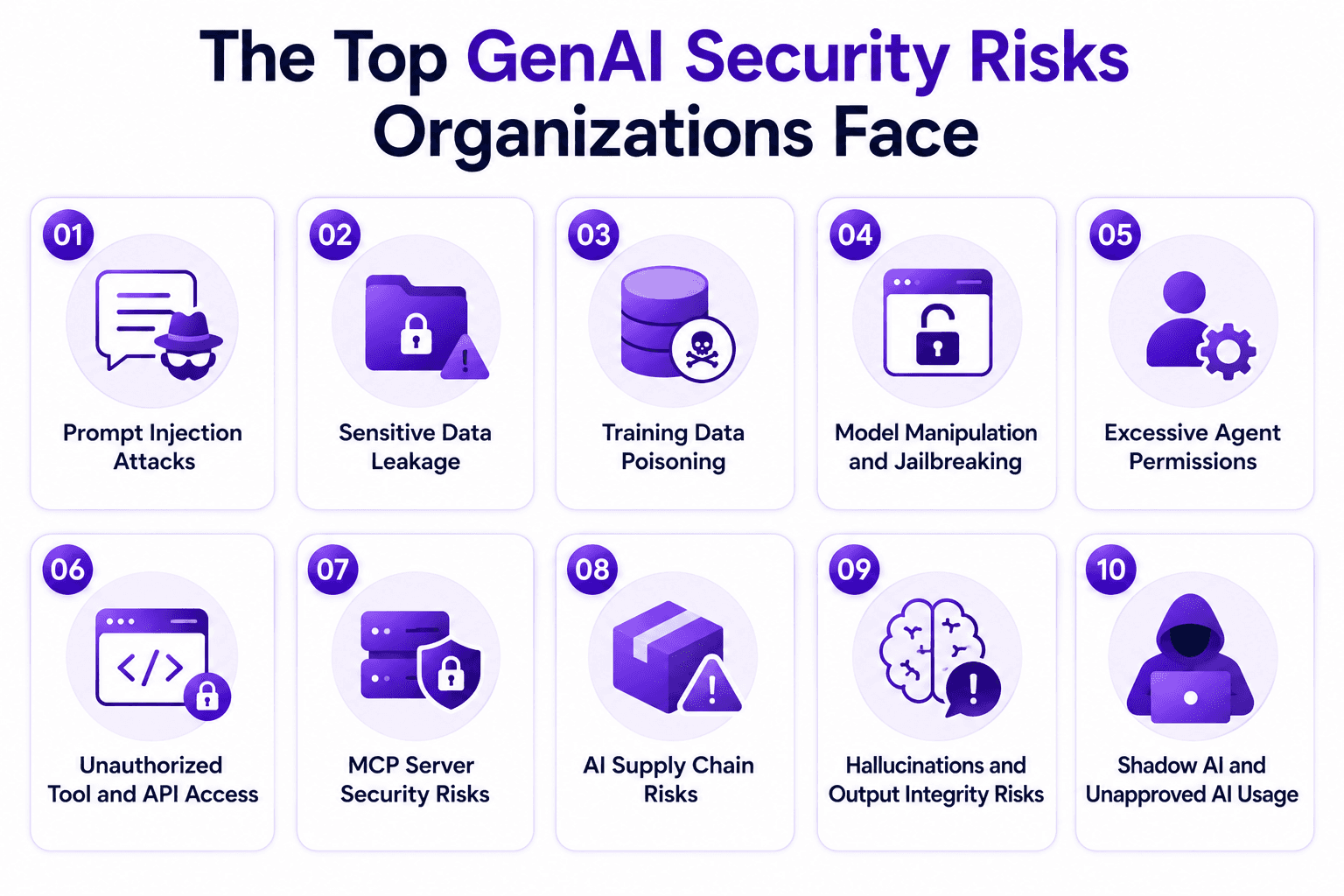
The Top GenAI Security Risks Organizations Face
Security teams are facing some of the threats listed below, most with the rise of generative AI. These correspond to a concrete deficiency in LLMs and agents as input devices, tools, and output devices. These are concrete deficiencies of LLMs and agents as input devices, tools, and output devices.
Prompt Injection Attacks
Prompt injection attacks are the hallmark of attacks against LLM systems. An attacker embeds instructions in text the model reads, and the model executes the instructions as if they were valid commands. This can prohibit the system's intended action, leak its context, or lead an agent to sensitive actions. Prompt injection is one of the most popular risks on most GenAI risk lists, as it is easier to attempt and more difficult to prevent than most other threats because the model is incapable of reliably distinguishing trusted instructions from hostile ones within data.
Sensitive Data Leakage
LLMs and agents process confidential information on a daily basis, and this information can leak in numerous ways. A model can output sensitive context multiple times. An agent could duplicate information to a third-party tool. Prompts and logs can contain PII/credentials that remain unprotected. Retrieval systems can return documents a user shouldn't be able to see. All of these make a generative system a potential source of confidential information to be released out of the organization.
Training Data Poisoning
Poisoning attacks the knowledge acquired by a model. An attacker may embed malicious or biased examples in training or fine-tuning data, thus embedding hidden behaviors, degrading accuracy, or embedding backdoors that activate on specific examples. After-the-fact detection of poisoning is difficult because the poisoned behavior is part of the weights of the model, and the integrity of the training and fine-tuning pipelines is also a security concern.
Model Manipulation and Jailbreaking
Jailbreaking refers to the act of developing input to cause a model to generate content or execute actions that it was designed to prevent. The methods of manipulation can range from role-play framing to encoded instructions to multi-step persuasion. If a jailbreak is successful, it can cause a guarded assistant to leak out confidential information or perform unauthorized operations, and new jailbreak methods emerge faster than static filters can catch them.
Excessive Agent Permissions
Agents typically have access privileges much greater than they need for the assigned task. If an agent is given broad credentials because it's convenient, it's a high-value target because if it can be compromised or manipulated, anything it can touch, it can gain. A contained incident becomes a wide incident when too many permissions are given by the agent, allowing him/her to interact with systems and data that go beyond what he/she was meant to handle.
Unauthorized Tool and API Access
GenAI systems make calls to tools and APIs to accomplish tasks, and ineffective security on the calls allows attackers to access functions they shouldn't access. By manipulation, a call can be made to trigger sensitive tools, pass through some hostile parameters, or call some APIs in a sequence that could do some harm. If there are no per-action checks, the agent can do whatever he wants; the attacker can do what he wants.
MCP Server Security Risks
The Model Context Protocol links agents to tools and data, and MCP servers have exposures. A compromised or misconfigured server might display misleading tools, embed commands in tool descriptions, send fraudulent tokens, or be exploited in a server-side request forgery attack against an internal server. A compromised server is a direct route to all things an agent can reach because of trust in the tools advertised by the MCP server.
AI Supply Chain Risks
GenAI systems are composed of external pieces: foundation models, open source libraries, plugins, datasets, and third-party MCP servers. They are each dependencies that can have vulnerabilities or malicious code. Untrusted behavior is introduced into the trust boundary via an unvetted plugin or a public source for a compromised model. The supply chain risk refers to a GenAI application's security depending on the security of all that it relies upon.
Hallucinations and Output Integrity Risks
The models can generate confident, but incorrect, outputs, a phenomenon called hallucination. Fabricated output is not only in error, but may also be a security problem when systems automatically act on it, when it is passed along for subsequent decisions, or when code or commands are generated and run without being reviewed. A second output integrity risk is a model that produces content or data that is unsafe or malformed for the systems that rely on it.
Shadow AI and Unapproved AI Usage
Shadow AI is the generative counterpart to shadow IT, which is defined by users and teams using models, agents, and AI without the awareness of security. An unapproved tool may be able to provide data to a third party or perform actions that have not been vetted. The problem creeps in, taking only a few minutes to connect the new AI tool and leaving scant footprints. The actual attack surface is larger than any inventory that can be constructed manually.
What Attack Surfaces Exist in GenAI Applications?
To protect GenAI systems, it's essential to understand where they can be attacked. For any generative application, these are the surfaces that are entry points to map.
User Prompts and Input Channels
All the input channels, where the user and system can send text to a model, are potential targets for prompt injection and manipulation. This includes chat interfaces, form fields, uploaded files, and any API that feeds the model. The most direct surface is input channels since they connect directly to the model's reasoning.
AI Agents and Autonomous Workflows
Agents are an attack surface. They can plan, call tools, and chain actions, meaning that if a manipulated agent responds with a bad answer, it can do so much more. This is expanded across multiple steps and/or multiple agents in some cases, and the surface isn't one decision point anymore, but a series of decision points and actions that an attacker can flex.
Model Context Protocol (MCP) Integrations
MCP integrations provide visibility of the relationship between agents and the tools and data they use. This surface contains tool definitions that an agent reads, sessions that it maintains, and outbound calls made by a server on its behalf. If any weakness is found anywhere in the MCP layer, it can allow the attacker to supply malicious tools or push a server toward internal resources.
External APIs and Tools
The external APIs and tools to which an agent can connect increase the attack surface of the systems these APIs and tools call upon. Once an agent can be made to use a tool for purposes other than the developer intended, the tool becomes a tool for the attacker. The set of functions that the agent is allowed to invoke is as big as the surface here.
Vector Databases and Retrieval Systems
That retrieved content is a surface in and of itself, and retrieval-augmented systems retrieve content from vector databases to ground model responses. Indirect prompt injection can be present in poisoned or attacker-controlled documents, and the access protection on a document retrieval could reveal data the user would not want to see. A model's content is the content a model can act upon.
Third-Party Models and Providers
The use of external model providers creates a facade which is beyond the scope of the organization. There's data sent to a provider, provider security, and models update with no warning. Any change or compromise to the provider side can impact every application that was created in that model.
How Attackers Exploit GenAI Systems
It is important to understand the attacker's technique so that a list of risks becomes something that defenders can do something about. Now that you know about these exposures, you can see how they're converted into actual exploits in the following methods.
Prompt Injection Techniques
Direct prompt injection is a technique where the model's input is the prompt itself. Text sent by the attacker makes the model disregard its constraints, expose its context, or execute an action that it is forbidden from executing, and a system that fails to distinguish between trusted instructions and user text may comply. Techniques include role-play framing, encoded or obfuscated instructions, and language that mimics system messages.
Indirect Prompt Injection Attacks
Indirect injection is more difficult to detect, as the malicious instruction is embedded in data that was pulled from the system. A model summarizing a web page, reading a document, or processing a record retrieved from a database may receive unintended text designed for that model, and may execute commands it reads while assuming it is summarizing ordinary text. The trick here is that the attacker does not touch any of the user-facing input, but leaves the payload where the agent will look.
Agent Workflow Manipulation
Workflow manipulation involves providing an injected or crafted input to guide an agent's multi-step process. The attacker pushes the agent in the direction of some desired tool, tries to change the sequence of operations, or gives the agent different conditions that alter its plan. Since the agent is working on its own, a slight push at the beginning can send the whole workflow in a direction that will lead towards an attacker's objective, but each individual step seems reasonable.
Tool Abuse and Function Calling Attacks
Attackers target the calls, while agents call functions. Tool abuse occurs when an agent is asked to execute a sensitive function, when arguments are passed to the function that are not intended by the function, or when tools are used together in an inappropriate manner. This is an attack method that relies on inadequate validation between the model's decision and the tool's action; the model's compromised purpose turns into a legitimate, privileged action.
Data Exfiltration Through LLMs
LLMs are a tool for extraction of data by attackers. They can alter prompts, gain access to an agent, or manipulate it to reveal private context, retrieve documents it doesn't have, and/or encode sensitive data into its output. Exfiltrations may occur in agentic settings via sequences of tool calls that collect and then pass data, where the LLM acts as an unsuspecting conduit for the leakage.
GenAI Security Risks in Agentic AI Systems
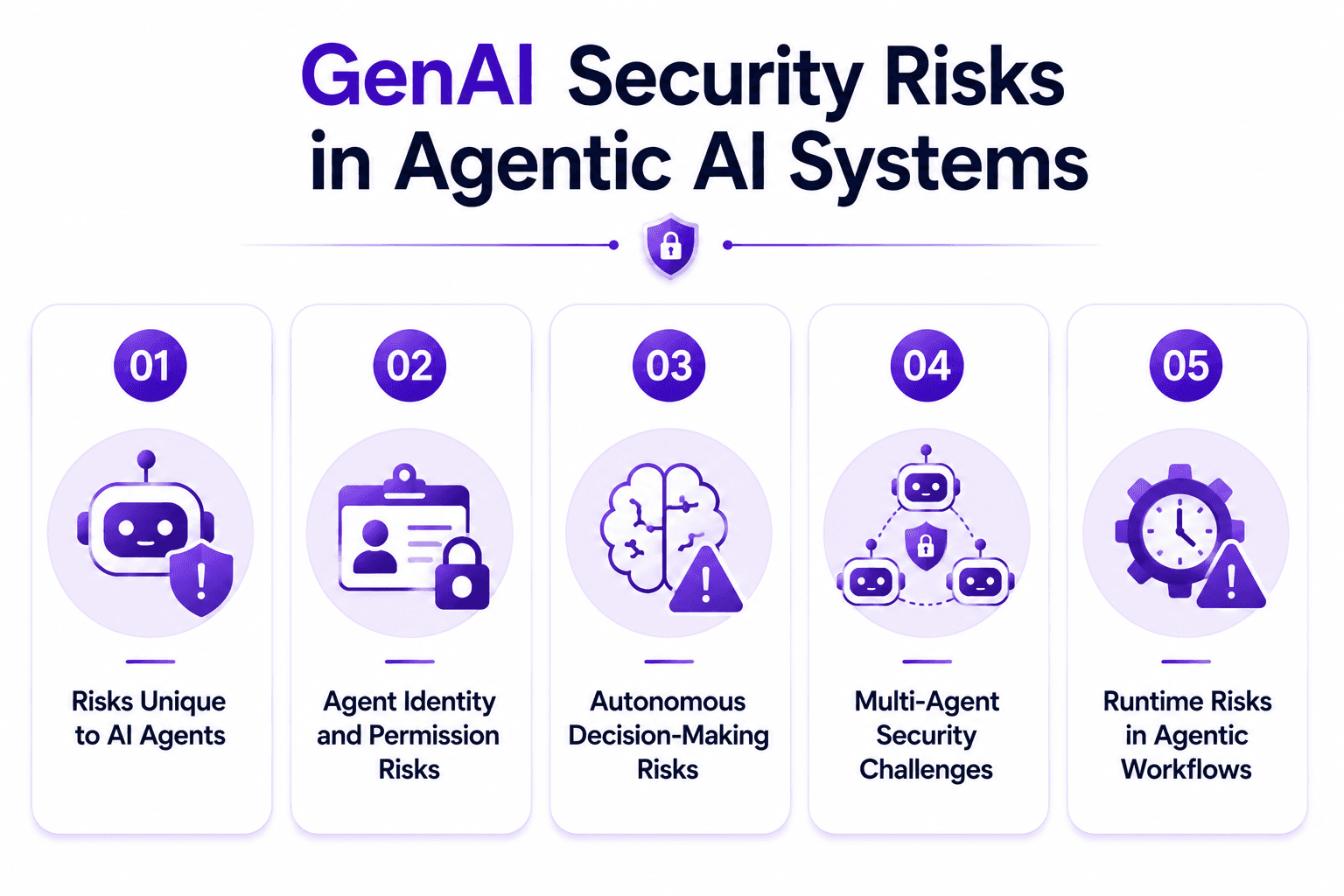
Agentic systems focus and intensify the risks covered to date. The emphasis in this part is on the exposures that are specifically generated by agents with identities, decision-making, coordination, and runtime action.
Risks Unique to AI Agents
Unlike non-autonomous applications of LLM agents, they pose risks. They make decisions with real impact, persist over steps, and function with low human involvement between decisions. The threats to AI agents range from manipulation that may make the AI work in ways it wasn't designed to, to tool misuse which makes AI tools work in ways they're intended to be avoided, to the domino effect of one poor step leading to the next. Autonomy and access are the unique security challenge in agents.
Agent Identity and Permission Risks
Agents work with machine identities, and these identities tend to be both over-privileged and under-managed. A credential with a long tenure and wide authorization is a treasure to be coveted by an agent, and a weak authentication mechanism and authorization scope for an agent allow it to propagate through. Permit and identity risk is agentic excessive access, and rests in the heart of the majority of severe agent incidents.
Autonomous Decision-Making Risks
Agents make decisions and act without human oversight – and the errors and manipulations are carried out instantly. An agent that misinterprets a goal, follows an injected instruction, or reasons wrongly may cause damage doing so before it's noticed. With autonomous decision-making, a natural "checkpoint" of human review has been eliminated, and thus the safety has to be built into the system.
Multi-Agent Security Challenges
If agents coordinate, their output is another agent's input, and trust is transferred between the agents. If an agent is compromised or manipulated, it may send poisoned context, false results, or bad instructions downstream, and the receiving agent is unlikely to know what it's being sent. It can also be difficult to determine the origin of a problem in a multi-agent system, as the responsibility is distributed among multiple autonomous agents.
Runtime Risks in Agentic Workflows
The greatest exposure in agentic systems plays out at runtime, while agents are actively working. Conditions change, inputs come in that none of the tests had foreseen, and an agent's response can deviate from what was validated prior to deployment. However, the risk when running the code is that injected instructions may come into effect during the task, that potentially useful tools may be used incorrectly in the live sequences, and that potentially useful tools may be used in such a way that only occurs under real conditions. That's why the only thing that can't be the complete answer is static, in-advance controls.
Why Governance Alone Cannot Solve GenAI Security Risks
Governance is needed, but it will not necessarily prevent a manipulated agent from acting at the moment. This section illustrates the limitations of static policy, where it is failing, and how and why continuous monitoring must be the solution for filling the gap.
The Limits of Static Policies
Policies defined and approved at a particular time define what should occur, but not what will occur as systems are executed. An attacker can come up with any number of prompts and an autonomous agent can find any number of situations. Rules executed only once and never updated become ineffective; models change, the tools available to agents change, and threats change. Policy establishes purpose, but purpose is not enforcement.
The Gap Between Governance and Runtime Security
The gap between the governance document and actual behavior of an AI system is real. Governance can require that agents remain within scope, but someone else has to be checking the action against the scope requirement as it occurs. If there wasn't that layer of enforcement, governance generates approvals and audits, but the risk, someone acting in an unauthorized way right now, isn't addressed. To fill this gap, there needs to be controls that are active at runtime where the risk is.
Why Continuous Monitoring Is Required
Since GenAI behavior is always evolving, security must be ongoing. Continuous monitoring keeps a close eye on the models and agents in action, detecting manipulation and drift as they happen, and provides enforcement that can act on the spot. It makes governance a dynamic capability to see what the team is doing, instead of a periodic review that wouldn't reveal it. Once a system is in production, its monitoring keeps it "governed".
How to Mitigate GenAI Security Risks
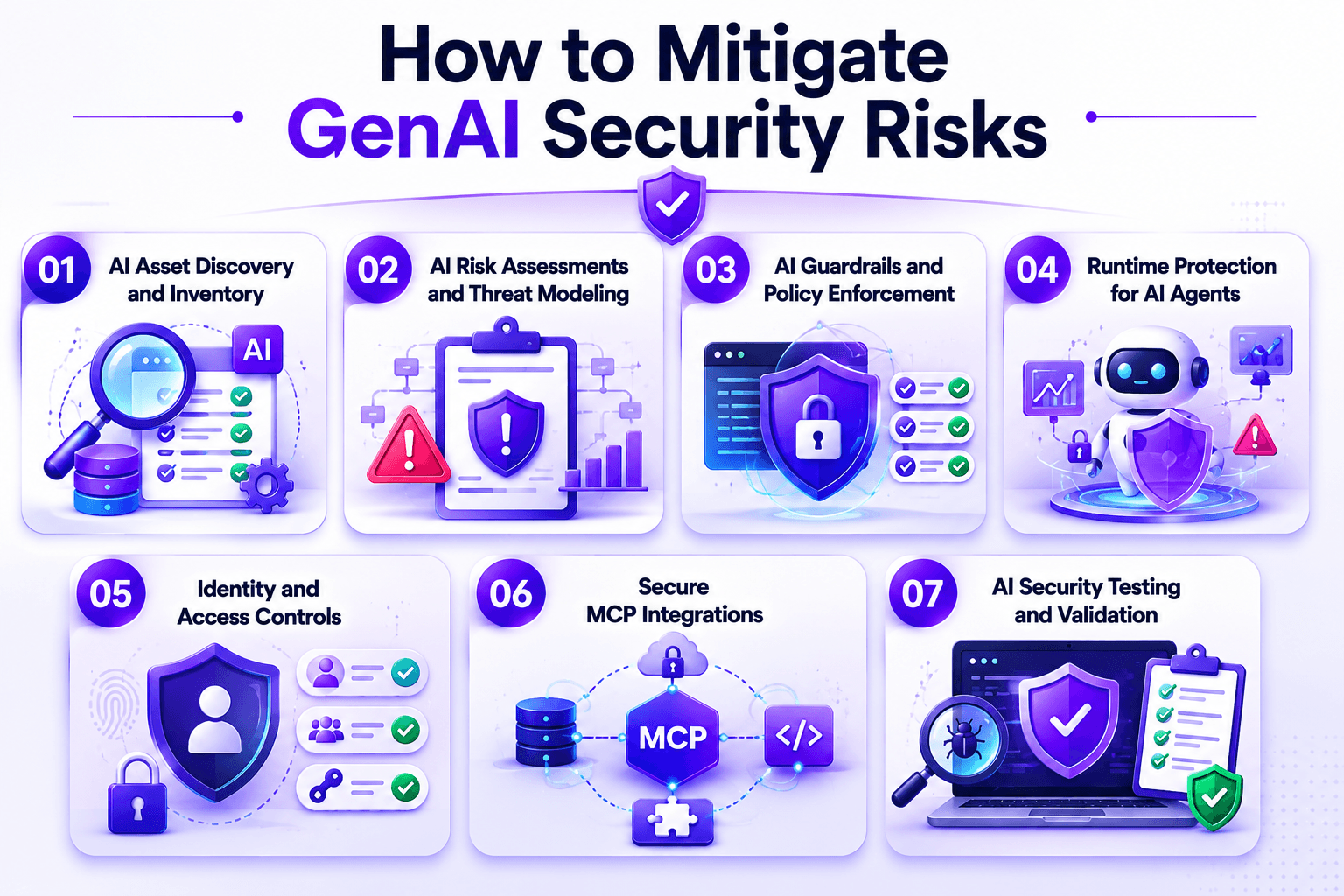
Mitigation is achieved through the stacking of discovery, assessment, enforcement, runtime, identity, integration, and testing controls. All of the following practices complement one another, and none by itself is sufficient.
AI Asset Discovery and Inventory
The first step in mitigation is to find what is present. Every model, agent, MCP server, and connected tool in the cloud, on-prem, and within the employee environment, including shadow AI, is discovered and tracked over time on what they can do and what they can access. Akto automates this discovery, cataloging MCPs, AI agents, tools, and resources across infrastructure, cloud, and employee laptops, ensuring the inventory is not stale a moment after it is created. The basis for all other controls is an accurate, real-time inventory.
AI Risk Assessments and Threat Modeling
Knowing the assets, evaluate their risks and how they can be attacked. The data a system encounters, the degree of autonomy, and the things it can do are all considered when assessing risk. Realistic attack paths, prompt injection from retrieved content, abuse of tools, too many permissions, so to be safe, so to speak, there are real vulnerabilities to be defended. As controls change, revisiting both as systems is done to keep the controls aligned to exposure.
AI Guardrails and Policy Enforcement
Guardrails are what make policy into runtime enforcement. They look for data that is being injected into a system, ensure that an agent can only perform the actions specified by its rules, and scan the outputs for leaked data or unintended content, preventing anything that isn't allowed by the rules from being provided. For autonomous systems, a written policy is the only way to make it real, as the agent cannot be relied upon to police itself.
Runtime Protection for AI Agents
Run–time protection agents are monitored during runtime and act on threats during runtime. It logs behavior, identifies unusual and drifting behavior, and prevents unsafe actions before they are finalized. Protection that works at runtime is catching agent risk that cannot be detected by pre-deployment testing – because most agent risk does not manifest in non-live environments.
Identity and Access Controls
If an agent becomes compromised or manipulated, strong identity and access controls restrict what it can access. Each agent must have its own identity, least-privilege scopes, and access that is reviewed and can be revoked. These strict controls limit the scope of impact in a failure and prevent it from becoming a system-wide incident.
Secure MCP Integrations
Mitigating is key since securing MCP is an essential component of connecting agents to tools and data. We need to verify MCP servers, verify the tools they advertise, be careful of outbound requests, block and inspect outbound requests to avoid SSRF, and not pass through unsafe tokens. By designating each MCP integration as a privileged connection, it is removed from the capability of being a gateway through internal systems.
AI Security Testing and Validation
Testing proves that controls are effective. Security testing tests GenAI systems for prompt injection, data leakage, jailbreaks, and unsafe behavior prior to shipping, and validation tests that guardrails adhere to the intended policy. Testing is not a one-time task; it is ongoing as models and threats are changing.
Runtime Security for GenAI Applications
In the real world, where all of the risk from GenAI is reflected in Runtime, it should be a layer of defense on its own. This section explains what runtime AI security is, how to detect, monitor, and block at runtime.
What is Runtime AI Security?
Runtime AI security means securing GenAI systems during runtime, not just prior to deployment. It includes the ability to inspect inputs and outputs in real time, to watch agent actions and impose controls on each action in real time. While pre-deployment testing is based on the question of whether a system can be broken, runtime AI security focuses on attacks and failures that were not anticipated by any test.
Detecting Threats During Execution
Detection at runtime involves reviewing prompts, tool calls, and outputs as they are received, identifying any suspicious activity, such as injection attacks or any tampering. Real-time detection is able to identify threats that only appear when a system receives actual input, like an injected instruction in retrieved information. The intent is to come up with an issue as soon as it happens, rather than a log days later.
Monitoring Agent Actions in Real Time
When monitoring agent actions, you are tracking every tool call and decision that an agent performs, creating a baseline of an agent's normal activity, and identifying abnormal activity. Any agent calling tools that it has never been called on to use, at volume levels that it hasn't ever called at before, or in sequences that it has no reason to be called on to use is a red flag to watch for early warning of. Real-time monitoring makes it possible for an agent's activity to be seen as opposed to being a black box.
Blocking Unsafe Actions Before They Execute
The best runtime control: prevents an unwanted action from running. This inline feature validates every activity with the policy as it happens and denies any activity that does not match the policy; it may be a tool call that's not allowed, it may be an attempt to exfiltrate data, it may be the result of an injected prompt. Blocking in the moment is the difference between active protection and after-the-fact detection.
AI Red Teaming and Continuous Security Testing
The way a system is tested is how it will be tested by the adversary. It's how a team tests a system that it's going to be tested by an adversary. This section covers the concept of AI red teaming, automated GenAI testing, runtime validation, and the connection of red teaming with runtime protection.
What is AI Red Teaming?
AI red teaming involves testing your own AI systems against malicious methods and practices to expose vulnerabilities before an opponent does. In the case of LLMs and agents, this involves simulating prompt injection, jailbreaking, manipulation, and tool abuse in a realistic environment and fixing what makes it through. Red teaming uncovers what really happens with the actual paths of an exploit - something a functional test or a checklist won't uncover.
Automated GenAI Security Testing
Manual testing is unable to handle the high rate of system releases and the multitude of attack vectors of GenAI systems, which is why automation is key. Automated testing continuously and at scale applies large libraries of adversarial cases to models and agents. Akto's solution also features its GenAI security testing framework, which focuses on prompt injection and output vulnerabilities, along with continuous agentic attack simulations from its AI Agent Attack Matrix database of over a thousand real-world agent exploits, which act as a way to test LLMs, agents, and MCP servers for vulnerabilities.
Continuous Validation of AI Agents
A one-time test only captures a moment in time, which is quickly replaced by new models and tools, new techniques, and emerging models. Continuous validation tests are adversarial tests on an ongoing basis, and a change that sneaks back in an opening vulnerability will be noticed soon. This continuous pressure is the only certain method for agents to maintain their confidence in security up to date.
Red Teaming vs Runtime Protection
Red teaming addresses one side of the problem, and runtime protection addresses the other side. Red teaming is proactive; it simulates attacks to detect vulnerabilities in advance of deployment and following changes. In the best way, runtime protection is reactive, meaning that it can detect and stop threats in production, even those not expected by the test. A mature program requires two: red teaming to strengthen systems, and runtime protection to protect systems during runtime.
Building a GenAI Security Program
Individual controls are best implemented within a framework of a structured program that provides ownership, standards, and a program lifecycle. This section describes the basics of a GenAI security program, from governance to integration of the life cycle and incident response.
AI Governance Foundations
AI governance is the framework of policies, roles, and accountability that govern an organization's usage and implementation of AI. Governance determines who owns AI assets, the tiers of risk and associated levels of control, as well as the decision-making group, typically cross-functional, that guides a program. It gives the framework for which the more technical controls are plugged in.
AI Security Policies and Standards
Policies turn governance into rules: what kinds of AI can be done, what data can be used, what controls must be in place, and what can't be done. These are all actionable, with required logging, guardrails, authentication, and testing defined by Standards. A set of clear policies and standards provides something to build on and something to enforce with regard to security.
AI Incident Response Planning
Sometimes strong defenses break down, and a plan for when they do is essential. Incident response planning will outline how to detect, contain, investigate, and report a GenAI incident, including roles and escalation. It should include AI-related scenarios such as a manipulated agent or a leaking model, and discuss how to safely isolate or shut down an autonomous system in the middle of an action. Practice makes perfect, so rehearse the plan to make it useful when needed.
AI Compliance and Audit Readiness
Security and substantiation are two distinct things. Compliance work maps controls to the regulations and standards to which the organization is responsible, and audit readiness ensures that the evidence, inventories, test results, guardrail logs, and incident records are easily organized and verifiable. Ongoing reporting on that mapping turns an audit into a routine review, not a scramble.
Integrating Security Throughout the AI Lifecycle
A system is subject to security tests throughout the entire lifecycle of its development and testing, deployment, runtime, and retirement. Development controls are much less expensive than post-development controls, and pre-release validation is the least expensive way to detect bugs; runtime controls handle the most expensive, longest, and riskiest phase. Security is a process done throughout the lifecycle, not a one-time gate or forgotten.
Real-World GenAI Security Incidents
What is documented are the risks as they actually occur, not merely as they might occur. This list of patterns below represents some of the types of GenAI failures that have emerged with its increased adoption.
Prompt Injection Data Exposure Cases
Prompt injection is no longer the stuff of research demos but of documented exposure in the real world. One such scenario that was widely reported was a GitHub MCP server, with instructions embedded in the public repository issues, which were processed by an agent, resulting in access and data leakage that exceeded what the user intended. It has been demonstrated many times that when content is embedded in web pages, documents, or emails, it can hijack assistants that read it, making it an injection vector.
Model Manipulation Incidents
In many instances, public chatbots and assistants have been manipulated, capable of generating limited output or even disclosing system instructions when users intentionally game the system with prompts that circumvent safety filters. In cases that are common, public chatbots and assistants have been hacked so that they can deliver limited content or even provide private instructions to the system when users "game the system" with tailored prompts. The incidents illustrate the ease with which manipulation techniques propagate when they're discovered and the fact that filters that are trained on known attacks are inadequate against new ways of doing things. The same applies to the pattern, in that a restriction that worked for regular input doesn't work for other inventive input.
AI Agent Abuse Scenarios
When the agents were able to call tools, abuse scenarios came along. Examples include agents being directed to exfiltrate data through their tool access, being called with attacker-supplied parameters, and following attacker-injected instructions that were able to hijack a multi-step workflow. The common denominator for these scenarios is that the agent entered trusted data or received data from a trusted tool, but should have treated it as untrusted.
Lessons Learned from Enterprise Deployments
The common theme in all these incidents is that the flaws were not exotic, but instead systemic. The issues of over-permissioned agents and missing input or output inspection, blind trust in retrieved content, and lack of runtime visibility keep appearing. Companies that did better were better at discovering their AI assets, putting in guardrails, and tracking agent activity so manipulation was detected and contained, not allowed to run unchecked.
GenAI Security Best Practices
The practices below capture the guide in action for a security team. They represent a foundation to ensure that generative AI is adopted and put into production.
Maintain Continuous Visibility into AI Assets
Perform discovery continuously to keep all models, agents, and MCP servers in a live inventory, including shadow AI. The basis is visibility, since if the organization does not know of a system, then there can be no control.
Assess Risks Before and After Deployment
Assess risk and/or model threats to each system before shipment and continually reassess as models, tools, and conditions evolve. Risk is not a fixed entity and therefore an assessment cannot be a one-time gate.
Implement Runtime Guardrails
Implement real-time active guardrails in front of production systems for inspection, action constraint, and output verification. Systems that act on their own, guardrails transform policy into enforcement.
Test AI Systems Continuously
Test adversarial and conduct red teaming throughout the development, not only at launch, to catch weaknesses introduced by change or new techniques early. It is essential to keep security confidence up-to-date with continuous testing.
Secure AI Agents and MCP Integrations
Assign individual identities to agents, ensure they have limited permissions, ensure all MCP servers are authenticated, and ensure validation of tools they expose and control outbound calls. With more autonomy and integrations, there will be a higher proportion of risk placed at this layer.
Establish AI Incident Response Procedures
Establish and practice organizational incident detection, containment, investigation, and reporting procedures for GenAI incidents, such as isolating an autonomous agent mid-action. A business continuity or disaster recovery plan transforms a crisis into a controlled situation.
Frequently Asked Questions About GenAI Security Risks
What Are the Biggest GenAI Security Risks?
Some of the most significant threats include rapid injection, data leakage, too many agent permissions, access to restricted tools and APIs, model jailbreak, and shadow AI. Agentic systems have the highest exposures when the agents are autonomous, the inputs are manipulated, and they have high access to systems and low human supervision.
How Are GenAI Security Risks Different from Traditional Cybersecurity Risks?
Traditional risks focus on deterministic software that has a set of known behaviors, with GenAI risks taking aim at systems that process language, engage in probabilistic action, and operate independently. A system that uses a Generative AI approach can be persuaded, not just exploited, can drift over time, and can recognize instructions and data as similar types of input, unlike older security models.
What Is Prompt Injection?
A Prompt Injection Attack is an attack in which a text that a model reads is modified with malicious instructions that make the model execute the attacker's instructions instead of its intended behavior. It can be direct, can be in the input supplied by the user, can be indirect and hidden in the content it accesses, and can leak data, infringe constraints, or alter what an agent does.
How Do Organizations Secure AI Agents?
Organizations find those agents and inventory them, provide each agent with an identity with the lowest privilege possible, put guardrails around what any agent can do, monitor their activities at runtime, and continuously red team them. The combination helps to maintain agents outside of approved bounds and to detect misuse while it is in its early stages.
What Security Controls Should Every GenAI Application Have?
At a minimum: discovery and inventory of AI assets, input and output inspection, runtime guardrails on actions, least-privilege identity and access, logging and monitoring, and continual security testing. More dangerous systems should have more rigorous enforcement and require human approval for sensitive actions.
Why Is Runtime Security Important for GenAI?
The reason that runtime security is important is that most of the risk associated with GenAI is only revealed when the system is running, and there will clearly be input data that are not fully foreseen by the pre-deployment test. The agents run for a few milliseconds with minimal human involvement, and controls that identify and neutralize threats at the time that they happen are what separates an altered system from actual harm.
The Future of GenAI Security
As agents become autonomous and link into more systems, threats are moving toward exploiting agent reasoning, multi-agent trust, and the tool integrations that agents rely on. Be prepared for more advanced indirect injection attacks, coordinated attacks between agents, and abuse of the emerging MCP ecosystem. The threats are rising from the model to the agent's behavior and interconnections.
Attackers are starting to leverage AI to automate themselves: they are linking together steps that probe, manipulate, and exploit GenAI systems with minimal human involvement. Autonomous attack chains can adapt in real time and run at the speed of the agents themselves, making defense that much more challenging. Human reaction-time-based security will have problems defending against autonomously moving attacks.
The clear message is that continuously running security, discovery, guardrails, runtime protection, and red teaming is becoming a precondition to safely adopt GenAI at scale. It is handled through the entire agentic stack: AI agents, MCPs, and LLMs are continuously discovered; automated red teaming is enabled using its AI Agent Attack Matrix; runtime guardrails block risky actions in real time; and GenAI security testing is applied for prompt injection and output vulnerabilities, and Akto has partnered with the Cloud Security Alliance to help shape enterprise standards for the agentic era. To experience how continuous discovery, testing, and run-time protection unite to secure generative AI in production. Book AI Agent Security Demo today with Akto.
Important Links

Experience enterprise-grade Agentic Security solution