AI Risk Assessment Framework: A Complete Guide for AI Agents, LLMs, and Governance
Learn how to build an AI Risk Assessment Framework for AI agents and LLMs. Discover risk scoring, governance, compliance, and security best practices.

Rushali

Today, AI systems make decisions, dial external tools, and perform on users' behalf with little human oversight in between. That change has outstripped the controls that most security teams have created for traditional software. An AI Risk Assessment Framework provides a repeatable method for discovering all models, agents, and integrations you're running, rating them for their risk levels, and prioritizing the fixes you should make first. This guide introduces you to the basic structure of an agentic system, why it challenges older concepts, and how you can implement it for LLM-based applications and for autonomous agents. This structure aligns with well-known controls standards, and it is flexible enough to accommodate both a new document and controls that are already in place but not very streamlined. The objective is to get a defensible and clear picture of your AI risk, both for auditors and attackers.
What is an AI Risk Assessment Framework?
AI Risk Assessment Framework is a systematic approach for assessing, quantifying, and mitigating risks associated with building, acquisition, or deployment of AI systems. It serves as a guideline to what to inventory, what threats to test against, the scoring of what it finds, and the frequency of revisiting each judgment. The aim is consistency: two reviewers assessing the same model should come to similar conclusions, and a finding six months ago should be retrievable today.
Why AI Risk Assessment Is Different from Traditional Risk Management
In traditional risk management, it is assumed that conventional systems act in the same manner when they execute. AI systems do not. A model might produce different results for the same input, may contain instructions embedded within data it manipulates, or may learn patterns that are not explicitly programmed. Agentic systems are added in that they take action in the world, and a bad decision is a bad transaction. Probabilistic behavior, provenance of training data, and autonomy at runtime were features of AI risk evaluation that have been unmodelled by classic asset-based approaches.
Benefits of Using a Structured AI Risk Assessment Framework
Clear structure gives rise to no more opinions and only evidence to defend. Teams no longer debate the risks of a chatbot and begin to compare the results of scoring. It speeds audits, since controls map to named requirements. It also brings to the fore shadow AI before an incident happens and provides leadership with a single risk posture view rather than a dozen disconnected tool reports.
Why Organizations Need AI Risk Assessment Frameworks
Growing Risks in AI and Agentic AI Systems
As a new capability is added to a model, the attack surface expands. Answering questions only has a limited blast radius with an LLM. Wired to email, databases, and payment APIs by agents can do real harm with one manipulated prompt. Agentic AI risk is exacerbated when agents link calls together, share context across tools, and respond more quickly than a human can to intervene.
Regulatory and Compliance Requirements
Starting with guidance, regulators have now switched to rules that can be enforced. The EU AI Act imposes binding requirements based on risk tiers, and sector regulators in finance and healthcare would like to see documented controls for automated decisions. AI risk management frameworks provide an opportunity for organizations to demonstrate the evaluation, scoring, and mitigation of risk, as opposed to merely its avoidance, a requirement that auditors are now seeking to prove.
AI Governance and Risk Management Objectives
A good program correlates technical conclusions to business goals. Governance establishes who is responsible for each AI system, acceptable use, and what risks the organization will take, transfer, and refuse. The role of risk assessment is to provide the information to that governance layer to let them make policy decisions with real data rather than assumptions.
Core Components of an AI Risk Assessment Framework
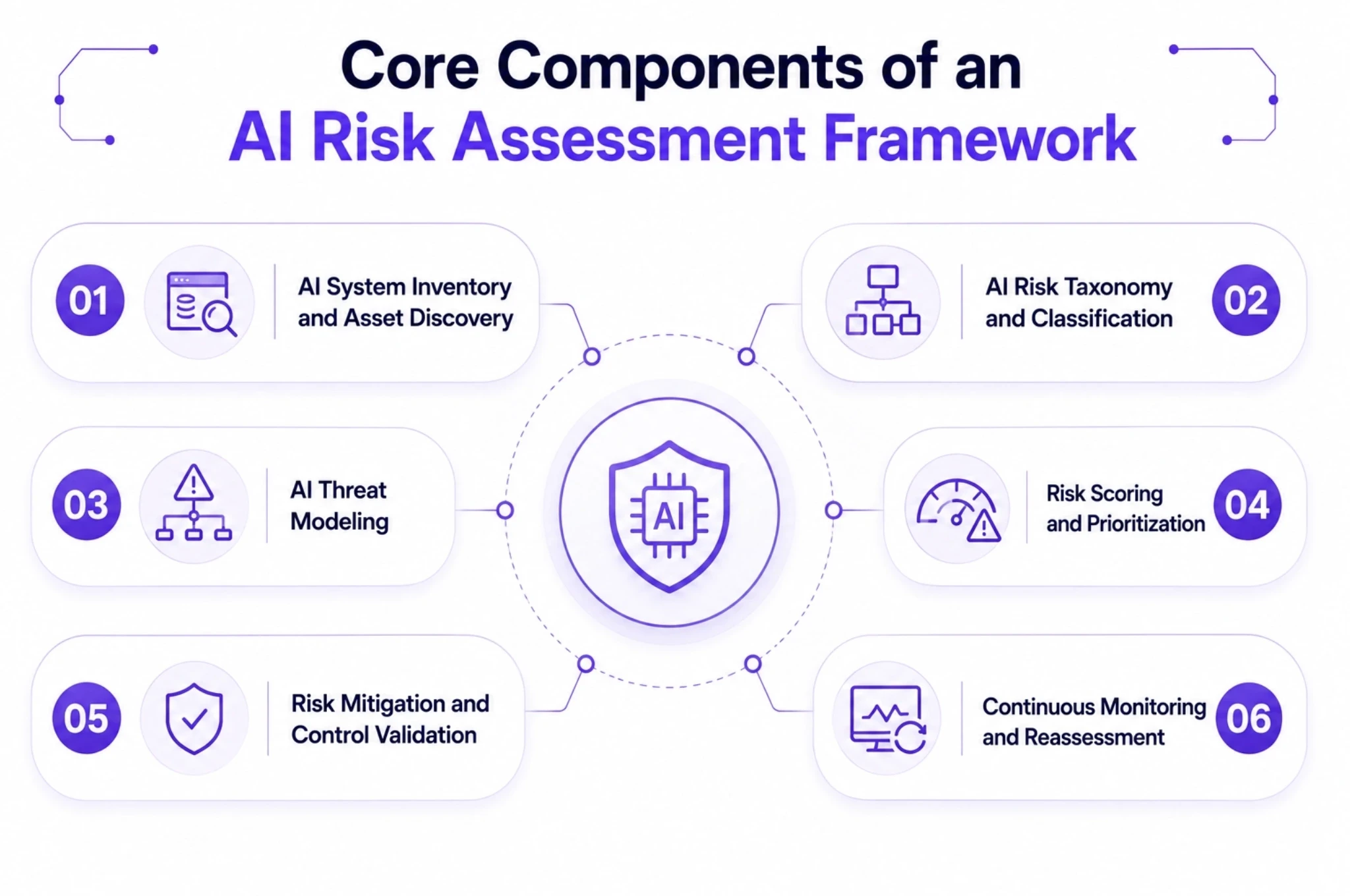
AI System Inventory and Asset Discovery
One can't measure what one can't see. A thorough AI system inventory documents all models, agents, vector stores, prompt and template definitions, and tool integrations on cloud, on-prem, and employee devices. The process of discovery needs to be ongoing because teams release new AI capabilities and integrate new tools at a pace quicker than any quarterly review.
AI Risk Taxonomy and Classification
An AI risk taxonomy assigns a name and category for each risk, ensuring that prompt injection, data leakage, and too many permissions are all treated in the same manner between teams. Then, assets are classified based on the sensitivity of the model; an internal summarization tool is at a lower tier than a model that touches regulated data. Later scoring is possible due to consistent taxonomy.
AI Threat Modeling
AI threat modeling illustrates the ways that an adversary might gain access to and exploit a system. In the case of an LLM application, it involves following untrusted input all the way to the prompt, the model, any retrieved context, and to the downstream tools. The activity shows which inputs trust is placed in, where the outputs are going, and which integrations expand the blast radius farther than anticipated by the team.
Risk Scoring and Prioritization
The purpose of scoring is to rank the findings. All risks are scored on likelihood and impact, then prioritized for the teams to tackle the handful of risks that are the greatest and avoid the ones that are not. With no scores, each discovery appears equally critical, and the little time spent in security is spent on the wrong issues.
Risk Mitigation and Control Validation
Risk identification will be of no use if controls don't hold. Control validation retests to ensure the control is effective against an attack; mitigation applies fixes like input filtering, permission scoping, or output validation. When probed, a guardrail that fails is worse than not being there at all, as it leads to false confidence.
Continuous Monitoring and Reassessment
AI systems drift. Models are updated, prompts are edited, and new tools are linked, and a closed risk is re-opened whenever changes are made. In continuous monitoring, runtime behavior is observed, and re-assessment is performed when there is some change in material content, not at the next scheduled assessment.
What Risks Should an AI Risk Assessment Framework Address?
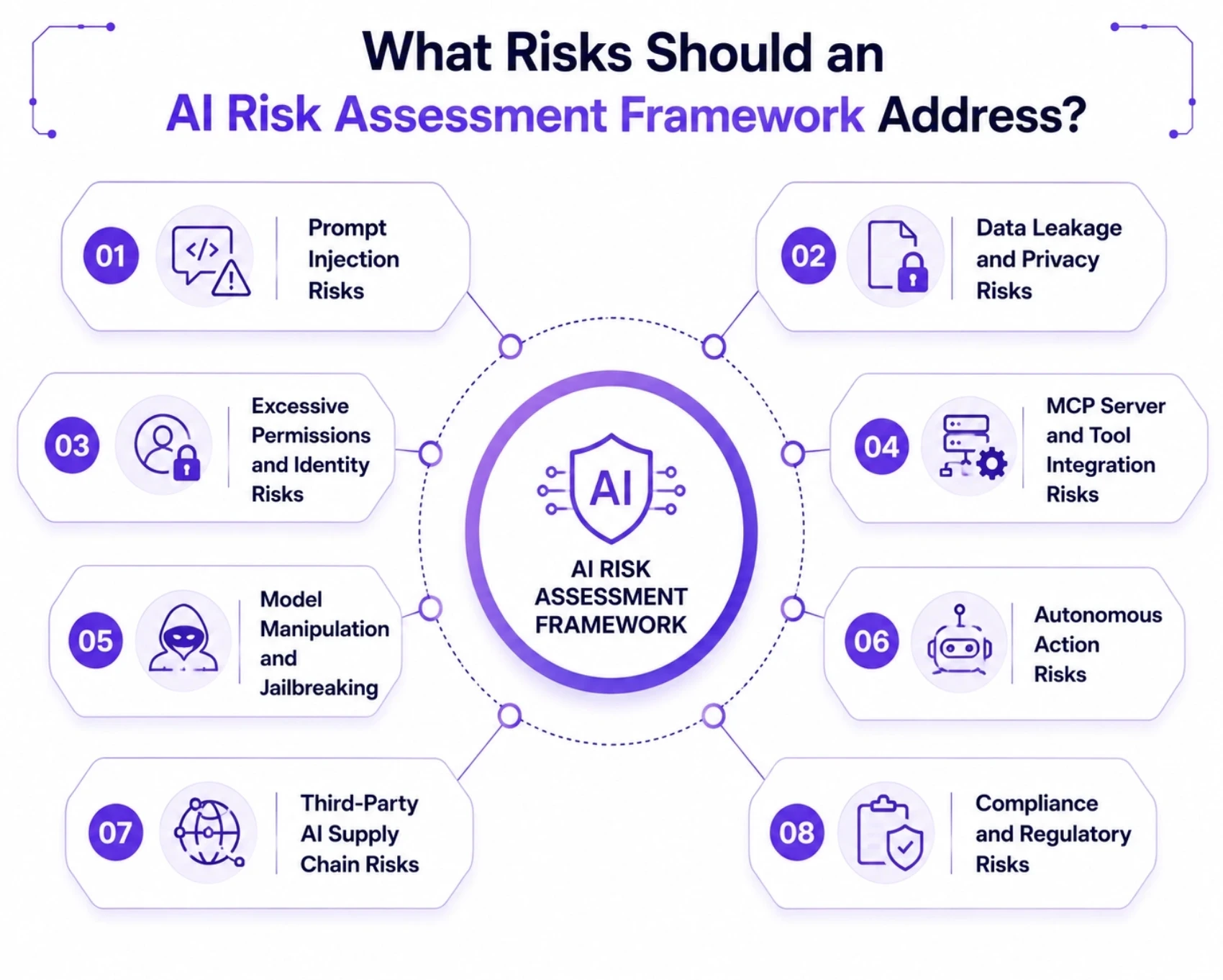
Prompt Injection Risks
Prompt injection involves forcing a model to perform a task that is implicit in the data that it is working on. Indirect is worse, as the malicious instruction can reside in a web page, document, or tool response that the agent reads, but that no human has ever seen.
Data Leakage and Privacy Risks
Models can be used to expose sensitive data in the model output, in the model log, or in the training sets. Embeddings might reveal information that seemed anonymized, and an LLM that was fed customer records might present them in an unrelated response. A privacy risk assessment must follow the ingestion, retrieval, and response of the data.
Excessive Permissions and Identity Risks
Agents are frequently granted general credentials to be able to work flexibly, and if an agent is compromised, that agent has all the credentials. Single manipulated decisions become wide reach with over-scoped tokens, shared service accounts, and standing access. It's no surprise that identity risk is one of the most underrated components of agentic security.
MCP Server and Tool Integration Risks
The Model Context Protocol enables agents to call external tools, and this connection layer is a new attack surface. It is possible to inject poisoned responses, steal execution, or steal context that the agent may be holding on a malicious/misidentified MCP server. The more connectors you add, the greater the risk of tool integration.
Model Manipulation and Jailbreaking
In the case of an attack, it's called a jailbreaking attack, since the attacker creates inputs that evade a model's safety constraints. Corresponding techniques poison training data or tweak towards attacker goals. Both allow for the modification of the model's behavior without modifying the surrounding code.
Autonomous Action Risks
If an agent can make a mistake without permission, it's a mistake, and it's a misaction. Agents that end up in a loop can consume budgets, send unwanted messages, or repeatedly activate downstream systems. To determine autonomous action is to see what an agent is permitted to act on autonomously, rather than what it claims to.
Third-Party AI Supply Chain Risks
The majority of AI systems rely on external models, datasets, libraries, and APIs that are hosted. Any such vulnerability or hidden behavior enters into your system directly from those flows. Supply chain assessment ensures that all external elements that an AI system relies on are from trusted and verifiable sources.
Compliance and Regulatory Risks
An AI system can be technically secure but not follow rules when it comes to automated decisions, data residency, or transparency. By assessing compliance for each system with its obligations, AI compliance assessment bridges the divide between security and legal liability stemming from specific use cases and data.
Leading AI Risk Assessment Frameworks
NIST AI Risk Management Framework (AI RMF)
The NIST AI RMF has four activities: Govern, Map, Measure, and Manage. It will be flexible and voluntary and will be a good foundation for an internal program that you do not have to be bound to a particular program of controls. Many teams employ it as the link between other more prescriptive standards.
ISO 42001
ISO/IEC 42001 is the management-system standard for AI – designed, much like ISO 27001, but with a specific governance focus for AI. It establishes requirements for policies, roles and continuous improvement, and has the advantage of being formalized, so it is attractive to organizations that require an auditable and recognized stamp.
EU AI Act Risk Framework
The EU AI Act categorizes AI systems into different tiers of risk, from prohibited uses to high-risk applications, to minimal-risk applications, and imposes obligations on each category. High-risk systems have the most rigorous documentation, oversight, and data quality requirements. The Act therefore establishes a floor for compliance for anyone who is involved in the operations or sales within or into the EU.
OWASP Top 10 for LLM Applications
The OWASP Top 10 for LLM Applications is a list of the most prevalent security vulnerabilities in LLM systems, such as prompt injection, insecure output, and data leakage. It's very practical and threat-centric, which makes it a good checklist to use when performing application-level AI security risk assessment rather than governance-level security risk assessment.
Industry-Specific AI Risk Frameworks
There are also published sector-specific examples of guidance on AI, such as those from finance, healthcare, and public-sector organizations, which have their own specific data and responsibilities. These are layered on top of general frameworks, and do not obviate them, but add a layer of sector controls on fairness, explainability, and patient or consumer protections.
How to Implement an AI Risk Assessment Framework
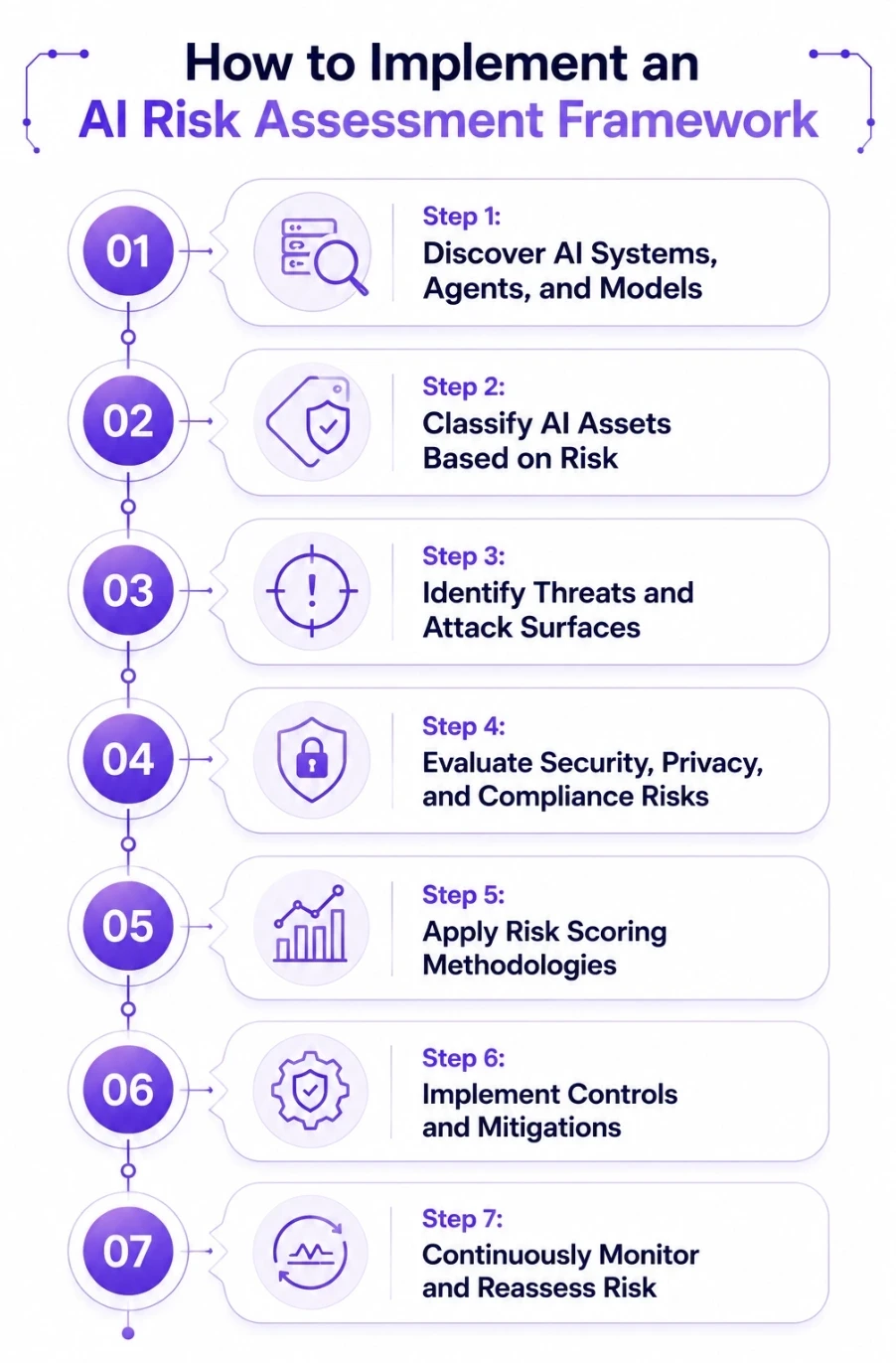
Step 1: Discover AI Systems, Agents, and Models
First, identify all the things. Track and monitor the use of sanctioned and shadow AI on teams, whether it's within SaaS applications or via agents on employee devices. What you develop here is the maximum possible standard for the remainder of the assessment.
Step 2: Classify AI Assets Based on Risk
Identify Data Sensitivity, Autonomy, and Exposure of assets found during Sort. Access to a public-facing agent whose job is to have access to the database is well above an in-house draft writing assistant. Classification indicates where to allocate more time and effort on the deeper assessment process.
Step 3: Identify Threats and Attack Surfaces
Trace the input, output, and integrations for each asset of high priority and determine where an attacker might be able to intervene. That's where AI threat modeling comes in handy. That's where AI threat modeling comes in handy.
Step 4: Evaluate Security, Privacy, and Compliance Risks
Test both systems in one pass to check data exposure and regulatory gaps within their threat model. The complete risk assessment for the asset is a combination of security, privacy, and compliance findings.
Step 5: Apply Risk Scoring Methodologies
Assign a score to each finding based on the likelihood and impact of the finding, based on common criteria, which makes the scores comparable across assets. The result is a prioritized backlog instead of a list of problems.
Step 6: Implement Controls and Mitigations
Implement concrete controls for the top risks to lower them: scope down permissions, add input and output filtering, sandbox tool calls, and provide guardrails for autonomous actions. Retest all controls for the same value.
Step 7: Continuously Monitor and Reassess Risk
Wire monitoring into runtime for automatic re-assessment of behavior changes, new agents, and new integrations. Risk checks only once are risks that you don't know anymore, once the system changes.
AI Risk Assessment for Agentic AI and LLM Applications
Unique Risks in Agentic AI Workflows
When task flows are agentic, a small mistake in one step can result in a big mistake in the next, as reasoning, tools, and memory are chained across the steps. Injected instructions can be transmitted between tools, and because the agent is autonomous, there's no human checking each hop. Application risk (LLM) and agentic risk are similar but different; agents amplify the risk by taking action on LLM-generated content.
Assessing AI Agent Permissions and Identities
Each agent should be evaluated on what they can gain access to and what they can do with that access. Check for too much "scope", long duration, and permissions that are too wide of a stroke for the agent's task. The concept is least privilege, but with respect to a non-human actor that can be manipulated.
Evaluating MCP Security Risks
MCP connections are an exception and need to be evaluated separately as they give an agent more access to external tools. Decide if the MCP servers are authenticated, if they need to be validated before the agent trusts them, and if a poisoned tool might be able to direct agent behavior. To find and validate these connections, rather than believing they are safe, Akto offers dedicated MCP discovery and security testing.
Risk Assessment for Autonomous Decision-Making
Assessment needs to consider what will happen if agents make and act on decisions without confirmation. Identify what types of actions will need a human in the loop, what types are okay to do without a human in the loop, and what is the maximum amount a human will spend, message, or use data on a per-session basis.
Runtime Risk Assessment for AI Agents
Static review: Can't detect behavior that exists only in production. Runtime risk assessment monitors agents as they are running and detects loops, unauthorized tool calls, and excessive use of the tool as it happens. This gap between the agent intended and real traffic action is closed.
Operationalizing AI Risk Assessment
Automated AI Asset Discovery
Manual inventories quickly become out of date. Automated discovery continuously scans traffic and infrastructure to model the catalog, identify models and endpoints, and identify data stores, including shadow deployments. This is the basis of automated AI risk testing, as you can only test what discovery is able to locate.
AI Agent Discovery and Inventory
Agents and MCP tools must have their own discovery pass in most cases, as they can be outside of the scope of normal application monitoring. Dependency mapping creates an inventory of agents and tools that reveal the flow of sensitive data and which agents call which tools. Lineage tracking is important here, as it shows how a risk that is introduced in one tool cascades down to all of the agents that rely on that tool.
Continuous AI Risk Scoring
The score should be updated in accordance with changes in the systems, not remain static between audits. Continuous scoring updates assets as new findings emerge, or behavior changes, ensuring the prioritized backlog is kept up to date. This is where the risk assessment becomes a living view!
AI Red Teaming and Security Testing
AI agent security testing by red teaming mimics real attacks to test controls. Prompt injection, privilege escalation, data leakage, and tool misuse can be detected through probes, preventing vulnerabilities from being exploited by attackers. Akto has thousands of these probes that run across injection, escalation, data leakage, and tool misuse and validate agent behavior within CI/CD pipelines.
Runtime Monitoring and AI Guardrails
Guardrails set limits during system operation, preventing unsafe input, output, and activities in real time. Monitoring feeds those guardrails by identifying exceptions like agent loops or unwanted calls. As a team, they move away from pre-deployment review to live defense.
AI Incident Response and Remediation
In the event that something fails, you need to know which agent, model, and/or integration was involved and how to contain it. Incident response is linked to runtime alerts, inventory, and risk scores, enabling responders to trace back to the source of the incident and address the control gap.
AI Risk Scoring Methodologies
Likelihood-Based Risk Scoring
Likelihood scoring is a method for estimating the probability that an exploit exists, based on the system's exposure, the skill needed, and whether there is a known attack path. A "prompt-injection" vulnerability on a public agent beats the same vulnerability on heavy access control methods.
Business Impact Assessment
Business impact is the loss suffered if the risk actually occurs: loss of revenue, loss of trust, disruption of operations, contractual penalties. At the same probability, a model involving financial transactions has an impact that exceeds an internal note.
Security Impact Assessment
Security impact is concerned with the technical reach of the effect of the blast, such as the number of data exposed, the number of systems reached, and the number of privileges obtained. This is because an agent with database write access and with wide credentials is a greater threat to security than a summarizer with only read access.
Compliance Impact Assessment
Regulatory exposure: fines, disclosure or loss of certification. A system that manages regulated personal data as per EU AI Act or sector rules has compliance implications which would not be captured by a security score alone.
AI Risk Posture Management
These dimensions will generate an overall AI risk posture, which is a single picture of the organization's exposure to AI risks across all AI systems. Posture management monitors that view over time so leaders can understand if risk is increasing or decreasing over time as the AI footprint expands. AI risk scoring tools can aid in the aggregation of the findings into this posture, instead of having them spread across reports.
AI Governance and Compliance Integration
Aligning Risk Assessment with AI Governance Programs
Risk assessment provides evidence to guide decision-making for risk governance. Assessment is the comparison of reality with policy set by governance on acceptable use and risk tolerance. The two are only effective if assessment results are used directly in governance reviews.
Mapping Risks to Regulatory Requirements
Every scored risk should correspond to a specific obligation on the EU AI Act, on ISO 42001 control or on a sector rule. This mapping makes AI compliance assessment line-by-line rather than line-by-belief.
Audit Readiness and Reporting
Auditors want to see risk identified, scored, mitigated, and re-checked with a paper trail. When it's not a scramble, it's a review. A maintained AI risk checklist as a linked reference assists teams to demonstrate coverage in audits.
Building an Enterprise AI Risk Management Program
An enterprise program integrates discovery, scoring, controls, governance, and reporting under one operating model and ownership. It scales by making AI risk assessment a repeatable process flowing with the way teams ship AI products, rather than a one-off project.
Comparing AI Risk Assessment Frameworks
Framework Comparison Matrix
Framework | Primary focus | Mandatory | Best suited for |
|---|---|---|---|
NIST AI RMF | Governance and risk process | Voluntary | Building an internal program backbone |
ISO 42001 | AI management system | Voluntary, certifiable | Organizations needing certification |
EU AI Act | Regulatory compliance | Mandatory in scope | Anyone operating in the EU |
OWASP Top 10 for LLM | Application-level threats | Voluntary | Hands-on LLM security testing |
Strengths and Limitations of Each Framework
NIST AI RMF is flexible yet allows you to specify your own controls. ISO 42001 brings auditable rigor at the cost of heavier process. The EU AI Act is legally binding in its scope of application but limited in breadth. OWASP is very practical in the area of threat from LLM and lacks any discussion about governance. Most mature programs are not single, but multiple.
How to Select the Right Framework
Make your decision based on motivation. Regulatory exposure relates to the EU AI Act and ISO 42001. Hands-on security testing indicates the need for OWASP. Any interest in organizing the entire program is directed towards NIST. Define the commitments and their level of maturity, and then choose the combination that will cover them.
AI Risk Assessment Best Practices
Maintain a Real-Time AI System Inventory
The basis of all the rest is a current inventory. Don't try to stop it from being continuous and automated – the new models and agents should emerge as they ship, not at the next review.
Assess Risks Continuously Instead of Periodically
Annual reviews are too infrequent to keep up with AI changes. Drift, new integrations, and new attack techniques that occur between actual audits are captured through continuous assessment.
Include Runtime and Agentic Risks
In design-time review, it does not catch the behavior; it only occurs in production. To assess the behavior of systems and not just how they were constructed, cover runtime loops, autonomous actions, and tool calls.
Integrate AI Security Testing and Red Teaming
Theoretical risk lists require empirical testing to validate that what can be exploited can. Integrate the elements of red team and security testing into delivery pipelines to ensure that vulnerabilities are checked in practice against actual attacks before being released.
Establish Clear Ownership and Accountability
All AI systems must have a named owner, who is responsible for the risks associated with the system. Findings remain unaddressed, and there is no accountability unless they are owned. Attach each asset from the inventory to a person and a team.
Frequently Asked Questions
What Is an AI Risk Assessment Framework?
AI Risk Assessment Framework is a systematic approach to identifying, quantifying, and mitigating AI risks. It specifies which items to include in inventories, which threats to test, scoring of findings, and when to review, ensuring that risk decisions remain consistent and defensible across teams.
How Does AI Risk Assessment Differ from Traditional Risk Assessment?
Traditional assessment is based on a deterministic approach. AI risk assessment takes probabilistic outputs, instructions embedded in data, training data provenance, and agents acting autonomously into account. The additional criteria of model behavior and of being self-supporting at runtime necessitate approaches which were not available before in the realm of classical asset-based review.
What Frameworks Are Used for AI Risk Management?
AI risk management frameworks commonly used are the NIST AI RMF, the EU AI Act risk tiers, and the OWASP Top 10 for LLM Applications. Many organizations use a governance approach in conjunction with an application-level threat list, as opposed to just one of these approaches.
How Do Organizations Assess Risks in AI Agents?
They identify and track all the agents and all the connections with the tools, review permissions and identities, threat-model tool inputs and integrations, and perform security testing like red teaming. Then, Runtime monitoring will detect any abuse, such as loops or uncalled-for tools in production.
What Is AI Risk Scoring?
AI risk scoring assigns the likelihood and impact of each finding, possibly in various security, business, and compliance aspects, and generates a list of risks in order. These scores, when combined, provide an overall AI risk posture for the organization.
How Often Should AI Risk Assessments Be Performed?
Continuously. Assessments should be conducted on a regular basis, but not necessarily annually; as per the content of the material change, models, prompts, and integrations are constantly changing, and automated discovery and monitoring of change should trigger reassessment of the systems.
Getting Started with AI Risk Assessment
Quick Wins for Security Teams
Begin with discovery, as most teams vastly underestimate how much AI they actually use. Identify shadow models and agents, narrow down the most over-permissioned agents and red team your most exposed public agent. These three moves have already reduced the actual risk before a bigger program has come along. For example, platforms such as Akto can automate discovery and testing processes, and hook the quick wins in days instead of months.
Building a Risk Assessment Program
Make the quick wins something that happens all the time: continuous inventory, consistent scoring, validated controls, clear ownership. Relate findings to governance to ensure policy is based on evidence and incorporate assessment into AI team shipping.
Selecting the Right Framework for Your Organization
Synchronize the system with your responsibilities and experience. Identify the regulatory exposure, determine if certification is necessary, and select the NIST, ISO, EU AI Act, and OWASP that best fit your team's security and compliance requirements without overwhelming them with process.
Future-Proofing AI Risk Management
The capabilities of AI continue to grow, and agentic systems will perform more impactful actions. A program designed to continuously discover, assess systems at runtime, and validate with controls will change to match the changes in the systems, rather than requiring a rebuild for each model generation.
The ability to assess and manage risk has become a part of the job, not a one-off task, and AI risk has gone beyond theoretical to operational. A framework provides structure, and automation provides reach, using it with all models, agents, and MCP connections you run. With AI agent discovery, thousands of attack probes for red teaming, MCP security testing, and runtime guardrails all in one platform designed for modern security teams, move from finding AI risk to controlling it with Akto. See your AI risk posture throughout your LLM, agents, and MCP tools – book a AI Agent Security demo with Akto to watch a live assessment of your own AI stack.

Experience enterprise-grade Agentic Security solution