AI Detection and Response (AIDR): A Complete Guide to Securing AI Agents and LLM Applications
Learn how AI Detection and Response (AIDR) helps detect, investigate, and respond to threats targeting AI agents, LLMs, MCP servers, and AI applications.

Rushali

From pilot projects to production systems that touch customer data, financial workflows and internal tools, enterprise AI has progressed from being just a pilot project to being a live production system. LLM apps resolve support inquiries, AI agents create expense reports, and MCP servers facilitate access to databases and APIs without manual intervention. Those are all active attack points that are different from the web apps that your security team is already familiar with. Traditional monitoring is designed for code, packets, and endpoints and does not cover the prompts, tool calls, and model decisions that constitute AI risk. AI Detection and Response (AIDR) brings security into AI environments, providing teams with visibility, detection, and response tailored to the way that AI environments function. This guide explains what AIDR is, why it's important, and how to conduct an AIDR.
What is AI Detection and Response (AIDR)?
Definition of AIDR
AI Detection and Response is a security field dedicated to actively observing AI systems during runtime, identifying threats unique to them, and reacting to prevent damage from affecting the system as a whole. It sees LLM applications, AI agents, and MCP servers as assets of their own, with security signals generated as a result. While older tooling monitors the infrastructure, AIDR monitors AI behavior – the prompts that a model receives and the tools that an agent invokes, as well as the data that such interactions expose.
How AIDR Works
AIDR's operation is based on the principle of collecting data on the behavior of the systems in production, establishing a baseline of normal behavior, and identifying deviations. It consumes prompts, model responses, agent tool calls, and MCP traffic, and uses AI behavior analysis and anomaly detection to identify suspicious AI behavior. If an event hits a Risk Threshold, the platform can alert an analyst and add context to it, or it can automatically block the event, depending on the event type. This loop is not based on a scan schedule, as AI threats don't come up in static code; they come up in live interactions.
Why Enterprises Need AIDR
AI is being adopted by enterprises faster than it is being secured. One team can deploy an agent that reads from a CRM, writes to a ticketing system, and calls three external APIs in one workflow. So that agent is a blind man in a dark room without AIDR. With AI risk detection, AI security teams can gain visibility into the activities of AI systems, detect misuse at early stages, and demonstrate that AI workloads are under constant surveillance.
Key Components of an AIDR Platform
The AIDR platform combines discovery of AI assets, continuous security monitoring of AI assets, threat detection customized to AI attack patterns, behavior analytics, and a response engine. It integrates with the places AI operates, like cloud platforms, employee endpoints, and agent frameworks, and links detections to investigation and remediation workflows, allowing analysts to take action without having to change tools.
What is AI Detection and Response (AIDR)? AI Detection and Response (AIDR) is a security strategy designed to real-time monitor AI agents, LLM applications, and MCP servers; identify AI related threats, like prompt injection and unauthorized tool use; and take action to contain and remediate the threat before it causes damage.
Why Traditional Security Monitoring Falls Short for AI Systems
Limited Visibility into AI Activity
Network flows, process events, and log lines are visible in SIEMs, firewalls, and endpoint agents without AI activity monitoring. They don't realize that an agent was asked to summarize a document, and surreptitiously given a directive to exfiltrate a list of customers. Legacy sensors simply don't recognize activity happening within prompts or outputs, so the most critical evidence is never captured by the analyst.
Lack of AI-Specific Telemetry
There was no existing security stack that was connected to the collection of AI telemetry. They do not understand what a system prompt is, what a tool schema is, how to look up an embedding, or what it means to reason with an agent. If it doesn't have that data to match against, then detection logic can't match it—and AI security analytics can't analyze it.
Runtime AI Behaviors Are Dynamic
A web app is the same app and executes the same code on each request. The AI agent has the ability to follow different paths each time, selecting tools, chaining calls, and modifying based on the input. This dynamism is the reason why signature-based detection is not sufficient, as everything assumes predictable outputs, while this is not the case in AI runtime monitoring.
AI Threats Require Context-Aware Detection
There is a wide variety of AI attacks that appear harmless when seen singly. A prompt is simply text. A tool call is nothing more than an API request. The only time the risk becomes apparent is when you tie the prompt to the action that it caused, and the data that was returned. By combining these pieces, a context-aware detection is able to make a much more meaningful link than can a generic monitoring system, which views each event as an isolated log entry.
Why can't traditional SOC tools detect AI threats effectively? Traditional SOC tools are not capable of effectively detecting AI threats due to a lack of AI-specific telemetry, lack of visibility into AI prompts and tool calls, and static rules that can't match dynamic AI behavior. Legacy sensors can't capture the threats within the interactions between models, and AIDR is required to gather the data and perform context-aware detection.
The Growing AI Threat Landscape
Prompt Injection Attacks
Prompt injection is the technique of embedding malicious code in the content that the model is processing, like an email, web page, or document. If the model interprets that injected text as a command, the model can be manipulated to leak data or misuse tools. It is still one of the most prevalent attacks used by AI since it has a large surface area and the difficulty of sanitizing the input surface.
Excessive Agent Permissions
Agents are given lots of freedom to move quickly. The agent who has access to production systems and sensitive stores with read rights becomes a high-value target. Those permissions then become a direct pathway to damage if an attacker can control its actions, making it more powerful in terms of the other attacks on this list.
Unauthorized Tool Usage
Agents call tools for getting things done, but they can be misled into calling tools that they shouldn't call or using the tools in a different way. One of the agents charged with reading the records may be pressured into deleting them, making it essential to know which tools the agent is using and when.
Sensitive Data Exposure
Prompts and context are often full of PII, credentials, and proprietary data, which are managed by AI systems. That information may be conveyed in the model's answers, be saved as plain text, or even be shared with an outside service, making monitoring the flow of sensitive data in AI interactions a consistent detection concern.
Shadow AI Deployments
Teams start models, agents, and assistants without informing security. These shadow AIs operate outside of policy and monitoring and frequently have access to real systems and are identified as the first step in managing the risk.
Malicious MCP Servers
The aim of the MCP servers is to link AI systems with tools and data. Poisoned instructions can be inserted by a malicious or compromised MCP server, hidden server functions can be exposed, or traffic can be secretly captured from an agent to the APIs it uses. A public case was a popular MCP server that allowed attackers to add malicious code to public issues for execution by an agent.
Agent-to-Agent Abuse
As more agents are deployed that communicate with one another, one compromised agent can control another, passing poisoned context or launching unintended actions across the chain. The multi-agent interactions generate attack paths that are not seen by single-system monitoring.
Core Capabilities of an AIDR Platform

AI Asset Discovery
The first step is to understand the type of AI you are operating. A powerful platform identifies AI agents, LLM applications, MCP servers, tools, and data sources they interact with on cloud infrastructure and employee endpoints. This inventory brings the shadow AI to a managed AI.
Continuous AI Monitoring
When assets are ascertained, the platform monitors them constantly. Continuous monitoring includes not only detecting and analyzing calls to tools, but also capturing prompts and responses as they occur, providing an analytics layer with real-time data rather than snapshots. This live view is the building block of AI runtime security.
Threat Detection
AI threat detection uses AI to scan incoming transactions for threats against AI models such as prompt injection, tool poisoning, and data exfiltration attempts. Strong detection involves both the detection of known attacks as well as behavioral detection that leads to a potential detection of novel attacks.
Behavioral Analytics
Behavioral analytics will create a profile of the agents' and models' typical behaviors and will flag drift. An agent that suddenly accesses a new data source or calls tools at an unusual rate is surfaced for review via AI behavior analysis.
Risk Prioritization
All alerts are not created equal. AI security events are ranked by how likely it is that they will have an impact based on the sensitivity of the data, the permissions of the agent being affected, and the level of confidence the analysts have that the event has been detected, which means that analysts work the threats that matter first, as opposed to how often they are seen.
Incident Investigation
If a detection activates, then analysts must know what it is. The platform offers a complete view of the AI incident: the prompt, what the AI did, the tools it used, and any data it retrieved. This can help expedite security investigations without manual log stitching.
Automated Response
AIDR takes action. Automated response can prevent a risky tool call, quarantine an agent, revoke a session, or apply a guardrail to prevent harm from spreading. This is accomplished by using its Agentic AI Security Platform's runtime guardrails that prevent unauthorized agent actions from occurring in real time and report on atypical access patterns as they happen.
AI Detection vs AI Response
Detection and response are two halves of the same workflow. Detection is about finding out that something is amiss; response is about doing something about it. A program that only detects will raise alerts that no one will act on, and a program that only responds will begin firing blindly. AIDR matches the two, and signals become outcomes.
AI Detection | AI Response |
|---|---|
Identifies threats | Contains threats |
Generates alerts | Executes remediation |
Monitors AI activity | Enforces actions |
Detects anomalies | Reduces impact |
AIDR vs Traditional Security Solutions
AIDR vs SIEM
A SIEM combines and correlates the events from the infrastructure, but is not inherently familiar with prompts or agent behavior. AIDR gathers AI telemetry that a SIEM fails to see and uses detection fine-tuned for AI attacks. They complement each other as AIDR can pass AI security events into a SIEM for consolidation and reporting.
AIDR vs EDR
EDR monitors processes, files, and system calls to safeguard endpoints. It runs beneath the AI layer, and can't understand what an agent is thinking about or what tool he has just called. While EDR operates at the network layer, AIDR is on the surface; EDR was never meant to travel.
AIDR vs XDR
While XDR enhances endpoint, network, and cloud visibility and correlates signals from across multiple domains, it doesn't yet have AI-native sensors. Mature programs add the AI domain to the picture, and for AIDR, its detections are yet another telemetry source to correlate with XDR.
AIDR vs AI-SPM
AI Security Posture Management is pre-runtime focused on configuration, inventory, and risk: What AI you have and how you set it up safely. AIDR emphasizes runtime (active response and live threats). Posture management minimizes the attack surface, and AIDR protects it when it's being used.
AIDR vs Runtime Guardrails
Guardrails are AI input/output policies that prevent prohibited prompts or responses. They are not a program; they are an enforcement mechanism that AIDR employs. Discovery, detection, investigation, and analytics are wrapped around guardrails by AIDR.
Capability | SIEM | EDR | XDR | AI-SPM | AIDR |
|---|---|---|---|---|---|
AI telemetry collection | No | No | No | Partial | Yes |
Prompt and tool-call visibility | No | No | No | No | Yes |
Runtime AI threat detection | No | No | No | No | Yes |
AI posture and inventory | No | No | No | Yes | Yes |
Automated AI response | No | Partial | Partial | No | Yes |
The AIDR Lifecycle
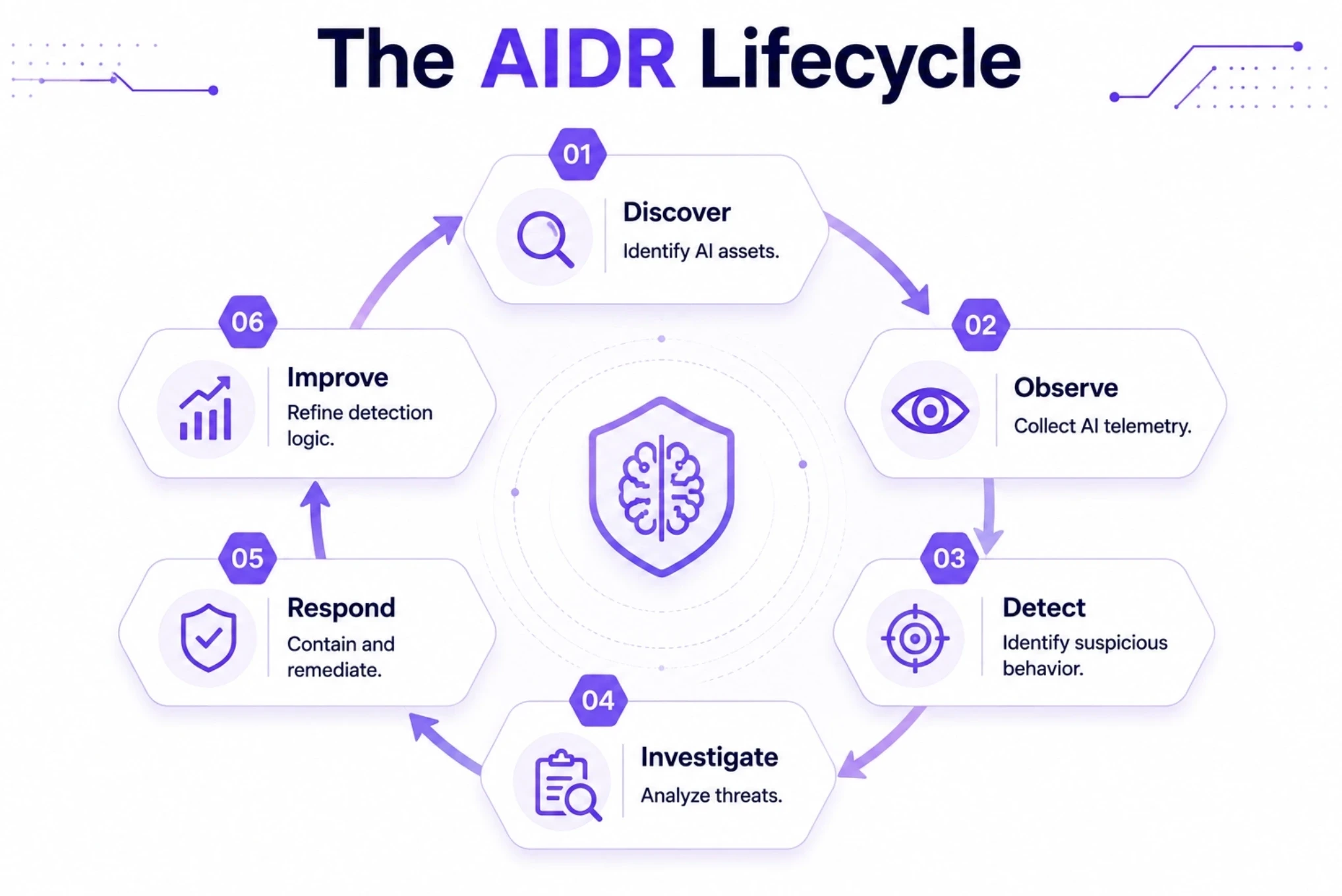
Discover
The lifecycle begins with discovering all the AI assets in the environment, such as agents, models, and MCP servers deployed by teams without the knowledge of security. Everything else is based on a complete inventory.
Observe
Once the assets are mapped, the program gathers the AI telemetry from those assets: prompts, responses, tool calls, and MCP traffic. This observation layer is responsible for the AI observability to reason about behavior.
Detect
Detection uses rules, signatures, and behavior models to detect suspicious AI activity on the telemetry stream. It's in this area that the first signs of prompt injection, abnormal tool use, and data leakage emerge.
Investigate
If a detection triggers, the analyst goes to work. They go through the entire chain of events, verify if the activity is malicious or not, and determine the blast radius. With strong AI security workflows, it's fast thanks to the automatic surface of context.
Respond
Confirmed threats initiate AI containment and AI remediation. This could be locking an action, isolating an agent, blocking access, or securing a guardrail. The purpose is to sever the impact as soon as possible.
Improve
The program learns from each incident. Teams continue to evolve detection logic, fill gaps, and revise playbooks, ensuring that the next time the same attack occurs, it will be detected in the early stages and AIDR will remain effective as threats change.
Key Use Cases for AI Detection and Response
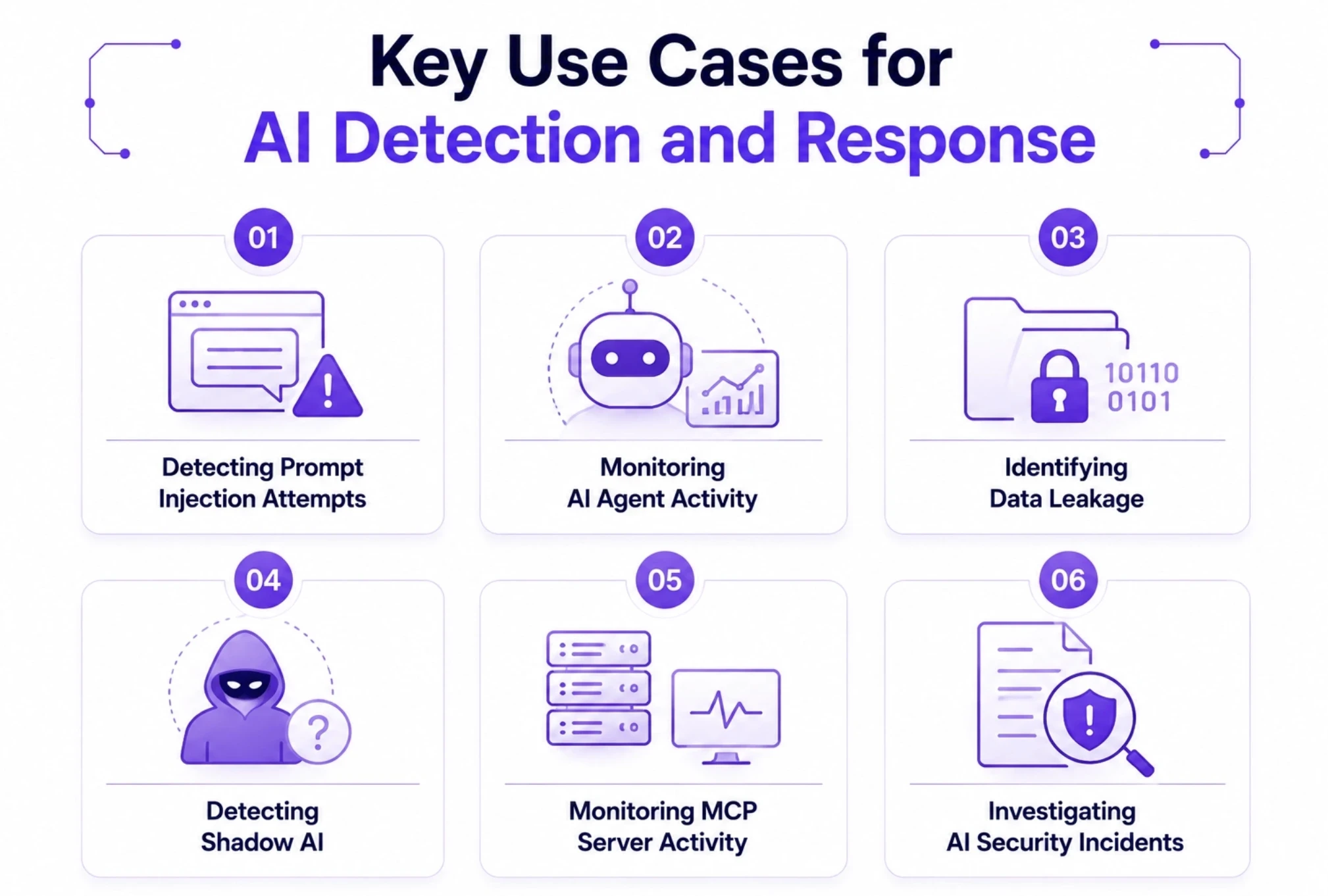
Detecting Prompt Injection Attempts
AIDR checks files as they are being delivered to models and searches for injected code elements camouflaged within documents, on the Web, or in user input. The platform correlates a suspicious prompt with the agent action it generated, and thus detects injection which might not have been detected as suspicious text otherwise.
Monitoring AI Agent Activity
Agents work independently, making observation of their behavior key. AIDR monitors agents that call into different tools, the data read by the agent and the way it's changing over time, and identifies an agent that's doing something different than it normally does.
Identifying Data Leakage
Data may be exposed via model responses or sent to external services. AIDR will actively watch for AI interactions with PII or credentials, and escalate AI security incidents when protected information is found where it shouldn't be.
Detecting Shadow AI
Discovery scans AI systems in cloud environments and endpoints that are not official. Control out-of-control AI surfacing puts security ahead of the curve by controlling unmanaged agents and assistants before they become a problem.
Monitoring MCP Server Activity
MCP servers are really located between agents and the tools they use; therefore, it is a high-leverage place to view. AIDR is capable of real-time detection of poisoned instructions, monitoring of AI-to-API traffic with MCP servers, and detection of shadow/hosted servers. When agents invoke tools, Akto's MCP security capabilities identify the MCP servers in an environment and track their activity to detect suspicious activity.
Investigating AI Security Incidents
Teams have to reconstruct the AI incident rapidly in the event of an incident. AIDR gathers data, the agent's reasoning trail, the prompt and the tools called, and the data touched, all in one place, enabling AI incident response without manually logging the data together.
Building an AI Security Operations Center (AI SOC)
AI Telemetry Collection
The basis of an AI SOC is data. Teams instrument their AI systems to send the prompts, responses, tool calls, and MCP traffic to a central pipeline. How complete this collection is determines the quality of everything downstream.
Detection Engineering
Detection engineering for AI involves writing and tuning rules and models to convert telemetry into alerts. Engineers program known attack patterns, create behavioral baselines, and minimize false positives for analysts to trust what they see.
Threat Hunting
AI threat hunting is a proactive process in which AI technology is used to identify threats that are not detected automatically. Hunters develop hypotheses around how an agent might be misused, then pose a question to the telemetry to “prove” their hypothesis, and discover new attack paths before they become an incident.
Incident Response
In the event of a true threat, the AI SOC follows a well-defined process: Triage, Scope, Contain, Remediate and Recover. Playbooks that are scenario-specific to AI, such as when there is a compromised agent or poisoned MCP server, maintain consistent response when things get tough.
Continuous Improvement
The more lessons learned from each incident and hunt are fed back to the AI SOC, the more it evolves. The program strives to further refine baselines, extend coverage, and embed security automation in the security operations center workflow over time.
Metrics Every AIDR Program Should Track
AI Asset Coverage
This is a gauge of the percentage of your AI assets that are discovered and tracked. Low coverage is blind spots, and teams monitor what percentage of known AI agents, LLM applications, and MCP servers are being monitored and strive to increase this percentage.
Detection Accuracy
Accuracy reflects the rate of correct detections compared to false alarms. The high false-positive rate will affect analyst trust and lead to alert fatigue, and tuning accuracy helps maintain the program's credibility.
Mean Time to Detect (MTTD)
MTTD is a measure of the amount of time needed to detect a threat once it has been introduced. This is because the shorter the time to detection, the more the attacker can get.
Mean Time to Respond (MTTR)
MTTR is the time between a problem being detected and it being contained. But it's not enough to detect the threat quickly if the response doesn't keep up. Teams monitor MTTR to ensure that AI containment is keeping up.
AI Incident Volume
Tracking AI incidents over time can reveal if the risk is increasing or decreasing and the focus of the risk, informing policy leadership of where to invest effort to address the AI system that is causing the majority of the incidents.
Risk Reduction Metrics
These tie security outcomes with security activities, including fewer over-permissioned agents, more sensitive data kept protected, and reduced residual risk across AI workloads. Risk reduction metrics convert AIDR work into leadership actions.
Common Challenges Implementing AIDR
Limited AI Visibility
Many teams simply don't see their activities at the AI level, as the telemetry was never gathered. The most difficult thing to do is often the first step, which is to stand up that data pipeline over a number of agents and endpoints, without which nothing else works.
Alert Fatigue
AI systems can produce a massive amount of events, and having a poorly tuned detection can leave analysts drowning in noise. Without prioritizing, the alerts that are important are lost. Risk management through ranking is a continuous process.
Lack of AI Context
Without context, it's hard to act on an alert. Teams are frustrated if they are unable to connect a detection to the prompt, agent, and data. Creating that context into AI security workflows requires intentional engineering.
Evolving Threats
The tactics for attacking an AI system can evolve rapidly, and the detection logic can become outdated as soon as it is written. Rules must be regularly updated, and a constant stream of fresh threat intelligence must be added to the programs to remain current.
Integration Complexity
AIDR must interface with the cloud platforms, agent frameworks, endpoints, and current security tools. Connecting everything together and maintaining those services as the AI stack evolves will come with real operational costs.
The Future of AI Detection and Response
AI-Native SOCs
AI will be viewed as a key area of the SOC, and AI-specific playbooks, AI-specific detection content, and AI-specific telemetry will be developed from the ground up.
Autonomous Response
As confidence in detection increases, so will response become more automated. Platforms will be filled with threats; they will be denied access, and they will modify guardrails with less human interaction, reducing the time it takes to detect and do something about risks.
AI Threat Intelligence
There is a growing body of AI threat intelligence coalescing around real-world agent and MCP exploits. This intelligence can be used in detection to protect teams from attacks that they have encountered elsewhere before reaching them.
Continuous AI Risk Monitoring
In contrast to PIT assessments, posture and runtime signals are continuously monitored, providing up-to-the-minute insights into risks as AI workloads evolve every day.
Convergence with AI-SPM and Runtime Security
Posture management, runtime guardrails, and detection and response are coming together into end-to-end AI security platforms. It's a direction that Akto embodies, offering discovery and posture management for AI agents and MCP servers, as well as runtime protection and threat detection in a single platform, allowing teams to control risk from inventory to live response.
Frequently Asked Questions
What is AI Detection and Response (AIDR)?
AIDR is a security discipline that continuously monitors AI agents, LLM applications, and MCP servers and identifies threats specific to AI such as prompt injection and unauthorized tool usage, and performs containment and remediation actions. It takes security operations beyond the line of sight of traditional tools and into AI environments.
How does AIDR differ from EDR?
To safeguard endpoints, EDR monitors processes, files, and system calls at a granular level, which is below the AI layer. All AI interaction activities are monitored by AIDR at the AI interaction layer, covering prompts, agent tool calls, and MCP traffic. It is impossible to interpret what an agent is doing from EDR, while AIDR has been designed to enable this visibility.
Why do organizations need AIDR?
AI agents and LLM applications are deployed before being secured, resulting in blind spots where unsecured systems access sensitive tools and data. While traditional stacks may not be able to monitor AI for security, AIDR offers security teams visibility into AI behavior, identifies misuse early, and offers continuous monitoring for AI.
What threats can AIDR detect?
AIDR alerts for prompt injection, too many permissions granted to the agent, unauthorized tool use, exposure of sensitive data, hidden AI deployments, compromised or malicious MCP servers, and agent-to-agent misuse. It detects anomalies in behavior and known attack patterns that indicate new or unknown threats.
How does AIDR support AI agents?
AIDR identifies agents throughout the environment, tracks all the interactions agents make with tools and data at runtime, establishes a behavioral baseline to detect drift, and validates runtime interactions to prevent risky ones. This provides teams with some control over autonomous agents that operate without human supervision.
What are the core components of an AIDR platform?
Key features include AI asset discovery, continuous AI monitoring, AI threat detection, behavioral analytics, risk prioritization, incident investigation, and automated response. These two together make up a loop from discovery of AI assets to threat mitigation to them.
Final Thoughts AI Detection and Response (AIDR)
AI is becoming the way enterprises function, and the systems, agents, LLM apps, and MCP servers that power it are creating risks that traditional monitoring wasn't designed to address. AI Detection and Response provides security teams with a means to gain visibility into the behavior of AI, identify threats that are shaped by AI system behavior, and take action to prevent harm from spreading. Establishing an AIDR program requires gathering AI telemetry, engineering detection of AI-specific attacks, and closing the loop with swift and often automated response. Akto's Agentic AI Security Platform combines all these elements to identify AI agents and MCP servers, perform real-time testing, and apply runtime guardrails to prevent threats from ever reaching the endpoint. If you are deploying AI in production, find out how Akto can secure it. Book AI Security demo with an Akto.

Experience enterprise-grade Agentic Security solution