12 KPIs to Prove Your AI Agent Security Program Works in 2026
Measure the effectiveness of your AI agent security program with 12 essential KPIs covering agent risk, runtime security, compliance, red teaming, guardrails, and threat detection.

Rushali

For the past two years, the security teams have been setting up AI agents as fast as they can be taken down. Now leadership requires evidence that those investments are yielding results, and most teams have no easy way to demonstrate it. Spending and effort can be easily documented. Outcomes are not. AI Agent Security KPIs fill that void, transforming a web of disconnected systems into data that a CISO can present to a board and an engineer can take action on the same afternoon. This guide explains the twelve metrics that should be tracked, how they can be computed and how they relate to governance frameworks.
Why Measuring AI Agent Security Matters in 2026
The answer is a good starting point: what are AI agent security KPIs? They are quantifiable measures that assess the effectiveness of security measures against AI agents and autonomous systems. These can range from agent discovery coverage, runtime visibility, prompt injection detection rate, policy violation rate, guardrail effectiveness, compliance coverage, and security incident reduction. Each asks a particular question regarding the effectiveness of the control you have set up, and that is more important than it was last year, since the control systems themselves are radically different.
The Rise of Autonomous AI Agents
Agents are no longer chatbots that answer questions. They build plans, summon tools, search databases and link actions, and review them somewhat. Using a support ticket, a single agent can pull customer information, create a refund, and send it through a payment API without any human involvement. Then multiply that by engineering, finance, and operations, and you come up with a new category of autonomous AI risk, which acts in a way very different from a traditional web application. Each agent also creates a layer of the AI attack surface: every Model Context Protocol connection activated by the agent, each credential held by the agent, and every tool that it can call is an avenue for probing by an attacker.
Why Traditional Security Metrics Fall Short
The majority of programs continue to report Vulnerability, Patch Cadence, and Scan Coverage. Those numbers were designed for deterministic software, which means that they yield the same output given a fixed input. Agents break that assumption. A vulnerable scan will give you virtually no information about how an agent will behave when pushed to the limits, depending on the context and tools available. Time is also not accounted for in traditional AI risk metrics. A static report: A system was secure on the day tested, and that's it. But what about the weeks after, when prompts can drift, and integrations change? You can't have a snapshot of the system as it's constantly moving if you don't have runtime visibility into production.
From Security Controls to Security Outcomes
The one change to make is from counting controls to measuring outcomes. When you believe you've put in place AI guardrails, you have control. That 94 percent of the actions that violated policies were blocked last month is an outcome. This is the key to effective, meaningful security control KPIs: all KPIs should link a control you have to some result that you can see. The effectiveness of AI security is not a measure of the number of tools purchased! It's the quantifiable decrease in risk that those tools created, in numbers that you can read on the screen in front of you – auditors, operations, board.
What Makes a Good AI Agent Security KPI?
A metric is good when it leads to a decision, is testable, is business relevant, and self-updates.
Actionable
An actionable KPI is a particular next step. If the growth in the detection of prompt injection goes up this week, someone should be made aware of the agents to be hardened and prompts to be explored. Ask what you would do if you moved your KPI up or down 10 points before you add a new one. If it is not, then drop it.
Measurable
All of the data that the metric is based on must be measurable in the same way and not with a lot of manual work being done. If a KPI requires the export of logs to be done on a weekly basis on a Friday, that KPI will simply cease to be tracked in less than a month. Good metrics are based on instrumentation that already exists in your environment, so the number will be the same today, next quarter, next year, etc.
Business-Aligned
Security leaders are more and more convincing business decision-makers of the value of spend. When it comes to the ROI of AI security, it's not just about money; it's about revenue protection, regulatory risks, or operational continuity. If you can demonstrate incident reduction, saved quantifiable investigation hours, or compliance coverage that closed an audit gap with a real penalty attached, then the metric becomes a business input.
Continuously Monitored
There are agents that change on a daily basis, a quarterly KPI is useless when it arrives. The metrics to keep are constantly updated and are linked with on-going security testing and live monitoring, not periodic audits. The quarterly value is for your use to know where you were, so the continuously updated value is only for your use to know where you are, because after that, the gap that is a quarter of an hour later will be an incident.
The 12 AI Agent Security KPIs Every Security Team Should Track
These twelve have something to do with all the stages: learning what you have in place, monitoring its operation, detecting the attack, enforcing your policy, responding quickly, testing constantly, and proving your program reduces risk. Look at them together, and you have a defensible cloud of AI security posture metrics.
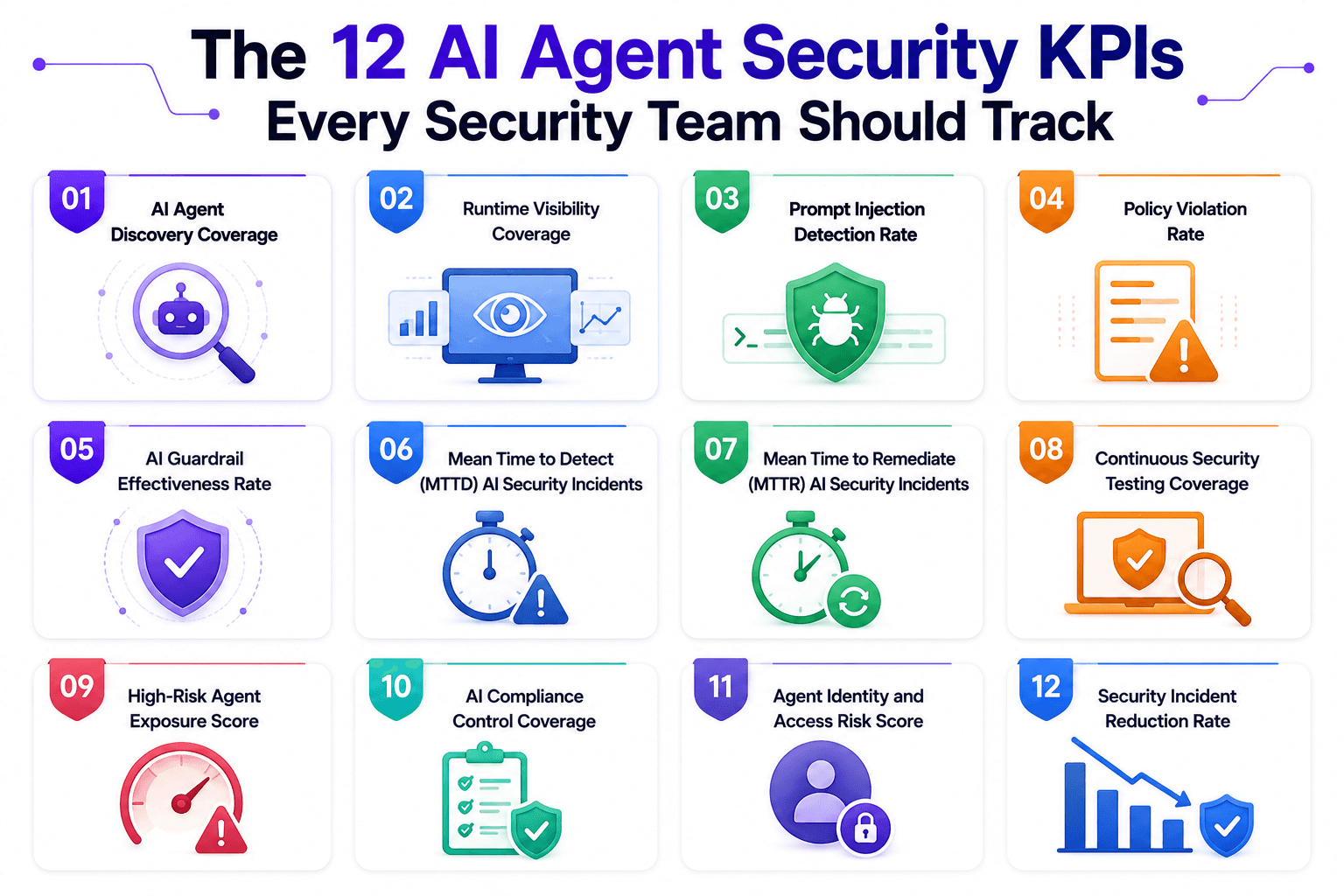
1. AI Agent Discovery Coverage
Formula: Discovered Agents ÷ Estimated Total Agents
Agent inventory coverage is the bottom line of it all – you can't secure what you can't see. This KPI represents the percentage of agents that your tooling has detected in comparison to your best estimate of the number of agents in all cloud, on-premises, and employee endpoints. When you are exposed to risk, but you do not know who the agents are, it is unmanaged risk. As long as a team turns on an agent with access to the database without registering it, it has created an unmonitored potential gateway to the sensitive data. But 70 percent discovery coverage translates to about one-third of your fleet being completely unsupervised. Do this until it is fully covered and maintain this until new agents join in.
2. Runtime Visibility Coverage
Discovery informs you that an agent has been found. It will tell you what it does when it is in use. With runtime visibility coverage, you can see how much of the agents you've discovered are under active monitoring of their prompts, tool calls, data access, and actions. An agent that you've inventoried that you can't watch is a name on a list. This coverage is critical to strong AI runtime security metrics, as all unmonitored agents represent a blind spot.
3. Prompt Injection Detection Rate
The signature attack on agents is prompt injection, i.e., the inputting of instructions into data read by the agent. This KPI monitors the number of prompt injection attempts detected over a period of time, providing an indication of the pressure that is being placed on it by the attackers and providing a measure of whether it is becoming easier or harder to detect. Even an increasing rate is not necessarily a bad thing; it may just be that you are getting better at detecting prompt injections. When it goes up, it's going up; when it goes down, it's going down, and you're winning. When both go up, specific agents need hardening; attackers are outpacing your controls.
4. Policy Violation Rate
This KPI records the frequency of agent attempts to actions that violate your rules, and it will be broken down into three categories: sensitive data violations, which are agent accesses or exposures to data that is not allowed; unauthorized tool use, which are agent calls to a tool that is not authorized to be called; and restricted actions, which are agent attempts to perform an operation that is explicitly restricted by the rules. This is a way to break policy violations down into a specific signal. An increase in unauthorized tool use indicates a permissions issue, whereas an increase in sensitive data violations indicates a data scoping issue. Under this measure is effective tool usage monitoring, as you can only monitor unauthorized tool calls if you monitor all tool calls.
5. AI Guardrail Effectiveness Rate
Formula: Blocked Violations ÷ Total Violations
Guardrails are placed between an agent and a risky action, preventing the action from executing. This KPI indicates the proportion of attempted violations that AI guardrails detected. If the rate is 95 percent, then nine out of ten times, guardrails succeeded in stopping the policy-breakers, and one failed. One of the easiest outcome metrics you can report is the effectiveness of the AI guardrails, as it addresses the question leadership cares about: When an agent does something dangerous, do we stop them?
6. Mean Time to Detect (MTTD) AI Security Incidents
The mean time to detect is the average time in which an agent is used in an inappropriate way until your team is aware of it. This window is more important with autonomous systems than with traditional software, as a single agent can execute hundreds of decisions in the few minutes that people are not aware of it. Some of the cutting is under the control of runtime visibility and good alerting. If the number is persistently decreasing, report MTTD as a trend – it means that the detection capability is maturing.
7. Mean Time to Remediate (MTTR) AI Security Incidents
Where detection ends, remediation begins. MTTR measures how long it takes to contain a risk once it has been detected or discovered, which could involve credential revocation, disabling a tool or shutting an agent down. Proper containment is the key; when an agent is compromised, it keeps doing what it does until it is prevented. Good MTTR relies on well-defined response playbooks, and on being able to isolate an agent without impacting the surrounding systems. The total amount of time the attacker had to work was the detect plus the contain; so reducing it is one of the most unambiguous ways of demonstrating the program is making progress.
8. Continuous Security Testing Coverage
This KPI indicates the percentage of agents who complete regular testing instead of a one-off test at launch. The testing should include several approaches, including AI red teaming, attack simulations, and runtime validation to ensure that controls are effective in real-world scenarios. Agents drift – and continuous security testing coverage requires a separate metric. A barrier put in place to prevent an injection technique may not be in place six months later when a new variant is encountered, while pipeline changes can be made without notice and leave old gaps open. High coverage refers to the ability of your security validation to meet the ever-changing attack techniques as well as the changes in your security systems.
9. High-Risk Agent Exposure Score
Every agent is not created equal, and applying the same treatment to the various ones is a waste of time. This KPI identifies your risky agents on the basis of a few criteria: More permissions than needed for the task, access to sensitive data, and being used in critical workflows with high stakes if it fails. This type of scoring allows you to prioritize protection in the area of maximum blast radius. A payment workflow agent, who has wide access to the system, has a lot more to answer for than an agent reading the internal documents.
10. AI Compliance Control Coverage
The regulators and standards have been swift to act on AI, and this indicator measures the depth of your controls conforming to the standards. Compare coverage with EU AI Act, NIST AI Risk Management Framework, ISO/IEC 42001, and/or internal AI policies. A percentage of the controls that can be shown to be implemented and effective. AI compliance metrics are not just for avoiding penalties. If an auditor were to ask you how you regulate agent behavior, you are prepared with AI compliance evidence on demand. Any control that you cannot demonstrate is a gap, since it is the same in the audit when it is not demonstrated or present.
11. Agent Identity and Access Risk Score
Identity is one of the fastest-growing risks in agentic systems, as agents must be both authenticated and carry credentials, and execute with privileges. This KPI measures the identity risk in a number of aspects: shared credentials (where multiple agents share the same secret and you lose attribution); excessive privileges (when agents have too much access to the program as compared to what they are supposed to have); and orphaned agents (where agents are maintaining secrets that they no longer need to maintain). As agents are deployed at scale by enterprises, agent identity management is emerging as a growing pain, especially because not enough was designed to keep up with the agent proliferation. Orphaned agents with live credentials are an invitation in the making, and shared credentials make investigation basically impossible. This metric is important in the context of MCP security where agents are attached to an ever-expanding web of tools and servers.
12. Security Incident Reduction Rate
The last KPI is the one that is going to show that the entire program was successful. It quantifies the decline in real security incidents over time, segmented by incident categories relevant to agents: prompt injection incidents, unauthorized actions, data exposure events. This is the single most important security metric for AI, and all other metrics here are designed to bring it down. A declining incident rate for all 3 categories is a direct measure of the reduction of actual harm – not only activity – your controls achieve. It's these AI security performance indicators that leadership carries with them and that make continued investment in security more compelling than any list of tools deployed.
Mapping AI Security KPIs to Governance and Compliance Frameworks
KPIs that correspond to known frameworks are weighted more, since if the number is linked to a standard, then both auditor and regulator will agree to that number. Connecting your AI governance metrics to frameworks transforms the way you track internally into an external proof.

NIST AI Risk Management Framework
The NIST AI RMF is based on three principles: govern, map, measure, and manage. The map function is supported by discovery coverage and high-risk exposure score. Discovery coverage and high-risk exposure score support the map function. The detection and remediation metrics are used to measure and manage. Using these functions in your reporting KPIs indicates that you have a structured risk process, rather than a set of risk controls.
ISO/IEC 42001
ISO/IEC 42001 is the management system standard dedicated to AI, having repeatable and auditable processes. It can easily be mapped to Continuous testing coverage and compliance control coverage because the standard doesn't care so much about a particular test as it does about the running of a consistent, documented program. KPIs that are continuously changing will give the evidence that an audit of a management system is seeking.
EU AI Act
Compliance requirements are tiered by risk under the EU AI Act, and are most stringent for high-risk systems in relation to transparency, oversight and risk management. This is reflected in the high-risk agent exposure score and compliance control coverage, where you can see the agents that are exposed and the controls that are required that the agents are showing. The mapping of KPIs to the Act turns a "burden of regulation" into a "program of tracking" for organizations that sell to the EU.
Internal AI Governance Programs
Most companies, in addition, have their own AI governance initiatives that have a policy aligned to their risk appetite. These are then measured using the KPIs, giving the governance committees the layer of oversight they require for the autonomous system. Policy violation rate and guardrail effectiveness will give you an idea if your own policies are being followed and enforced.
Common Mistakes When Measuring AI Agent Security
There are many teams that measure and feel safe, but they aren't. Many teams are measuring and feeling safe, but they are not. All of the following errors are reasonable individually.
Tracking Only Vulnerabilities
Familiarity with vulnerability counts makes them the first teams to go for. The issue here is that the risk of an agent is not just their known weaknesses but their behavior. But if the agent has no vulnerabilities, it can still be persuaded to leak data if the prompt is well-designed, for it is in the way it reasons, not some patchable fault. But just enumerating vulnerabilities and stopping there is ignoring that which is truly new in the risk.
Ignoring Runtime Behavior
A similar approach is to test on a small scale before putting it into production and moving on. Systems that make dynamic decisions at runtime require pre-deployment testing, but it is never enough. An agent acts differently when it encounters real data, real users, and real adversaries as compared with a controlled test situation. Agent visibility is not measured at runtime.
Measuring Activity Instead of Outcomes
In this trap, you get the most flashy-looking reports with the least value. Measuring effort, not effect, such as counting tests run, alerts generated, or tools deployed. It is not enough to show 10,000 tests carried out on a dashboard – it does not tell you whether any tests were detected that were significant. Activity metrics are answered by outcome measures, such as reducing incidents and the effectiveness of the guardrail.
Focusing Only on Compliance
Compliance coverage should be part of your dashboard, but if a program is only designed to pass audits, it is optimizing for the wrong target. There's no ceiling for frameworks, and an agent may meet all the checklist items without taking any action that is not regulated by an existing regulation that covers real operational risk. If compliance is viewed as an objective instead of a standard, you could find yourself vulnerable to attack by those who didn't think of it.
Building an Executive AI Security Dashboard
One dashboard is not enough for everyone, as a board member would want to see one view of the program, while a security analyst wants another. The best solution is to customize the AI security dashboard to fit its audience and show the KPIs that each of them chooses. Great AI security reporting is as much about audience as it is accuracy.
Metrics for CISOs
This needs to be the program CISOs are looking for, with a focus on risk and return. Present the surface-level security incident reduction rate, high-risk agent exposure score, and a roll-up of compliance control coverage. These address the questions a CISO conveys up the chain: How are we lowering risk, what is our biggest exposure, and do we fulfill our obligations? This perspective is also the perspective in which AI security ROI is configured – reduction of incidents and avoidance of audit findings is correlated to cost.
Metrics for Security Operations
Operations Teams require metrics that cause action. Here you'll find: mean time to detect, mean time to remediate, prompt injection detection rate, and policy violation rate. This approach favors freshness and granularity, as the operator will be making a decision about what to explore next, and not last quarter's average.
Metrics for AI Governance Teams
Governance teams have an interest in process and policy compliance. Provide them with ongoing coverage, guardrail effectiveness, and compliance views mapped in the framework. These demonstrate the effectiveness of the controls the program requires, and will give the committee the evidence it needs to approve new deployments or identify those that aren't.
Metrics for Board Reporting
Boards require the least detail, and the most context. It's best to focus on a few trendlines: number of incidents over time, compliance rating relative to key frameworks, and percentage of the agent fleet managed. This is not for the purpose of getting a better grasp of the program's improvement, nor is it for the purpose of ascertaining the exposure of an organization; the intent of this is rather to find out if the program is improving and whether the organization is exposed, in language that a non-technical director can take in very quickly.
How Automated Security Testing Improves AI Security KPIs
Manual measurement doesn't stand up to an increasing agent fleet. These KPIs are only accurate if they are based on automated underlying work. Akto Argus is designed for this, providing an AI agent systems in discovery, test, monitor, and guardrails.
Continuous Agent Discovery
Only as often as you look is discovery coverage complete. Akto is capable of detecting AI agents, MCP servers, and GenAI applications continuously across cloud and endpoints, including shadow AI resources teams that never registered. This way, you'll maintain your agent inventory coverage up to date when new agents join, rather than only up to the day you conducted a manual count.
Automated Red Teaming
Test coverage without human initiation requires continuous testing. The automated AI red teaming identifies over 1,000 real-world agent exploits in Akto's AI Agent Attack Matrix to constantly test agents for prompt injection, tool misuse, context leakage, and unsafe behavior. This is because it raises your testing coverage and your prompt injection detection metrics, since it highlights test holes before an attacker does.
Runtime Monitoring
All detection and remediation metrics are based on the monitoring of agents in production. Akto's runtime monitoring can identify rogue agents, shadow tools, and unauthorized invocations in real time to help ensure your runtime visibility numbers remain honest and driving mean time to detect down.
Guardrail Validation
The effectiveness of a guardrail is only as meaningful as how hard the guardrails are pushed. A control that worked at deployment times will not silently decay if Akto implements runtime guardrails to prevent dangerous agent activity before it is run and constantly validates the agent against new attack techniques.
Future of AI Security Measurement: From Compliance to Continuous Assurance
AI security measurement is shifting from one-off, snapshot checks to continuous assurance, with validation continuously running and governance occurring at runtime. For slowly changing systems, an annual audit was a sensible course of action. The behavior of autonomous agents varies by the hour, so that any snapshot taken on an annual basis is outdated almost as soon as it is signed. Continuous assurance does not audit a security system to prove security on audit day, but it does prove security right now, and the KPIs are continuously updated, while the controls enforce policy as an agent acts. The running scoreboard of this model is Agentic AI security KPIs.
Designed for this change, Akto provides security teams a unified platform for continuous discovery, automated red teaming, runtime monitoring, and guardrails enforceable for AI agents and MCP servers. When combined, that makes the 12 KPIs in this guide into a real-time picture of your AI security posture. When you're ready to see a demonstration of your fleet of agents, continuously test them, and provide metrics that can withstand a board and auditor, schedule AI Agent Security demo and experience continuous AI agent security.

Experience enterprise-grade Agentic Security solution