
2026 State of Agentic AI Security
How ready is your organization to secure AI agents?
3 quick questions. See how you compare to other security leaders.
Security teams asking "how do we actually secure our GenAI applications" now have a cheatsheet.
The OWASP GenAI Security Project just released the Q2/Q3 2026 update of its LLM & GenAI Security Landscape - a peer-reviewed, community-built map of the available solutions covering the GenAI security lifecycle. Akto is named in two of the categories: Test & Evaluate and Monitor.
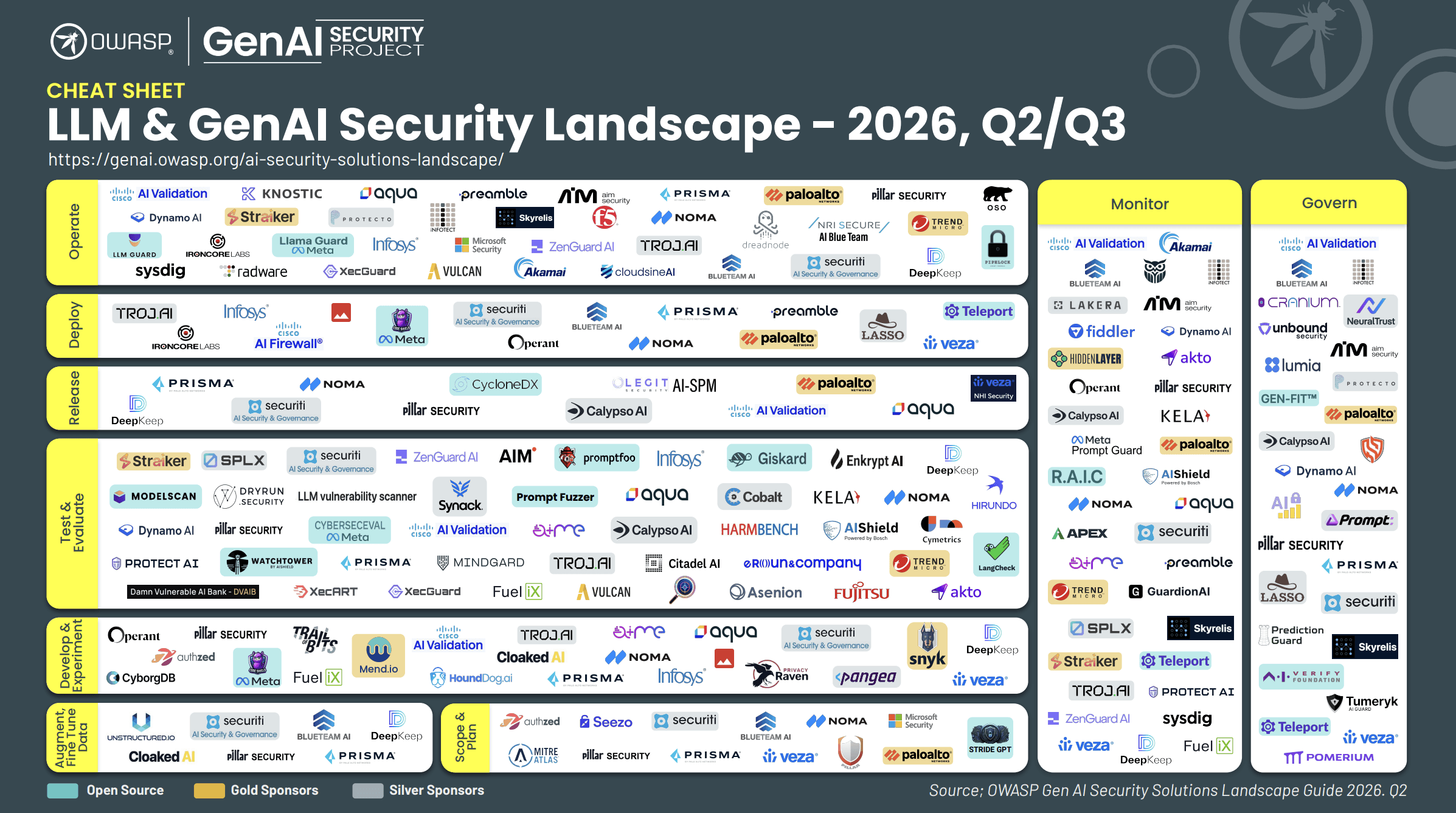
What is the AI Security Solutions Landscape for LLM and GenAI Apps?
The AI Security Solutions Landscape for LLM and GenAI Apps is a continuously updated view of the tools and platforms shaping security across the entire LLM and generative AI lifecycle. It maps solutions across the DevOps–SecOps intersection, helping teams address evolving risks as AI systems move from development to production.
Guided by the OWASP Top 10 Risks and Mitigations for LLM and GenAI, along with real-world SecOps workflows, the landscape categorizes both open-source and commercial offerings by lifecycle stage. It highlights how each solution supports key security responsibilities from discovery and testing to runtime protection and governance.
Built with input from industry practitioners and the broader security community, this peer-reviewed resource helps organizations navigate the rapidly expanding ecosystem of AI security solutions with clarity and confidence. Updated quarterly, it ensures teams stay aligned with the latest innovations in securing LLM and GenAI applications.
Where Akto appears, and why these categories matter
Test & Evaluate. This is the pre-deployment stage where GenAI applications are validated for security before they ship. The OWASP framework's LLMSecOps tasks for this stage include adversarial testing, application security orchestration, penetration testing, SAST/DAST/IAST, vulnerability scanning, and agent scanning. In other words, the work of finding what breaks before attackers do.
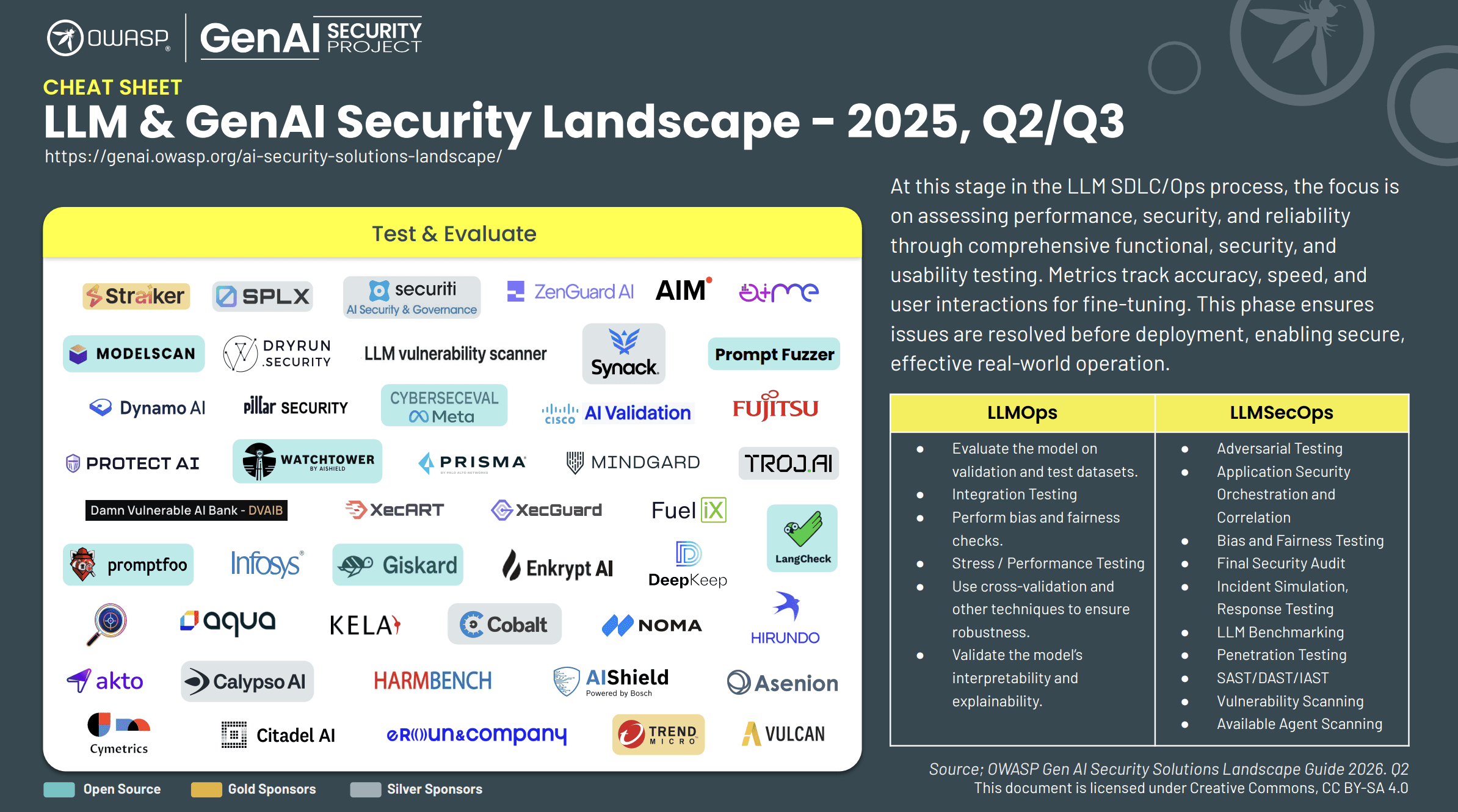
Security teams adopting GenAI keep asking the same question: how do we know this thing is safe to ship? Akto answers it by probing LLM endpoints, agentic workflows, and the MCP servers connecting agents to enterprise tooling - finding the prompt injection paths, the over-permissioned tools, and the data exposure routes before production.
Monitor. This is the post-deployment stage - the runtime layer. The OWASP framework's LLMSecOps tasks for Monitor include adversarial input detection, model behavior analysis, AI/LLM secure posture management, security alerting, user activity monitoring, and agent activity monitoring.
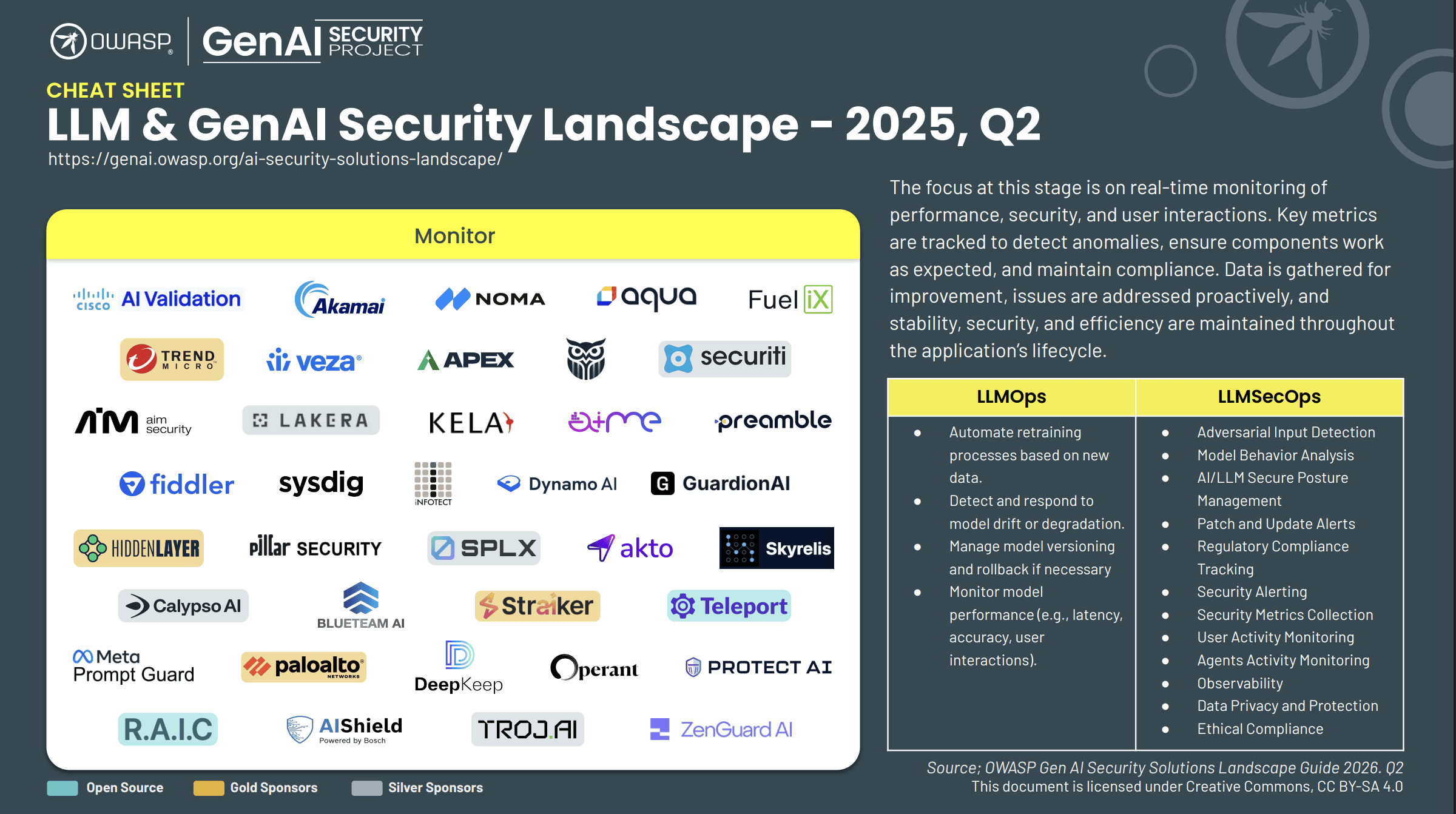
Akto is in this category because securing AI applications doesn't end at deployment. Once agents are live, the attack surface keeps moving - prompts shift, tools get added, agents start calling other agents, and the only way to keep up is to watch what's actually happening in production.
Akto is grateful for the recognition and, more importantly, grateful to be part of the conversation that's defining how Agentic AI is secured.
Read the full landscape: OWASP AI Security Solutions Landscape →

Experience enterprise-grade Agentic Security solution