Shadow AI Attack Surface: How Unsanctioned AI Tools Create Exploitable Risk
Learn how shadow AI expands the enterprise attack surface - credential exposure, malicious extensions, agent compromise - and how to reduce it.

Arpashree

Every AI tool an employee adopts without security review adds a door nobody is watching. The shadow AI attack surface is what accumulates behind those doors: unsanctioned browser extensions, unmonitored API connections, and agents no one inventoried, each one a potential entry point an attacker can reach before a defender even knows it exists.
What Is the Shadow AI Attack Surface?
The shadow AI attack surface is the set of exploitable entry points created by AI tools, models, and integrations that operate inside an organization without security team knowledge or approval. It is not a single category of risk. It spans browser extensions that route traffic through an AI sidebar, employees pasting proprietary code into a public chatbot, and development teams wiring an external AI API into a production system without a security review ever happening.
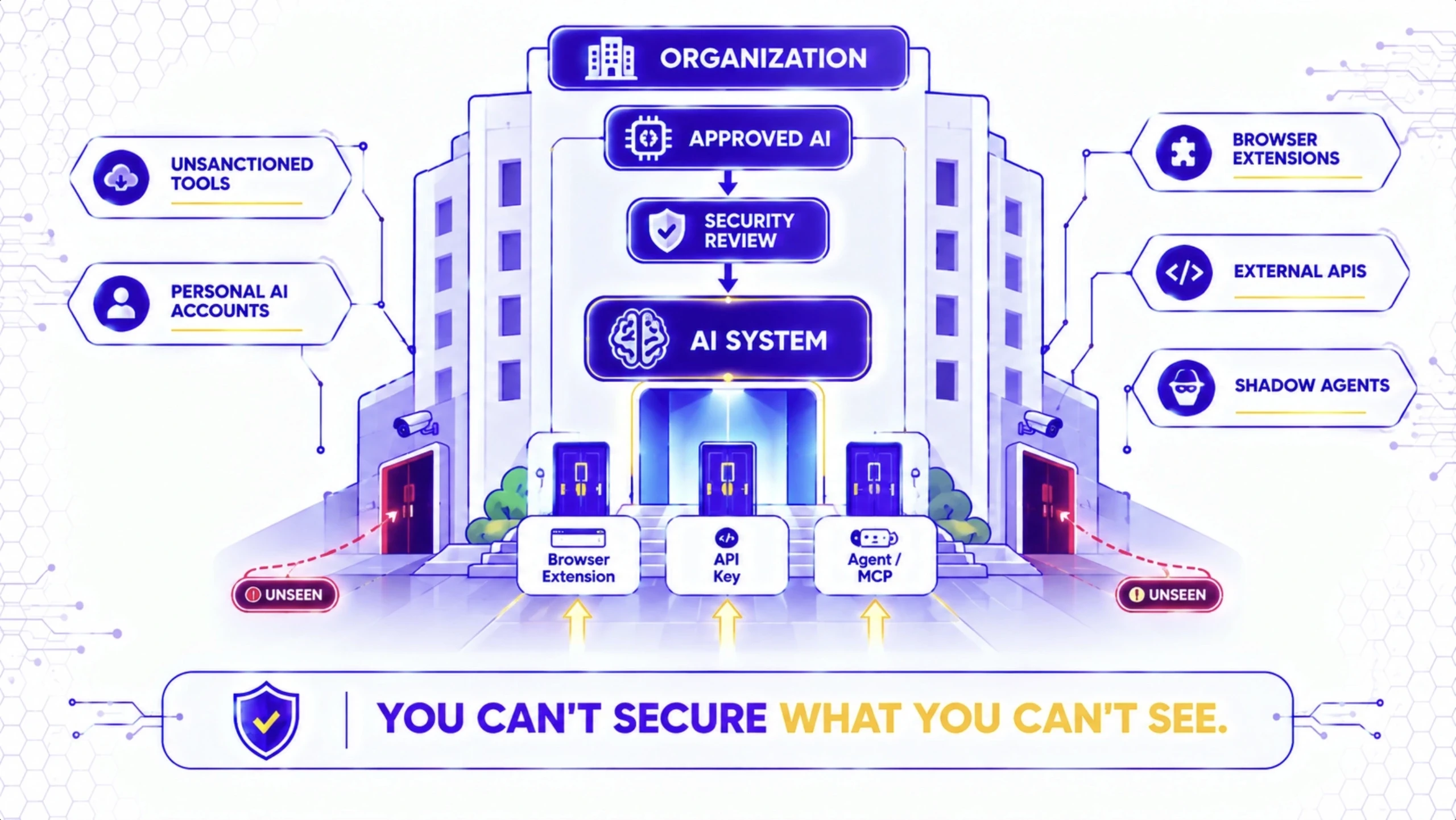
Shadow AI as One Category Within the Broader AI Attack Surface
CloudSEK's taxonomy of the AI attack surface splits it into four categories: external, internal, third-party, and shadow. The external AI attack surface covers public APIs, internet-facing chatbots, and exposed inference endpoints. The internal AI attack surface covers enterprise copilots and internal assistants with broad credential access. Third-party attack surface covers risk introduced through vendors, plugins, and open-source dependencies. Shadow AI is the fourth category, and it cuts across the other three: a shadow AI tool can be an unsanctioned public API, an unapproved internal assistant, or an unreviewed third-party plugin. What makes it distinct is not what the tool does but that security teams cannot see, inventory, or govern it.
Why Shadow AI Attack Surface Is Fundamentally Different from Shadow IT
Shadow IT has been a known enterprise problem for over a decade. Shadow AI looks similar on the surface, an unapproved tool an employee adopted without asking, but the underlying risk is a different shape entirely.
Data Goes Out, Not Just In
With shadow IT, the risk was mostly static. An employee stored a spreadsheet in a personal Dropbox account, and that file sat there, exposed but contained, until someone found it. As one security firm put it, the data did not just sit in a bucket somewhere with shadow IT, but it does with shadow AI: it becomes part of something larger and far less controllable. When an employee pastes proprietary source code or client data into a public AI model, that data can be retained, used to shape future outputs, and surfaced to entirely different users months later. There is no equivalent to deleting a file from a bucket once a model has learned from it.
Comparison Table: Shadow IT vs. Shadow AI Attack Surface
Dimension | Shadow IT | Shadow AI Attack Surface |
|---|---|---|
Deployment | Manual signup for a SaaS tool | Browser extension install, API key paste, or one-click agent setup |
Vulnerability types | Weak access controls, unpatched software | Prompt injection, model-specific exploits, credential exposure via tool calls |
Detection difficulty | Moderate; traffic to known SaaS domains is visible | High; AI traffic often looks like ordinary web or API traffic to legacy tools |
Data impact | Data stored, often recoverable | Data can be retained, learned from, or exfiltrated through agent actions |
How Shadow AI Expands the Attack Surface: Concrete Vectors
The attack surface Shadow AI creates is not theoretical. Each of the following vectors has already produced a documented, real-world incident.
Credential and API Key Exposure
Developers frequently embed AI API keys directly in code or CI/CD pipeline configuration to move fast, without routing the integration through a security review. Once that key is committed to a repository, whether public or shared internally with broader access than intended, it becomes a standing credential an attacker can use to call the AI service on the organization's account, at the organization's expense, with none of the usage monitoring a sanctioned integration would have.
Malicious or Compromised Browser Extensions
Browser extensions are one of the most underappreciated entry points in the shadow AI attack surface, because they sit between the user and every AI platform the user visits, with permissions few employees ever scrutinize. In December 2025, security researchers at Koi disclosed that Urban VPN Proxy, a Chrome and Edge extension with a Google "Featured" badge and more than six million installs, had been secretly intercepting conversations with ChatGPT, Claude, Gemini, and several other AI platforms since a July 2025 update, forwarding prompts, responses, and session metadata to external servers regardless of whether the VPN itself was active. Weeks later, OX Security disclosed two separate Chrome extensions, installed by more than 900,000 users, that impersonated a legitimate AI sidebar tool while exfiltrating ChatGPT and DeepSeek conversations, along with every open browser tab URL, to attacker-controlled infrastructure every 30 minutes. Both incidents involved extensions that Google had featured or approved, which means an employee doing everything reasonably expected of them, checking ratings and trusting store badges, still introduced the exposure.
Indirect Prompt Injection via AI Browser Assistants
Shadow AI risk is not limited to employees deliberately choosing an unapproved tool. Agentic AI browsers create a passive exposure path: a technique called HashJack, disclosed by Cato Networks, hides malicious instructions in the fragment portion of a URL, the part after the "#" symbol that web servers never see but that AI browser assistants read in full. A user can click a completely legitimate-looking link, and the AI assistant reading that page can be silently instructed to exfiltrate account data, insert a phishing link into its own response, or take other unintended actions, all without the underlying website ever being compromised. The technique affected Comet, Copilot for Edge, and Gemini for Chrome, with fixes applied at different speeds across vendors.
Shadow AI Agents: Active Compromise, Not Just Passive Exposure
A shadow SaaS tool is largely a passive risk: data sits somewhere it should not. A shadow AI agent is an active one. An agent an employee or team spun up without security review can hold live credentials, execute code, call external tools, and persist state across sessions, which means a compromised shadow agent does not just leak data once; it can take repeated unauthorized actions across every system it has been connected to until someone notices. The difference between a forgotten file and a forgotten agent with standing API access is the difference between a leak and an open door.
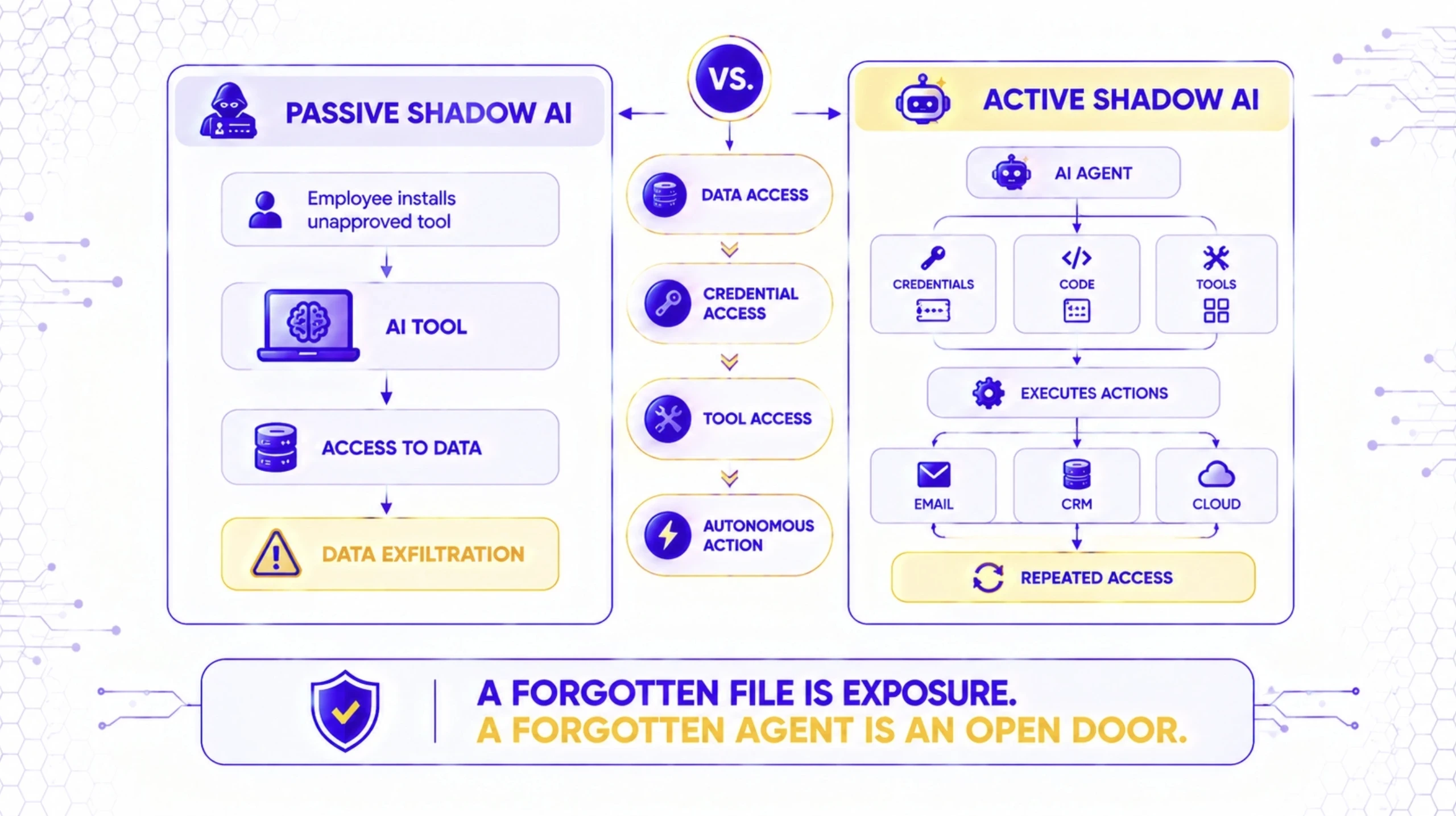
Data Exfiltration Through Unmonitored Channels
Every vector above shares a common thread: the data leaves through a channel the security team was never monitoring in the first place. Traditional data loss prevention tools watch known egress points, corporate email, approved cloud storage, sanctioned SaaS APIs. Shadow AI traffic routes through browser extensions, personal AI accounts, and agent-to-tool connections that were never classified as a monitored channel, so the exfiltration does not trigger the alerts an organization already built its defenses around.
Why This Attack Surface Is So Hard to Defend
The vectors above are individually well documented. What makes the shadow AI attack surface difficult in practice is that most organizations cannot see them happening at all.
You Can't Secure What You Can't Inventory
Every control downstream of discovery, access policy, credential governance, and DLP rules, depends on knowing an AI tool exists in the first place. An organization with a comprehensive AI Bill of Materials can apply consistent controls across every sanctioned tool. An organization without one is applying those same controls to a fraction of its actual AI footprint, while the rest grows unmonitored in the gaps between IT-approved software and whatever an employee installed on a Tuesday.
Traditional Perimeter and Endpoint Tools Miss AI-Specific Signals
Firewalls, endpoint detection tools, and traditional SAST and DAST scanners were built to catch code-level defects and known traffic patterns. They were not built to recognize a prompt injection payload, a poisoned tool description, or an agent making an unauthorized tool call, because these risks operate at the model and inference layer rather than the network or application layer those tools were designed to inspect. A shadow AI browser extension routing traffic to an external analytics endpoint can look, to a legacy tool, like any other benign background process.
The Real Cost of an Unmanaged Shadow AI Attack Surface
The financial case for closing this gap is no longer theoretical. IBM's 2026 Cost of a Data Breach Report found that security incidents involving shadow AI more than doubled year over year, now accounting for 43% of AI-related incidents, up from 20% the year before. Breaches tied to shadow AI cost organizations an average of $5.39 million, compared to $4.63 million for breaches without significant shadow AI involvement, a premium driven by the sensitivity of what typically flows through unmonitored AI channels and the added forensic difficulty of investigating an incident with no logs of what was actually sent. Detection remains the slowest part of the equation industry-wide: the same report put the average time to identify and contain a breach at 247 days, and shadow AI incidents, lacking the audit trails a sanctioned tool would generate, tend to run even longer before discovery.
Breach Cost and Detection Time Data
The gap between organizations with strong AI governance and those without is stark in IBM's data. Companies that had not established governance to manage AI or detect shadow AI usage rose to 68% in the 2026 report, up from 63% the year before, moving in the wrong direction even as the cost premium for shadow AI incidents grew. Only 38% of organizations require IT approval before an AI tool is deployed at all, meaning the majority are relying on employees to self-regulate a decision most are not equipped, or incentivized, to make carefully.
Reducing the Shadow AI Attack Surface
Closing this gap does not require banning AI tools, which tends to push usage further underground rather than eliminating it. It requires visibility, prioritization, and governance built specifically for how AI tools actually get adopted.
Visibility First: Discovery Across Browser, Endpoint, and Network
The starting point is continuous discovery across every layer where shadow AI actually shows up: browser extensions, endpoint processes, and network traffic to known and emerging AI service domains. A point-in-time inventory goes stale within weeks given how fast new AI tools and browser extensions reach the market, so discovery needs to run continuously rather than as an annual audit.
Scoring and Prioritizing Exposure
Not every shadow AI tool carries equal risk. A risk assessment process should score discovered tools by what data they can access, what permissions they hold, and how widely they have spread across the organization, so security teams can address the handful of genuinely dangerous tools first rather than treating every browser extension as an equal emergency.
Governing Credentials and API Keys
Because credential exposure is one of the most direct paths from shadow AI to a real breach, organizations need automated scanning for AI API keys embedded in code repositories and CI/CD configurations, paired with a rotation and revocation process that does not depend on someone remembering a key exists.
Gateway-Level Inspection for Sanctioned AI Traffic
Even sanctioned AI usage benefits from an AI security gateway that inspects traffic at the point it leaves the organization, since gateway-level visibility catches misuse of approved tools that would otherwise look identical to legitimate traffic, and gives security teams a single chokepoint to enforce policy rather than chasing enforcement across every individual tool.

Shadow AI Attack Surface in Agentic and MCP Environments
The shadow AI attack surface does not stop at browser extensions and chatbots. As organizations adopt agentic AI and connect agents to external tools through the Model Context Protocol, the same governance gap reappears at a higher level of risk: an unsanctioned MCP server connection or an agent spun up without review can hold live credentials and execute actions, not just expose data. The discovery and governance principles are the same, but the stakes scale with what the shadow tool can actually do.
How Akto Helps Reduce the Shadow AI Attack Surface
Discovery Across Employee Tools, Agents, and MCP Servers
Akto continuously discovers AI usage across browser extensions, employee-adopted tools, agents, and MCP server connections, building the comprehensive inventory that every downstream control, access policy, credential governance, and monitoring depends on.
Detecting Credential and API Key Exposure
Akto scans for AI API keys and credentials exposed in code repositories, CI/CD pipelines, and configuration files, closing one of the most direct and preventable paths from shadow AI adoption to an actual breach.
Continuous Monitoring, Not a Point-in-Time Scan
Because the shadow AI attack surface changes weekly as new tools and extensions reach the market, Akto's discovery runs continuously rather than as a periodic audit, so newly adopted tools are surfaced as they appear rather than months later during the next scheduled review.
Final Thoughts on Shadow AI Attack Surface
Shadow AI is not a problem that gets solved by banning AI tools or hoping employees exercise better judgment about browser extension ratings. It is a visibility problem first, and every other control, credential governance, gateway inspection, agent oversight, only works once an organization actually knows what AI is running inside it. The incidents already on record, from featured Chrome extensions harvesting millions of AI conversations to URL fragments hijacking browser assistants, show that this attack surface is being actively exploited today, not a hypothetical risk to plan around for later.
FAQs: Shadow AI Attack Surface
1. How is the shadow AI attack surface different from shadow IT?
Shadow IT risk was largely static: data sat in an unapproved location. Shadow AI risk is active: data entered into a model can be retained, used to shape future outputs, and surfaced to other users, with no way to delete what a model has already learned.
2. Why does shadow AI expand the attack surface more than a typical unsanctioned SaaS app?
Shadow AI tools do not just store data; they process it, and increasingly act on it through agents that hold credentials and execute tasks, which turns a passive exposure into an active one capable of taking further unauthorized actions.
3. Can browser extensions create shadow AI attack surface exposure?
Yes. Two documented incidents in late 2025 and early 2026 involved a combined total of more than 6.9 million installs across extensions that secretly intercepted and exfiltrated AI chat conversations, including one that carried Google's own "Featured" badge.
4. What is indirect prompt injection, and how does it relate to shadow AI?
Indirect prompt injection hides malicious instructions in content an AI system reads, such as a webpage or URL, rather than in the user's direct prompt. HashJack demonstrated this by hiding instructions in URL fragments that AI browser assistants process, but web servers never see.
5. How do shadow AI agents create more risk than passive shadow AI tools?
An unsanctioned agent can hold live credentials, execute code, and take repeated actions across connected systems, so a compromise produces ongoing unauthorized activity rather than a single, contained data exposure.
6. How does shadow AI lead to credential or API key exposure?
Developers often embed AI API keys directly in code or CI/CD configuration to move quickly, without routing the integration through security review, leaving a standing credential exposed to anyone with repository access.
7. Why is the shadow AI attack surface hard to detect with traditional security tools?
Firewalls, endpoint tools, and traditional code scanners were built to catch network and application-layer issues, not model-layer risks like prompt injection or unauthorized tool calls, so shadow AI traffic often looks like ordinary background activity.
8. What real-world incidents illustrate the shadow AI attack surface?
The Urban VPN Proxy extension harvesting AI conversations from over six million users, two OX Security-disclosed extensions exfiltrating ChatGPT and DeepSeek chats from 900,000 users, and the HashJack indirect prompt injection technique against AI browsers are all documented, disclosed incidents.
9. How much does an unmanaged shadow AI attack surface cost organizations after a breach?
IBM's 2026 Cost of a Data Breach Report found shadow AI incidents cost an average of $5.39 million compared to $4.63 million for other breaches, with detection across all breaches averaging 247 days.
10. How do you reduce the shadow AI attack surface without banning AI tools?
Continuous discovery across browser, endpoint, and network layers, risk-based prioritization of what is found, credential governance, and gateway-level inspection of sanctioned AI traffic together reduce exposure without pushing usage further underground through an outright ban.
11. Does the shadow AI attack surface extend to AI agents and MCP servers?
Yes. Unsanctioned agents and MCP server connections carry the same discovery and governance gap as browser extensions and chatbots, but with higher stakes, since agents can act on credentials rather than only exposing data.
12. What's the difference between the shadow AI attack surface and general AI attack surface?
The general AI attack surface includes external, internal, and third-party categories alongside shadow AI. Shadow AI is specifically the portion of that surface security teams cannot see, inventory, or govern, regardless of which of the other categories a given tool would otherwise fall under.
13. Can gateway-level controls help reduce shadow AI attack surface exposure?
Yes, for sanctioned traffic. An AI security gateway inspects traffic at the point it leaves the organization, catching misuse that would otherwise be indistinguishable from legitimate use, though it cannot cover tools a gateway was never configured to see in the first place.
14. How does Akto help identify and reduce the shadow AI attack surface?
Akto continuously discovers AI usage across browser extensions, employee tools, agents, and MCP servers, scans for exposed credentials and API keys, and maintains ongoing monitoring rather than periodic point-in-time scans.

Experience enterprise-grade Agentic Security solution