AI Governance and Compliance Tools Compared
Compare leading AI governance and compliance tools - features, regulatory mapping, agentic AI support - to find the right fit for your organization.

Rushali

A security team at a medium-sized insurance company took three months to create a spreadsheet of all the models currently in production and then found that, as part of a NAIC exam, they had missed 11 models supplied by the vendor and had not registered them. That's the situation of most companies these days. That's where AI governance and compliance tools come in, but the market has been divided into platforms to document AI risk, platforms to enforce it, and a few that attempt to do both. If it is not the right one, you will discover the reality of it when you are audited or hit a problem, which is often in the form of an incident.
This guide doesn't just present a Top 10 list of the market; this is a breakdown of the market by real capabilities, a comparison of seven big products head-to-head, and the identification of the limitations of even the best of the bunch, once agents and tools connected with the MCP are factored in.
What Are AI Governance and Compliance Tools?
AI governance and AI compliance tools are software platforms that enable an organization to identify the AI systems that are being used, to assess and score the risks of each AI system, to map the risk to regulatory requirements, and to provide evidence that can be given to an auditor or a board. The category emerged because there was a real need when a company has hundreds of models, dozens of vendor APIs, and a burgeoning population of LLM agents that were embraced by no one in particular. In its current state, AI compliance software is more a way of bridging four different roles that used to be housed in different teams behind the scenes: cataloging all of AI, scoring what it might get wrong, assigning that score to a specific regulation by name, and ensuring the entire picture remains up to date as systems evolve.
It's there that buyers also get confused, as they see a number of other adjacent categories of tools doing the same thing, and they're not.
Governance and Compliance Tools vs. MLOps Platforms vs. Data Catalogs vs. Traditional GRC
The mechanics of moving a model to production: pipelines for training, versioning, deployment infrastructure, and rollback are all managed by MLOps platforms. They will let you know the accuracy and latency of a model on a test set. They won't let you know if that model would need a fundamental rights impact assessment under the EU AI Act, and most were not designed to record that sort of legal metadata against a model record to begin with.
Data catalogs are a different approach to the same challenge. They trace lineage and metadata for datasets, tables, pipelines, and more, which is important for AI governance as you can't assess the risk of a model without knowing what data it was trained on. However, a catalog can only go so far as the data layer. It doesn't understand the concept of a model's risk tier, doesn't have a workflow for an AI use case intake form, and doesn't know how to create technical documentation as required by the EU AI Act's conformity assessment.
Traditional GRC platforms are designed to address enterprise risk in a general way – vendor risk, financial controls, security policy attestations, audit preparation, in all aspects that a company comes across. AI is just another class of risk; most were not built to be able to reason about drift, bias, prompt injection, or a single session calling five tools. Others, such as OneTrust, are taking the established GRC and privacy base and applying it to AI. Still others see AI as just another risk item in the larger risk register, forcing teams to create AI-specific workflows on a tool that wasn't designed to support them. Finally, for an MLOps vs. governance tool or GRC vs. AI-specific governance, the same question applies: does the platform have an understanding of the tier of regulatory risk associated with a model, and can it provide evidence, or does it simply run the model? The best way to determine what an AI governance platform needs to add is by knowing where your current MLOps, data catalog, or GRC investment ends.
Categories of AI Governance and Compliance Tools
Most comparison articles mention 10 vendors in a row and allow the reader to make their own suppositions about the differences. That strategy obscures the more useful reality that these products are grouped into five different product architectures, and each of those has different failure modes, buyers, and architectures. Once you know what type you need, instead of looking through the top 10 tools that need to be demoed for a general search audience, you'll be left with only 2 or 3 tools that you need to demo for your specific stack.
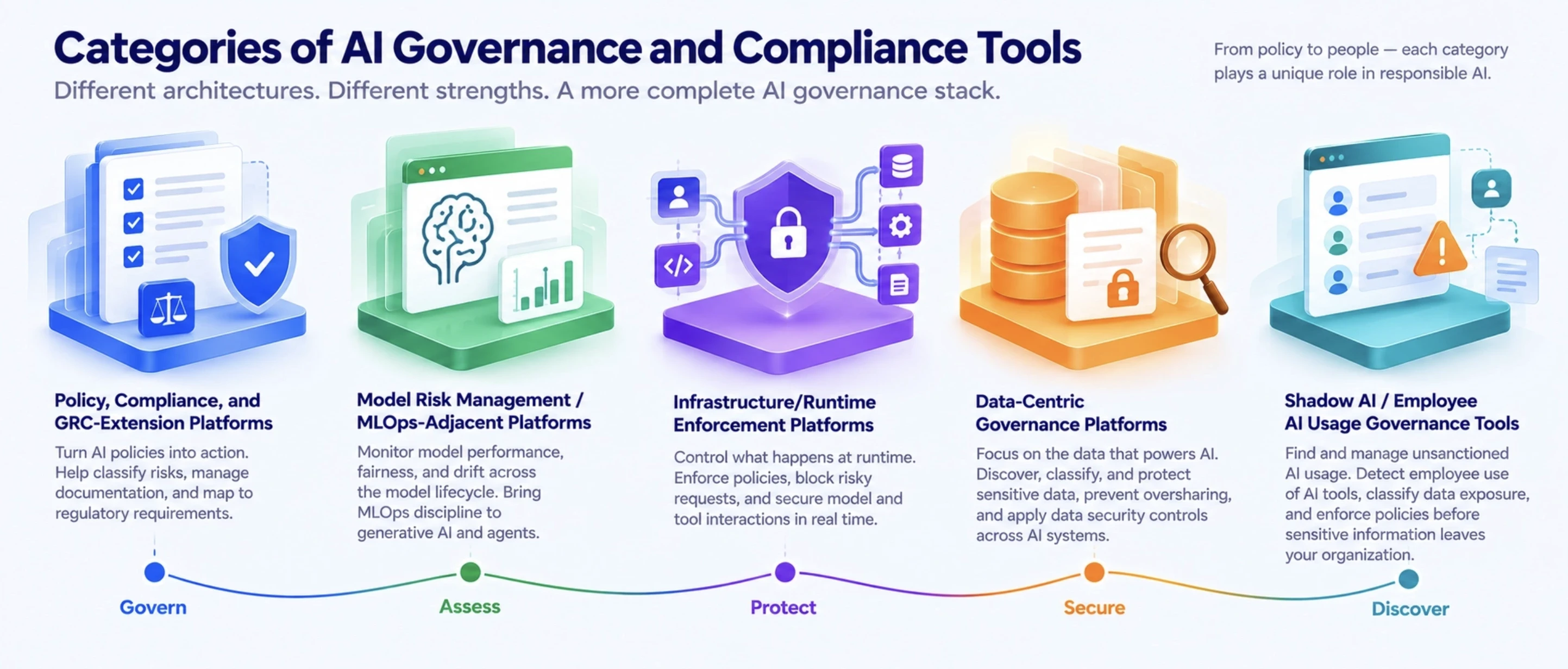
Policy, Compliance, and GRC-Extension Platforms
These platforms focus on policy intake, risk classification, and documentation generation, typically developed as an extension of an existing privacy or GRC product line aimed at AI. The clearest example is OneTrust AI Governance, which maps existing privacy and third-party risk workflows to AI systems, creating an AI bill of materials (AIBOM) that includes all AI models, datasets, third-party dependencies, and data protection impact assessments and AI compliance reports to the GDPR and the EU AI Act. Credo AI falls into this category too, although the Knowledge Graph and policy packs were custom-built for the AI, not repurposed from a privacy product; and the GAIA assistant automates the weeks of governance analyst intake and control-mapping work. Tools that fit in this bucket are best at generating the documentation regulators and auditors are looking for, and least at understanding the actual actions a model took at 2 a.m. last Tuesday.
Model Risk Management / MLOps-Adjacent Platforms
The category emerged from model risk management practices that banks and insurers have been managing for decades – such as SR 11-7 – and now extends to generative AI and LLM-associated risks like prompt drift and hallucination. The clearest example is IBM watsonx.governance, which integrates OpenPages GRC with AI Factsheets and OpenScale monitoring to monitor a model from intake to retirement, automatically creating audit-ready documentation, and notifying of fairness or drift above thresholds. Monitaur is a more targeted version of this type of solution – designed for NAIC, OCC, and actuarial standards of insurance and banking model risk teams looking to provide governance evidence that aligns with the way examiners currently operate. The platforms are good with the lifespan discipline for models with known inputs and outputs; not so good with agents that take different decisions for each run.
Infrastructure/Runtime Enforcement Platforms (Gateway-Layer)
Different from the first two categories, gateway-layer platforms are platforms that dictate what is happening at the call of a model or tool at the time of execution. The clearest representative is TrueFoundry, which places its AI gateway and MCP gateway in the request path of every model call, and has per-tool access policies written as policy-as-code, RBAC, OAuth 2.0 identity injection, and PII redaction, which mean that a rule change ships the same way as an engineering team would ship any other config change, instead of sitting in a document waiting for someone to notice. Unlike a policy-intake platform, this is an architecture that has appeal for platform and security engineering teams more than for legal or compliance teams, given its value is in the number of blocked requests and audit logs, not a compliance-percentage dashboard.
Data-Centric Governance Platforms
The category is led by Microsoft Purview, which considers the data an AI system interacts with the most important governance surface, not the model itself. It also has a Data Security Posture Management for AI feature that conducts weekly scans of the SharePoint sites Copilot relies on, adds sensitivity labels and DLP policies to what the AI tool can view, and alerts to oversharing before a Copilot query brings up a file that three users had set to "everyone" permissions. Securiti.ai has a similar playbook, which is independent of any cloud vendor. The power here is real: If you don't have control of the data that powers the AI system, you don't have control of the system itself. But it's also a reality because the depth of Purview decreases as soon as the AI system is outside of Microsoft 365 and Azure.
Shadow AI / Employee AI Usage Governance Tools
All the categories listed above are based on the assumption that you are familiar with the various AI systems. This premise falls apart at the customer tabs, where a new class of tools has been created to handle the challenge of pasting a customer record into a personal ChatGPT account. Aona AI fits into this category nicely: It does not control approved enterprise models, but instead runs a browser extension and desktop version that detects the usage of AI tools in a catalog of thousands of AI applications embedded in consumer SaaS, and classifies the sensitive data that flows into each of these tools, and then applies a policy from a warning to a hard block when an employee tries to submit a prompt. This is a separate category from the general discovery of shadow AI, which is performed within a wider governance framework, and is different from discovery via an API gateway or model registry, and will be able to detect the use of AI that never even involves a corporate model registry, since the employee didn't ask IT.
Core Capabilities to Evaluate
The differences between vendor marketing pages are often limited to the same 12 feature bullets, no matter the category, making it difficult to discern from the outside. The five capabilities below are where enterprise AI governance tools truly fall apart and where you get a mismatch between what you need and what a platform can do, which can be costly months after the sign.
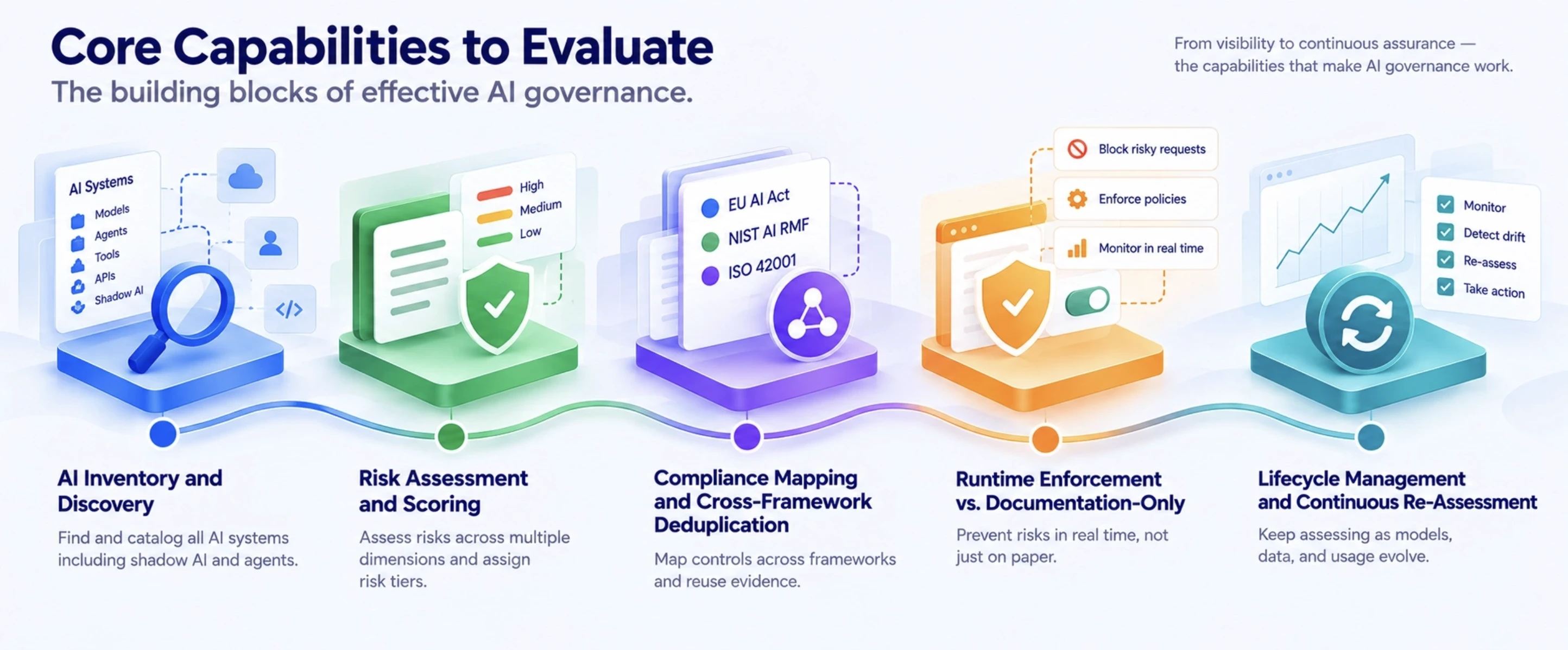
AI Inventory and Discovery (Including Shadow AI and Agents)
The precondition is, for all else, an inventory, and the difficult part is not keeping an inventory field for each model. It's the vendor's SaaS product with an embedded AI feature that nobody registered at procurement time; the data science team's SageMaker endpoint that nobody knew was created and exposed; or an engineer's own personal Claude Code session from a production database. Holistic AI's discovery scanner boasts the ability to uncover a full AI system inventory in as little time as 24 to 48 hours, without disrupting operations, and that's important because manual discovery via interviews can be outdated by the time it is finished. Agent discovery takes things to the next level: an agent can be made up of a model, a set of tools, and a series of API calls; a registration of "the agent" without a registration of what it can reach and what it was observed doing is a bit of an understatement in terms of the actual inventory.
Risk Assessment and Scoring
After a system is put into the inventory, it should be assigned to a risk tier, and the scoring logic under the risk tier is where platforms vary more than their dashboards. Based on their own research on building trustworthy AI, holistic AI scores models on five dimensions: bias, adversarial robustness, privacy, effectiveness, and explainability, and displays them in a red-amber-green format to allow executives to quickly scan without having to read the assessment. The model-level scoring most platforms default to is the foundation, with Credo AI's approach adding an extra layer of a purpose-built control library for agentic risks-tool misuse, scope drift, and inter-agent risk. The risk profile is different from the agent's risk profile (can the agent manipulate the risk profile into one it doesn't fit), the distinction is important because one would not be able to build a platform for the former question for the latter.
Compliance Mapping (EU AI Act, NIST AI RMF, ISO 42001) and Cross-Framework Deduplication
Most enterprises that operate globally are subject to at least two of these three frameworks simultaneously, with the most time being spent by governance teams mapping each control by hand against each framework. The NIST AI RMF breaks obligations down into four functions: Govern, Map, Measure, and Manage; the ISO 42001 provides a certification framework for an AI Management System based on the ISO 27001 structure; and the EU AI Act introduces new technical documentation obligations under Annex IV and post-market monitoring obligations under Article 72. Rather than clashing, these three frameworks overlap, with an inventory control that meets ISO 42001's requirement for a register of AI systems also directly contributing to the NIST's Map function and to the AI Act's documentation requirements of the EU.
The concept of cross-framework deduplication is the matching of a piece of evidence to each of the frameworks for which it is a match rather than collecting the same evidence three times. That is only possible if the evidence can be proven to be clean, that is, if the auditor can know which system the evidence came from, when that system ran it, and what version of the framework it ran on; otherwise, the deduplication is something the auditor must re-verify by hand. If the control mapping from the platform indicates that a single control meets both the EU AI Act and NIST AI RMF requirements, for example, a financial services firm must comply with both, there is no need for two separate assessment processes. The Cloud Security Alliance's AI Controls Matrix, a 243-control library that covers 18 security domains, released in the middle of 2025, does the same job at the industry-standard level in a single bundle, and a handful of vendors are creating their own mapping libraries atop it.
This is the same place that a platform's currency will appear. The Digital Omnibus on AI, Regulation (EU) 2026/1744, which introduces the toughest obligations, the Annex III high-risk obligations on education, credit scoring and hiring, was effective on 27 July 2026 and extended the deadline for the obligations in Annex III to 2 December 2027, while the obligations in Annex I for high-risk systems embedded in other regulated products, such as medical devices, were deferred to 2 August 2028. The powers of Article 50 with respect to transparency obligations (chatbot disclosure, AI-generated content marking) and the enforcement powers of the AI Office over general-purpose AI providers remain unchanged, both coming into effect on August 2nd, 2026. An existing compliance mapping tool on the original 2026 high-risk timeline will incorrectly assign an exposure window to a company, and it's also important to ask any vendor directly which version of the timeline their mapping is based on before relying on it for a board update.
Runtime Enforcement vs. Documentation-Only Governance
The difference between a model card, which describes what a system is supposed to do, and a control, which stops a system from doing something else, is crucial. Documentation-only governance results in a register, a risk score, and an audit trail, with a human reading a report and acting on it. Runtime enforcement is built into the execution path itself and can block a model call, an agent's tool invocation, or a data flow before it completes, such as when TrueFoundry's AI gateway restricts access to a sensitive text, or when Purview's DLP policies block a data flow from reaching a Copilot prompt. There is no right or wrong approach, but a documentation-first platform might be the system of record for legal and audit reasons, while a runtime layer is the right control for anything a human can't review quickly enough to care about. Most of the more advanced programs will eventually operate both, which is a separate section down the page.
Lifecycle Management and Continuous Re-Assessment
A risk assessment done at model launch is valid for weeks, not years, as retraining, rapid changes and data drift creep in and change the model's behavior upon go-live. The way IBM watsonx.governance does this is worth studying: drift detection and bias and fairness monitoring are continually checked against the pre-established thresholds and, when a threshold is breached, a re-approval workflow or retraining gate can be activated automatically, without waiting for the next review date. The organizations that treat governance as a point-in-time gate always get blindsided by the systems that got introduced in between the two assessments - that's what the auditor first notices.
Comparing Leading AI Governance and Compliance Tools
Each of the AI governance platforms listed below is compared head-to-head with the other platforms on the five capabilities above, based on the vendors' own documentation and independent analyst coverage as of mid-2026. Look at it in tandem with the category breakdown above, as a platform's category clarifies the overall trend of its row.
Tool | Category | Inventory | Risk Assessment | Compliance Mapping | Runtime Enforcement | Best-Fit Use Case |
|---|---|---|---|---|---|---|
Holistic AI | Policy/GRC-extension, audit heritage | Automated discovery, 24-48 hr scan | Five-dimension scoring (bias, adversarial resilience, privacy, efficacy, explainability) | EU AI Act, NIST AI RMF, ISO 42001, NYC Local Law 144 | Emerging via 2026 Guardian Agents (deployment gates, kill switch) | Bias-sensitive use cases (HR, lending) needing conformity assessments and a genuine audit practice |
OneTrust AI Governance | GRC-extension, privacy heritage | Yes, models/datasets/agents/vendors | Use case intake, impact assessments, vendor risk scoring | EU AI Act, GDPR, AI bills of materials | Emerging (2026 guardrails, agent detection layered on) | Orgs already on OneTrust for privacy wanting one system of record across privacy and AI |
Credo AI | Policy-driven compliance, agentic-native | Full registry incl. shadow AI, agents | Contextual scoring plus agentic risk library (tool misuse, scope drift) | EU AI Act, NIST AI RMF, ISO 42001 via Knowledge Graph cross-mapping | Governance-agent-driven (GAIA remediation, human-in-the-loop), not infra-layer | Multi-business-unit enterprises needing centralized policy-to-control automation across models and agents |
Microsoft Purview | Data-centric governance | Strong for M365/Azure AI estate, weak outside it | Sensitivity labeling, oversharing risk scans | Native Azure/M365 certifications; limited built-in EU AI Act article mapping | Yes, within Microsoft ecosystem (DLP block/warn on AI prompts) | Microsoft 365 / Azure-centric orgs governing Copilot and Azure AI data exposure |
IBM watsonx.governance | Model risk management / MLOps-adjacent | Multi-vendor model catalog (watsonx.ai, SageMaker, Bedrock, Vertex, Azure) | Drift, bias, fairness monitoring with automated alerting | EU AI Act, ISO 42001, NIST AI RMF accelerators | Yes, decision assurance with block/route/fallback for agents | Multi-vendor ML/LLM estates wanting lifecycle governance tied to existing IBM OpenPages GRC |
TrueFoundry | Infrastructure/runtime enforcement (gateway) | Request-layer visibility, not a compliance intake workflow | Limited to runtime signals (cost, latency, block rates) | Indirect, via VPC/self-hosted posture for SOC 2, HIPAA | Strongest of the group: RBAC, OAuth2, token budgets, PII redaction, MCP tool-level policies | Engineering-led teams enforcing policy at the model-call and tool-call layer, especially self-hosted |
Monitaur | Model risk management, industry-specific | Centralized model library across model types | Validation plus continuous monitoring tied to model risk lifecycle | NAIC, OCC, ASOP-mapped control library; EU AI Act, NIST AI RMF referenced | Process-oriented (Define-Manage-Automate), not infra-layer | Insurance carriers and regulated financial services needing governance mapped to NAIC/OCC exam expectations |
Holistic AI
Having started with algorithmic bias-audit work – such as audits for NYC Local Law 144 – holistic AI extended its scope into full inventory, risk, and compliance coverage, and that audit legacy shows in the way that holistic AI treats evidence quality. Gartner named it a Challenger in its Magic Quadrant for 2026. It's the first runtime response feature the platform has in its 2026 Guardian Agents feature, where automated actions are added to what had been a documentation and assessment-only feature, indicating the lines between documentation and assessment are already becoming fuzzy at the top of the market.
OneTrust AI Governance
The structural edge that OneTrust has is that there's a privacy team already in place, already using OneTrust for GDPR and CCPA, with the same operating model, same evidence repository, and the same audit relationships. OneTrust is recognized as a Visionary in the first-ever 2026 Magic Quadrant for AI Governance Platforms, as introduced by Gartner. The AI bill of materials feature on the platform, which provides details of all the models, datasets, and third-party APIs that an AI system relies on, is one of the more comprehensive documentation artifacts of the supply chain available, but it does not extend to the engineering level if you're looking to enforce over live model traffic.
Credo AI
Credo AI was early to consider agent governance as a separate problem from model governance and, since May 2026, has built its GAIA assistant to reduce the time and effort required to ingest and document governance into the governance team's workload, not to create another dashboard. The agentic risk and control library is a complete exception from most of the competitors, as it covers both the use and misuse of the tools and the drift of scope (both these points are covered in the agentic risk and control library), and the agentic risk and control is also earlier in practice than the core model and application governance of the platform on paper, per independent comparison.
Microsoft Purview
Purview's Data Security Posture Management for AI module performs an automatic weekly risk assessment on the top 100 SharePoint sites Copilot pulls in, without a security team having to do anything up front, a meaningful lower effort than most competitors require. While the platform is strong, it also has its limits, as an organization utilizing Azure and AWS Bedrock and Google Vertex for significant AI workloads will see the native coverage of Purview diminish outside the Microsoft estate, but may still be able to see some third-party AI site usage with the help of the DSPM for AI browser telemetry.
IBM watsonx.governance
Whereas, Watsonx.governance's factsheets automatically gather model metadata throughout the model's lifecycle, as described by IBM customers as creating “nutrition labels” for models with little manual documentation effort-a true time saver for teams that traditionally have done so by hand, after the model is built, in a spreadsheet. The platform now brings on board workflows for onboarding agents, agent-specific object types, and an expanded Risk Atlas that covers agentic risks, while the platform's best part is more focused on traditional and generative model lifecycle governance, rather than on agent-to-tool interaction.
TrueFoundry
Unlike the platforms listed above, TrueFoundry's AI gateway and MCP gateway reside in the actual call path prior to its execution, applying the RBAC, OAuth 2.0 identity, PII redaction, and per-tool access policies within the customer's own VPC. TrueFoundry was selected as a Representative Vendor in the 2025 Market Guide for AI Gateways by Gartner. The teams that opt for TrueFoundry are often not compliance teams seeking their system of record, but rather platform/compliance, security engineering teams trying to address a live enforcement gap where they need two distinct platforms to share evidence, not one to do it all.
Monitaur
Built from scratch around NAIC principles, the OCC guidance, and Actuarial Standards of Practice, Monitaur's control library automatically translates the governance as the insurance model team's examiners are used to seeing. Monitaur is recognized as a Strong Performer and Customer Favorite by Forrester in the Q3 2025 Wave for AI Governance Solutions. The tradeoff is horizontal breadth: In the case of a bank or asset manager that faces SR 11-7 instead of NAIC or OCC guidance, the deepest content that Monitaur can offer will be for a regulatory context that is adjacent rather than identical to their own.
Documentation-First vs. Runtime-Enforcement Governance
All of the comparisons above eventually break down to either do the platform create evidence of what AI is doing or does the platform alter the behavior of AI when it is happening? It's the wittiest and most cutting line in the whole market, more witty and more cutting than the categories the vendor might sell.
Whether it's OneTrust's use case intake workflow or Holistic AI's conformity assessment, a documentation-first platform does a great job answering the question “did we follow the process?” It creates the model card, the impact assessment, and the audit trail a regulator demands, and it does that with a human or a cycle of scheduled reviews to act upon what it surfaces. That's OK for a credit-scoring model that is retrained on a regular schedule and subjected to a model risk committee review prior to release. It doesn't work so well if a quarterly review reveals the pattern, but a tool has not been specifically reviewed by the agent for that particular activity, since the agent will have already been using the tool thousands of times.
The category TrueFoundry is answered by a runtime-enforcement platform and most completely fulfilled by it, in that it responds to a more limited question: "Can this particular action be performed now, by this particular identity, with this particular policy? This answer should be calculated in the course of milliseconds, so it is in a gateway, not a compliance dashboard. The downside to runtime enforcement is that it leaves behind weak evidence in the form of access logs for a board-level compliance report; it doesn't leave behind an impact assessment of the fundamental rights.
They are not competing with one another, but rather they are two different layers of the same stack, and the platforms most well-suited for what's next in what is already an exciting future are the two that are beginning to lay a foundation for a new connection between them, with early cash in for Holistic AI's 2026 Guardian Agents and OneTrust's 2026 guardrail additions.
What Most AI Governance Tools Still Miss
Even the best platforms on top were mostly geared towards a world of discrete models which were making individual predictions. That world still exists, but it isn't the only one that a governance program needs to address, and the two places it becomes most noticeable are.That world still exists, but it's not the only one a governance program needs to address, and it's most noticeable in those two places.
Agentic AI and Multi-Step Autonomous Actions
An agent doesn't predict once and then sit back. This replan, call, read, plan, call, read process repeats for the number of steps a task needs, and often does not need to be reviewed by a human at the individual step level, which's why agentic AI oversight can't be like a single-prediction model. While the use of AI agents in enterprise applications has been growing, Gartner estimates that less than 5% of enterprise applications will include task-specific AI agents by the end of 2026, and governance maturity has not yet followed that trajectory. What's interesting about the findings is that there is a direct correlation that can be named: 58 to 59% of organizations say they continuously monitor their agents, while 37 to 40% say they have actual containment, such as purpose binding or a kill switch. The ability to watch an agent in action and prevent him/her from doing so is the current serious drawback of agent governance, and no single platform in the above comparison table has yet managed to bridge the gap.
MCP and Tool-Call-Level Governance
The Model Context Protocol is now the standard for agents to find and call remote tools and adds a governance plane to the model-centric world: the tool call itself. A traditional AI inventory can only register the use of Model Y, but it doesn't natively understand that Agent X may be able to make a database query tool, post something on Slack, or use a code execution tool, each with its own blast radius when misused. As most commercial governance platforms have not developed standards for it yet, NIST's newly announced AI Agent Standards Initiative explicitly mentions MCP as one of the interoperability baselines NIST is establishing a technical profile around, scheduled for Q4 2026. Having to enforce identity, scope, and policy on each individual MCP invocation, rather than just the registration of the agent that makes it is a very different architecture than a compliance intake form. The distinction lies here, between the platforms listed above and the discovery and testing outlined in greater detail in Akto's guide to agentic AI security and its companion article about what MCP security does, in fact, require.
How to Choose Based on Your Stack
None of the categories above is always “right,” and the quickest route to choosing a governance tool is to consider one based on what you already have running, rather than on a list of features. The criteria that matter the most are your current stack, nearest compliance date, and real exposure to documentation and/or enforcement, and the four scenarios below cover most of the enterprises currently considering this market.
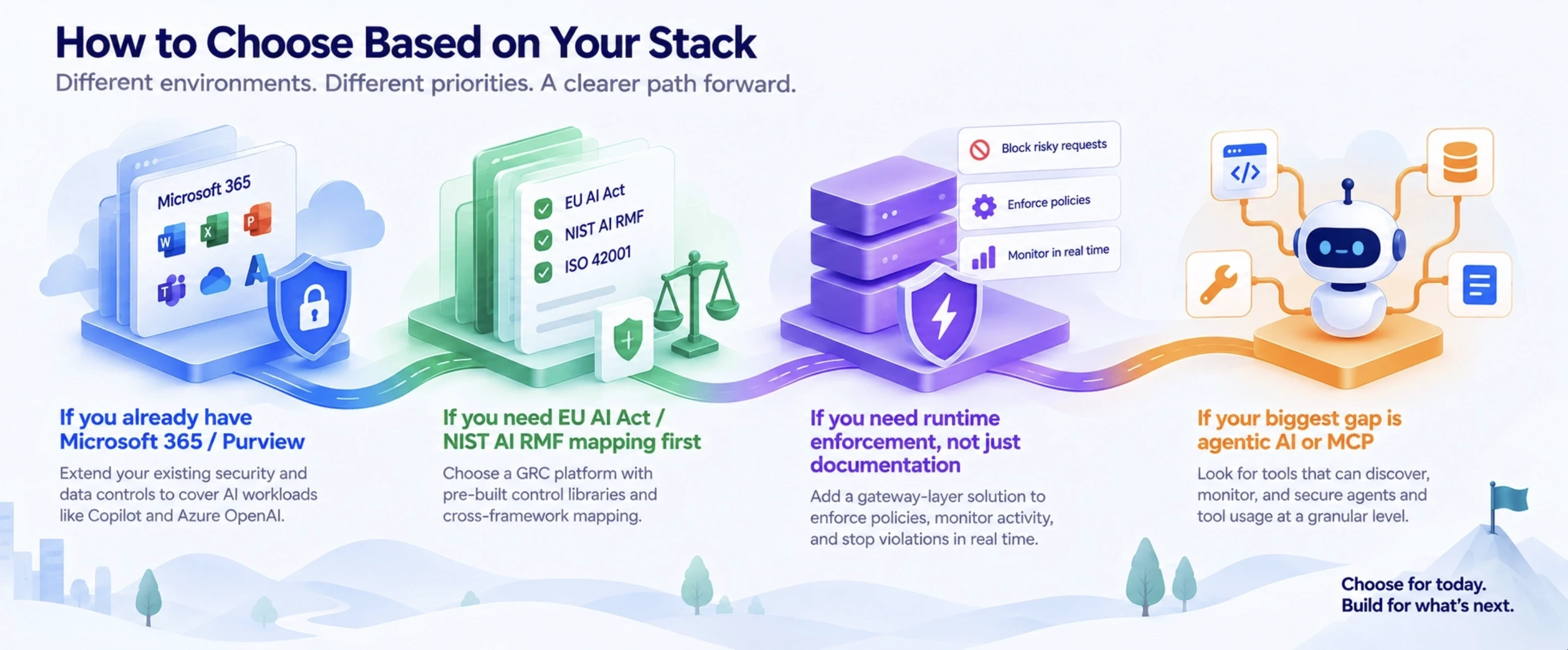
If You Already Have Microsoft 365 / Purview
If your AI workloads are predominantly using Copilot, Azure OpenAI, or Azure Machine Learning, the sensitivity labels and DLP policies your security team already has are largely applicable in the AI context, making it nearly always the "low-hanging fruit" to extend Purview's Data Security Posture Management for AI. The caveat to the catch is that if your organization has other models deployed to AWS Bedrock, Google Vertex, or open-weight models outside Azure, then you'll need to rely on the Purview category for that estate, not just on native coverage alone.
If You Need EU AI Act / NIST AI RMF Mapping First
A GRC-extension platform such as OneTrust or Credo AI will get you to a defensible compliance posture quickest since their control libraries do the cross-framework mapping work outlined above. Be mindful that any vendor mapping based on the old timeline applies to the EU AI Act only until the Digital Omnibus deferrals came into effect in July 2026, so a mapping that is based on this timeline would overestimate your high-risk exposure in the near term and underestimate what is actually happening on August 2, 2026.
If You Need Runtime Enforcement, Not Just Documentation
If there's no mechanism to prevent a violation when it happens, and policies are just sitting there on paper, a system of record isn't the only tool in your stack for this governance issue either; a gateway-layer platform like TrueFoundry should go alongside, not replace, a system of record. This is also the case where data sovereignty has the greatest significance: when data resides within your own infrastructure, and not a vendor's, several buyers in regulated industries insist that audit logs and enforcement decisions be within your control, not a vendor's.
If Your Biggest Gap Is Agentic AI or MCP
The gap described above is what traditional model-centric governance platforms will register when they get an agent but not see what the agent did at the tool-call level. To close it, you need discovery and testing implemented in the agent-and-tool architecture, rather than a point-in-time review, and enforcement that is able to take action on an individual tool invocation rather than the agent as a whole. Akto's platform naturally fits the scenario listed below.
How Akto Fits Into the Governance and Compliance Stack
Each gap described in this guide represents a behaviour that is not caught by the quarterly review, each monitoring that cannot capture what it observes, each individual call of a MCP tool, and each gap identified in the agent behaviour and its behaviour that is not included in the quarterly review, represents one architectural problem: governance for discrete models does not easily extend to agents and the tools they call. Akto has been designed to tackle this layer, and all three of its features are directly related to the three gaps raised above.
Discovery Across LLMs, Agents, and MCP Servers
Akto's discovery layer aims to address this inventory problem: Registering an agent while not knowing what tools it can access. It automatically identifies and registers MCP servers, AI agents, tools, and resources on cloud infrastructure and employee endpoints, including shadow AI usage and shadow MCP usage, which were not formally introduced due to lack of submission. That end-point-level visibility, from employee workstations using Akto Atlas and infrastructure-level discovery, is exactly the blind spot a model-only registry was designed to avoid.
Continuous Risk Assessment and Red Teaming
A documentation-first platform evaluates risk at launch and at the next scheduled review, while Akto carries out continuous adversarial testing, with over 4,000 automated probes against your prompt, privilege escalation, tool misuse, and data leakage built into your CI/CD pipelines, so you are testing on every change, not on a calendar. That fills the lifecycle re-assessment hole mentioned above, but specifically in the context of agent behaviors, such as an agent chaining tool calls in a manner a traditional model risk assessment was never designed to test for.
Runtime Enforcement Where Documentation-Only Tools Stop
This is exactly the governance-containment gap directly above: the ability of most organizations to monitor an agent rather than be able to prevent it from taking action. Akto's guardrails are in place to enforce policy at execution time, rather than waiting until after the damage to review anomalous and excessive agent usage, or unsafe agent loops and tool calls. That enforcement layer is available in a self-hosted or managed cloud deployment, and it ensures audit evidence is contained within the customer's own environment, a direct requirement for data sovereignty in the stack-selection section above.
Final Thoughts on AI Governance and Compliance Tools
Choose a governance tool based on the gap you are looking to fill and not on the number of features. A documentation-first platform such as Holistic AI, OneTrust, or IBM watsonx.Governance enables discrete ML and LLM models to get to audit-ready the quickest. When agents start to call the tools through MCP, the same approach reveals a clean inventory, while individual tool calls, chained agent behavior, and shadow deployments are left to run ungoverned below it.
Akto fills that exact middle ground, finding all agents, LLMs, and MCP's on infrastructure and employee endpoints, and continuously red-teaming them, versus just a point-in-time review, and enforcing guardrails at the time of a tool call, and not reporting on it later. If it's the agents and MCP-connected tools you have the least visibility of in your AI footprint today, then book an Agentic security demo with Akto to witness discovery, red teaming, and runtime guardrails in your environment.
FAQs on AI governance and compliance tools
What are AI governance and compliance tools?
They are software-as-a-service applications that identify the AI systems a company operates, assess the risk posed by each system, compare that risk to AI regulations, such as the EU AI Act, and report the compliance documentation or runtime controls. The range of factors covered in this category may be from GRC-extension platforms that depend on paperwork to gateway-layer tools that are able to enforce policy on live traffic.
How are AI governance tools different from traditional GRC software?
In traditional GRC, financial controls, vendor risk, and security attestations, along with AI, are all part of the enterprise risk management framework. AI-specific governance tools are not inherently modeled by a general GRC platform, such as model drift, bias scoring, prompt injection, and agent tool-call behavior, and some, like OneTrust, are beginning to add AI-specific capabilities to GRC.
How are AI governance tools different from MLOps platforms?
MLOps platforms manage the technical mechanics of getting a model into production: training pipelines, versioning, and deployment infrastructure. They generally have no built-in concept of regulatory risk tiers, impact assessments, or compliance documentation, which is the layer AI governance tools add on top of an MLOps foundation rather than replace.
What categories of AI governance and compliance tools exist?
Five distinct categories cover most of the market: policy and GRC-extension platforms, model risk management and MLOps-adjacent platforms, infrastructure and runtime enforcement platforms at the gateway layer, data-centric governance platforms, and shadow AI or employee AI usage governance tools built for the browser and endpoint layer.
What is the difference between documentation-focused and runtime-enforcement governance tools?
Documentation-based tools generate risk assessments, model cards, and audit trails, which are then acted upon by a human or by a scheduled review. Runtime-enforcement tools reside in the actual calls to the model and the tools themselves and enforce a model call or a tool call in real time, either blocking or granting access to the called object before the call is completed, thereby generating less compliance documentation but preventing a violation from occurring even though it might be caught by a periodic review after it has occurred.
What compliance frameworks do these tools typically map to (EU AI Act, NIST AI RMF, ISO 42001)?
For example, NIST's AI RMF categorizes controls by four functions - Govern, Map, Measure, Manage; ISO 42001 provides a framework for a certifiable AI Management System; and the EU AI Act has binding technical documentation and post-market monitoring requirements for systems in the EU. Other mapping tools are industry-specific, such as Monitaur's NAIC and OCC coverage for insurance and banking.
What is cross-framework deduplication, and why does it matter?
The mapping of an individual governance evidence (such as a completed risk assessment) against all of the regulatory frameworks a company fulfills at once, rather than gathering separate evidence for every framework a company is accountable to. Otherwise, a team subject to the EU AI Act and NIST AI RMF is left with two separate sets of documentation of similar requirements.
Can AI governance tools discover shadow AI and unauthorized agents?
However, the strongest platforms can; discovery methods vary by category. AI Governance suites such as Holistic AI and Credo AI are designed to identify unregistered systems, as well as vendor relationships, and browser- and endpoint-oriented tools such as Aona are designed to detect consumer AI tool activity that never touches corporate infrastructure at all, whereas agent and MCP-oriented products like Akto are specifically designed to discover shadow agents and MCP servers.
Do AI governance tools cover agentic AI and MCP-connected systems?
This coverage is not complete, and the conclusion of this guide is that most governance platforms were built for discrete models and don't track what tools an agent can call or what it did at each step of a multi-step task. That's where discovery, red teaming, and enforcement for tool-call-level behavior, such as Akto, will fill the gap.
What's the difference between AI-specific governance and general data governance tools?
General data governance, through tools such as data catalogs, monitors lineage, metadata, and quality of datasets and pipelines. AI-specific governance is built upon this data layer and includes AI-specific risk scoring on models and agents, regulatory mapping, and AI-specific documentation (such as AI bills of materials and model cards) that a data catalog could not have created.
How do I choose an AI governance tool based on my existing stack (Microsoft 365, GRC, DLP)?
Extend Purview: impact on a Microsoft 365 and Azure-based organization will be the fastest path as they expand the solution they already have in place, while an organization which already has a GRC platform will see a natural progression to AI governance on the same platform.
Are AI governance tools only for regulated industries?
No, but regulated industries did first, as they had specific deadlines for compliance and explicit penalties. AI's transparency requirements, which came into effect in August 2026, are not limited to regulated industries, but will apply broadly to any organization using AI tools in front of its customers, regardless of whether it is using an internal agent with access to sensitive systems or an AI vendor tools.
What features separate enterprise-grade tools from basic compliance checklists?
Continuous monitoring instead of point-in-time assessment, automated evidence generation instead of manual documentation, cross-framework control mapping instead of framework-by-framework spreadsheets, and increasingly, runtime enforcement instead of paper policy that nothing actually checks against live behavior.
How much manual work do these tools still require?
Not too long ago, but less than five years ago. Newer AI-driven capabilities, such as Credo AI's GAIA, focus on reducing the workload of the intake and documentation aspect, rather than fully replacing the need for human oversight in making consequential decisions, and even the most automated platforms require a human to establish risk taxonomies, review high-risk classifications, and take action on escalations.
How does Akto complement AI governance and compliance tools?
Documentation-first governance platforms were not designed for discovery and red teaming of every endpoint, including infrastructure or employee endpoints, nor for continuously monitoring them for risk, but Akto can do both of these things and more: discover all the LLM, agent, and MCP servers in an infrastructure and/or employee endpoint, continuously monitor them for risk, and apply guardrails when a tool call is performed. Rather than opting for one system over another, most companies are able to receive the best coverage with both Akto and a system-of-record platform.

Experience enterprise-grade Agentic Security solution