AI Governance Framework: Building Responsible AI Systems
Explore how an AI governance framework ensures responsible, compliant, and secure AI adoption in enterprises.

Bhagyashree
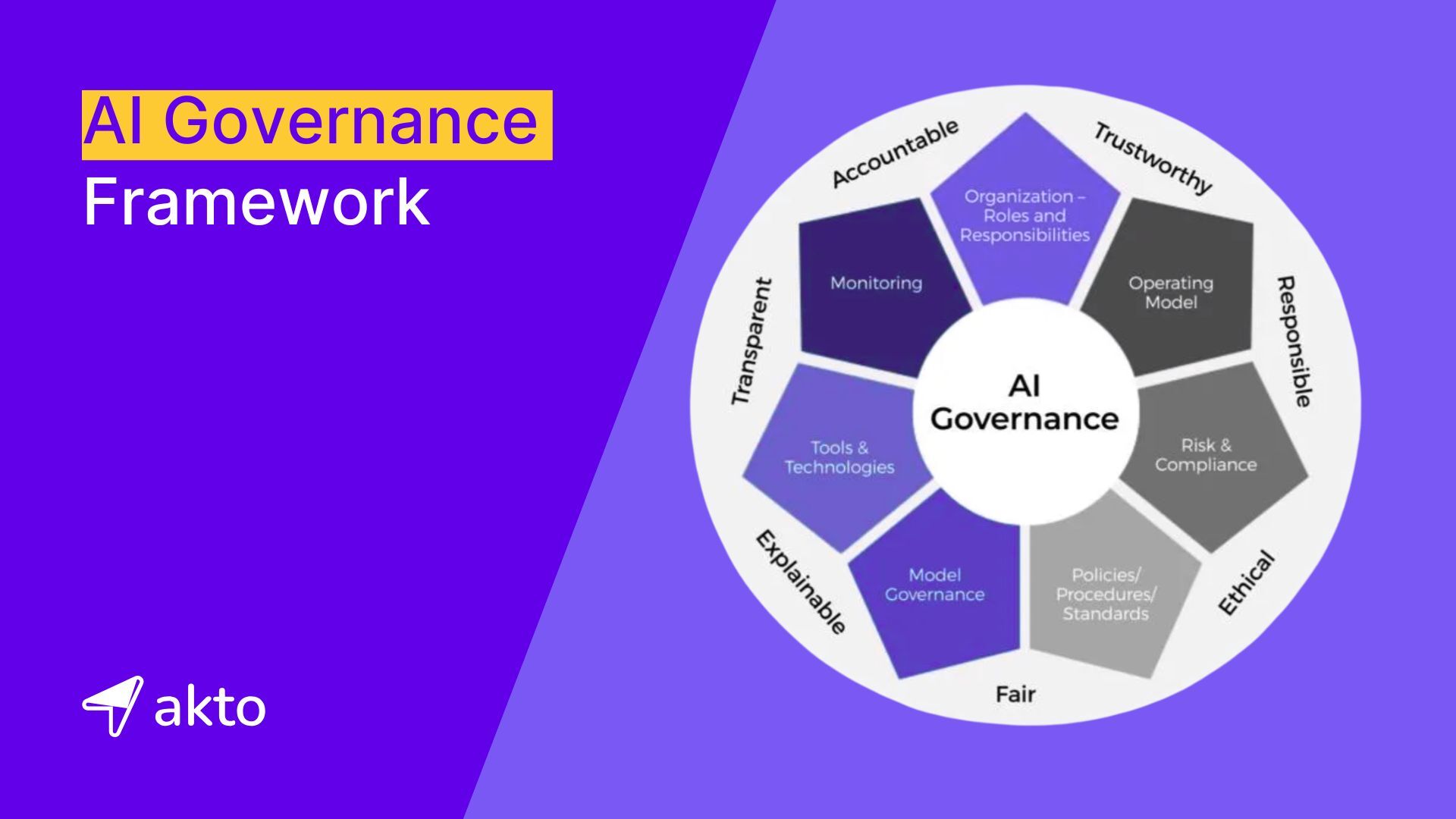
AI governance defines the structure, processes and oversight required to responsibly develop AI across enterprises. It matches AI with business objectives, ensures ethical, regulatory compliance and improves the reliability in production. Strong governance improves ROI by preventing failures, risks, and trust issues. Unlike the security, governance focuses on policies, accountability and decision making. An effectively laid out AI governance frameworks help organizations create scalable, compliant and trustworthy AI systems.
According to Gartner, AI trust, risk, and security management was number 1 top strategy trend in 2024 that factored into business and technology decisions, and by this year, AI models from organizations that operationalize AI transparency, trust, and security may achieve over 50% increase in terms of adoption, business goals, and user acceptance. In this blog, we explore what is AI governance framework and how to build effective security controls for AI governance.
Why is AI Governance Important?
Here is why AI Governance play a major role in the betterment of future AI development.
It ensures trust, compliance and efficiency in AI development and deployment.
It addresses bias, risks and explainability constraints which are cited by over 80% of leaders.
Minimizes legal, social and reputational risks from unregulated AI systems.
It enables perfect balance between innovation with safety to ensure AI respects human ethics and rights.
Builds user and stakeholder trust in AI-driven decisions.
Provides supports for continuous monitoring, addresses model drift and performance changes.
Goes beyond the compliance to ensure long term ethical and responsible AI adoption.
Core Components of an AI Governance Framework
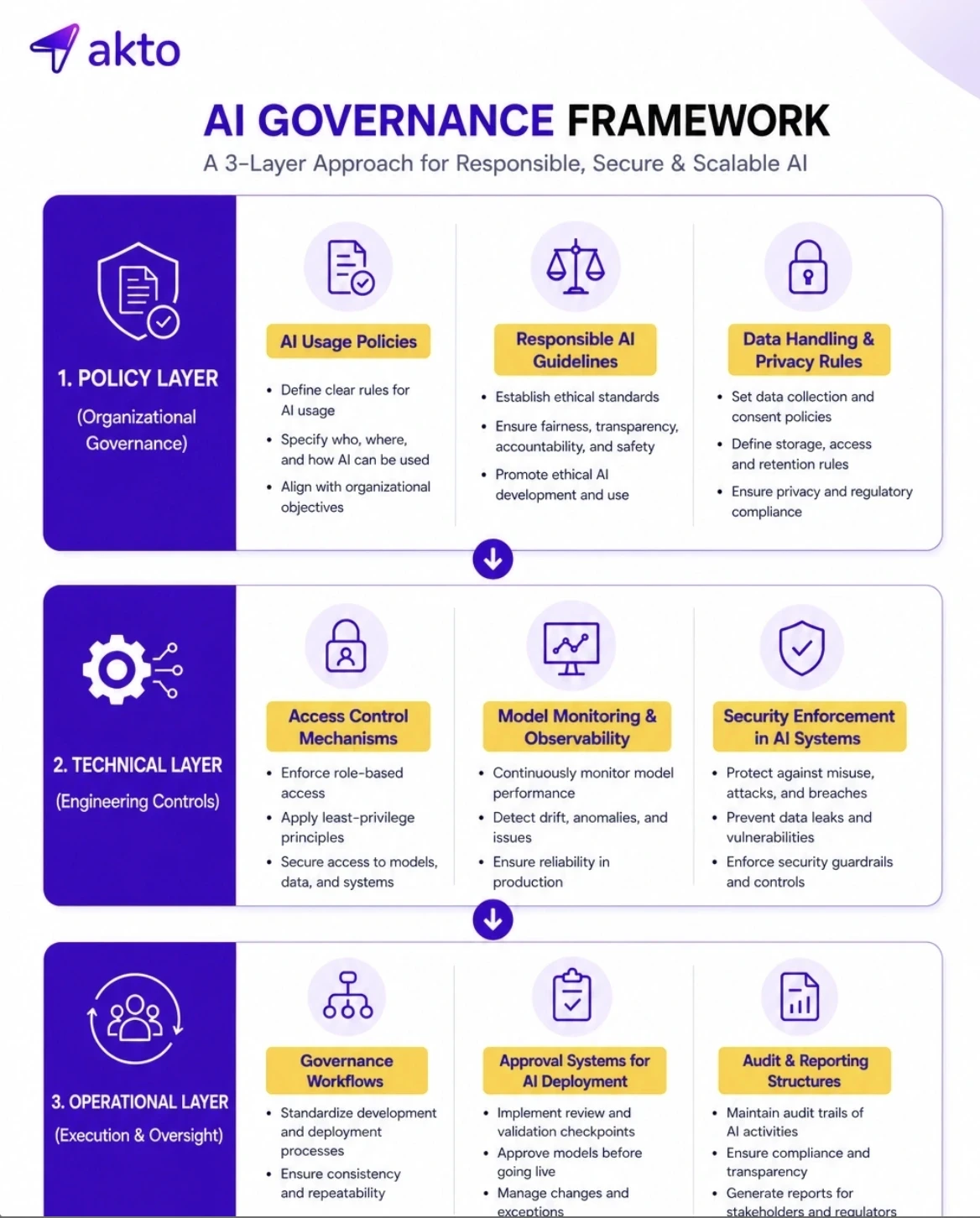
The AI governance components can be structured into technical, policy and operational layers. Here’s a brief overview of each functions under these layers.
Policy Layer
Policy layer sets the foundation and guardrails, which translates ethical intent into enforceable policies that guide the AI usage across the organization.
Ethical and responsible AI principles - Define the standards like transparency, accountability, and safety to guide how the AI systems are designed and used.
Policies and regulatory compliance - Set up clear policies for the AI usage, data privacy and legal compliance to ensure it matched with the regulations and organizational objectives.
Privacy controls and data governance - Ensure high quality secure and compliant data handling which includes storage, consent and protection of sensitive information.
Technical Layer
Technical layer integrates governance into the technology stack to ensure AI systems are secure, observable and reliable in practice.
Model governance and lifecycle management - Supervise model development, deployment, validation and monitoring to maintain performance, reliability and accountability.
Explainability and transparency - Make AI decisions easy to understand and explainable to stakeholders and users, which enables trust and accountability in outcomes.
Risk management and security methods - Capture, analyze and mitigate risks such as bias, data leakage and vulnerabilities through technical and operational security.
Operational Layer
Operational layer operationalization governance through processes, workflows and continuous oversight and ensures compliance and trust over long period of time.
Manual supervision and accountability - Assign clear ownership and ensure human control over AI decisions in high risk use cases.
Monitoring, auditing and continuous improvement - Track model performance, detect the drift and perform audits and ensure smooth compliance and ethical alignment.
Key Principles of AI Governance
Every strong framework needs a solid foundation, for AI governance that foundation comes with nine interconnected principles that works together to guide the ethical development and application of AI technologies.
Transparency and Explainability
Users and regulators need to understand how the AI systems produces output and make decisions. This addresses the black box problem through the techniques like SHAP values and audit logs that traces which data has influenced the projections.
Non-discrimination and Fairness
AI systems should need to continue or amplify the current biases via diverse training datasets, regular bias audits and fairness metrics such as demographic parity or equalized odds.
Accountability and Oversight
Every AI decision should trace to responsible parties. Humans need to retain meaningful control over high impact decisions with clear governance structures that defines who owns data quality, approvals and investigation.
Privacy and Data security
AI systems need to handle personal data responsibly via secure ingestion, encrypted training, anonymization where it is applicable and strict access controls that matches GDPR and CCPA.
Risk Management and Safety
Organizations need to proactively identify, assess and mitigate AI-related risks which includes operational failures, security threats, model drift, misuse and unintended social harm. Practices like AI impact assessments, risk registers, stress testing and adversarial testing to help ensure reliable and safe deployment.
Top AI Governance Frameworks and Regulations (2026)
To make AI governance actionable companies depend on established frameworks that offer structured approaches for implementation and oversight.
NIST AI Risk Management Framework
NIST is developed by U.S National Institute of Standards and Technology. It helps in assisting organizations through finding, evaluating and mitigating risks related to AI systems. It encourages reliability, transparency and fairness while providing a repeatable model for AI oversight.
EU AI Act
The EU AI Act introduces a risk based categorization system for AI applications. It establishes regulatory compliance requirements for high risk AI tools, focusing on documentation, testing and transparency. The Act aims to harmonize responsible AI governance across the European Union.
OECD AI Principles
The OECD AI principles aims at encouraging human-centered and credible AI. They describe global best practices to promoting innovation while safeguarding fundamental rights, data privacy and fairness in AI operations.
Organizations implementing AI governance frameworks need to map internal governance policies to these standards, which sets up clear accountability and measurable oversight. Continuous monitoring and auditing ensure AI systems stay compliant and effective as technologies keep improving.
ISO / IEC 42001
The ISO / IEC 42001 standard provides a formal management system for AI governance. It helps organizations to integrate ethical standards and accountability mechanisms into proper workflows which ensures consistency between governance practices and corporate objectives.
How to Build AI Governance Structure in Practice
While governance principles could define what good governance looks like frameworks are what define how those organizations implement their processes. Besides this, a practical AI governance framework translates high impact goals into specific roles, policies and controls which could fit within an organizations entire structure and risk tolerance.
Match Governance with Business Goals
Organizations perform better results when governance aligns business risk and impact. Not every AI system needs the same level of oversight. A chatbot that provide summary in external documents carries a different risk than a model that approves prioritizes loans or medical cases.
Establishes Governance Roles and Structures
For AI governance to be its most effective, as it must be cross functional. This includes continues collaboration between data, AI teams, legal, compliance privacy and security and business stakeholders include:
Role based access controls
Human in the loop requirements for high impact decisions
Properly defined RACI models
Cross functional governance committees
These structures clarify decision rights and minimize ambiguity as AI programs grow.
Define AI policies, Standards and Controls
Clear standards reduces friction and effective governance frameworks include:
AI risk classification criteria
Approval thresholds by risk tier
Necessary documentation
Monitoring, incident response and audit expectations.
When standards stay vague, teams invent the local interpretations. When standards remain concrete where teams keep moving at a rapid pace with low hiccups.
Governance across the AI / ML Lifecycle
Governance spans complete AI / ML lifecycle from data collection, model design to monitoring and deployment. Security teams define policies early, validate datasets, implement ethical guidelines and make documentation. During testing and training, you can assess bias, security and performance. After the deployment you can continuously monitor models, manage risks and ensure compliance, create a feedback loop for continuous improvement.
Embedding Governance into CI / CD for AI
Integrate governance directly into CI / CD pipelines by automating policy checks, approvals and validations. Every stage comprises of data validation, security scans and model evaluation against compliance standards. Implement guardrails before the deployment to ensure only approved models move forward. Continuous monitoring and automated alerts help identify drift, bias, violations to maintain consistent governance without impacting velocity.
Implementing Security Controls for AI Governance
Here’s how to implement security controls for AI governance effectively.
Adaptive AI Governance
Adaptive AI governance enables organizations to improve their governance techniques in response to changing risks, regulations and system behavior. Dynamic policy updates ensure that governance rules remain effective while RBAC control enable security teams to scale security measures based on sensitivity and impact of multiple AI use cases which ensure balanced approach between innovation and control.
Automatic AI Security Testing
Automated AI security testing enables that models are continuously analyzed for safety, reliability and robustness across their lifestyle. AI red teaming offers simulation for real world attack scenarios to discover vulnerabilities in prompts and outputs. Whereas attack testing further challenges LLMs with malicious or deceptive inputs to evaluate their resilience. Besides, continuous validation solidifies this layer by regularly monitoring model behavior to detect drift, unsafe or bias responses to ensure the systems stay aligned with intended policies over time.
Runtime Guardrails and Monitoring
Runtime guardrails and monitoring offers real-time protection when the AI systems are in use actively. These guardrails implement predefined policies to prevent harmful or non-compliant outputs before they reach the end users. Prompt and response monitoring helps in tracking interactions for misuse, anomalies or violations. Whereas, AI agent behavior controls ensure that autonomous systems work under defined ethical and operational boundaries, reduces the risk of unintended actions.
AI Agent and Workflow Security Controls
AI agent and workflow security controls focuses on securing how the AI systems interact with the tools, data and processes. Tool access restrictions limits the resources an AI agent can use to prevent unauthorized actions , whereas agent permissions boundaries define clear roles and access levels. Additionally, workflow level observability offers end-to-end visibility into multi step AI processes that enables teams to map decision paths to quickly to capture potential risks or inefficiencies.
Monitoring and Auditing AI systems
Monitoring and auditing AI systems allow transparency, traceability and compliance with governance requirements. Real-time logging identifies captures every interaction, that comprise of prompts, responses and systems actions that create a exhaustive data trail. Further more, audit trails support compliance by maintaining structured records that can be reviewed for regulatory purposes and performance analysis.
Incident Response for AI systems
Incident response for AI systems is designed to quickly find, classify and mitigate the issues that are specific to AI behavior. This includes categorizing incidents such as bias, data leakage, hallucinations or misuse. Response playbook offer predefined steps to contain and resolve the issues correctly, to minimize impact and ensure system reliability while also retaining trust in AI-powered processes.
Real World Examples of Successful AI Governance Implementation
Here are some real world examples of effective AI governance implementation:
E-Commerce Biggie Fixes AI Data Tracking Problem
A popular global e-commerce brand was facing challenges with AI governance as it scaled.
It required to track how the customer data moved from AI models across website interactions, payment processing, and recommendation engines.
By implementing end-to-end data lineage, the company:
Complied to GDPR, CCPA, and other regulations.
Achieved complete visibility into data collection and usage.
Allowed AI-driven decisions aligned with customer consent.
With proper governance implementation they are not compliant but have also created customer trust and internal efficiency.
Top Bank’s AI Governance Strategy to Prevent AI Bias
One of the top banks prevented challenges in bias by implementing real-time AI monitoring to capture and fix problems before models went live. Their strategy was :
To highlight the bias indicators during model training.
Audit AI decisions in production to ensure fairness.
Track changes to understand how data influenced outcomes.
By integrating AI governance early, they were ahead of compliance and turned fairness into a competitive edge.
Future of AI Governance
Looking ahead, here is what the future looks like for AI in GRC
Continuous monitoring - AI may enable continuous compliance monitoring, detecting and addressing non-compliance issues instantly.
AI lineage tracking - This tracking helps businesses know where the data comes from, how it is transformed and how it is used.
AI governance and regulatory advancements - AI governance that gets it right maintain trust, minimize risks and improves AI performances.
Final Thoughts: Building Resilient AI Governance Systems
AI Governance is a must for businesses that want to thrive without ethical or legal pitfalls. The
AI governance monitoring tools like Akto help businesses to continuously comply with governance practices. These tools helps ensure proper alignment to business and compliance.
Akto’s Agentic AI Security helps teams assess risks across LLM security, AI safety and alignment, RAG integrity, and agentic behavior, enabling advanced validation against emerging threats like memory poisoning, model theft, goal hijacks, and excessive autonomy.
Enable your organizations to safeguard fast-growing agent ecosystems with continuous, enterprise-grade protection. Besides this, achieve runtime protection, safety alignment, and AI governance readiness.
See Akto’s Agentic AI Security and MCP Security in Action by booking a demo today!
Important Links

Experience enterprise-grade Agentic Security solution