Gen AI Red Teaming: A Complete Guide to Testing and Securing AI Systems
Learn how Gen AI Red Teaming identifies prompt injection, jailbreaks, data leakage, and AI risks. Explore best practices, OWASP LLM Top 10 mapping, and Akto's AI security testing.

Bhagyashree
2026 State of Agentic AI Security
How ready is your organization to secure AI agents?
3 quick questions. See how you compare to other security leaders.
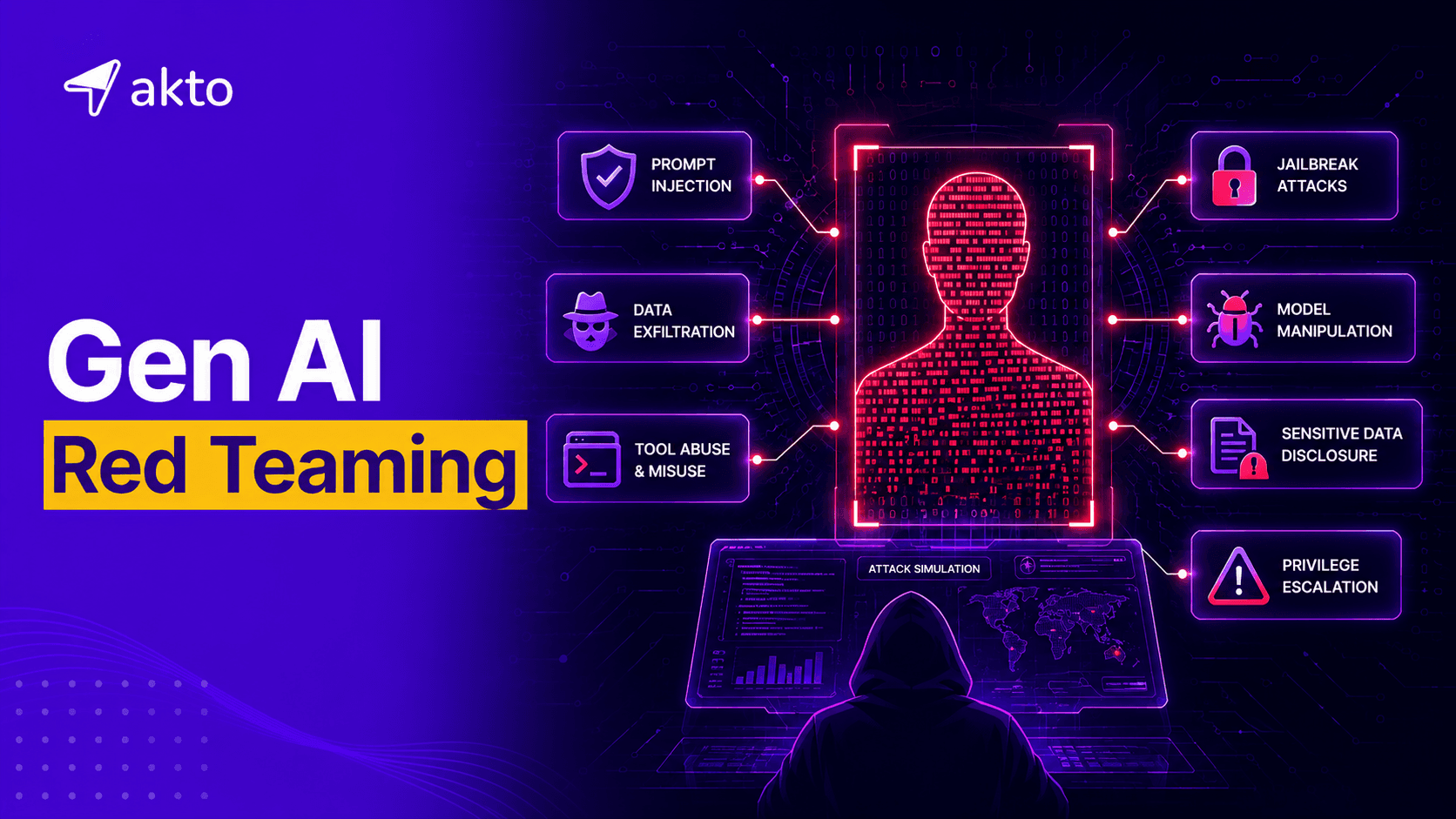
Security teams are trained on static code and network exploits, hence they are not able to tackle Gen AI threats. AI threats are not a fixed vulnerabilities, they are agentic, behavioral, probabilistic and agentic. A prompt injection could fail but eventually end up with successful exploitation with corrupted input. Agentic systems bring autonomy into equation which lets AI models take real world actions across the tools, APIs and multi agent pipelines. That autonomy significantly expands what an attacker can do with single successful exploit. Hence a new strategy is necessary where it tests behavior, not just the code that accounts for non-determinism that runs continuously.
This blog explores Gen AI Red Teaming and its concepts. It also offers insights on how to implement them effectively.
What is Gen AI Red Teaming and Why Does It Matter?
Gen AI Red teaming is a technique that simulates harmful actions against generative AI systems, like large language models, to identify security vulnerabilities, testing and validating the protection and reliability of AI systems. Unlike traditional cybersecurity techniques, this method looks at how AI responds to prompts and monitors whether it generates false, harmful or unethical outputs. It helps ensures AI stay secure, ethical and aligned with business values.
Here are some reasons why Gen AI Red Teaming matters:
Gen AI Red Teaming goes much more than traditional risks, it goes deeper and tests thoroughly against new AI risks.
AI Red Team can capture and remove biases in training data and processing. This approach prevents unwanted outputs like offensive speech and facilitates trust in organizational implementations.
Red teaming AI systems leads to more safety and thorough compliance with applicable laws laid out by GDPR and EU Artificial Intelligence Act.
Red teaming also helps in significantly improving AI systems performance besides identifying risky model behaviors.
Why use External Gen AI Red Teaming
Many security teams in organizations do not have the resources or expertise to conduct end-to-end cyber attack pattern analysis in house. External red teaming professionals bring their expertise, new insights, threat intelligence and domain specific knowledge with them. They help in discovering unnoticed risks, provide independent validation and benchmark your models against industry standards.
Akto’s AI Red Teaming platform is built on a continuously evolving library of cyber attack techniques aligned with OWASP LLM Top 10 risks and real-world security threats. Instead of relying on theoretical test cases, Akto automates 1000’s of attack simulations across RAG pipelines, AI applications and prompts to identify risks before attacks can exploit them.
As regulatory scrutiny significantly increases, working with trusted external AI Red Teaming companies can help organizations stay ahead of future requirements and highlight compliance in a credible way.
What Risks Does Gen AI Red Teaming Address?
Gen AI Red Teaming utilizes adversarial testing to intentionally probe models, tools, prompts and workflows for failure models.
Model Extraction and Business Data Theft
Cyber attackers may try to mimic AI models features or extract important business configurations and prompts. Red teaming performs simulations of such attacks to check if system prompts, intellectual property or model behavior can be leaked or copied.
Prompt Injection and Jailbreak Attacks
Gen AI red teaming tests if cyber attackers can manage to corrupt an AI model into ignoring system instructions, bypass security controls or perform unauthorized actions. This process reveals vulnerabilities in tools, prompts and guardrails before anyone can exploit them.
Sensitive Data Leakage
Gen AI Red Teaming analyzes if a model can expose sensitive information like customer records, proprietary business data, API keys or training data. Security testing helps capture privacy vulnerabilities and improves safeguards against intentional or accidental data exposure.
Toxic Content Generation
Generative AI could generate abusive, offensive, or policy violating content under certain situations. Red team professionals test these situations to identify whether content moderation and filters are effectively capable of preventing harmful outputs.
Data Poisoning and Other Risks
Gen AI Red Teaming security control tests evaluates if compromised datasets, malicious contributors or hidden triggers can impact model behavior. These tests help organizations identify weaknesses in data pipelines and authorize the integrity of the training and fine-tuning process.
Hallucinations and False Information
AI models can generate responses that are disguised as genuine outputs but contains false information. Red teaming professionals detect these situations where the hallucinations occur, helps organizations, improve reliability, accuracy and trustworthiness before deploying any AI systems in productions.
Manipulation and Edge Case Failures
AI systems can fail when they are exposed to new and unusual outputs. Red teaming tests how the models respond to harmful prompts, obfuscation methods, edge cases to ensure they operate stable and secure under adverse situations.
Key Steps in Gen AI Red Teaming Process
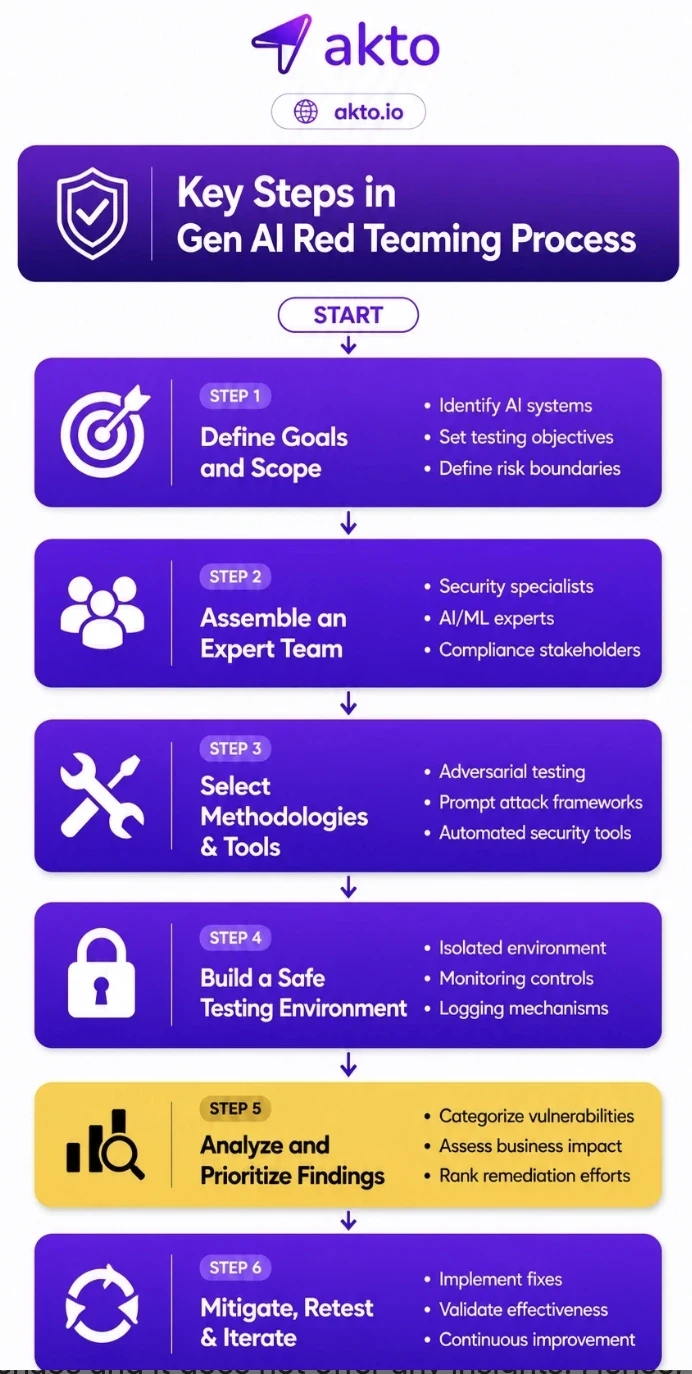
Here are steps to implement Gen AI Red Teaming:
Step 1 - Define Goals and Scope
Get particular about what you want to achieve. Are you testing for prompt injection, model bias or mapping failure modes. The answer shapes everything that follows. Have a proper scope regarding the model alone, the full application stack or infrastructure. Trying to test everything at the same time leads to chaos and it does not offer any insights. Hence, start by one situation, run it thoroughly and then move on to the next.
Step 2 - Assemble an Expert Time
Red teaming AI is a game changer. To make this process effective, you need ML engineers, behavioral scientists, security experts and people who understands the domain the system functions in. So, that if internal team is weak, the external red teaming professionals can chime in to close the gaps. What really matters is not credentials but the adversarial strategies and thinking. Thus, the teams must be briefed the same way a real attacker would be briefed with no guardrails, less context with no assumptions about how the system is supposed to work.
Step 3 - Select your Methodologies and Tools
Your methods need to reflect real world cyber attack exploitation patterns such jailbreak attempts, adversarial inputs, edge case manipulation. Manual methods remain irreplaceable for depth but frameworks such as Microsoft PyRIT can improve coverage and free up red teaming experts for harder testing work.
Step 4 - Build a Safe Testing Environment
Isolate the model versions, apply rate limits, identify full logs and set clear boundaries before testing starts. A controlled environment does not restrict creativity, it enables it. So, log everything which includes failed attempts. They surface edge cases and new risks that successful exploits miss and they reveal patterns such as jailbreaks retry behavior which matters later in the analysis.
Step 5 - Analyze and Prioritize
AI systems are probabilistic, so they need interpretation. A finding is not just a pass or fail its reproducibility, severity and cascading effect. Use that analysis to make update guardrails, remediation decisions or make informed risk acceptances.
Step 6 - Mitigate, Retest and Iterate
Red teaming is not just a one time task, it includes model update, data change, or application evolution. Along with this conduct regular retest. Add findings into your SDLC, refine methods as you learn, treat continuous testing as initial step.
How does AI Red Teaming Work
Here’s how AI Red Teaming Works:
Phase 1 - Expert Team Building
At the start, the main focus of Gen AI Red Teaming should be to recruit the best experts and right talent for the red-teaming process. Then utilize and assemble the necessary tools required for the process. Depending on the AI system being red-teamed, the members of the team may consist of traditional cybersecurity professionals, adversarial machine learning experts, operational and domain experts and AI practitioners.
Phase 2 - Execution
Once team is assembled and goals are set, the second phase begins. In this phase, the process is broken down into five steps:
Start by analyzing the target system to gather as much as insights possible to conduct the AI Red Teaming process. This step can include building threat models, data collection on the system and mission. Besides this, also utilize openly available knowledgebase of common attacks such as MITRE ATLAS.
Identify and potentially access the target system and AI model or component of the system that are prone to attacks. In some cases, gaining access to the system may be difficult, so a “black box” strategy is required to conduct the attack. This may include building a proxy system or model for the target system.
After the target system, threat model and AI model have been identified and understood, conduct the attack. For instance, if the target system is surveillance system and the threat model is to evade detection from AI model conducting face recognition, the development of the attack must be focused on face recognition evasion attacks.
Once more attacks have been developed for the AI red team exercise, implement and launch the attack on the target system. The type of implementation could vary depending on the target system and threat model.
Conduct impact analysis of the attack. This analysis comprises of metrics of the individual model performance of the affected AI components. Furthermore, it should include top metrics to understand the effects of attack on the entire system under attack.
Phase 3 - Outcome Analysis, Feedback and Improvement
The last phase of Gen AI Red Teaming process is knowledge sharing. In this phase, lessons and feedback from the exercise are shared with the development teams and any stakeholder involved in securing the AI systems of the organizations or mission involved in the exercise. In addition, the outcomes achieved from the exercise are shared with auditors and broader AI Agent security community to expand knowledge and understanding of AI security risks and improve defense mechanisms.
Mapping OWASP LLM Top 10 Risks to Gen AI Red Team Testing
The OWASP LLM Top 10 Risks is one of the most standard framework used across AI security for detecting areas where AI will fail when under attack from an adversary. In the table below, we have mapped every risk to the red teaming methods used to identify it and the coverage provided by Akto.
OWASP Risks | Gen AI Red Team Methods | Akto Gen AI Red Teaming Coverage |
|---|---|---|
Prompt Injection | Direct and indirect injection attacks; adversarial prompt crafting across multi-media | Prompt injection testing with attack simulations across files, prompts, and multimodal inputs. |
Sensitive Information Disclosure | Extraction probes designed to evoke PII, credentials, and proprietary data from model outputs | Identifies sensitive data leakage, credentials, PII and confidential business data. |
Data and Model Poisoning | Backdoor evaluation and behavioral drift testing to detect manipulation of training or fine-tuning data | Analyzes model behavior for suspicious or unsafe instructions, poisoning patterns and exploitation risks. |
Misinformation | Factual accuracy stress-testing; hallucination elicitation across high-stakes domains | Measure policy violations, hallucination rates, factual consistency, and response reliability across scenarios. |
Improper Output Handling | Fuzzing downstream systems that consume LLM output; testing for code injection and unsafe content rendering | Tests AI outputs for harmful content, prompt or code injection, harmful instructions and unauthorized actions. |
Vector and Embedding Weaknesses | Adversarial document injection into RAG ; embedding inversion attempts | Analyze RAG pipelines for retrieval manipulation, embedding attacks and context injection. |
System Prompt Leakage | Extraction attacks designed to surface harmful system instructions via model responses | Tests AI system resilience against jailbreaks, system prompt extraction, disclosure and prompt manipulation. |
Supply Chain | Testing of third-party models, datasets, and plugins integrated into the AI stack | Detects risks from integrated tools, agents, APIs and connected tools. |
Unbounded Consumption | Resource exhaustion probes; repetitive and recursive prompt chains designed to spike latency or cost | Detects prompts and workflows that cause cost escalation, token usage, latency spikes or denial of service conditions. |
Excessive Agency | Agentic cyberattack scenarios that attempt to provoke unauthorized API actions, tool calls, or file operations | Checks agent permissions, API usage restrictions, tool access controls, and other unauthorized actions. |
Case Study: Scaling Gen AI Red Teaming in Production
Here are some hypothetical case study to better understand AI red teaming:
1. E-commerce
An e-commerce platform 3 agent recommendation pipeline has been cleared and tested. A red team injected malicious content into a product review. The retrieval bypassed poisoned context downstream. The reasoning agent made the attacker influenced pricing decisions. The action agent executed them and not a single agent was vulnerable but the entire pipeline was corrupted.
What to fix:
It is ideal to test the pipelines not just the components as the multi-agent vulnerabilities are emergent.
What should be avoided:
Component level testing the does not the cross agent context poisoning.
No runtime monitoring for goal drift or suspicious agent behavior
Third-party data feeds that are considered as credible source without proper security audit review.
2. Fintech
A Fintech that runs an LLM-powered support agent relies on biweekly manual red team sprints. After a routine fine-tuning cycle, a previously prevented a jailbreak that was resurfaced and undetected for more than 2 weeks.
What to fix:
The fix here is conducting OWASP mapped probes that run continuously, adversarial regression tests baked into CI/CD and quarterly external red team activities.
What should be avoided:
Excessive reliance on manual testing in continuous deployment environments
Testing the model but missing the external tool integrations.
Ignoring the third party LLM providers and RAG pipelines as supply chain risks.
Best Practices for Effective Implementation of Gen AI Red Teaming
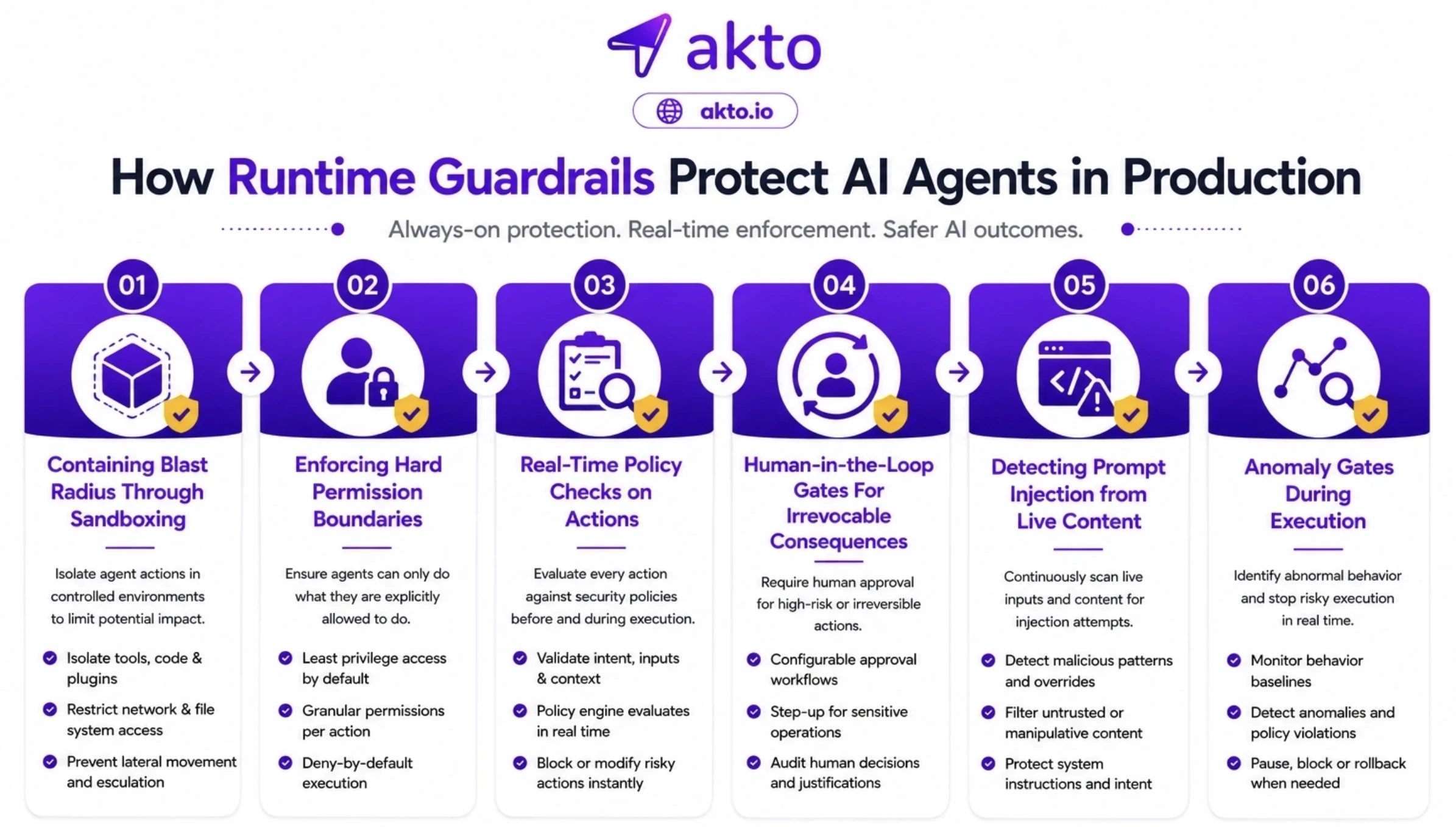
The best practices to implement Gen AI red team are as below:
Balance safety with functionality
Models must sometimes conduct attack simulation in order to complete legitimate tasks. For example, a legal AI tool might need to process discriminatory language for analysis. It is important to build guardrails that allow authorized functionality without letting harmful or unethical behavior.
Implement multi-layer mitigation methods
Training is not just to ensure safety. Effective systems comprise of layered mitigation, like keyword filters, output moderation, escalation workflows, and human review. Red teaming insights should be correlated to improvement actions across the AI lifecycle.
Enable human expertise with automation
Automated tools can scale red teaming efforts much faster, but they cannot replace human insight. A hybrid approach with a combination of human review and automation is ideal. Domain experts can design seed prompts, whereas automated systems generate variations and score outputs. This allows for proper coverage and fast iteration.
Set up clear policies and risk profiles
Red teaming begins with mapping all the security and content risks, both at the model and application levels. These risks may differ based on different business context and use case. Once captured, policies should be written and continuously updated to reflect acceptable and unacceptable behaviors.
Conduct diagnostics and analyze performance regularly
Security testing must comprise prompts of varying difficulty, as well as repeated prompts to analyze model consistency. Because AI is stochastic, vulnerabilities most often show up across a percentage of outputs, not just one instance. An ideal system must perform well across several iterations and edge cases.
Consider LLM red teaming as different from general security testing
The attack surface for language models differs from traditional software. Effective LLM red teaming needs domain expertise in how models reason, how prompts generate through varied conversations, and how agentic systems can be misdirected across tool calls and not just network and application security knowledge.
Document insights against recognized frameworks
Red teaming outputs are most actionable when mapped to frameworks like OWASP LLM Top 10, MITRE ATLAS, and NIST AI RMF. This creates audit-ready evidence and ensures findings are directly related to remediation measures across legal, compliance and engineering teams.
Akto’s approach to AI red teaming
AI red teaming at present is more about features and capabilities than a product category. Most teams build custom workflows using lightweight platforms. This space is significantly growing at faster rate, and some Agentic AI Security vendors have begun to include features to make it a comprehensive security platform. As that starts to happens, the line between red teaming and comprehensive AI security testing becomes blur. Traditional security does not secure AI systems. Gen AI demands purpose built red teaming combined with external expertise, agentic workflow coverage, with OWASP alignment and continuous execution. It is crucial to carefully determine and consider all factors when choosing a proper and reliable Gen AI Red Teaming platform. Ensure to match your use case, model type and most importantly the risk profile.
Here’s how we approach AI red teaming to uncover critical vulnerabilities before they become serious issues.
From prompt injection to multi-agent exploits, Akto runs relentless 1000+ probes to expose and validate risks before attackers do.
Contextual Attack Simulation
Run 1000+ contextual attacks across MCP Servers and AI Agents to mirror real threats.
Prompt Hardening
Harden system and user prompts to block injection, manipulation, and goal drift.
AI-powered Red Teaming
Use AI-driven attacks to generate high-impact, multi-turn exploits and surface deep failures.
Get visibility and enforce guardrails for LLMs, AI agents, and MCP tools used by employees across their devices, ensuring safe AI usage at the individual level.

Experience enterprise-grade Agentic Security solution