Continuous Security Testing for AI Agents: Why Point-in-Time Assessments Fail
Learn why continuous AI security testing is essential for AI agents. Prevent prompt injection, model drift, tool abuse, and runtime security risks with continuous validation.

Rushali

AI agents aren't built to last long. A prompt is tweaked on a Friday afternoon, a model is replaced by a less expensive one, a new tool is added to the agent's toolbox, and what you validated last quarter is no longer what's running in production. This is the fundamental issue with adopting AI agent security as a "one-and-done" project.
The traditional security assessment methodology was developed for software that is released every 3 or 4 months. The process of change in agentic systems happens on a day-to-day, and sometimes hourly, rhythm, while the ways to assess them are designed for the previous one. This is where most incidents with agents happen in real life.
Continuous Security Testing for AI Agents fills this gap by adopting a different perspective on security validation – continuous. This article explains the reasons why point-in-time assessments fail to work, how they get "tangled up," how to design a continuous program, and how to determine if the program is working.
Why Point-in-Time Security Assessments Fail for AI Agents
A traditional penetration test is used to answer one question: "Was this system secure on the day the test was conducted? If it's a web app that's on a set release cycle, it's a pretty safe answer until the next big update. When it comes to an AI agent, the answer may become outdated even before the report is completed. This false "tested" sense of security is potentially more risky than not having an assessment at all, as security and compliance teams have a signed document stating that it is "tested" when it has already been moved on by the underlying system.
AI Agents Evolve Faster Than Traditional Applications
In conventional applications, releases are defined as a build being tested, approved, and shipped. Agentic systems evolve continually and sometimes in ways that are not obvious to the security team. A prompt engineer is someone who fine-tunes a system prompt to correct a formatting error. A team of data scientists optimizes the underlying model using new data. A customer requests a new tool integration, which is approved by a product manager. A customer requests a new tool integration, and the same is approved by a product manager. None of these will necessarily go through a code deployment change management gate, but each will affect the agent behavior, attack surface, and guardrails the agent will follow. This is further compounded with the introduction of autonomous AI agents that can chain decision and tool calls in a manner that is not preset, creating even more variability when modifying a prompt or model, or when a new input or context is introduced.
Why Static Security Assessments Miss Runtime Risks
Static assessment looks at the agent in a controlled test environment, using a set of fixed inputs. It cannot watch what happens when the agent is involved in a real customer conversation, in a retrieval of data from a document she's never encountered, or engaging in a multi-agent workflow with another agent. These run-time risks, such as a context poisoning attack, a user discovering a new angle for prompt injection, or a novel tool chaining attack, only occur when the agent is running in an actual and unpredictable environment. The fact that a lab exercise reports no vulnerabilities at all gives little indication of what the agent will do at 2 a.m. when you make a request you didn't expect. That is why AI runtime protection is not a solution to replace pre-deployment testing but should be used along with pre-deployment testing.
Why Traditional AppSec Cannot Secure Agentic AI
Traditional application security tooling was based on deterministic code paths: Given the same input, there is only one output; Vulnerabilities are typically related to one line of code or a configuration. AI agents act in a random way. Different responses can result from the same prompt based on temperature settings, context being retrieved, and/or past conversation history. Traditional AppSec scanners can only detect known patterns such as SQL injection strings, or if they have memory poisoning tricks, they are limited to those that they already know. They cannot detect an agent being socially engineered by a multi-turn conversation, or a goal hijacking. The challenge is to achieve agentic systems with AI security measures designed for probabilistic, tool-using, autonomous behavior, rather than an AI security tool gilded with a number of additional monikers.
Five Scenarios Where Static AI Security Testing Breaks
Static testing will not fail in abstraction. It explodes in certain predictable, consistent scenarios that all teams with agents in production face at some point. Once you've identified these situations, deciding to move to a continuous model is much easier to accept as a legitimate situation.
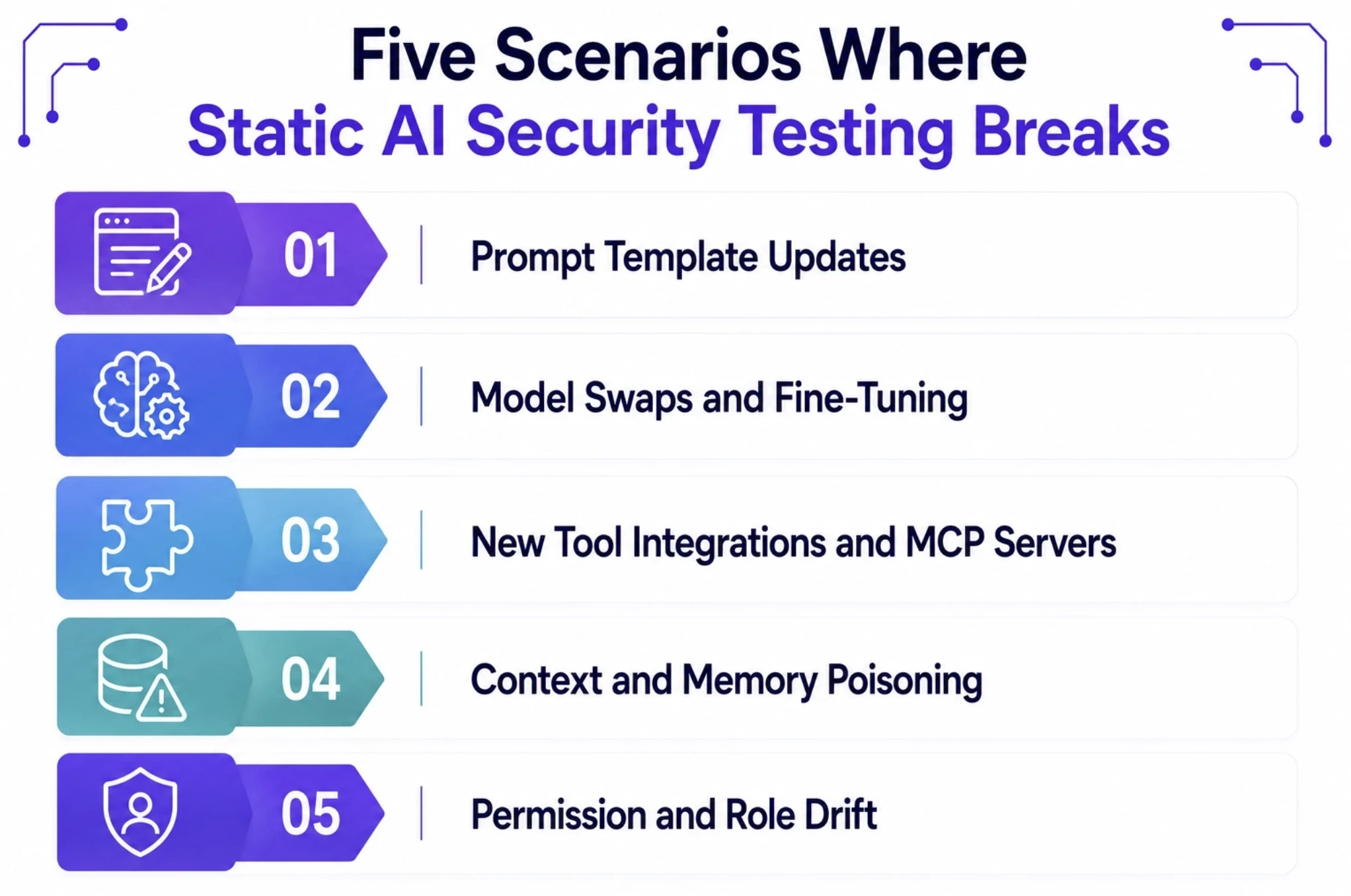
Prompt Template Updates
Often prompt templates are not considered code and are edited outside the normal review pipeline. A change in wording to make the response more useful may open up an avenue for an unsafe response, or slip a safety rule, without intention. Prompt edits are a very common part of the process, and hence they are also one of the most common reasons for silent security regressions, a fact that a security review done before the last 10 prompt revisions gives you no indication of what the current situation is.
Model Swaps and Fine-Tuning
When switching between different foundational models or when adjusting an existing model with new data, the agent's behavior at the core is changed. The jailbreak method that doesn't work with a specific version of the jailbreak might become successful after the subsequent version of jailbreak. Additionally, if the fine-tuning is done on internal data, it can create new failure modes, for example, the model generating sensitive training examples in the output. No matter how similar the two models look on paper, any assessment made against the previous model version is not representative of the new model version.
New Tool Integrations and MCP Servers
For each new tool or MCP server “attached” to an agent, the agent can perform more actions in the world, such as querying a database or sending an email or even running a financial transaction. If a security review takes place before integrating a tool, then it does not have visibility into the new permissions, data flows, or trust boundaries that integration adds. This is especially important for MCP servers because they define and agree upon a standard procedure for agents to discover and invoke external tools in the protocol, so that a single misconfigured or malicious MCP server could reveal the identity of all other agents communicating with it. A security program is able to see these changes occurring months later rather than when they happen due to ongoing “AI discovery” of new tools and servers.
Context and Memory Poisoning
Memory or retrieval-augmented generation agents retain information from one session to another or retrieve it from another source during a query. If an attacker can alter what is written to that memory (or what is read from it) and/or the context (or what is added to it), they can alter future agent behavior without ever altering the model or altering the prompt template. A point-in-time test only sees the agent's response to the crafted input at the time of the test, and will not catch slower attacks (those that inject the poison data that is used days or weeks after the attack is sent).
Permission and Role Drift
Permissions are added over time, as teams are given access to block other use cases, and once they are granted they don't usually get taken away after the initial need is fulfilled. A narrow scope of permissions tested can appear drastically different 6 months later after being granted access to other systems, data sources or user impersonation features. Agent risk is one of the biggest risk factors that is unmonitored if not managed regularly.
Applying NIST AI RMF and OWASP to Continuous AI Security
In addition to providing security teams with a common language for managing and understanding AI risks, such as the NIST AI Risk Management Framework or the OWASP Top Ten for LLM Applications, the key benefit of these frameworks is that they are applied continuously, not as a one-off compliance check. Because these frameworks are familiar to stakeholders, mapping continuous testing to these frameworks makes it easier to justify the transition to stakeholders.
Aligning Continuous Testing with NIST AI RMF
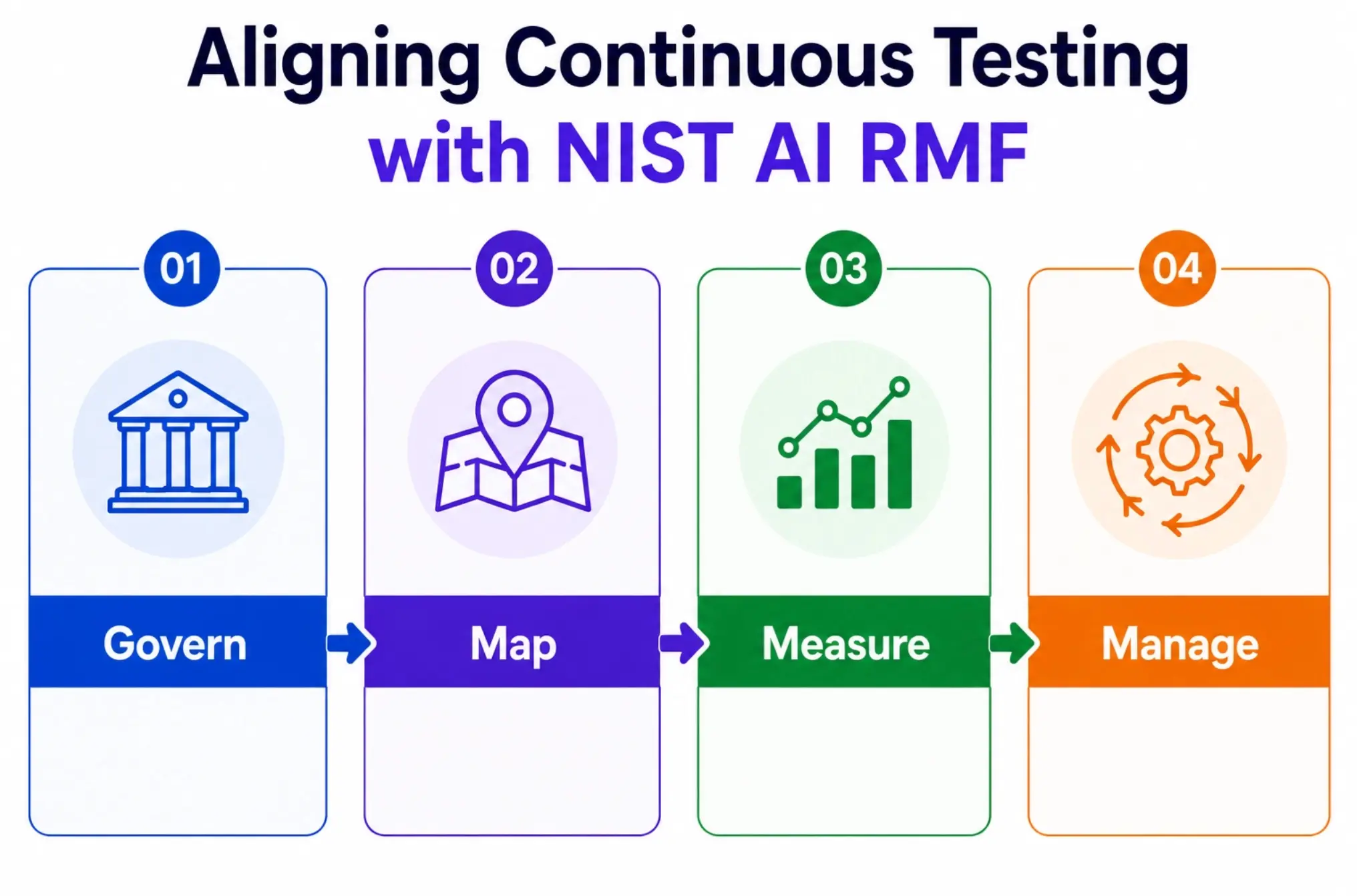
The four functions of the NIST AI RMF, each of which corresponds to a cadence of testing, fit into a typical review cycle.
Govern is not set it and leave it, but rather updated as new agents and use cases are introduced and AI risks emerge.
The process of Map is continually evolving, with context, use cases, and potential impacts changing as agents acquire additional tools, data, and permissions.
Measurement is a continuous process of analysis and tracking of AI risks, but without measurement against the current version of the system, it is of little value.
Manage is about prioritizing and acting upon identified risks, and requires access to current, not historical, data on risks in order to take action.
These four functions are not to be followed in a linear sequence but are to be used as a continuous cycle, and that is how the framework becomes operational, not aspirational.
Continuously Covering the OWASP Top 10 for LLMs
The OWASP Top 10 for LLM Applications lists vulnerabilities such as prompt injection, insecure output handling, training data poisoning, excessive agency, and disclosure of sensitive information. All of these risks can reappear following a change unrelated to the fix for the vulnerability. A model update might close a prompt injection vulnerability that was previously addressed, but will reopen it again. A new tool integration can add back in too much agency risk even if the agent doesn't have any different permissions. Coverages are updated as often as necessary to ensure the agent is as current with the entire list of OWASP as it can be through continual testing rather than checking it off once.
The Continuous Security Testing Lifecycle for AI Agents
A continuous security program is not something that can be attached to an existing pipeline. It's a lifecycle which is validated throughout the working life of the agent, not just at the end, and not only when it is used to serve live traffic.
Development & CI/CD - Shift Security Left
Security testing should be integrated into the same stream that delivers prompt changes, model updates, and tool integrations. Regressions are prevented from entering production by automated tests that are executed against all pull requests or configuration changes, when it is least expensive to correct the issue. This also implies viewing prompts, tool definitions, and agent configurations as version-controlled artifacts that are also subject to the same review discipline as application code.
Pre-Deployment - Automated AI Agent Red Teaming
Automated AI agent red teaming needs to test an agent with a well-defined set of scenarios before it is released to the public: Prompt Injection, Tool misuse, Goal hijacking, and Data leakage for sensitive information. This is done automatically and repeatedly – not as a scheduled manual procedure – so it can be performed against each meaningful change instead of being done once a quarter.
Production - Runtime Monitoring and AI Guardrails
When an agent is running, runtime monitoring is able to monitor for patterns of unusual tool calls, attempts to exceed permissions granted, and inputs that match known attack patterns. AI guardrails establish boundaries that are enforced in real time, rather than just reported afterward, and stop users from taking actions that are risky. This stage brings it back to the development part, as results from production should be directly fed into the next production cycle of red teaming and testing.
Point-in-Time vs. Continuous Security Testing
The differences between the two ways are most evident when compared side by side.
Dimension | Point-in-Time Assessment | Continuous Security Testing |
|---|---|---|
Coverage | Snapshot of a single version | Ongoing coverage across every version |
Frequency | Quarterly, annually, or ad hoc | Continuous, triggered by every change |
Agent Version Awareness | Tied to one fixed configuration | Tracks prompt, model, and tool changes as they happen |
CI/CD Integration | Typically manual, outside the pipeline | Embedded directly into the pipeline |
Runtime Visibility | None once testing concludes | Ongoing monitoring of live agent behavior |
Feedback Loop | Findings delivered as a static report | Findings feed directly back into testing and guardrails |
Scalability | Doesn't scale with agent count or change velocity | Scales automatically as more agents and updates ship |
That's why point-in-time security assessments work fairly well on infrequently updated systems, while they are typically poor for agentic systems that change nearly every day.
Measuring the Success of a Continuous AI Security Program
A program that is only valuable with long-term measurement of its effectiveness is a continuous program. These metrics provide security and engineering teams with a common way to gauge if the program is actually lowering risk.
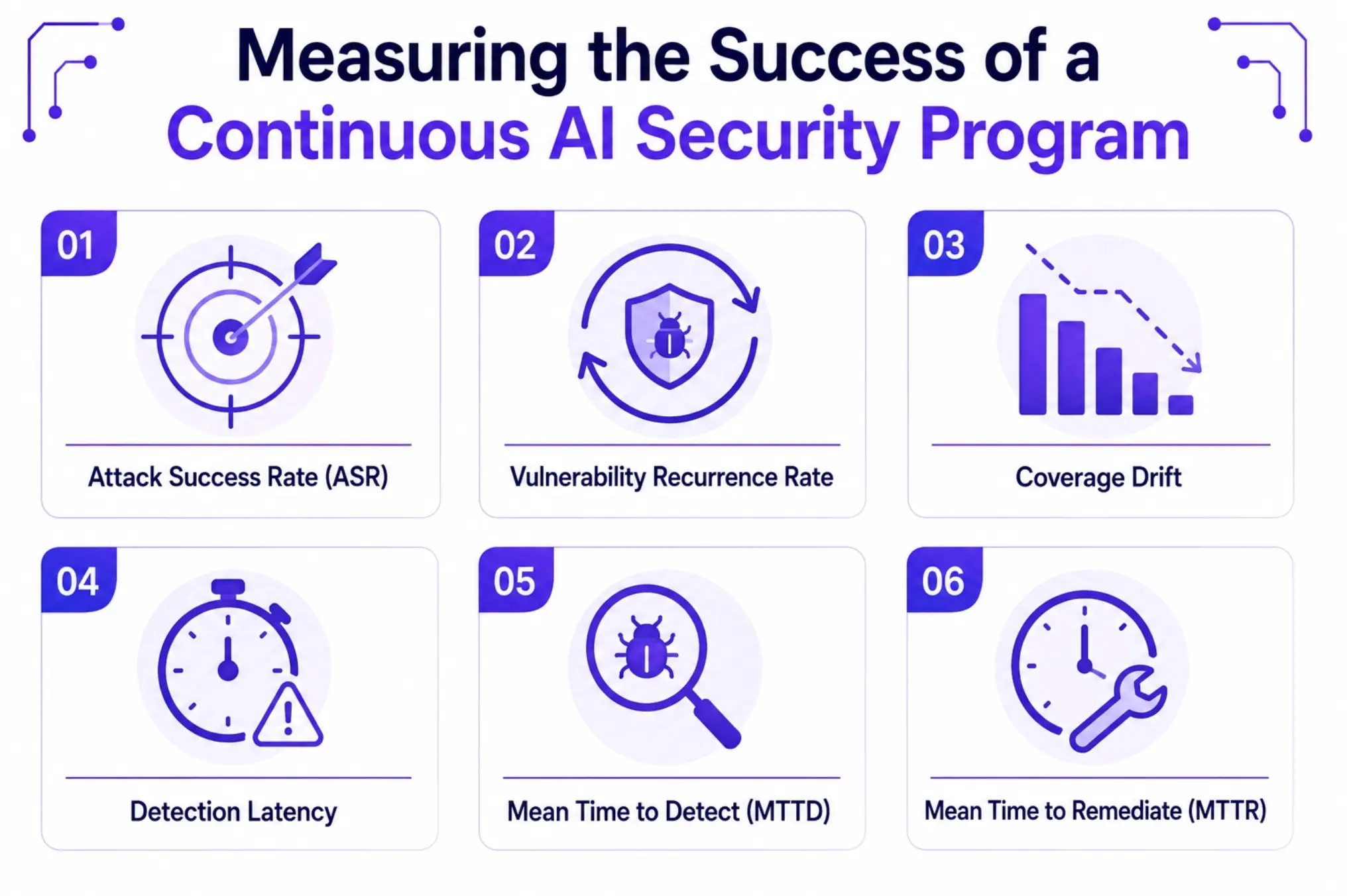
Attack Success Rate (ASR)
Attack Success Rate measures the proportion of attacks, like prompt injection or jailbreak attacks, that manage to circumvent the agent's defenses. One of the most obvious signs of effective guardrails and mitigations is a downward trend in ASR across testing cycles.
Vulnerability Recurrence Rate
It gauges how often previously identified vulnerabilities resurface after a change, like a model swap or prompt update. If a high recurrence rate is seen, it is likely that the fixes were at the symptom level and not structural, or that regression is not being performed consistently for all changes.
Coverage Drift
Coverage refers to the difference between what the testing program validates and what the agent's current abilities and integrations contain. Testing coverage should be expanded as new features, data sources, or permissions are acquired by agents. A major sign that the security program is not keeping up with the development of its agents is drift.
Detection Latency
Detection latency is the time elapsed from the first detection of a risky behavior until the behavior is detected by a monitoring or guardrail system. The faster the latency, the closer the security program is working to finding problems when they are happening instead of in a periodic review cycle.
Mean Time to Detect (MTTD)
While monitoring an actual security event, MTTD examines the typical time to discover the event that is successful – whether it's a successful prompt injection, a data exfiltration attempt, or an agent running outside of its scope of work. This is a measure of the capability of runtime monitoring and alerting in particular.
Mean Time to Remediate (MTTR)
MTTR is the time between detecting an issue and rollout of a fix or mitigation. In agentic systems, remediation can take the form of an updated guardrail policy, a prompt patch, or a restriction of a tool's permissions, and a faster MTTR provides less time for a known issue to be used.
Implementing Continuous AI Security with Akto
Many security teams don't want to build their own security program from start to finish in discovery, testing, and runtime enforcement, so opting for an AI security platform that covers the entire lifecycle is a much easier task.
Automated AI Discovery
Akto automatically identifies and catalogs AI agents, LLMs, and MCP tools in an organization's infrastructure and networked environments. This provides a continually updated list of agents, tools available to them, and information they can retrieve-all crucial to any continuous testing program. If the discovery isn't accurate, then you have no idea of what needs to be tested.
Continuous AI Agent Red Teaming
As part of its GenAI Security Testing capabilities, Akto continuously red teams discovered agents by mimicking scenarios such as prompt injection, tool abuse, goal hijacking, and more. Since this testing is not done periodically, it is focused on identifying regressions that occur when the program is edited, modified models are installed, or new tool integrations are added, in a much more timely fashion than months after, as described above.
Runtime AI Guardrails
Agentic posture management and guardrails are mechanisms implemented by Akto to manage agent activity in production, including tracking agent behavior and warning or blocking potentially harmful activities, such as unauthorized calls to tools or access to sensitive data. When used in conjunction with discovery and red teaming, this provides teams with a closed loop – know what agents are there, continually test them, and enforce boundaries on their live behavior.
Final Thoughts
Point-in-time assessments are designed to address a question that becomes moot when an agent's prompt, model, or a tool integration is altered-which, for most production agents, happens on a regular basis. Instead of this snapshot-based testing, continuous testing is an ongoing process that marches in time with the actual evolution of agentic systems. Discovery, red teaming, and runtime protection are not independent efforts, but they are concerted efforts where the findings of one stage reinforce the next.
By doing it correctly, it can enable organizations to adopt AI agents more quickly without compromising on security; validation is not just a hurdle that slows down the process, but a continuous step that takes place during development. Akto combines discovery, ongoing AI agent red teaming, and runtime guardrails in a single platform, providing security teams with visibility and controls to safely run agentic systems on a large scale. Request an AI agent security demo and experience how continuous AI security testing integrates into your pipeline.
Frequently Asked Questions - Continuous Security Testing for AI Agents
What is continuous security testing for AI agents?
It's the process of regularly evaluating an AI agent's security posture, rather than just once, to ensure testing aligns with the rapid changes, model updates, and new tool integrations.
Why are point-in-time security assessments insufficient for AI agents?
Since agents are constantly changing due to prompt edits, model swaps, and new integrations, one assessment will only reflect the agent's security posture for that day and will be outdated quickly.
How often should AI agents undergo security testing?
It is best to trigger a test whenever any significant change occurs, such as a forced update, model upgrade, new tool integration, etc., and not just at regular intervals of, say, a quarter or a year.
What is the difference between continuous AI security testing and traditional penetration testing?
Traditional penetration testing tests a system at a specific time, whereas continuous AI security testing conducts continuous, automated, and adaptive validation, adjusting as prompts, models, and integrations of the agent evolve.
How does AI agent red teaming support continuous security?
Unlike manual red teaming exercises that happen only occasionally, automated red teaming continually tests the latest version of an agent for regressions brought on by any recent changes, as well as for various other adversarial scenarios, such as prompt injection and agent tool misuse.
Why do model updates require continuous security validation?
The new or refined model may respond differently to the known attack techniques than the one it replaces, so security that has been established against the old model may not apply to the new model.
How do MCP servers impact AI security testing?
Instead of a single discovery and test, the discovery and test process must be continuous as the number of agents that depend on a specific MCP server can be compromised by a single misconfigured or compromised MCP server.
What role do AI guardrails play in continuous security?
AI guardrails provide live behavioral constraints to agents during production, preventing agents from taking riskier actions during runtime and reporting back any findings to the wider continuous testing/red teaming process.
Important Links

Experience enterprise-grade Agentic Security solution