AI Agent Governance: Framework, Principles, Risks and Best Practices
Discover what AI agent governance is, why it matters, and how organizations can govern autonomous AI agents with security controls, monitoring, and compliance.

Bhagyashree
AI agent governance marks an important evolution in how enterprises oversee intelligent systems which shifts from managing model outputs to controlling an autonomous action. Unlike before, generative AI tools have responded to prompts, agent’s plan, execute multiple tasks and work across enterprise systems with very limited human supervision.
This autonomy reveals the gaps that traditional framework weren’t built to address. Most of the AI governance programs were designed to model outputs, and not independent decisions. Yet the agents can call tools, and trigger downstream consequences at a runtime often faster than a human review allows.
The stakes are substantial. McKinsey has estimated agentic AI may unlock around $2.6 - 4.4 trillion in annual, still only 1% of organizations consider their AI adoption very mature. Governance maturity is not keeping pace with the experimentation. AI agent governance bridges that gap which evolves from static policy alignment to sustained operational control over delegated authority, agent boundaries and real-time accountability.
This blog explores what is AI agent governance and what are the considerations for effective AI agent governance.
What is AI Agent Governance?
AI Agent Governance is the integrated framework of policies, processes and technical controls. It offers both transparency and command over AI systems throughout their entire existence. It refers to implementing structured oversight to the inherent nature of agents. This framework spans the complete agent journey. It begins with data preparation and model selection. It moves through the tool integrations and evaluation. It continues into monitoring, deployment and lineage tracking. A proper governance layer need to cover this entire process.
AI Agent governance is foundational. Unlike traditional software, AI agents execute instructions, chain API calls and make decisions at a machine speed which creates authorization risks that can outpace human review. Gartner highlights that 25% of enterprise breaches may stem from AI agent abuse by 2028. Real world consequences, mis-scoped APIs, misconfigured workflows, exposed customer data are already surfacing.
Effective AI agent governance treats security and control as architectural foundations, not after thoughts - this enables organizations to scale agentic systems without sacrificing any visibility or accounting.
Traditional Governance vs Agentic AI Governance
Here are some key differences between traditional governance vs ai agent governance.
Traditional AI Governance
Traditional AI Governance was designed for the systems that informs the models that generate outputs, predictions, or recommendations in response to the human prompts. Control lived at the edges: in training pipelines, validation checkpoints and output reviews. Humans remained firmly in a decision loop. As IBM notes, early governance frameworks were created to ensure AI systems were “ethical and safe”. This is a standard anchored in model behavior and not an autonomous action.
It is focused on predictions, model outputs, and recommendations.
Governance stops at the model boundary.
Humans analyze AI suggestions before acting.
Compliance is driven by model transparency and data fairness.
Auditability is limited to model performance logs
Permissions are scoped to users and not systems.
Agentic AI Governance
AI agent governance addresses systems that act autonomously executing tasks, chaining the tool calls, and make runtime decisions with limited human supervision. Control must live inside the workflow itself, integrated before agents are ever deployed. CTO of Trust wise said, “trust and governance should be embedded directly into agent decision loops, not bolted on afterward.”
Agents act first, human reviews happen later.
It is focused on autonomous actions, tool use, and decision chains.
Risk centers on cascading, unauthorized or irreversible actions.
Auditability requires full agent action and decision trails.
Governance need to be embedded into agent architecture itself.
Permissions scoped per task, per session, per agent.
Core Risks and Threat Surfaces in AI Agent Deployments
Failures of governance in AI agent deployments rarely announce themselves. They keep accumulating quietly via permissions that never exercised properly, agents that were spun up outside approved channels or autonomous decisions made at machine speed with zero human in the loop. By the time failure crops up, the conditions that caused it have been present for several weeks.
Excessive Permissions
An excessively permissioned agent can read the files which are not necessary, write to systems it should not touch and trigger the actions that is far outside the scope of its intended task. When something goes wrong. For instance, a misunderstood instruction or a manipulated prompt - the threat surface expands in direct proportion to the permission granted.
Shadow AI Agents
Shadow agents are critical because security teams do not know to look for failure signals they don’t know exist. When organizations deploy agents without a proper security review, they operate beyond the visibility of AI agent governance framework. They can connect to sensitive data sources, users, without any oversight, audit logs or incident response coverage.
Prompt Manipulation
Prompt injection occurs when malicious content is embedded in agents environment. For example, webpage browses, a document it reads, an email it processes all contain instructions that redirects the agents behavior. It can also agent to steal the data, bypass approval workflows, or performs actions that contradict the original instructions.
Agent Drift
AI agents can behave differently overtime, not because of the malicious inferences but because the systems they interact keep changing. The gradual difference between the behavior an agent was designed and validated to produce and the behavior it actually conducts in a changing environment. The agent is functioning technically but differently than intended. Addressing agent drift needs continuous behavioral monitoring, not just pre deployment testing.
Non-Approved Autonomous Actions
Unapproved autonomous actions occur agents conduct risky actions such as sending communication, modifying records, making transactions outside the boundaries that governance teams intended. This risk scales with both capability and consequences of action. Autonomous AI risk management frameworks need to define what agents can do, what needs human confirmation and what is off the governance framework or guidelines.
AI Agent Governance Principles and Lifecycle Coverage
Most security teams that have deployed AI agents have also deployed observability tools to monitor them, security controls to control and compliance programs to audit them. Most of the observability, security and compliance aspect does not answer what the agent is exactly supposed to do - whether the agent has performed right actions, in a right way or with proper human oversight. To address this gap AI agent governance is developed. This framework is created to from documented failures, step by step lifecycle that enables human oversight at every consequential decision point.
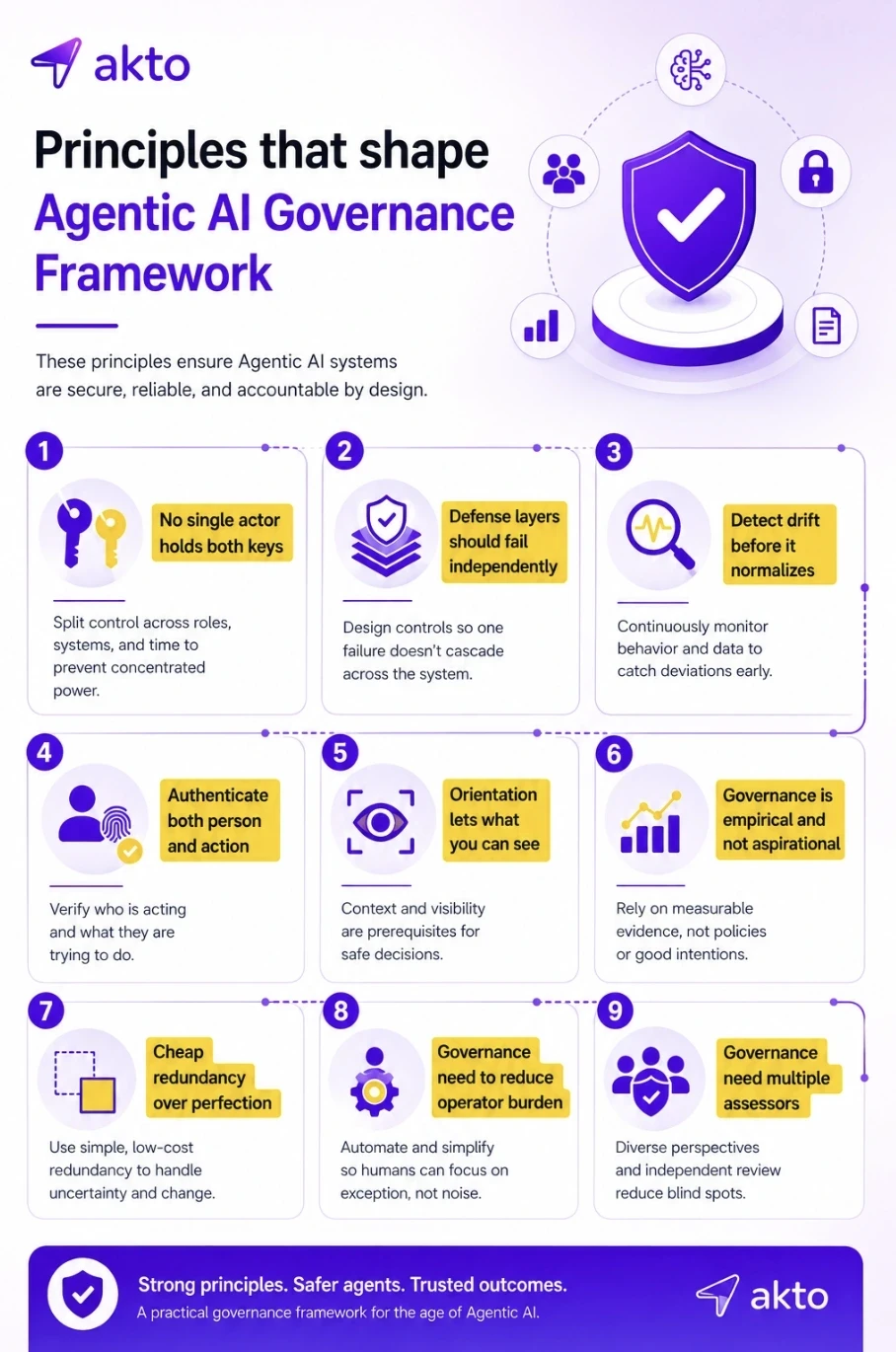
Principles that shape Agentic AI governance framework
The frameworks nine principles are extracted from the documented failures. Each principle emerged because something went wrong without it.
No single actor holds both keys: Agent that writes its own plan and executes it without independent review is a single point of failure. Phase gates implement separation; the proposing agent and approving authority are different which is the AI equivalent of separation of duties in financial controls.
Defense layers should fail independently: When a governance mechanism is added, its failure mode must differ from current layers. Two controls may fail for same reason which are dependent on just human’s attention or vigilance. Safety comes from stacking mechanisms with different failure modes, not from perfecting any layer.
Detect drift before it normalizes: Every suspicious pattern or deviation from an expected behavior must be documented, even if the outcomes are acceptable. A pattern of borderline outputs are signs of drift. The remediation is a structural commitment to prevent treating deviations as new baselines which leads to the collapse of security teams.
Authenticate both person and action: Being informed on who approved a decision and whether the decision was necessary is extremely crucial. Both must pass independently.
Orientation lets what you can see: Different actors ask different questions and capture different failures. A planning agent oriented towards throughput misses compliance gaps. An operator focused on output quality misses prerequisite failures. Governance systems need actors with genuinely different orientations and not redundant actors asking the same questions.
Governance is empirical and not aspirational: Every mechanism must trace to specific incident. Controls that cant be traced to real failure are questioned. Governance complexity without a corresponding safety advantage is itself a risk.
Cheap redundancy over perfection: Several automated checks are more cost-effective than depending on single human judgement. Human attention is the scarcest resource in any governance system. Mechanisms must reduce operator cognitive load and not add to it.
Governance need to reduce operator burden: Governance creates a decision overload introduces systemic risk. Systematic phase transitions, pre-validated decision surfaces and standardized impact statements that are present to compress complex governance decisions into forms that operators can analyze reliably and quickly.
Governance need multiple assessors: An actor who has helped design a plan shares that plan’s assumptions and cannot see failures that those assumptions obscure. Independence needs a an entirely different perspective from analytical point of view at an enterprise scale and organizational separation from shared incentives.
Ways to Implement Runtime Governance and Security Controls for AI Agents
AI governance needs more than runtime security alone. Security teams control who can release AI -driven powered features, approve any updates or modifications, and access the production environments. As AI agents increasingly generate code, human oversight becomes very important through approval workflows, detailed audit logs, and granular access controls that track every single deployment and configuration change. The advanced security platforms combine runtime controls automated governance using the feature flags, progressive rollouts, kill switches, rollback mechanisms and real-time monitoring.
These runtime governance controls help minimize the blast radius of AI generated changes by gradually exposing releases based on the production health signals like latency and error rates.
Set up Continuous Runtime Monitoring
Runtime governance starts with real-time visibility into AI agent patterns. Security teams need to monitor prompts, tool usage, memory access, API calls, and execution patterns to understand how the agents operate in production. Continuous observability helps detect prompt injection attempts, unauthorized actions, outputs, and suspicious behavior changes before it escalates into bigger security incidents.
Use Progressive Rollouts
AI driven changes or updates should never be deployed without safety controls. Progressive rollout strategies let security teams to gradually expose new AI behaviors or generated code while monitoring production health signals such as latency, error rates and violations of policy. Runtime kill switches and rollback mechanisms assure problematic changes can be paused quickly without redeployment.
Implement Dynamic Runtime Policies
Static permissions alone are just not enough for AI systems. Runtime governance need to applied in a context-aware policies that analyze every agent action before execution. These controls can block sensitive operations, validate tool usage, implement least privilege access, and prevent unsecure actions that are based on organizational rules, user permissions and risk levels.
Maintain Comprehensive Audit Trails
Every AI-driven action, deployment, approval, and configuration change must be recorded in an exhaustive audit logs. Strong auditability improves incident responses, supports the compliance requirements and helps the organization answer the important governance questions like who made a change, when did it occur, and which systems are affected.
Solidify Identity and Access Governance
Every AI agent most often function by making use of APIs, service accounts, and machine identities. Runtime governance must comprise strong authentication, credential rotation and detailed access auditing. Restricting privileges and continuously validating identities minimizes the risk of exploitation of sensitive systems or data and unauthorized access.
Regulatory and Compliance Considerations for AI Agent Governance
Security teams need to set up governance practices that ensures AI Agents are auditable, compliant, secure and reliable across regulated environments.
Set up risk classification and AI governance
Classify the AI agents based on operational and regulatory risk to determine proper oversight, monitoring requirements, approval workflows, and security measures.
Stay updated with Latest AI Regulations
AI regulations keep evolving across global market, which makes it difficult for security teams to track changing requirements without any structured compliance monitoring and governance processes.
Verify documentation and auditability
Manage comprehensive records of training data sources, testing activities, decision logs, approvals, and compliance assessments to support regulatory audits and investigation.
Enforce data protection and privacy controls
AI agents process sensitive information which requires strong encryption, data minimization practices, access controls and privacy governance aligned with applicable regulations.
Maintain human oversight for high risk decisions
Human review and intervention mechanism need to govern critical agent actions that comprises of legal outcomes, financial transactions, customer impact or privilege system access.
Govern external AI providers and integrations
Perform due diligence on third party AI vendors and integrations to analyze transparency, security controls, compliance posture and contractual obligations.
Develop AI incident response procedures
Establish response plans for AI-related failures, security incidents, harmful agent behavior, compliance breaches which includes escalation workflows and forensic logging practices.
Final Thoughts on AI Agent Governance
AI governance monitoring tools like Akto help businesses to continuously comply with governance practices. These tools helps ensure proper alignment to business and compliance.
Akto functions at the intersection of AI discovery, runtime security, and governance making it one of the nine solutions which covers all the three areas. This platform helps security teams inventory AI assets, identify shadow deployments, monitor posture drift and maintain visibility across the AI environments.
It helps govern agent permissions, data usage, and tool access while generating the audit trails for compliance. At runtime, Akto adds real-time guardrails against the prompt injection, data exfiltration and abnormal agent behavior by offering comprehensive security context across the AI ecosystem.
See Akto’s Agentic AI Security and MCP Security in Action by booking a AI agent security demo today!
Important Links

Experience enterprise-grade Agentic Security solution