Enterprise AI Governance Best Practices for Secure AI Adoption
Learn AI governance best practices for AI agents, MCPs, and LLMs. Build secure, compliant AI with guardrails, risk management, and runtime controls.

Rushali

AI agents, copilots, and LLM applications are being deployed faster by enterprises than security and compliance teams are able to follow. These systems process sensitive data, invoke internal APIs, and are increasingly acting independently, taking us far beyond what traditional IT controls could have anticipated. AI governance is the field that allows an organization to utilize AI capabilities at speed without compromising risk, security or compliance. This guide outlines a step-by-step approach to creating an AI governance program for the enterprise, including what AI governance is and isn't, the principles behind AI governance, the risks that need to be mitigated, and the steps to take. It also includes policy, lifecycle operations, guardrails, red teaming, risk management, regulatory alignment, metrics, and a roadmap to start on in the next 90 days.
What Is AI Governance?
AI governance defines a group of policies, controls, roles, and processes an organization employs to ensure that AI systems are safe, compliant, and aligned with business intent. Before we dive into the principles and frameworks, it's important to clarify the definition of IT governance within an organization, its significance for AI agents and applications on LLMs, and how it differs from the governance models teams typically utilize in their businesses.
What Does AI Governance Mean in Enterprise Environments?
AI governance in an enterprise is a set of unambiguous, strictly followed rules governing what AI systems can access, what they can use, who is responsible for them, what they can do with them, and how. In an enterprise, AI governance is a set of rules that unambiguously and strictly define, at any given time: It covers all the aspects of AI assets, from the customer-facing chatbot to the internal coding agent to the MCP servers that bring agents in contact with enterprise systems.
By implementing good governance, the practice of using AI becomes measurable. Governance establishes the guardrails, approval paths, and monitoring that will occur in the organization, rather than each team creating its own models and agents and having no common ground rules. It provides a unified security, legal, compliance, data, and engineering model, rather than each having to invent their own.
Why Is AI Governance Important for AI Agents and LLM Applications?
Agents and LLMs differ from the software security teams they are accustomed to. At runtime, an agent selects the tools that it wants to call and in what order to call them, typically based upon the natural language input that it does not always have the means to verify. The autonomy is the point, and the risk. One incorrect instruction can result in data being exposed, an API being called that isn't permitted, or some other action being taken that wasn't approved.
The exposure for LLM applications is supplemental. They can have a leak of training data or context data, they can be misguided by injected prompts, and they can give correct-looking authoritative answers that are incorrect. Governance is important because the momentum and impact of these systems grow rapidly when there is a small gap. An organization that lacks oversight has no way to know what its AI is doing, and to demonstrate compliance with bounds.
How AI Governance Differs from Traditional IT Governance
Traditional IT governance is based on the deterministic behavior of systems: a fixed software does a fixed thing, a fixed code path can be reviewed by a reviewer. AI challenges that notion. The outputs of models are probabilistic, the behavior of agents emerges from the model, and the set of actions a system can take is large and partially unpredictable.
The differences are “real.” The challenge in AI governance is that one has to deal with assets that come out of nowhere, shift their actions when models are updated, and perform autonomously, as opposed to IT governance, which can deal with known assets with stable interfaces. For IT access control is all about users and roles, but for agents, it needs to involve machine identities with wide privileges and link actions together. Tracking change from transactions to behavior and intent. AI governance is not IT governance; it is part of governance for a new class of systems that IT governance could not have predicted.
What Are the Core Principles of AI Governance?
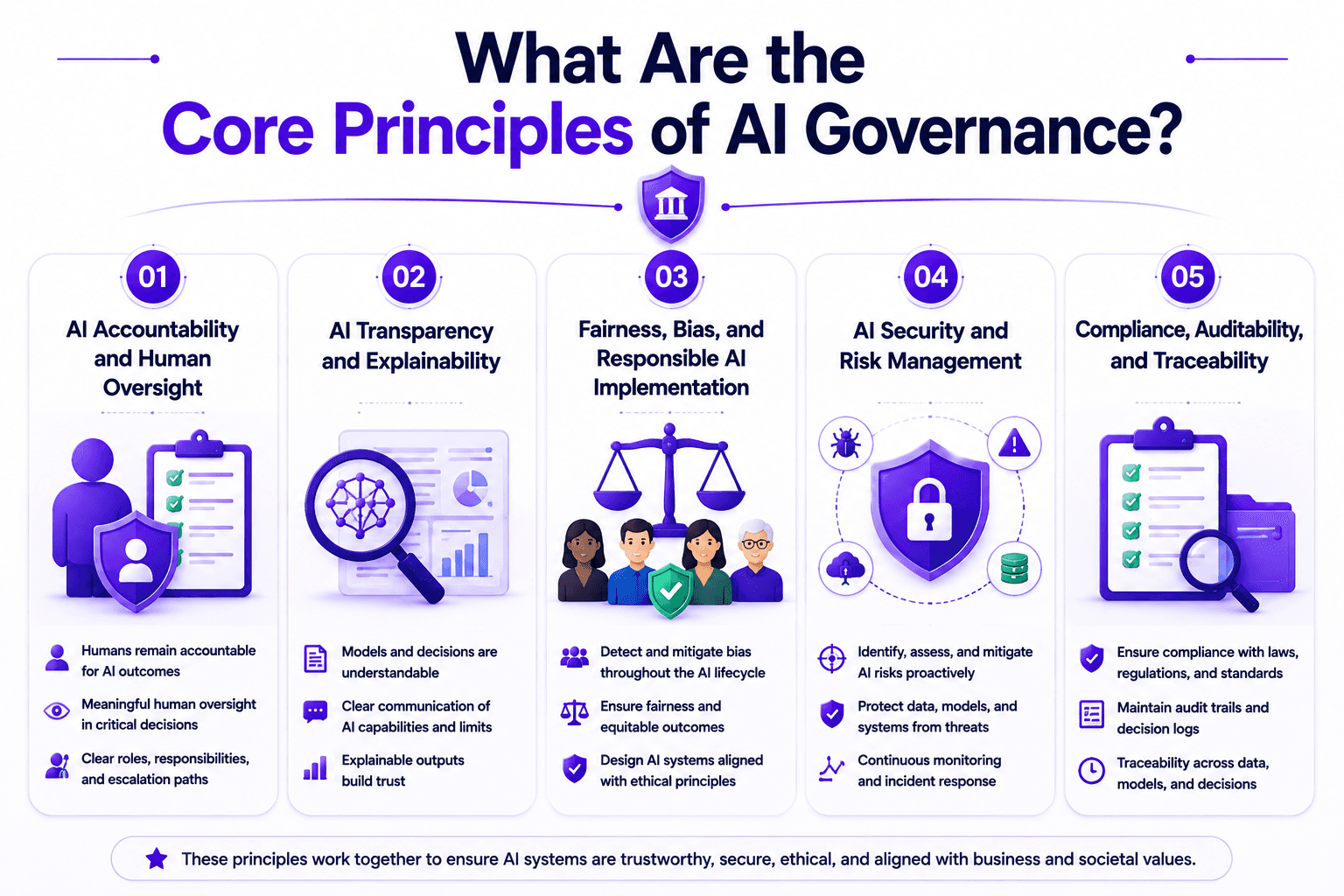
A successful program is based on a few fundamental principles that all policies and controls can be traced back to. Below are the sections on accountability and oversight, transparency, fairness, security, and the accountability and oversight compliance backbone that connects them.
AI Accountability and Human Oversight
All AI systems must have an owner, and the responsibility for them must be clearly established within human beings. AI accountability requires someone to take responsibility for an agent's behavior, and AI oversight involves a person's ability to monitor, intervene, and/or prevent an agent's actions if necessary. Any decisions that have a significant impact should be made with a person in or on the loop; with the agent proposing a decision and a human approving, not the system making decisions on its own. Actions have to be attributable, too: there should always be a trace of an action back to the agent, the identity, and the policy that made it possible.
AI Transparency and Explainability
AI transparency involves understanding and documenting the system's outputs and why it took a certain action. This will be the case for an LLM application, where it is important to document the prompts, context, and versions of models used. For an agent, it involves recording the links of tool calls made and the rationale behind each step. Explainability helps to build trust, debugging, and auditing. To detect problems and to meet the demands of regulators who are increasingly demanding this information, stakeholders must be aware of what data a model used, what it could do and how a specific result was obtained.
Fairness, Bias, and Responsible AI Implementation
Building and operating systems responsibly involves creating and deploying systems that are fair to people and aligned with the organization's ethical principles. Governance must incorporate bias testing, representative evaluation data, and continual testing after deployment when a model is applied to skewed data to ensure it yields a biased outcome in hiring, lending, or service decisions. AI ethics does not need to be conducted once. Fairness must be continually assessed and linked to explicit, acceptable thresholds before a system is brought to users, because bias can resurface with changes in the data and/or retraining of the model.
AI Security and Risk Management
AI security ensures that AI models, agents, and data are used, manipulated, and not compromised. It covers the input layer (prompt injection and malicious instructions), the execution layer (unauthorized tool calls and excessive permissions), and the output layer (data leakage and unsafe actions). These exposures are prioritized based on the probability and consequence of their occurrence, and then mitigated by the appropriate risk controls. Governance is the difference between an agent that can move money and an agent that can summarize documents, and it is what makes it explicit and enforced that there is such a difference.
Compliance, Auditability, and Traceability
Governance must deliver, not only plan, results. Compliance involves correlating AI controls with applicable laws, standards, internal policies, etc. Auditability refers to the ability to record the events in detail and in a way that an internal or external auditor can check. Traceability links the actions with their origins, their authorization, and their results. Combined, they provide an organization with a way to show, at any given moment, that their AI has been used within approved parameters, and thus becomes a governance program that is defensible, rather than a slide deck.
What Risks Does an AI Governance Program Address?
A governance program is worthwhile if it helps avoid certain, predictable exposures, not abstract concerns. Here are the risks enterprise teams encounter most often with the proliferation of AI adoption.
Shadow AI and Unauthorized AI Usage
Shadow AI is when employees and teams use AI models, agents, browser extensions, and SaaS AI without security's knowledge, just like shadow IT. Each user-operated tool has the potential to transmit private information to a third party, or execute actions for which no one has been vetted. The problem is not obvious, and it develops over time, as it takes minutes to start an agent from scratch, or to attach to an MCP server. Governance does that by ensuring discovery remains ongoing, rather than happening in the dark, and that any usage of AI that is not authorized comes under policy review.
AI Agent Security Risks
Agents bring risks of their own due to their autonomy and range. An agent with too many permissions can have a lot more than he or she needs. A manipulated agent may be directed to use legitimate tools inappropriately. With multiple agents, a compromised agent can infect others with bad instructions and/or data. Since agents are being run with machine identities that frequently have wide permissions, the range of damage from one failure is large. Governance restrains this via least-privilege access, via isolation between agents, and by monitoring what each agent is actually doing in production.
Data Leakage and Sensitive Information Exposure
LLMs and agents deal with sensitive data every day, which opens numerous avenues for it to leak. A model is able to output a confidential context again. An agent can export information to a third-party application. Logs and prompts can record PII or credentials that are subsequently left unprotected. Governance is the response, using data classification, limiting each system's visibility, hiding sensitive information, and limiting the routes to which AI-generated information can be sent.
Prompt Injection and AI Manipulation Attacks
Prompt injection is the most prevalent attack method for LLM systems. An attacker codes instructions into the text that the model reads, such as a user message or instructions in content that an agent retrieves, and the model executes the instructions as if they were valid commands. This can be used to divert the attention of an agent to certain sensitive tools, modify the arguments passed to an agent, or get a model to disregard its constraints. Governance tackles manipulation by checking the input, separating trusted instructions from untrusted data, and putting in place guardrails that prevent an injected prompt from causing actions.
Model Drift and Unintended Behavior
Models do not stay still. Things can change in ways that nobody expected, such as due to retraining, to a different foundation model, or to the system being exposed to a different subset of the data it's been trained on – this is called drift. A model that worked well at launch can start to get worse, become biased, or begin to produce unsafe outputs months after launch. Agents may also acquire unexpected behaviors as a result of changes in their tools and environment. Governance manages this by constantly evaluating, monitoring for changes in behavior, and implementing an intervention mechanism to detect and correct drift before it eventually reaches users.
Regulatory and Compliance Risks
There is a rapidly expanding regulatory landscape for AI, ranging from the EU AI Act to sectoral regulations and data protection laws. Fines, lawsuits, and reputational damage will result if AI is not shown to be compliant. This is leading to a growing need for transparency, human oversight, and risk assessment processes for more high-risk applications. Governance minimizes this exposure by establishing controls on regulatory requirements and maintaining documentation of compliance.
How to Build an Enterprise AI Governance Framework
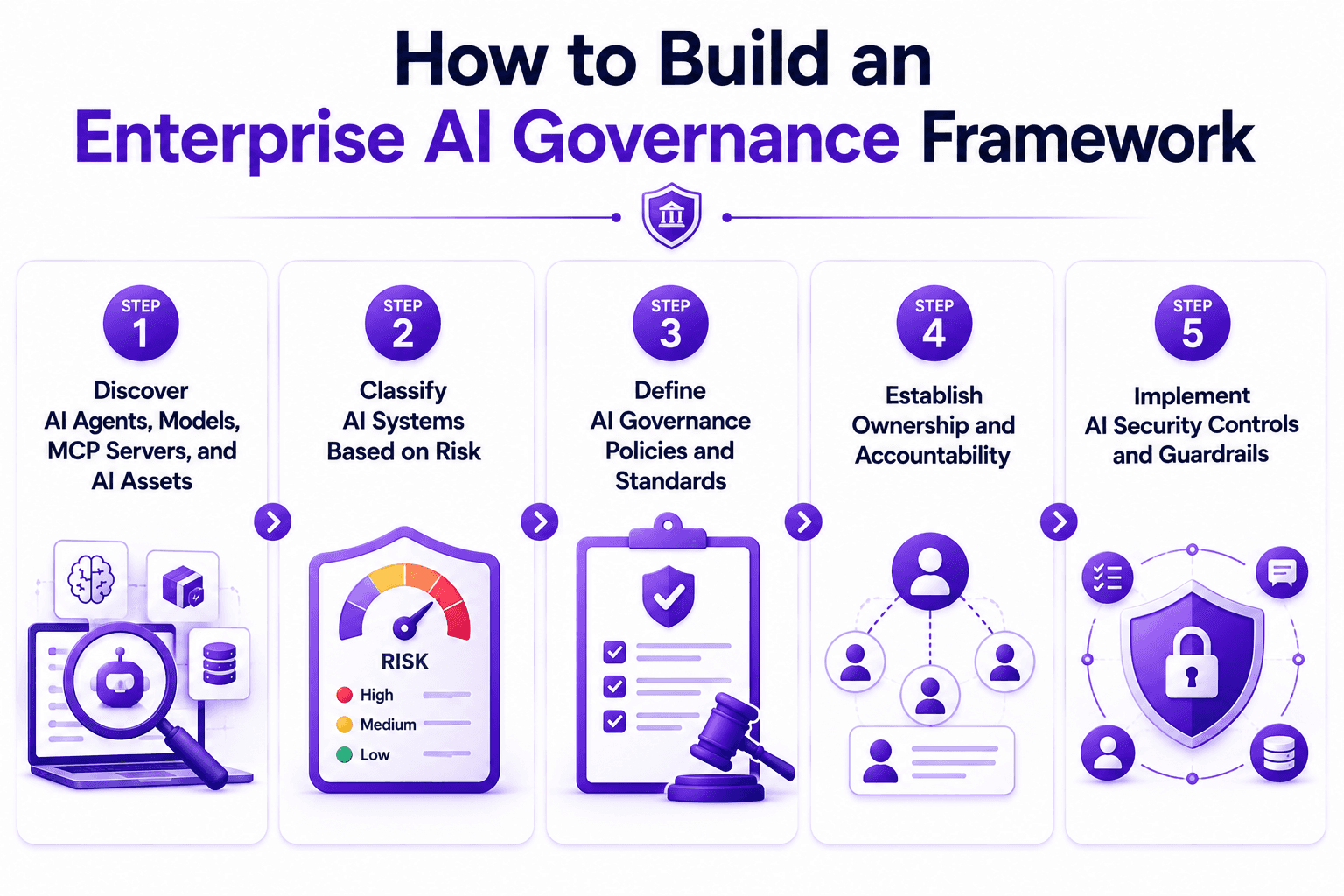
Principles are only important if they are codified in a repeatable structure! An enterprise AI governance framework converts them into clearly spelled-out actions that will take an AI asset from discovery to classification, policy, ownership, and security measures. Below are 5 steps that you can follow in a practical order.
Step 1: Discover AI Agents, Models, MCP Servers, and AI Assets
If you can't see it, you can't govern it; that's why discovery is first. AI agent discovery involves the ongoing discovery of all AI models, agents, MCP servers, and connected tools in any cloud infrastructure, on-prem systems, and employee endpoints, and even shadow AI that has never been registered. The end result is a live inventory that captures what each asset is, what data and tools it can access, and what actions it can perform. Some platforms like Akto automate this discovery, maintaining the inventory fresh by cataloging MCPs, AI agents, tools, and resources on infrastructure, cloud, and employee laptops without going stale after it is written.
Step 2: Classify AI Systems Based on Risk
Once the inventory is developed, you should then break the systems into categories by risk, and then apply controls accordingly. Classification is concerned with the types of data that a system interacts with, the types of operations it can perform, its level of independence, and those whose concerns it impacts. An agent who will execute transactions or be able to reach production is in a high-risk tier and subject to harsh controls and approval. Lower, you'll find a read-only summarizer. This tiering ensures governance is not applying the same treatment to every tool, thus either restricting the use of low-risk tools too much or not protecting the use of high-risk tools enough. It also dovetails well with the regulatory approach that categorizes AI by risk.
Step 3: Define AI Governance Policies and Standards
Policies convert principles and risk levels into rules that people and systems have to follow. This step determines what can be done, what information can be used, what permissions are required, and what cannot be done at all in the different AI classes. Standards translate policies into reality: what is required to be logged, what are the required guardrails, what is required for authentication, what are the tools they are allowed to use, etc. It is not a fuzzy set of vague guidelines that can be interpreted by engineering, but a well-defined AI governance policy that can be enforced by security.
Step 4: Establish Ownership and Accountability
Each AI asset must have a responsible owner tasked with its actions, security, and adherence to standards. This step designates to whom they belong and what their roles will be: who will approve a new agent, who will check their access, who will react if they behave inappropriately. Many companies establish a cross-functional governance committee comprised of security, legal, data, and engineering to decide on cross-team issues. The principle of clear ownership is what ensures that there is no governance for everyone and hence no governance for anyone.
Step 5: Implement AI Security Controls and Guardrails
Working controls are installed in the final step. This covers least-privilege access for agents, authentication on MCP servers and tools, sandboxing execution, inspection of input and output, and runtime guardrails which enforce policy as systems run. The level of control needs to be commensurate with the risk level from Step 2, and be the highest for the highest risk assets. This is where governance isn't just about putting documents together and becomes active in the way AI can and can't be used in production.
What Should an AI Governance Policy Include?
If a policy doesn't address the right issues and includes sufficient detail, then it is not useful. An AI governance policy covers everything from use of AI, to data sourcing, security, vendor management, the identity of agents used, to incident response. There are sections in each of the areas listed below that should be covered in your policy.
AI Usage Policies
There are policies to control the use of AI by employees and teams. They clearly define the tools to be used, the appropriate use of these tools, data that may be input into an AI system, and how to request a new capability. The first line of defense against shadow AI is clear usage rules because it is much more likely that people will follow a sanctioned path if there is one and it is easy to use.
Data Governance Requirements
This section outlines the data flow of AI systems. It includes information on the types of data that can be stored and transmitted in various systems, the sensitivity of the data to be masked or tokenized, and how much data is required to be retained for prompts and logs when they are processed by AI services. With robust data governance, you can prevent AI from becoming another unsecured path through which sensitive data can escape the organization.
AI Security Requirements
Every kind of AI system has to adhere to security requirements before and during production: authentication standards, access control models, required guardrails, logging, and testing expectations. They specify the minimum requirement for AI security for low-risk systems and more stringent requirements for high-risk systems. Explicit requirements create a basis for security that is not negotiated on a case-by-case basis.
Third-Party AI Vendor Governance
Most companies use AI from vendors and create their own – and each vendor becomes part of the company's risk surface. This section clarifies the assessment of third-party AI tools, security and data commitments vendors must be willing to make, and how access to these tools is scoped and monitored. It should also address data that may be imparted to the vendor and how to end a relationship on a good note.
AI Agent Access and Identity Controls
Agents are assigned an identity, and those identities must be as strong and as carefully considered, if not stronger, than human identities. This section describes the manner by which agents are authenticated, what authorization they are given, how it is reviewed, and how an agent's authorization is revoked when the agent is retired or compromised. Multiple agent identities with least privilege helps to prevent any one agent from becoming the skeleton key to the enterprise.
Incident Response and Escalation Procedures
If someone has an AI system that acts poorly or is attacked, people should be aware of what they should do. AI incident response procedures outline the detection, notification, containment, and shutdown of misbehaving agents, as well as investigation and reporting of incidents. Escalation paths are clear and show when the issue escalates from Engineer to Security leadership to Legal. This in turn makes a potential crisis a managed process.
How to Operationalize AI Governance Across the AI Lifecycle
Governance needs to be part of day-to-day activities, not just approval gates. AI lifecycle management involves implementing controls throughout the system's lifecycle from development to retirement. The following stages indicate what governance is like at each stage.
Governance During AI Development
Governance begins at design time. As the system is designed, teams should record the system's intended function, the data the system will be accessing, and the boundaries of the system. As the system is designed, the system purpose, data the system will be using, and the intended boundaries for the system should be documented, and security controls and logging should be designed from the start. Threat modeling at this stage will identify design weaknesses at an early stage, when they are inexpensive to address. It is far more expensive to retrofit controls to a system already in production.
Governance During Model Testing and Validation
A system must go through quality and security requirements prior to shipping. Validation tests for accuracy, fairness, and bias; and security tests for prompt injection, data leakage, and unsafe behavior. This is also where red teaming fits, in which one should try to break the system while using it adversarially to find out what it cannot do. No high-risk model should be allowed to proceed to production without this gate.
Governance During AI Deployment
When deployed, governance ensures that the controls outlined above are actually implemented: authentication is set up, guardrails are turned on, access is limited to the bare minimum, and monitoring is linked in. Ownership is also formally assigned, and the asset is added to the governed inventory during deployment. A clean deployment checklist ensures that systems don't go live with security on their list of to-dos.
Governance During Runtime Operations
Governance becomes ongoing once a system is live. The Runtime operations entail tracking agent behavior, enforcing guardrails on all actions, managing for anomalies and drift, and reacting to incidents as they occur. This is the longest and most challenging stage since feelings and circumstances are constantly changing and the autonomous systems are active. Most real risk occurs in runtime, so the amount of time that needs to be devoted to it should be the highest.
Governance During Model Retirement
All systems can be removed or taken down, and decommissioning poses risks if not done properly, and retirement poses risks if it is not done properly. At this point, governance involves taking access and identities away from the system, removing or archiving data as per policy, updating the inventory, and ensuring that no one else is relying on the system data. A clean retirement puts away unused agents and boring credentials that might otherwise sit there inactive.
How Do AI Guardrails Support AI Governance?
Policies are what are supposed to happen, but guardrails are what make it happen in real-time. The runtime controls that implement governance on live systems are called AI guardrails, which inspect and limit what models and agents are doing. The common forms they assume are described in the sections below.
Runtime Guardrails for LLMs and AI Agents
Runtime guardrails monitor inputs, outputs, and actions in a system during runtime. On the input side, they intercept injection attempts and blocked requests. They prevent sensitive information from leaking from the output end and prevent unsafe responses. For agents, they are in front of tool calls to restrict what is allowed. An agentic proxy for MCPs and AI agents, Akto applies least-privilege checks and prevents risky actions at the point of action, rather than after.
Policy Enforcement for Autonomous Systems
A system that functions in isolation is implemented by written policy, which is enforced through the use of guardrails. Policy enforcement, as opposed to relying on an agent to stay within its bounds, validates each action at runtime against the rules and denies any action that is not in the rules. This is also critical for autonomous workflows, where a sequence of multiple steps is chained together, and a single operation that may have been unchecked can cause a chain reaction.
AI Action Validation and Approval Controls
There are actions that are too important to be automatically allowed. Validation and approval controls involve a specific check, in some cases, manual approval, prior to the high-risk action taking place, such as moving funds, changing access, or touching production. The control should only grant permission to a specific action and target rather than an entire class of actions and targets; therefore, when the specific action is approved, the class of actions shouldn't be automatically approved as well.
Monitoring Agent Behavior in Production
Another area of governance that is addressed by guardrails is the recording and analysis of agent behavior. Behavior monitoring creates a profile of the standard behavior, and detects abnormal behavior: a tool is called by an agent that had never called it before, with a volume it had never heard, or in a sequence it had not observed. This will transform runtime into an evidence-of-governance and early-warning tool and not simply an enforcement layer.
How Does AI Red Teaming Strengthen AI Governance?
The only way to see if your controls are effective is to test your system the way an attacker would. Governance has proof instead of assumption with AI red teaming. Here you will learn what it is, how it differs from a normal test, and how to incorporate it into a program.
What Is AI Red Teaming?
Adversarial testing of your own AI systems using the very same techniques you would use against a hostile system (AI red teaming). For LLMs and agents, it translates to allowing them to be fired by prompt injection, manipulation, jailbreaking, tool abuse scenarios, and seeing what survives. The idea is to publish the actual paths through which you can exploit it, under realistic conditions, and then patch them. To ensure that guardrails function as expected, Akto continuously conducts agentic Red Teaming against MCP servers and AI agents, leveraging a large probe library, featuring a variety of attacks ranging from prompt injection all the way to multi-agent attacks.
Red Teaming vs AI Security Testing
A standard security test is used to test if "known controls" have been set up properly, and if the system complies with a list. Red teaming takes it one step further by presenting a creative, goal-oriented competitor that is able to link techniques together and find where a checklist is lacking. Testing asks the question of whether you've constructed what you intended to construct. Red teaming is the answer to the question: could what you built be defeated? A mature program employs both, with testing being the minimum and red teaming the stress test.
Continuous Validation of AI Agents
The one-time red team is only valid for a specific moment in time, as models are updated, tools change, and new attack techniques emerge. Continuous validation runs adversarial tests continuously, and a stealth change in an adversarial test that reopens the vulnerability will be detected fast, not after months. The pressure is constant for agents, who are constantly changing to keep up with their surroundings, and it's the one measure that can keep their confidence up to date.
Integrating Red Teaming into Governance Programs
When the results of red teaming are returned to governance decisions, they offer the greatest value. Findings should lead to risk classification, lead to fixes prior to high-risk systems shipping, and verify that guardrails apply policy. Embedding red teaming into release gates and into the run-time monitoring lifecycle puts it in the context of the organization's governance of AI and makes it more than just a report that sits in a drawer.
AI Risk Management Best Practices
Risk management is the glue that ensures that governance remains on target. Sound AI risk management detects exposures, thinks through how they might be leveraged, plans for incidents, and manages risks outside the organization. Each is addressed in the practices below.
Continuous AI Risk Assessment
AI risk is dynamic and cannot be assessed yearly. Continuous assessment means periodically re-evaluating each system's exposure when models evolve, or new models are added, or as the threat environment changes. It maintains up-to-date risk scores and ensures that controls are appropriate to the risk the system presents. New and changed assets are assessed as they are added, not slipping through the cracks.
AI Threat Modeling
Threat modeling is the visualization of the ways in which a particular AI system might be attacked, what to attack, how to attack, and what the impact of the attack would be. For an agent, this means quick injection of content retrieved, misuse of tools, session hijacking, and too many permissions. Following these paths in design and following them as the system develops allows teams to create defenses against actual attacks and not generic ones.
AI Incident Response Planning
Strong defenses can be busted at times, and a BUST plan is necessary. AI incident response planning outlines who should be doing what in the event of an AI incident, detailing the containment, investigation, and reporting protocols with roles defined, and with escalation paths outlined. It should cover AI-specific situations such as a compromised or leaking AI agent or model, as well as the ability to shut down or isolate an autonomous system during action. If we rehearse it, it won't be a theory when it happens.
Managing Third-Party and Vendor Risks
The risk of AI is not limited to any particular model, API, or tool that the organization uses from third parties. Vendor risk management evaluates the security and compliance of third-party AI vendors, restricts access, and tracks the use of their products. It also outlines plans for the data passed on to vendors and what will happen if a provider is breached. Keeping third-party tools under control by treating them as a part of the attack surface prevents them from becoming a back door.
Governance for Agentic AI Workflows
Agentic workflows that involve agents taking multiple steps and in some cases coordinating with other agents have a focus on the risks above. A single workflow can be used to impact many systems and make many actions with minimal human involvement. Controlling the processes necessitates limiting the capabilities of the entire process; isolating the processes from one another so that failure in one doesn't affect the others; tracking the processes as a whole; and requiring approval at key points of the process where failure will have the greatest consequence. This is the pivot upon which the risk management function of AI turns. With autonomy rising, this is the pivot on which the risk management function of AI turns.
AI Governance and Regulatory Compliance
Governance and compliance go hand-in-hand: the majority of what regulators expect is a product of a well-run program. This section discusses mapping controls to requirements, preparing for new rules, aligning to enterprise risk, and remaining audit-ready.
Mapping Governance Controls to Regulatory Requirements
Compliance begins with linking the controls that you already operate with the responsibilities that you have to fulfill. All regulation and standards requirements should align with a governance control and evidence that demonstrates its effectiveness. This mapping identifies areas of coverage and gaps in coverage and transforms audits from a task of creating missing records to producing existing records.
Preparing for Emerging AI Regulations
Regulations for AI are rapidly growing, and as of now, some of them are voluntary but can be made mandatory in the near future. Preparation involves tracking emerging needs and requirements, such as the EU AI Act and sector-specific rules, and a proactive approach towards them, particularly the shared principles of transparency, human oversight, and risk assessment. Focusing on these long-term themes in preparing strategies for AI compliance gives the organization the flexibility to adjust when individual rules are issued rather than having to make hurried, rushed changes.
Aligning AI Governance with Enterprise Risk Programs
AI governance works best as part of the organization's broader risk management, not a separate silo. The first step is to ensure all AI risk is added to the enterprise risk register, with shared severity scales, and reporting of AI risk in conjunction with other operational and security risk to leadership. This alignment places AI risk on the radar at the top and ensures governance remains aligned with the risk decision-making process of the business.
Compliance Reporting and Audit Readiness
Being compliant and being able to prove it are different things. Audit readiness is reliant on ongoing and organized documentation – inventories, access logs, test results, guardrail logs, and incident reports in a format that can be audited. An audit is no longer a 'fire drill' as you routinely report back to your control mapping.
Measuring AI Governance Effectiveness
If a program is not measurable, it is not a program that can be improved or defended. The right metrics will indicate if governance is functioning and provide leaders with a gauge on AI risk. The following list includes those measures that are worth reporting.
AI Governance KPIs and Metrics
High-level indicators provide a view of the state of the program overall: percentage of AI assets governed, AI assets with owner assignment, time to classify, and percentage of guardrails on high-risk systems. These KPIs address the fundamental issue of the proportion of the organization's AI that is subject to governance versus not.
Security and Risk Metrics
Security metrics are used to measure exposure and response, such as the number of high-risk findings open, their age, red teaming pass rates, blocked attack attempts, time to detect and contain AI incidents, and the number of agents that are over-permissioned. These figures help to reveal the pattern of improvement or deterioration over time in the organization's AI security posture.
Compliance Metrics
Compliance metrics will be the ratio of the requirements that are covered by controls and possess current evidence, the compliance gaps that are present, and the audit findings and the time to resolve them. These tell leadership that, if challenged, the organization can stand behind its compliance claims.
AI Lifecycle Management Metrics
Lifecycle metrics report the governance activity throughout the lifecycle a system experiences: percentage of systems with documented design and testing, amount of time spent in each lifecycle step, number of drift incidents identified, etc., and the number of clean retirements completed. They are used to indicate if governance is being applied to the whole life of a system from the beginning or not.
Executive and Board Reporting
There is a need for a non-technical understanding of the maturity of AI risk and governance from leadership. Executive and Board Reporting takes all the above and summarizes it into a picture: Overall Exposure, Progress towards the Program's Objectives, Incidents of importance, Regulatory status. Good reporting ensures that AI risk remains at the forefront of Leadership agendas and helps a governance program to garner funding and authority.
AI Governance Best Practices for 2026
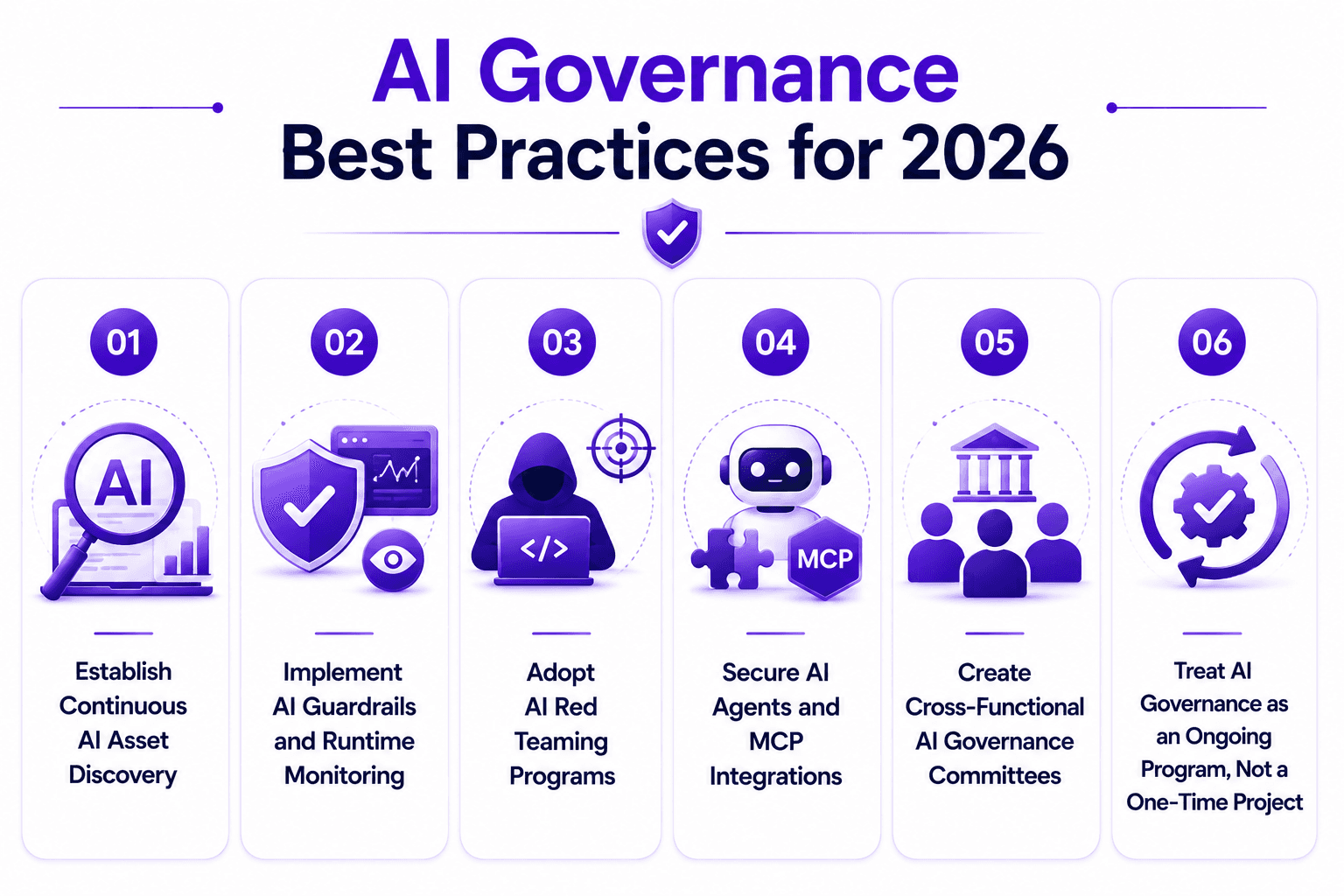
As the use of agentic AI has proliferated, the practices that set the best programs apart from paper programs have been honed. These are the top AI governance best practices for 2026, where AI enterprise teams are investing their time.
Establish Continuous AI Asset Discovery
Embrace continuous discovery - rather than periodic manual inventories. Since AI assets are distributed everywhere in the cloud and within employees, continual discovery is essential to stay on top of shadow AI and ensure governance has a full set of facts to work with. All else in a program is based on the premise that there is something already known.
Implement AI Guardrails and Runtime Monitoring
Install hard barriers and ongoing monitoring systems in front of all production AI systems. In autonomous systems, static policy is insufficient as it does not prevent unsafe actions at runtime; runtime enforcement to prevent unsafe actions when they occur is now expected, not advanced.
Adopt AI Red Teaming Programs
Adversarial testing as an ongoing program, rather than an event. Continuous red teaming of agents, LLMs, and MCP servers ensures that controls continue to be effective as systems and threats change, and that governance has a record of how effective the defenses are, not an assumption.
Secure AI Agents and MCP Integrations
View agents and the MCP servers they connect to as top-tier security resources. This implies that they maintain per-agent identity, least-privilege access, authentication on MCP servers, and strict limitations on the access to the tools agents can reach. The more integration and autonomy agents gain, the more part of the total AI risk this layer will bear.
Create Cross-Functional AI Governance Committees
Organize a cross-team committee for decisions that transcend teams (security, legal, compliance, data, engineering). AI governance only gets stuck in one function because the risks cover the entire organization, as do the fixes. Through a cross-functional body, governance is granted the strength and scope it requires.
Treat AI Governance as an Ongoing Program, Not a One-Time Project
Develop governance as a continuous process, evolving as it goes. A program that is created and never updated will become outdated quickly, with models changing, agents growing, regulations getting updated, and attacks rotating. Organizations that are ahead of the curve see governance as a continuous function, with ongoing ownership, budget, and iteration.
Frequently Asked Questions About AI Governance
What Are AI Governance Best Practices?
AI governance best practices are the tried-and-tested approaches to safely adopt AI at enterprise scale: Discovery of AI assets ongoing, risk-based classification, clear policies and ownership, runtime guardrails, ongoing red teaming, and ongoing measurement. They work together to rapidly enable an organization's use of AI without compromising security, compliance, and risk control.
What Is an Enterprise AI Governance Framework?
An enterprise AI governance framework refers to a series of steps and controls designed to manage AI throughout an enterprise. It will usually start with finding AI assets, then classify them by risk, establish policies, assign ownership, and design and deploy security controls throughout the lifecycle of AI.
How Do Organizations Govern AI Agents?
Organizations control AI agents by discovering and inventorying all agents, assigning each a unique identity with least-privilege access, setting guardrails on actions performed by agents, monitoring their behavior in production, and continuously red teaming. This is a combination that can keep autonomous agents within acceptable boundaries and spot misuse at an early stage.
What Is the Difference Between AI Governance and AI Risk Management?
AI governance encompasses the overall policy, role, and controls framework for responsible use of AI. AI risk management is the component of that system that deals specifically with the identification, evaluation, and reduction of the risks associated with AI. Risk Management is embedded in governance: Governance provides the structure and the levels, and risk management runs within it to manage exposures.
How Do AI Guardrails Support Governance?
AI guardrails apply governance on the fly by monitoring inputs, outputs, and actions as AI systems run, and then preventing anything that is not compliant with policy. They convert rules written into code so that the rules can become active controls for autonomous systems, a requirement when agents are allowed to operate independently without any human oversight of each move.
Why Is AI Agent Discovery Important for Governance?
Governance only applies to the systems that it knows about, which is why AI agent discovery is critical. New agents and MCP servers emerge rapidly and with no registration, so the discovery surfaces update the inventory and continue to provide a shadow of the AI. All other controls, such as classification and guardrails, first require one to know what to control.
Getting Started with AI Governance
Starting is not about a big rollout; it's about the right sequence of moves. This section specifies quick wins, a 90-day plan, and the longer term towards a mature program.
There are a few high-impact actions that can bring early momentum. Conduct a discovery sweep to identify the existing AI agents, LLM applications, and MCP servers in operation, including shadow AI agents. Know which systems pose the greatest risks and ensure that they are owned, have some level of access control, and are being logged. Install fences at the front of the most vulnerable agents. These steps provide visibility and quickly lower actual exposure in weeks, and pave the way for a comprehensive program.
The first quarter is the basis for a focused one. In the first 30 days, develop discovery and create the baseline AI asset inventory. Over the next 30, we will classify systems by risk, establish owners, and develop core policies and standards. Over the last 30, implement guardrails and monitoring on high-risk systems, conduct an initial red teaming exercise, and establish a cross-functional governance committee. They have visibility in the organization by day 90, a policy baseline, working controls around the riskiest AI, and a body to guide what's next.
A lasting strategy considers responsible AI implementation to be an ongoing ability that continues to build the more they adopt it, matches controls to changes in regulation, strengthens runtime defenses, and leaves red teaming and measurement on. From discovering AI agents, MCPs, and LLMs to joining the Cloud Security Alliance to influence enterprise standards in the agentic era, Akto supports every part of the agentic stack and more.
If you want to see how continuous discovery, guardrails, and red teaming come together to govern AI in production, book AI Agent Security demo.
Important Links

Experience enterprise-grade Agentic Security solution