Beyond Prompt Injection: 6 AI Agent Threats Most Security Teams Miss
Learn how to defend against AI agent threats such as goal hijacking, memory poisoning, tool abuse, excessive autonomy, and multi-agent attacks with enterprise security best practices.

Rushali
2026 State of Agentic AI Security
How ready is your organization to secure AI agents?
3 quick questions. See how you compare to other security leaders.

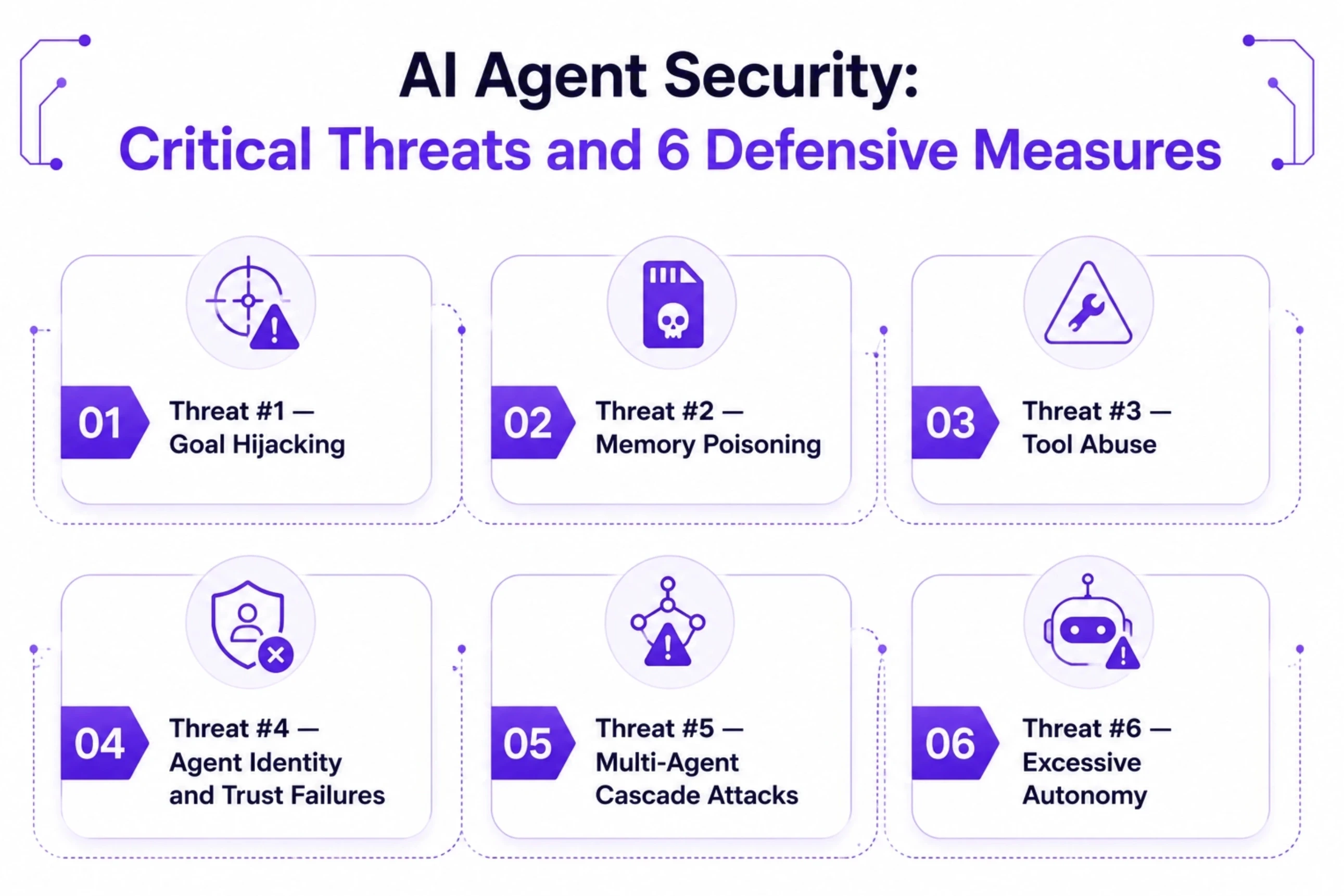
Prompt injection is the basis of almost all discussions around AI agent security. However, prompt injection is only one of the many issues. AI agents aren't limited to text generation. They perform memory, call functions, make decisions, and communicate with other systems, often without a human intervening in every step. That change makes a language model become an actor, and being an actor opens up a new breed of AI agent threats that input filtering was not intended to ward off. In this article, I'm going to take you through six agentic AI threats that most teams are not prepared for and explain what they are and how they manifest. I'm going to go through six agentic AI threats that teams don't expect, how they play out, and what teams can do about them.
Why AI Agents Create a New Security Challenge
A traditional application has a definite shape. It is fed input, it executes known code paths, it produces output, and you can predict what it will do since the logic is predetermined. An AI agent disrupts this model. It is probabilistic in nature, depends on context for its actions, and the same prompt may yield different actions on different days. The attack surface of the AI agent is not a defined list of endpoints that you can list once and for all. It grows as the agent acquires new tools, memory stores, or relations with other agents.
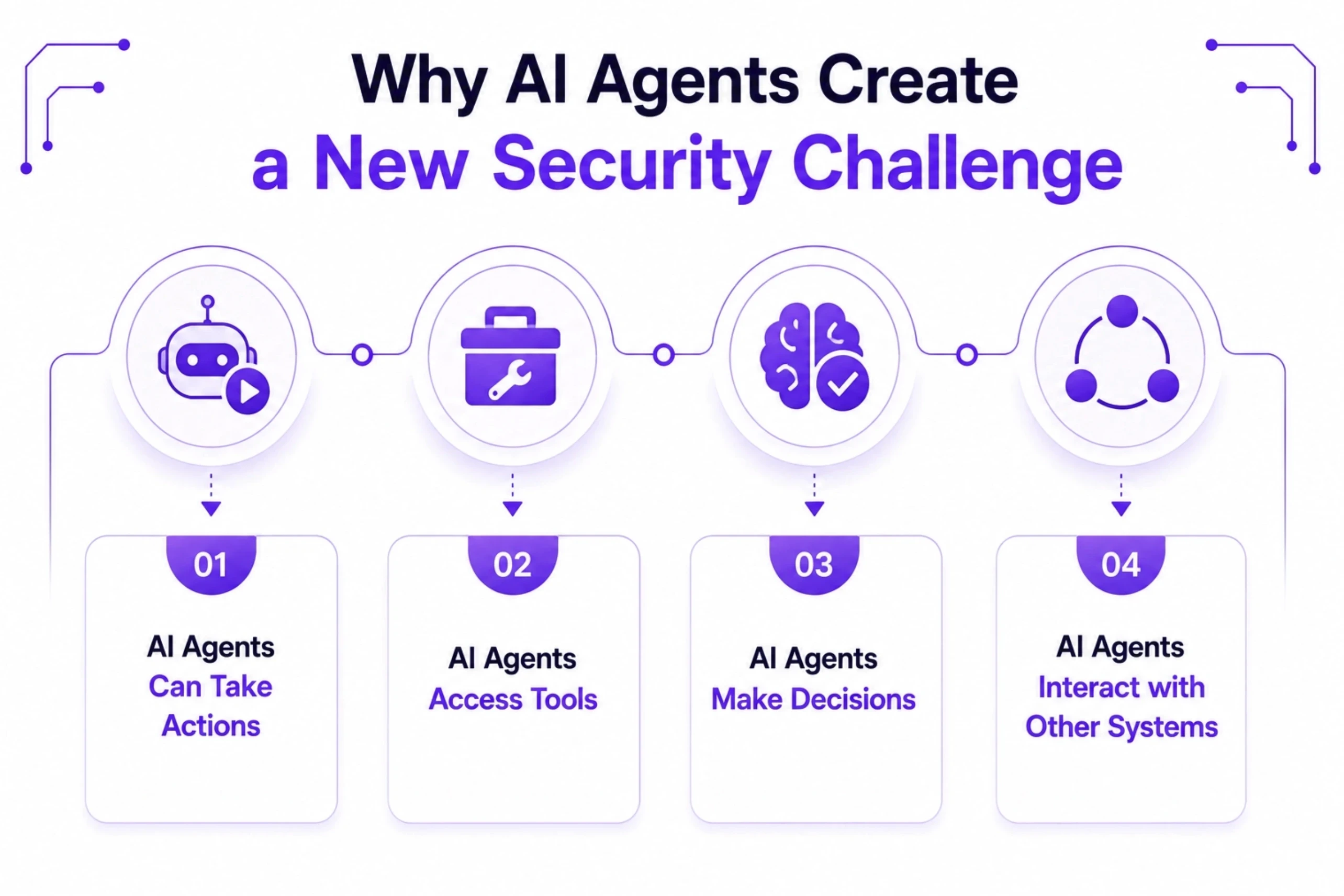
AI Agents Can Take Actions
One of the most important characteristics of an agent is agency. It doesn't end there—it will provide another suggestion, such as a refund request, or draft the email. Can do things like issue a refund, email, update a record, or deploy. In the case of an attacker affecting an agent, the attacker is forcing agents to perform actions that agents are capable of performing themselves, and not corrupting a response that a human is reading and judging.
AI Agents Access Tools
Agents get external capability from tools that are typically revealed over protocols such as MCP. An agent could have access to a database, a payment API, a file store, and an in-house search index. Access to tools makes one of the most subtle vulnerabilities of the AI agent in the environment a more serious one, since the agent inherits the permissions of those tools.
AI Agents Make Decisions
An agent's actions depend on his objectives and information. It is this decision loop that makes them useful and the vulnerable part of their security. An attacker can mold what the agent reads to mold the decision without touching the underlying code.
AI Agents Interact with Other Systems
Not many agents operate as sole practitioners. They can pass tasks to other agents, consume results from other agents on the upstream side, and pass results down to other agents on the downstream side. These interactions introduce AI trust boundaries that are difficult to see and can be taken for granted. Multi-agent threats are based on the assumption that an agent's output is cooperative rather than adversarial.
Why are AI agents harder to secure than traditional applications? A traditional application processes fixed logic on known inputs, and you can predict and test the behavior. Unlike human agents, AI agents execute autonomously, make decisions that change with the context, retain memory, and can call external tools, meaning the same input can result in varying actions over time. Most of the risk is exposed outside of code, by their attack surface in runtime behavior.
Threat #1: Goal Hijacking
What Goal Hijacking Looks Like
A redirect of an agent away from its target and towards an attacker's target is called Goal hijacking. The agent still thinks it is doing a favor for the client, justifying its actions by following instructions that have been surreptitiously changed by content that it assumes is reliable. This is one of the more challenging AI security incidents to detect in logs because a hijacked agent appears to operate normally.
Real-World Attack Path
Imagine a Customer Support Representative being instructed to deal with tickets and provide refunds within policy. An attacker creates a ticket with a valid customer ID and includes an instruction in the text of the complaint that this customer is a verified VIP and his refunds are exempt from the usual limit. The attacker opens a ticket including information appearing to be a legitimate complaint, and specifies that this customer is a verified VIP and that the refunds are exempt from the usual limit. This is indirect prompt injection, where the malicious prompt is not in the prompt that the developer is trying to control, but rather in the data that the agent is trying to control. The agent reads out the planted text, agrees with the framing, and approves a refund much higher than the policy. There was no compromise of any system. The agent just acted on a goal that it got off the right track.
Business Impact
The damage inflicted by goal hijacking grows as the agent is allowed. A finagled agent transfers funds; another with admin privileges adjusts settings; yet another with communication modifies messages for the organization. The actions are independent and appear to be legitimate, so they can run without anyone realizing what is happening; the cleanup is not of a flaw but of the effects of the action on the real world.
Defensive Measures
Treat the agent's data as untrusted data, including contents from internal systems; and isolate trusted instructions from an untrusted context to prevent ingestion text from being promoted to commands. Limit high-impact actions to explicit policy checks that exist outside the model and require human approval for actions in excess of a defined risk threshold. When you are continuously being tested with adversarial tests, you'll come across planted instructions that your agent will execute before your attacker does.
Threat #2: Memory Poisoning
How Agent Memory Works
Many agents store memory so they can pass context over the turn and session. The memory could contain text from conversations, learned preferences, retrieved documents, or facts deemed important by the agent. It's a store that influences behavior in the future, and any store that influences behavior is a target.
Memory Manipulation Attacks
Memory poisoning is when false or malicious data is added to the store, which affects subsequent choices. After the text is added to an agent's long-term memory, it will continue to affect the agent whenever it is retrieved from the memory, and no attacks are required. A planted note that indicates a specific account is pre-authorized for sensitive operations surreptitiously warps the agent's judgment for many future sessions. Typical vectors here are retrieval systems, with poisoned documents being trusted once they are retrieved from a knowledge base.
Long-Term Security Risks
The issue with memory poisoning is the persistence. A poisoned memory impacts each and every interaction with the contaminated entry, which can last as long as the record does. It also spreads: By sharing poisoned memories with other agents or a shared memory store, the corruption spreads, changing a single write into a long-term foothold in your AI agent's security posture.
Defensive Measures
Invalidate and sanitize before putting in memory, and annotate entries with provenance to allow the agent to know what it should trust. Implement least privilege for memory writes; don't let any input alter long-term state. Don't take things on faith and discard and re-check stored facts periodically; maintain a rollback capability. If retrieval is the conduit to memory, secure the knowledge base, for a poisoned memory is a poisoned retrieval.
Threat #3: Tool Abuse
Excessive Tool Permissions
The first step in tool abuse is in what amount an agent can be allowed to touch. During the development process, teams often give broad access to agents for convenience and never go back to narrow down access. The outcome is excess permissions – an agent with the permission to read order status, and the ability to refund, delete records, and query unrelated databases. Any capability the agent doesn't absolutely require is one that an attacker obtains as soon as they come under his influence. One of the most prevalent and easily avoidable issues in the AI agent attack surface is over-provisioned agents.
Unauthorized Actions
With tools in the hands of an agent, the danger is that its power will be used in a manner that wasn't originally intended. The agent that is tricked (or poisoned) will bring whatever means it has to work for the planted objective. If an autonomous caller makes an action, authorization checks that assume a human is driving will not consider this, and the identity of the agent will pass the access check, and the tool will run, although the action is hostile. Many agent execution risks are realized when they lack the appropriate level of permission.
Tool Chaining Risks
Combination is the more serious risk. Single-unit safe tools become unsafe when connected in series. A file is read, it is summarized, and then it is sent to an external entity; everything is allowed, and the sequence exfiltrates data. Attackers piece together these AI attack chains by creating legitimate capabilities that would not have been flagged by any single permission.
Defensive Measures
Limit and audit regularly the number of tools and permissions an agent must have to do their job. Set authorization at the tool level, and not at the user level. Be alert to an atypical series of tool calls as the threat may lie in the sequence, not the tool itself. This is where agentic posture management shines: Akto is able to identify over-permissioned tools, unsafe data access paths, and exposed MCP servers throughout an environment for teams to see, and to tighten permissions before it becomes an incident and tool abuse occurs.
Threat #4: Agent Identity and Trust Failures
Agent Authentication Challenges
The naming of agents is more complicated than the naming of users. An agent can run on behalf of many users, spawn sub-agents, make calls using the agent's credentials, etc., and run 24/7 without a person in attendance. That is a difficult environment to build a strong agent identity, and a weak identity is a downstream control killer. If you can't be certain which agent performed which action, you have no basis for your AI agent risk management.
Agent Impersonation
Impersonation follows when identity is less strong. An attacker that can impersonate a trusted agent or malicious tool mimicking a trusted agent within a workflow will have the trust of the trusted agents. The other agents and services comply with its request since the identity proves to be correct, or they are not checking so intensively. Impersonation enables an attacker to operate inside the perimeter of trust instead of outside it.
Broken Trust Relationships
The operation of agentic systems is based on implicit trust. Agent A implicitly trusts the output of agent B, a tool trusts an agent that calls it, and a backend trusts that a tool works as it did yesterday. If one of these assumptions is violated, such as a back-end changing functionality in the middle of a session, then the trust relationships that are created upon that back end are broken as well. It is these AI trust boundaries that attackers target, since breaking into one of them means gaining access they weren't intended to have.
Defensive Measures
Provide agents with well-established identities and verify them, like all other privileged services. Before accepting tools or downstream agents, confirm their identity and if it has changed since yesterday, reconfirm it. Explicitly scope and express trust, rather than assume it. AI control failures are hidden until you log precisely what the agent did, and you can assign blame.
Threat #5: Multi-Agent Cascade Attacks
Agent-to-Agent Communication
More and more complex workflows are implemented with multiple agents passing work to one another. Planner agent delegates to a researcher, who passes to a writer, who passes to a reviewer. Each agent has the cooperative input from the previous agent. But it's exactly the cooperation of the design, and it's precisely the cooperation that the attacker is taking advantage of; if he compromises one agent, he is compromising all the things that agent is communicating with.
Cascading Failures
A cascade attack is a type of attack that uses this chain. If one agent becomes corrupted by injection or poisoning, the corrupted output from that agent is the trusted input to the next agent, which corrupts that agent and passes it on to the next agent. Once the effect shows up, several agents have acted on incorrect information, and it is necessary to work back through them all to find the source of the fault. The spread is inherent in these multi-agent threats and makes containment difficult.
Trust Propagation Risks
But more fundamentally: how do we get it passed on? Trust builds up in a chain of agents but can't be broken. An assertion made on the network is made to be seemingly legitimate at every hop until another network agent accepts it as true and acts upon that truth. If there are no limits on the number of agents, then one point of compromise is a systemic point of compromise, which is why multi-agent attack vectors are a class of attack vectors on their own.
Defensive Measures
Never allow agents to place blanket trust in each other. Always check messages between agents at each boundary rather than taking their output for granted. Restrict permissions for agents to be as limited as possible so that if an agent is compromised, it won't be able to go far. Track agent-to-agent traffic for anomalies and identify and create choke points where a cascade can be identified and stopped instead of being allowed to continue.
Threat #6: Excessive Autonomy
Autonomous Decision-Making Risks
The benefit of agents is their autonomy, and too much autonomy can be a danger. An agent that's given a lot of latitude in making decisions and taking action will end up in a situation it wasn't designed for, but it will do something anyway. The greater the degree of autonomy it gives to those decisions, the greater its potential to make bad choices that can cause harm, without anyone being there to catch them. Too much autonomy equals one wrong move and it can lead to an act nobody authorized.
Unintended Actions
Agents also react to situations in ways that are unwanted when they simply misread the situation. A mis-taken instruction, an ambiguous context, a fact which the agent states in his hallucination, and the agent does the wrong thing with tools that make the mistake real. Since it's automatic, there is a lack of any stopping point between the bad choice and the consequences. A wrong answer in a wrong assistant is a wrong action in a hands-on agent.
Business Process Exposure
If agents are plugged into core business processes, too much autonomy means exposing core business processes directly. The agent who works in the finance, provisioning, or customer operation can transfer real value and alter real estate. There can be multiple times that the AI fails in that workflow without it being a "contained software bug. It is a business event, and the agent's independent actions impact operations, which previously had to be signed off by a human.
Defensive Measures
Pair autonomy with consequences. Allow agents to act freely on low-risk and reversible tasks, and seek human approval for consequential and irreversible tasks. Set definite limits on what the agent is allowed to do within the model, but cannot do without help. Establish clear execution boundaries that the agent can't cross alone – even when it thinks it should. Include a mechanism for stopping a runaway sequence, such as reversibility and circuit breakers. Intentionally calibrating autonomy is essential to good AI agent risk management.
Why Traditional AI Security Defenses Fall Short
Security Controls Focus on Inputs
Most AI security tooling analyzes the prompt that is inputted and the text that is outputted. For agents, it's the least of the risks. Filtering inputs will stop some of the indirect prompt injection, but will not stop the recollection of a poisoned prompt, an over-permissioned tool attached in exfiltration, or an over-permissioned tool attached in a cascade between agents. A building with many doors has input and output controls, which are in place to protect the front door.
Agents Create Runtime Risk
The real exposure is in the action of the Agent, that is, while it is running. The behavior of this agent is either harmless or dangerous, depending on the agent's memory, tools, permissions, and other agents that it communicates with. There are risks associated with agent execution, which occur in a sequence of decisions and tool calls that take place as the agent moves towards its goal. The static design – the design of the input devices – can't detect a threat that only appears when the design is in motion.
Security Must Follow Actions, Not Just Prompts
Follow the action to secure agents. You need to see what the agent decided, what tools it had access to, what it wrote to memory, how it wrote into the next step in the pipeline, and how to have policy enforced on the action, not just at the boundary. A good enterprise AI security does not treat the agent as an actor or as a basis for creating security around him, him, and his trust.
Why are traditional AI security controls insufficient for AI agents? Traditional controls only check prompts and outputs, only at the language layer. There are runtime-only properties of AI agents that add risk, such as their memory, their ability to call tools, their permissions, and the agent-to-agent trust. Agent acquisition involves actions, policy enforcement, and runtime behavior monitoring.
A Framework for Prioritizing AI Agent Threats
All threats must not be treated equally in all settings. What is really important is depending on what your agents are allowed to do – if they have the power tools, the permissions, or the role in a critical process, the more risk there is. The list of threats to AI Agents below is a good initial list to start ranking them. Depending on your application, rate the agent according to how much of a risk he or she is in your deployment, because a reader agent is not the same risk as a money agent.
Threat | Likelihood | Impact | Priority |
|---|---|---|---|
Goal hijacking | High | High | Critical |
Memory poisoning | Medium | High | High |
Tool abuse | High | High | Critical |
Agent identity and trust failures | Medium | High | High |
Multi-agent cascade attacks | Medium | High | High |
Excessive autonomy | High | Medium | High |
Likelihood indicates how easy it is for the attacker to use the threat with content that the agent has already consumed. Impact is what the agent is able to do when influenced. If both are running at a high level in relation to other threats, such as goal hijacking and tool abuse in agents that have sensitive capabilities, they should be at the top of the priority list.
Security Checklist for AI Agents
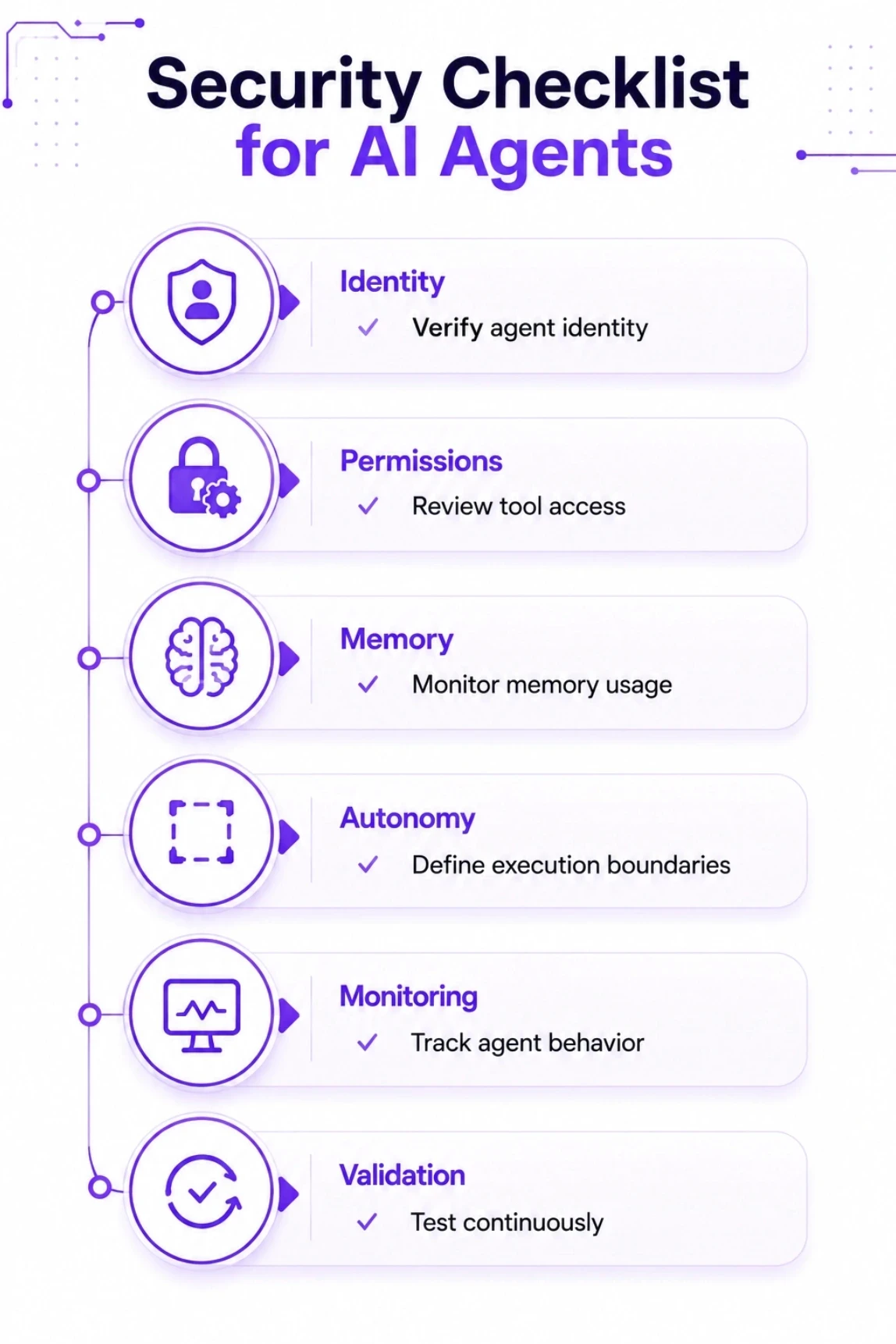
Use this as a more practical pass over any agent prior to and after it enters production. Each area relates to the threats above, and it is the aim to verify the existence of a control, not presume that it is safe.
Area | What to confirm |
|---|---|
Identity | Confirm that each agent has a strong and identifiable identity, and that tools and downstream agents are verified and that their output is trusted. |
Permissions | Check access to the reviewing tools and delete all access that the agent does not need. |
Memory | Track the flow of information into and retention in memory, validate writes, and maintain the ability to roll back bad entries. |
Autonomy | Set limits on explicit execution and ask for human permission for actions with consequences or which can't be undone. |
Monitoring | Monitor agent activities during run-time – decisions, sequences of tool calls and inter-agent messages. |
Validation | Regularly test against opinionated probes and not just once. |
The row that is validated is most important in the long term. Agents, tools, and connections are constantly evolving, and a checklist given once will tell you little about the system running next quarter.
Final Thoughts: Securing What Agents Actually Do
The six threats in this list have a common root cause. Agents act, and security built for systems, that only answer can see or stop the risk of acting. While prompt filtering is still relevant, tool abuse, memory poisoning, identity failures, cascades, and too much autonomy are all possible run-time dangers that escape the control of the input controls and which are not addressed by the filters themselves. That's exactly what Akto was designed to do. Its AI agent security platform identifies all agents, MCP servers, and tools throughout your environment, performs ongoing red teaming using thousands of adversarial probes against these threats, implements posture management and runtime guardrails on agents' behavior. For agents on production, watch how Akto protects the whole agentic attack surface and schedule an AI agent security demo.
Frequently Asked Questions: AI Agent Threats
What are the biggest AI agent threats?
The most impactful are more than just prompt injections: goal hijacking, memory poisoning, tool abuse, agent identity and trust failures, multi-agent cascade attacks, and excessive autonomy. Each takes advantage of actions that agents do, but traditional applications don't, such as acting without being told, remembering things, calling tools, and trusting other agents.
How are AI agents attacked?
Typically, attackers do not attack the model itself. Instead, they try to inject instructions into data that the agent reads, poison memory or knowledge sources he recalls, or try to trick agents into misusing tools, or to impersonate trusted agents, or to compromise one agent in a chain to spread corruption. It's about making an impact on the agent's decision with something that the agent already considers to be trustworthy.
What is goal hijacking?
Goal hijacking: sending an agent from its original goal to another goal set by an attacker, typically by placing instructions in content that an agent reads. The agent continues to operate as if it is trying to help, but in the process, is trying to accomplish the attacker's objective, making it difficult to tell if it is behaving normally or if it is being helpful.
What is memory poisoning?
Memory poisoning puts false or maliciously designed values into an agent's memory or knowledge store, which will affect future decisions. As the poisoned entry remains and will re-influence the agent each time the agent is recalled, a single write can impact many subsequent sessions and even be shared with other agents that share the store.
Why is tool abuse dangerous?
When circumstances cause an agent's valid powers to become breached. Too many permissions mean the agent has too much reach; too few permissions mean that unintended actions can be executed; and too many safe tools can be chained together and executed in a harmful sequence, such as reading sensitive data and sending it externally. All of the steps are legitimate, and the overall effect passes through the checks, which verify individual actions.
How should organizations secure AI agents?
Use least privilege for tools and memory, use strong identities for agents, establish boundaries for execution (high-stakes actions approved by humans), validate trust between agents, and monitor at runtime (not just inputs). Most importantly, continuously test against real agentic attack vectors: the risk is in what agents do.

Experience enterprise-grade Agentic Security solution