LLM Runtime Security for AI Agents: The Enterprise Guide (2026)
Learn how LLM runtime security protects AI agents from prompt injection, tool abuse, memory poisoning, and runtime attacks using guardrails, monitoring, and policy enforcement.

Rushali

AI agents were not just demos; they became production systems capable of reading e-mail, moving money, asking questions from databases, or calling internal APIs without human supervision. The security problem was shifted by that change. The risk isn't now just whether or not you selected a particular model; it's what the agent does after it's running. LLM runtime security is a field of securing the running, observing the input, memory, tool calls, and output of the agent during its execution, rather than relying on a pre-launch test to find all the bugs. It provides an overview of the concept of runtime security for AI agents, an overview of the architecture, the key controls, and how to monitor agents in production.
What is LLM Runtime Security?
The security measures implemented during the LLM's runtime, such as controls, monitoring, and policies, fall under the scope of LLM runtime security. It monitors all prompts, retrieved documents, tools called, and answers in real time.
How Runtime Security Differs From Model Security
Model security is concerned with the artifact: Training data, weights, and alignment in isolation. While a well-aligned model can release data from a tainted document or wire money via an unchecked call, runtime security is a concern of the live system around it.
Why AI Agents Introduce New Runtime Risks
A chatbot provides answers and stops. The agent plans, calls tools, reads information on the results, updates memory, and then decides what to do next, dozens of times for each task. Every loop provides a new opportunity for redirecting behavior, and every tool that is accessible can be misused.
Runtime Security vs AI Red Teaming
Red teaming tests an agent prior to deployment by simulating attacks to discover weaknesses that you can plug. Runtimes are always on and will enforce policy on real traffic and block threats at runtime. The runtime controls prevent the agent from breaking and causing damage, while red teaming uncovers where the agent breaks.
Why Traditional Security Models Fail for AI Agents
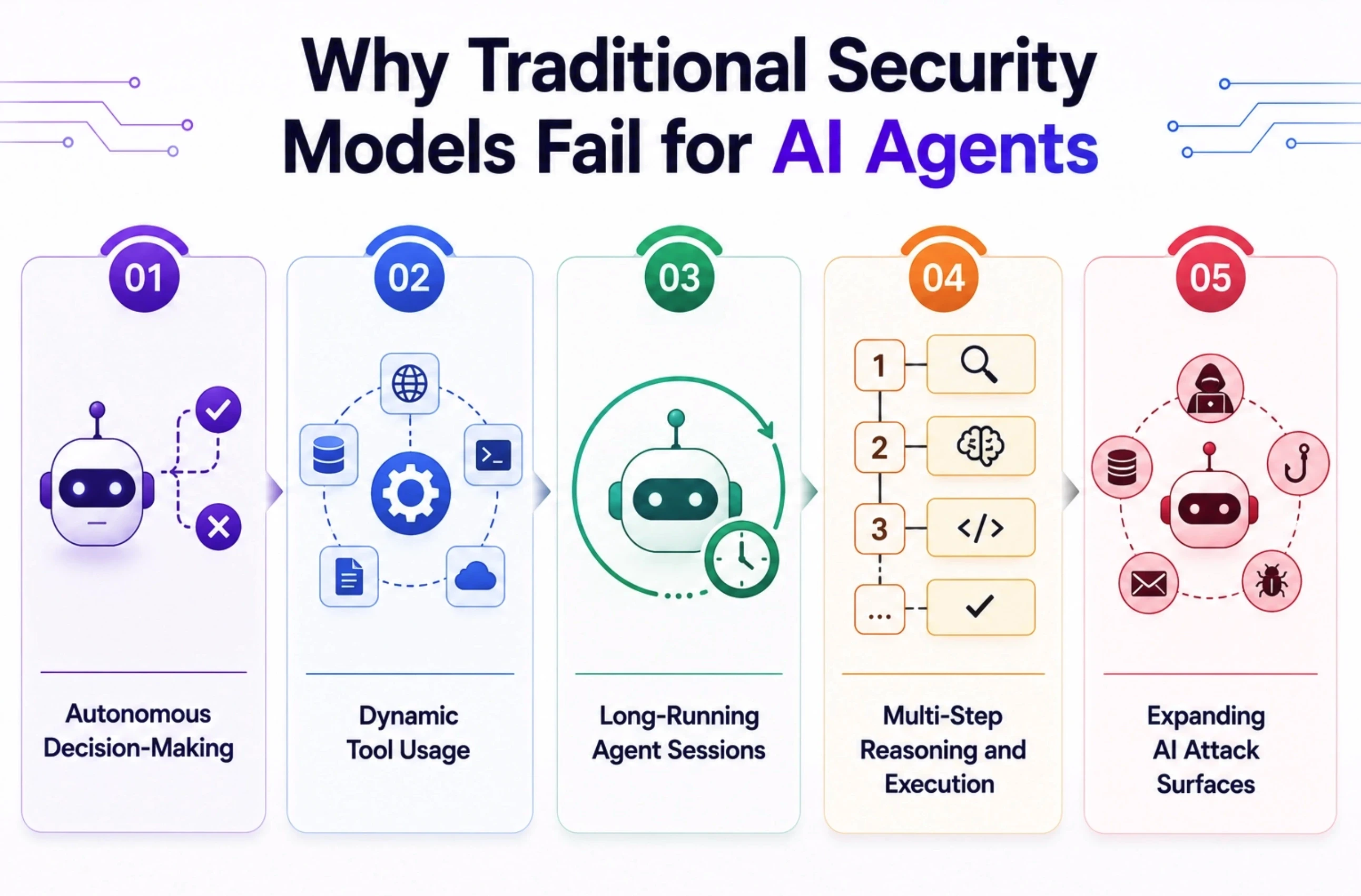
Autonomous Decision-Making
Doing application security in the traditional sense is a matter of assuming known code paths you can audit and lock down. Agents can take any action they want, based on natural language reasoning, and different tool calls can be made based on the same input across different runs. AI agent runtime security is a security approach that verifies decisions during runtime.
Dynamic Tool Usage
At runtime, agents attach to tools and may find new ones at runtime via a registry or MCP servers. If an hour goes by since the deployment, the allowlist is not available to a tool that was picked up during the deployment, and that authorization has to be carried over into each tool call.
Long-Running Agent Sessions
A lot of agents have extended durations, running for minutes or hours, gathering context over a lot of turns. An instruction injected early can sit there dormant and be activated much later, when a single-request scanner has moved on. A single message inspection gives no indication of attacks that cross a session.
Multi-Step Reasoning and Execution
A task can include retrieving, summarizing, writing to a database, and calling out to an external API. An innocuous step may be a dangerous one in a series, for instance, reading a record and losing it through a subsequent call. The controls should be familiar with the chain.
Expanding AI Attack Surfaces
So every integration an agent connects to expands an attacker's reach. For agents, AI attack surface management must consider prompts, memory stores, vector databases, as well as tool endpoints and other agents themselves, which are all potential vectors for malicious payloads.
Understanding the Runtime Attack Surface of AI Agents
User Inputs and Prompt Flows
The most apparent is direct user input, where the attacker coerces the user to enter something other than what is intended, or to extract instructions or to get the agent to go outside the scope of its job. The agent is a language reader, so it is necessary to inspect all the input channels since language can be both data and instructions.
Agent Memory Systems
Agents retain state between turns and sometimes sessions. If an attacker can write to that memory, they can put code in place that will affect future behavior. A single bad prompt will not last long compared with the durability of memory poisoning.
Tool Calls and Function Execution
Tools are where an agent puts down the pen and picks up the keyboard and starts influencing the world by emailing out, running queries, or making payment calls. Unvalidated calls to tools enable a manipulated agent to execute privileged operations on true systems.
MCP Servers and External Integrations
The Model Context Protocol enables agents to access external tool servers via a common protocol and interface and retrieve capabilities and instructions from servers not included in the agent's distribution. Security cannot be ignored at the center of any runtime assessment, as a compromised MCP server can provide poisoned tool descriptions or hijack a request.
Multi-Agent Communication
If the agents share the work, what one produces is the input for the next agent, and trust is implicit. Channels between agents must be treated as if they were user input, as a compromised agent can pass around stuff down the channel.
Data Retrieval and RAG Pipelines
Retrieval-augmented generation will pass external documents to the agent as part of the context, and if they include hidden instructions, then the agent can execute them. The way this works as an indirect prompt injection is that the pipeline consumes content that is considered trustworthy by the agent.
The Core Architecture of LLM Runtime Security
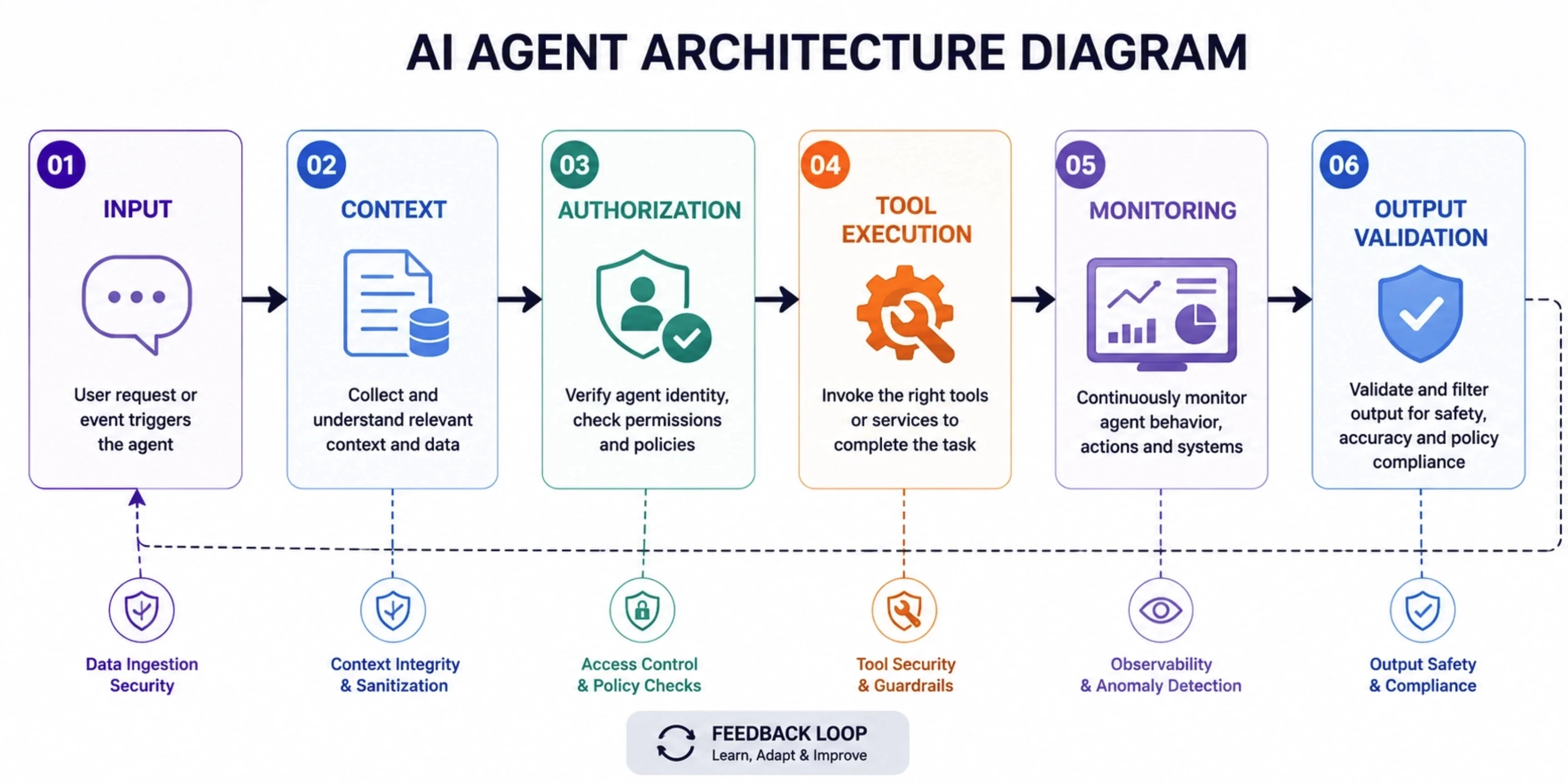
A workable runtime security architecture is made up of multiple layers that each examine and control the agent at a different point in its runtime loop. The layers below create a pipeline around the agent from input to the end result.
Input Security Layer
This layer filters all data that comes into the agent: user prompts, documents retrieved, and results from the tools. It detects injection, jailbreak, and malformed payloads, and cleans or rejects them before the model can process them.
Context Security Layer
Context window security is the process that determines what will appear in the model's working context, such as the system prompts, memory, and retrieved chunks. It differentiates trusted instructions from untrusted data, and then it won't take untrusted content as a command!
Authorization and Identity Layer
Each agent requires an authentic identity and a well-defined set of permissions. Agent identity verification identifies who is doing what, and dynamic authorization determines, on the fly, whether or not that agent is authorized to do this action.
Tool Security Layer
This layer validates the calls to the tools before any function is executed, checking that the tool is allowed, that the parameters are within their valid ranges, and that the call is suitable for the function. It prevents calls to unregistered tools and detects arguments that resemble exfiltrations.
Execution Monitoring Layer
Agent execution monitoring tracks and logs the execution of the agents during the live action loop with the reasoning behind the decisions made as appropriate. It monitors tool sequences, timing, and resource utilization to enable safe AI agent execution and highlights patterns indicative of manipulation during the run.
Output Validation Layer
This layer examines a response to determine if any secrets, sensitive information, or policy violations should not be included in the response before it reaches a user or downstream system. It's a last opportunity to prevent data from leaking out.
Audit and Governance Layer
All the agent activity is recorded in a tamper-proof audit log, which enables investigation, compliance, and runtime governance. This layer is to link identities and policies with decisions to reconstruct what has happened and why.
Essential Runtime Security Controls for AI Agents
These runtime security controls are used to control what an agent can do at each point in its execution loop.
Prompt Injection Detection
The first control blocks attempts to subvert the agent's instructions by providing input that is crafted and includes pattern matching, classifier models, and behavioral signals. Effective prompt injection prevention is implemented on each input stream, as injected text can also be provided via documents and tool responses.
Indirect Prompt Injection Prevention
Agent retrieves content, such as a web page, PDF, or database field, and embeds instructions inside it. Prevention assumes that retrieved data is untrusted and separates it from the instruction channel and examines it for embedded instructions.
Runtime Policy Enforcement
A runtime policy engine checks each proposed action against rules for what the agent can access, what tools the agent can use, and what data the agent can move. The policy enforcement takes place at runtime, and an action that is violating the policy is blocked before execution.
Dynamic Access Control
Static roles do not fit agents who have varying needs according to the task. Dynamic authorization will only give the agent access to do the step and remove it when the step finishes, so a summarizing agent will never have “standing” write access to production.
Tool Call Validation
All functions called by the agent are evaluated against an allowlist, a schema, and expectations. By validating the calls to these tools, a manipulated reasoning step is prevented from becoming a harmful action by rejecting unknown tools, malformed arguments, and arguments that resemble exfiltration.
Output Filtering
Output filtering checks for sensitive information, credentials, internal context, and unsafe content within the responses generated by the system prior to it leaving the system, and removes what should remain confidential. It reduces the damage done after the damage has already been done by the attacker when it comes to reasoning.
Human Approval Workflows
There are some actions that are too important to be fully automated. Human-in-the-loop approvals prevent the agent from executing and only allow it to proceed when an operator approves a high-risk transaction or to delete data, providing the necessary additional oversight without disrupting everyday workflow.
Session Risk Scoring
A session risk score is a combination of signals from within a session: injection attempts, unusual tool sequences, sensitive data access, and policy near-misses. The system can tighten controls, seek approvals, or end the session as the score rises.
Top Runtime Threats Facing AI Agents in 2026
Prompt Injection Attacks
The most frequent threat is direct prompt injection, where the attacker uses the agent to send system prompts, evade restrictions or make unauthorized actions without the user's knowledge. Language is the control interface for the agent, so it can be easily attempted and difficult to remove.
Tool Poisoning Attacks
Tool poisoning focuses on descriptions and metadata that provide an agent with information about the operation of a tool: a poisoned description can cause an agent to leak out information even when the agent believes the text to be documentation. This is a serious risk when tools are purchased.
Memory Poisoning
Memory Poisoning – places malicious code into the persistent memory of an agent that affects how it behaves in the future. Poisoned memory manifests over the course of the game and across tasks, unlike a one-off prompt, so it must be monitored for what is being written into memory.
Unauthorized Tool Access
An agent that is "manipulated" to call tools that went beyond its scope of responsibility can call into systems that it was not intended for. Without dynamic authorization on each call, one manipulation can open up a wealth of privileged operations.
Agent Impersonation
More generally, in a multi-agent system, an attacker can pretend to be an agent and give trusted commands or claim to be an agent to obtain someone else's rights. If you don't have agent identity verification, then downstream agents will listen to commands from anyone claiming to be the correct sender.
Data Exfiltration Attempts
Agents that have access to sensitive information and any outbound tools are obvious targets for exfiltration. The "read-then-send" pattern is another target of AI agent detection that requires close monitoring between steps, because neither step in and of itself is alarming.
Context Manipulation Attacks
An agent passes in misleading information to manipulate its conclusions without there being any injection string. An attacker's decisions are potentially harmful and appear reasonable, so the defender must gauge the level of trust for anything that goes into context.
Privilege Escalation Through Tool Chains
An agent can link a number of single permitted tools into an outcome no single agent would permit. It's not per-call approval, but it does require agent behavior analysis throughout the entire process.
Securing MCP-Connected AI Agents at Runtime
Why MCP Changes the Security Model
The model context protocol defines the rules for agents to get connected to other tools and data, but the runtime invokes the agent's capabilities from servers that can be located outside of your trust zone. Governance moves from a predetermined set of internal mechanisms to a fluid and dynamic network of external relations.
Runtime Risks Introduced by MCP Servers
Every MCP server that the agent accesses is a source of tools, descriptions, and responses the agent will trust, and a contaminated server can provide the agent with tainted definitions, take over requests, or collect data. Servers can be added in "mid-session," which means their risk is variable.
Authorization Failures and Confused Deputy Attacks
An MCP agent with a wide range of permissions can do things on behalf of an attacker that the attacker could not have done on its own, by using a confused deputy attack. Each interaction with dynamic authorization fills this gap.
Securing Tool Discovery and Invocation
The discovery of tools should not be "open" but governed by MCP. Agents must have a list of approved servers and tools, a form of validation of the tool descriptions before they are added to context, and a validation of the tool calls on each invocation; a rogue server would otherwise be able to sneak in and quietly increase the scope of what an agent can do.
Runtime Monitoring for MCP Activity
When it comes to monitoring MCP traffic, there should be separate monitoring of the servers that an agent reaches, what tools it runs, and what information it passes through the boundary. This is where Akto comes in handy. Akto also supports real-time agent and MCP discovery, runtime guardrails, and Argus, which allows for control of prompts, responses, tool calls, and agent actions when the workflow is connected to MCP in production.
Runtime Observability and Monitoring for AI Agents
What Security Teams Need Visibility Into
The initial step in effective LLM security monitoring is a comprehensive inventory list: All agents deployed, all the tools they can access, and all the MCP servers they can communicate with – even those deployed in a shadow environment. Teams should also have access to prompts, tool calls, memory writes, and outputs.
Monitoring Agent Actions in Real Time
AI observability for agents in practice is monitoring the agent's action loop as it runs, which means that if there is a dangerous tool call or access to data, it can be flagged or blocked in real-time. During operation, Akto's Argus can detect and block threats (including prompt injection and unsafe tool execution) and can monitor agent execution in production.
Detecting Abnormal Agent Behavior
Baselines of normal behavior draw attention to deviations: an agent suddenly accessing new systems, looping on a tool, accessing unusual amounts of data. Agent behavior analysis is the process of taking a view of live activity and comparing it to those baselines and known attacks.
Logging Tool Usage and Decisions
Log files of tool invocations, parameters, results, and reasoning provide security teams with what they need in terms of evidence for detection and investigation. Decision logs relate an action to the input that triggered it.
Building AI Security Dashboards
Dashboards transform raw telemetry data into actionable information for teams, providing a single source for monitoring current agents, risk levels, denied actions, and policy violations. Good dashboards focus on what matters, not on drowning analysts.
Building a Runtime Security Program for AI Agents
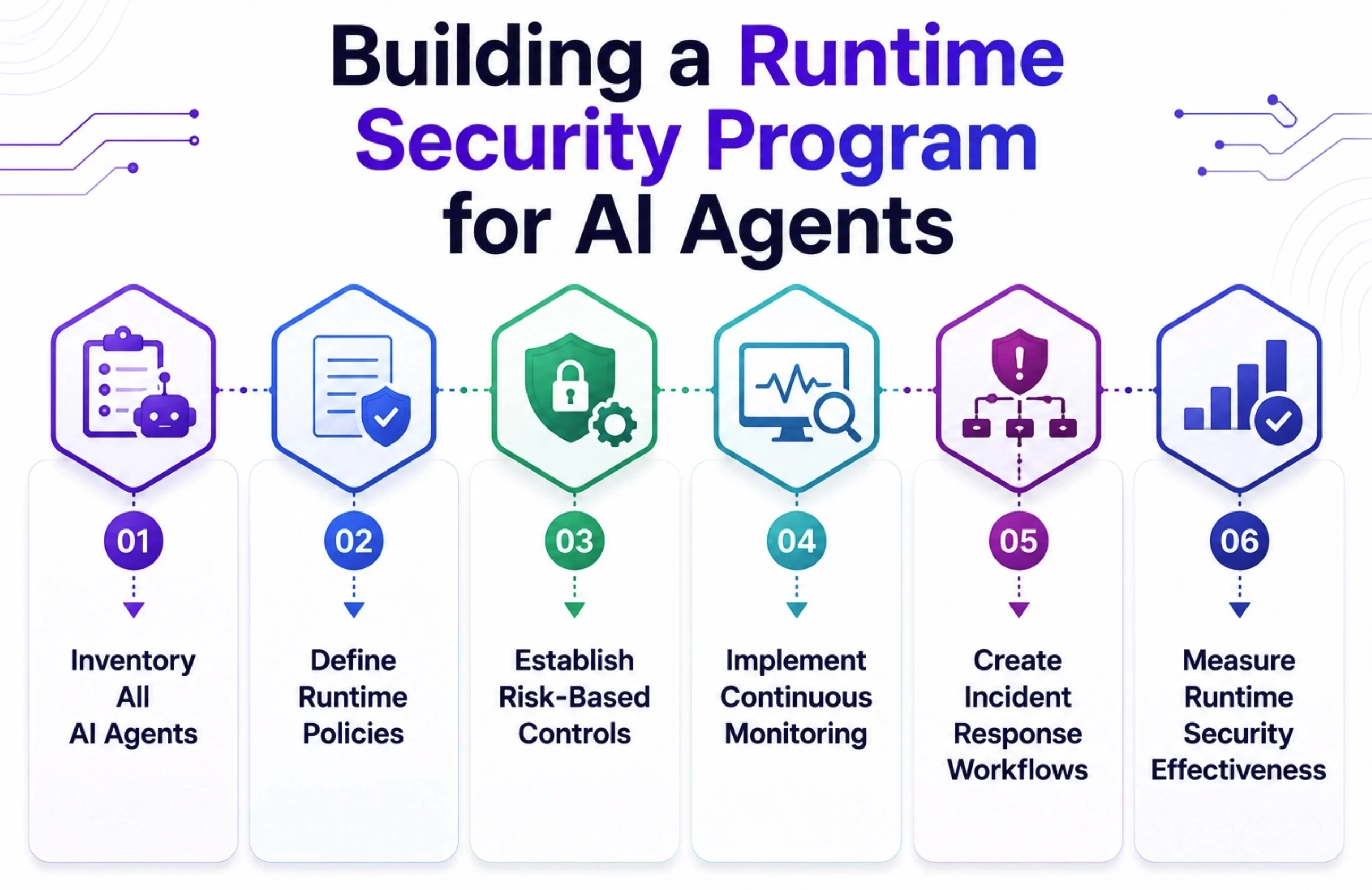
Inventory All AI Agents
Knowing what you have is the first step in a program, so find all your agents, models, tools, and MCP servers, both in the cloud and on endpoints, as well as the ones that teams have set up without security knowing. An ungoverned agent is unknown, and any discovery is ongoing to keep the inventory up to date.
Define Runtime Policies
Once you have an inventory in hand, establish rules for agent actions: Data available to agents, which tools can be used, and what actions must be approved. Policies should be aligned with actual business risk, not a blanket restriction.
Establish Risk-Based Controls
Not every agent warrants the same scrutiny; a read-only research assistant needs lighter controls than an agent with payment authority. Tier your AI security controls by the access and impact of each agent so effort lands where risk is highest.
Implement Continuous Monitoring
Implement monitoring that monitors agents in production at all times, not just during testing. Continuous monitoring helps detect, incident response, and validates policies under real traffic.
Create Incident Response Workflows
Assume if a control is circumvented or a compromised agent occurs. Outline how to contain a rogue agent, revoke access to the agent, maintain records and investigate, acting on the audit trail. Agentic incidents are time-sensitive!
Measure Runtime Security Effectiveness
Measure indicators that demonstrate the effectiveness of the program: blocked injection attempts, violations of the policy identified, average time to detection, and coverage of the inventory. Over time, measurement will reveal gaps and enable better runtime governance.
LLM Runtime Security Best Practices
Apply Least-Privilege Access
Do not give an agent more rights than what is absolutely necessary for the agent to accomplish the assigned task, as restricting the scope of access reduces the scope of damage an agent can cause when he/she is manipulated. The greatest accelerator of agent risk is standing privileges.
Validate Every Tool Output
Consider the results of tools as untrusted data because they may contain injected instructions or altered data. Ensure that the agent reasons over the output or gives it to the next step after sanitizing and validating.
Continuously Monitor Agent Memory
Memory is a persistent attack surface, so monitor writing and reading to and from memory. Memory write monitoring prevents poisoning attempts from influencing further decisions, especially for long-lived agents.
Enforce Identity-Based Access Controls
Ensure all actions are tied to verified agent identity and make decisions on authorization based on agent identity and context. Agent identity verification prevents the use of impersonation and provides authorization with a secure base.
Maintain Full Audit Trails
Maintain comprehensive, unalterable records of inputs, decisions, tool usage, and outputs. Audit trails help investigations, compliance, and holding agents accountable for independent actions, and the log records the agent's motivation for their actions.
Integrate Runtime Security Into AI SDLC
Integrate security into the agent development lifecycle, not add-on after deployment. The best way to implement AI runtime protection is to implement pre-deployment red teaming and runtime controls within CI/CD and DevSecOps pipelines, ensuring that the same risks found during testing are enforced during runtime.
Future Trends in LLM Runtime Security
Autonomous Runtime Guardrails
The enforcement of guardrails is becoming more autonomous and takes into account the actual situation rather than applying static rules. This is what Akto's Argus does, providing autonomous runtime guardrails for AI agents and MCP servers, and adapting to risk as it evolves while executing.
Agent Identity Frameworks
Trust in multi-agent and cross-organization systems is gaining a foundation in standardized identity for agents. These frameworks will provide agents with verifiable credentials, scoped permissions, and accountable identities that are platform-independent.
Runtime Risk Scoring Engines
Risk scoring is moving from a simple counter to engines that factor in numerous active signals into a real-time, contextual risk score. With the rise in risk, these engines will generate automated responses, adding friction, or ending a session.
AI-Native Security Operations
New tooling, dashboards, and playbooks are being developed for agents instead of adapting existing apps for security operations to support AI workloads. AI-native operations regard prompts, tool calls, and memory as first-class telemetry.
Emerging Standards for Agent Security
Industry standards and frameworks are beginning to emerge for agent security, including agent authorization, security for the MCP, and runtime controls. Standardized standards allow for easier evaluation of vendors, safe interoperability, and common denominators for systems.
Final Thoughts: LLM Runtime Security
AI agents pose a class of risk that is not found in the model file, and conventional security tools were not designed to control an autonomous system that independently calls the tools it is creating in production. Runtime security fills in that gap and secures the entire execution path, inputs, context, memory, tools, monitoring, and outputs in a way that is continually enforced and observable. Testing and governance are not enough when deploying agents in 2026; organizations require a dedicated runtime architecture. This is what Akto is designed for. Its agentic platform features real-time AI agent and MCP discovery, ongoing red teaming, and autonomous runtime guardrails to identify and prevent threats while agents are running. Book an agentic AI security Demo.
Key Takeaways
While AI models pose risks during their training, AI agents pose runtime risks that are not addressed by traditional security tools, since the security threat is in the live execution of the model, not in the model itself.
The input, memory, tools, execution, and output should be protected together as a single pipeline in runtime security.
For agentic AI systems, the ability to monitor them continuously and to enforce policies inline with the attacks, as they are likely to proceed in extended processes, is paramount.
For organizations implementing AI agents in 2026, runtime security architectures are more critical than just pre-deployment testing and governance.
Frequently asked questions: LLM Runtime Security
What Does LLM Runtime Security Mean?
LLM runtime security involves safeguarding an AI application in real-time while it is actively operating, monitoring and regulating its prompts, retrieved data, memory, tool calls and outputs. Implements policy and monitors for threats during runtime, not only prior to deployment.
Why do AI agents require runtime security?
Agents are autonomous, call tools, and conduct long multi-step sessions, which can result in different actions and/or injected instructions that can cause many steps later. Pre-deployment testing is not enough to cover all possible paths, and agents must be protected on the go.
How does runtime security prevent prompt injection attacks?
It monitors all incoming channels (such as user prompts, documents retrieved, and tool output) for instructions to override the agent. It is able to isolate untrusted data from trusted instructions in the context window, look at validations of tool calls prior to their execution, and filter outputs.
What are the most important runtime security controls?
The key controls include prompt injection detection, runtime policy enforcement, dynamic access control, tool call validation, output filtering, human-in-the-loop for high-risk actions, and session risk scoring. They control the actions an agent can perform at each step of the execution cycle.
How is MCP related to LLM runtime security?
The Model Context Protocol allows for the run-time attachment of external tool servers to an agent, increasing the capabilities of the agent and leading to possible poisoned tool descriptions and confused deputy attacks. Those connections are protected by runtime controls via MCP security, such as governed tool discovery, dynamic authorization on every call, and monitoring of all MCP traffic.

Experience enterprise-grade Agentic Security solution