AI Agent Security Risks in 2026: Runtime Protection & Security Best Practices
Learn AI agent security risks in 2026, including prompt injection, memory poisoning, runtime protection, MCP security, and zero-trust AI.

Rushali

The autonomous AI agents are quickly invading enterprise spaces. They search the web, write and run code, access emails, make queries to databases, and even collect information from other agents and perform tasks that previously needed human intervention at every stage. This operational prowess is also what has driven the necessity of AI agent security issues to the forefront of the cybersecurity agenda.
Having an AI agent is not like having a regular app. A web-app has a set of rules that it sticks to. In thinking, planning, and acting, an agent often rationalizes in ways in which it was not explicitly programmed. It fetches the data from outside and dynamically invokes tools in the case of multi-agent systems; it receives guidance from other models. All of those behaviors manifest exposure not covered by traditional security solutions.
This guide has covered everything from prompt injection to privilege escalation, memory poisoning to the risks posed by the MCP and the runtime protection and agentic workflow security measures that can minimize this threat environment in 2026.
What are AI Agents and Why Do They Matter?
A chatbot responds to a question. An AI agent works to achieve a desired outcome. It is important that it doesn't seem to be.
Input, generate output, and halt: that is a chatbot. An AI agent can be split into a goal, then into steps, choose the tools it will use, use them, check the output, and repeat or stop if it cannot proceed. It can adapt its working plan in mid-task depending on what it comes across. Can pass and execute subtasks to other agents. It's able to recall context between sessions and make decisions based on remembered context.
The use of these systems in enterprises is gaining momentum. Businesses are sending agents for customer support or code review, for internal research or financial analysis, or for workflow automation. It is obvious that the productivity case is present. The security case remains to be worked out.
Complexity isn't the only thing that differentiates agents from traditional software when it comes to security. It's their independence. An agent may make consequential actions without getting a person's approval. It can use information that would have been private, make contact with production environments, connect to external services, and interact with external servers as it performs a task. A compromised or manipulated agent fires a much more powerful blast than a compromised static application.
AI agent deployments are never optional to be protected at runtime, nor are there any AI agent security best practices that are not a must-have feature. These are key obligations.
Agentic Workflows: Anatomy and Attack Surfaces
Knowing the location and nature of AI agent surfaces requires an understanding of the architecture, construction, and operations of AI systems.
There are Multiple Layers involved in a typical agentic workflow.
The LLM is at the hub point. It is given context, "jots on it," and then decides to take action. It does what it is told, knows what data to get from, and how to use the tools provided to it to perform the task.
The _memory_layer is a layer to keep information across turns and sessions. The current context of the conversation is stored in short-term memory. The information stored in long-term memory is maintained between sessions, typically in a vector store or structured database. The changes that are made take place in memory—which is to say, in the information that an agent is trained off of—and who the agent is will play a significant role in how he will act in the future.
A set of tools and APIs make up the agent's interface with the world. It could also contain a tool that allows the agent to query a file, website, database, send a message or run code. Every tool the agent has is another surface for an attacker to access and/or manipulate.
The orchestration layer is responsible for breaking tasks down, coordinating agents, and sequencing their execution. The layer in multi-agent systems that transfers commands from one agent to another and coordinates the dependencies of tasks.
MCP (Multiple Clone Provisioning) servers are becoming commonplace in this type of architecture. Model context protocol connectors provide a structure for agents to access the capabilities, data sources, and services in the outside world. All Connectors have their own Security Profile.
External integrations are any service outside of the agent that the agent touches, using any of the API, webhook, or data pipeline methods.
There is no set surface of attack across these layers. It grows and evolves based on the agent's use of new tools, data access, and other platforms. When speaking of agentic workflow-security, it cannot only be about the surface as it is at the time of deployment, but also as it will be at runtime; this surface is constantly evolving.
The 2026 AI Agent Threat Landscape
The attack surface with static applications is clearly defined. Multiple inputs can be listed, execution paths can be traced, and limits can be tested. AI agents are not like that. They grow in attack surface as they plan, find, and execute. Each time you invoke a tool, connect to an external resource, or send a message to an external agent, there is a new entry point that does not exist until this time.
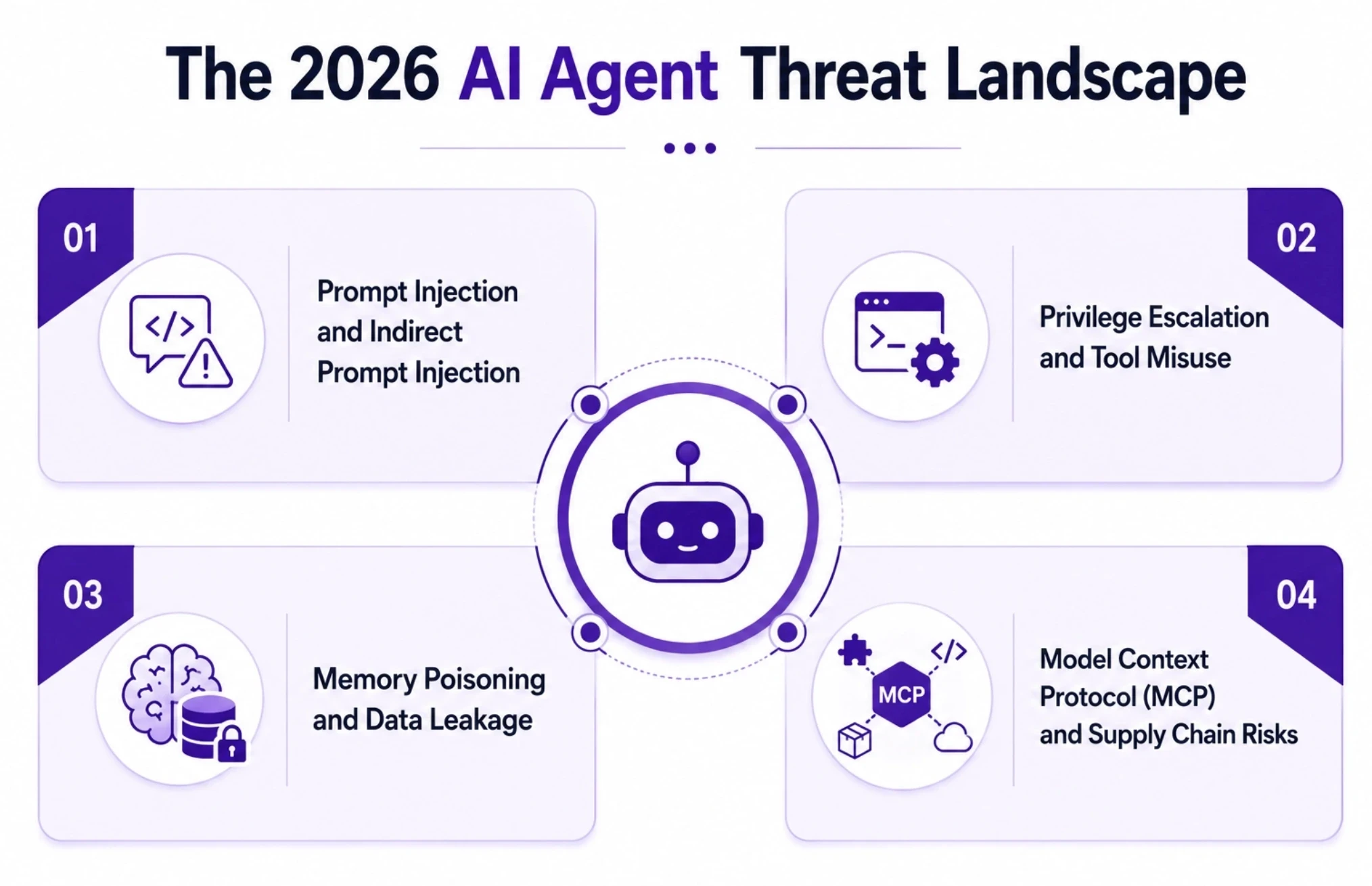
The whole reason why AI agent security risks are different from app security risks is because of that dynamic quality, and so is the threat landscape in 2026.
Prompt Injection and Indirect Prompt Injection
Prompt injection is the most widely used vulnerability on AI agent systems, and there are several variations to it.
Direct prompt injection occurs when a user enters input that includes instructions to change the system prompt or its behavior. The user is attempting to "rewire" the agent while he is in the middle of a conversation, telling him to interpret and perform as if the parts would be delivered as traditional dialogue.
Indirect prompt injection is more insidious and difficult to detect. Here, the bad code is not directly distributed by the user. It is sourced from content that has been extracted from a task, web page, document, email, or database record. The agent automatically reads the content as part of its duty, sees instructions that are embedded in the content, and acts on them. Those instructions were never sent by the user. The assailant had hidden them where an agent would later find them.
Context Manipulation Attacks leverage the models' use of conversation history. An attacker can make subtle changes in earlier interactions that will initiate a chain of events, leading the agent into an increasingly drifting behavior or priming the agent to behave later in a way the attacker can exploit for his/her purposes.
In cases of jailbreak chains, sequences of prompts with a gradual diminution of safety boundaries are applied. There is no distinct line between any one prompt. The combination does.
While multi-agent systems have their own 'comfortable' aspect is the cross-agent contamination of their agents. If an agent is compromised or its directives are manipulated, it does so by incorporating malicious instructions into messages they relay to other agents; there is no direct contact with the attacker on the orchestration layer.
All these variants should be taken into account when developing guardrails for LLM. If you only filter things that are directly input by the user, it doesn't solve indirect injection.
What is Indirect Prompt Injection in AI Agents?
Indirect Prompt Injection involves the downloading of external content (e.g., a webpage, email or document) with disguised instructions aimed at altering the agent's behavior. Malicious input is not required, as in direct injection. It's based on information obtained from the data the agent accesses during task execution.
Privilege Escalation and Tool Misuse
One of the most frequent and significant misconfigurations in agentic environments is over-permissioned agents. The greater the number of tools, APIs, and data sources available to an agent for any given task, the more damage can be done from a successful attack.
AI agent privilege escalation occurs when an attacker tricks an AI agent into performing actions that are not part of their intended permissions. This could result in nagging an agent to make a call to an API they are supposed to be utilizing, but are not for the current window of engagement, or getting two or three tool calls in a row to achieve a privileged outcome that none of the calls alone were intended to produce.
Unauthorized API execution, which refers to making an API call by an agent that is not part of the intended sequence of events - there may be a series of external services, internal systems, or data sources that the agent shouldn't be calling.
You can modify programs to achieve an undesirable result by combining a series of valid tool calls—this is called tool chain abuse. A single call may pass the inspection. The output of the chain is something that a single call can't make.
During these operations, credentials can be lost or stolen by agents, which leads to credential theft. A manipulated agent can be in the system and can be authentically used or passed on.
Command execution risks are also greatest when the users have access to code execution environments or system-level tools. An agent that is capable of running code is an agent that can almost do anything that a given system allows.
The idea of zero trust for AI agents is to ensure that each time a user requests access to a tool, an explicit agreement is obtained instead of an implicit one because the agent has access to it.
Memory Poisoning and Data Leakage
An important extension of the features of memory systems is that they can learn, which is to say, they can help their agents keep context from one session to another. They also present a class of vulnerabilities that most organizations are not well-managed.
Persistent Memory corruption occurs when an attacker is able to cause the target agent's long-term memory to become corrupted. When the input to the memory system comes from unreliable sources, without validation, a malicious input can be inserted into that memory buffer and affect the behavior of the agent in the next session.
Retrieval poisoning affects vector stores and retrieval-augmented generation (RAG) pipelines. An attacker can manipulate the documents or embeddings stored in the retrieval system, thus altering their context as the agent runs a query, and misleading the agent without ever having to speak directly to the agent themselves.
Manipulation is made possible by embedding. Manipulation takes advantage of the functioning of the semantic search. Sculpted content can be designed so that it seems to be relevant to a legit query, allowing it to blossom in places where it would not be expected.
In a multi-user-backed system, such as a shared memory-based system or a system with multiple users accessing the same data on the backend, there's a constant risk of exposing sensitive data. Unless access controls are in place for retrieval, an agent may return data from one user's session that is relevant to another user's query.
In a long-context contamination, the information in the initial context fractionally influences the information in the later context. This window for manipulation is a correspondingly large window in agents that have extended context windows.
Security breaches to DLP in agentic systems can only be accomplished at the retrieval layer and not only at the output layer.
Model Context Protocol (MCP) and Supply Chain Risks
Adoption of MCP has been burgeoning, along with a new type of supply chain or integration risk.
Extensions that can be done via Third-party MCP integrations extend the agent functionality while also being an integration dependency. If a connector is insecurely connected, poorly configured, or intentionally malicious, the connector becomes a point of entry to the agent's operational environment.
Malicious tools and plugins are a supply chain risk. An agent that sets up or processes tools from a third party and bypasses authentication may be run by an attacker who is controlling access to the tools or services.
Prompt tampering via the connector occurs when instructions are inserted into the data returned from an MCP server. The agent gets normal tool output, except for the presence of malformed instructions in that output—business direct instruction and tool manipulation malformed instructions. The agent is a normal tool, but this normal tool has malformed instructions within, business direct instructions, and tool manipulation malformed instructions.
A new dependency vulnerability occurs when an agent relies on external libraries, services, or models with their own security posture. The vulnerability of any dependent is also a vulnerability of the agent.
In a multi-agent architecture, the agent-to-agent trust boundaries are a fundamental concern. If you run in trust mode and pass information or context to another agent, then you must have a trust model for that. If it doesn't exist, a nasty agent can wield maximum influence on other agents without alarming any security controls.
The model context protocol adds true operational value. It will also demand the same security standards as any third-party framework integration in production.
How AI Agent Security Risks Manifest at Runtime
At runtime, AI agents can inflict the following types of damage: At runtime, the forms of damage that occur through AI agents are as follows:
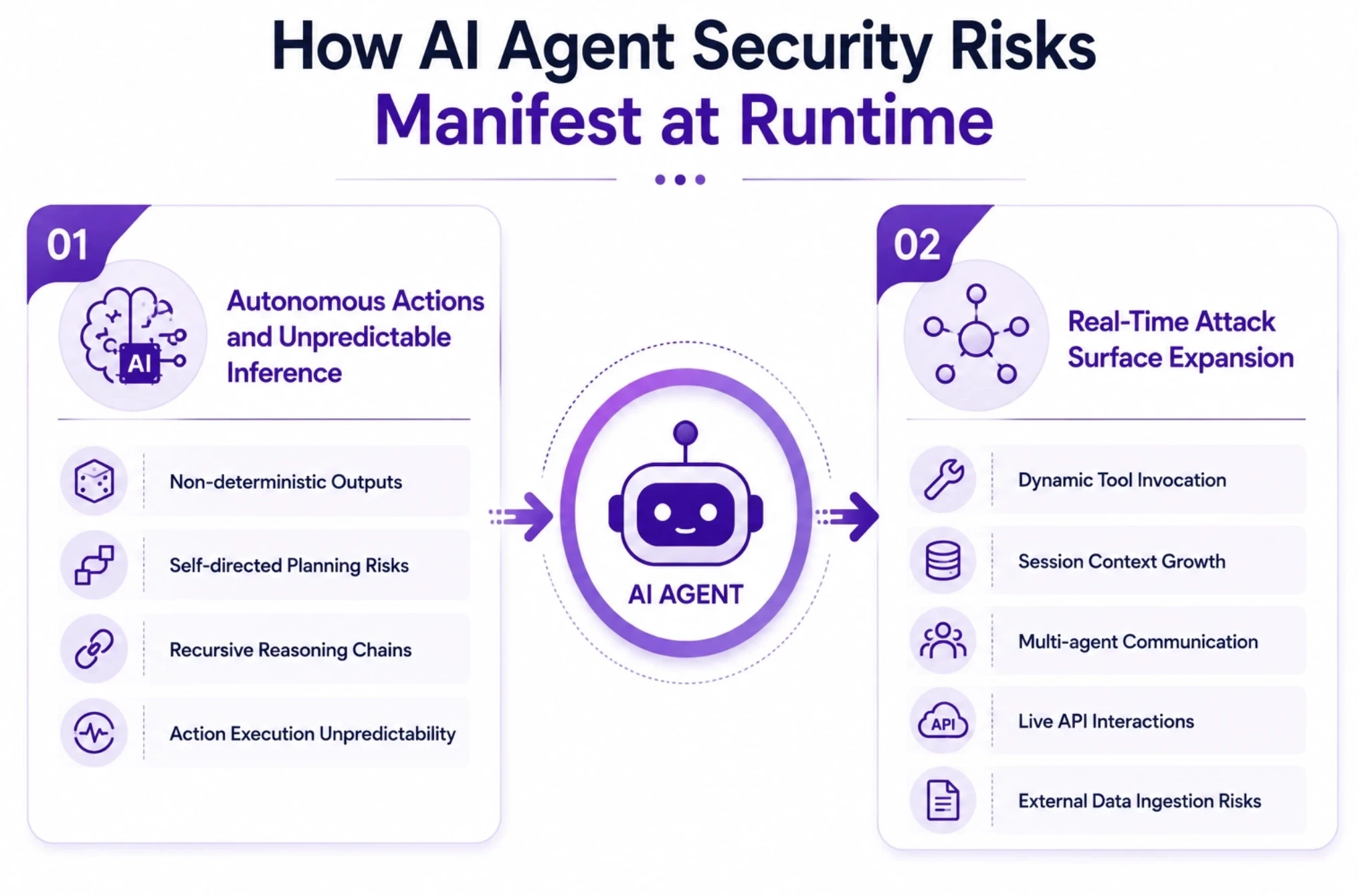
Known vulnerabilities can be discovered in pre-deployment testing, and the expected behavior can be validated. It cannot protect against threats that only manifest themselves in a real environment, where it is interacting with real data, users, and external systems. For self-publishing autonomous systems that do not behave the same every time they run, it is not enough to only do it statically.
This is an example of autonomous actions and unpredictable inference. This is the case of autonomous actions and unpredictable inference.
Autonomous Actions and Unpredictable Inference
LLM-based systems have essential features such as non-determinism. Input is not the same as Output. That lack of prediction isn't merely a product quality problem with an agent that takes real-world actions based on what it receives as input. It is a matter of #security.
Non-deterministic outputs: It's possible for an agent to be safe in testing and unsafe in production, and for this to occur without changing anything. There is some behavior that could never be seen in the evaluation process, but may manifest in the production process under the correct input and context, and under the aforementioned history of the conversation.
A risk of self-directed planning is that the agent may make an incorrect choice of how to divide a goal into steps. The order of operations it selects could be overwhelming, could use data or tools out of order, which could cause exposure, or could have side effects not expected.
Recursive reasoning chains occur when the chain of reasoning by an agent brings them back into the same state they were in initially, resulting in repetitive inferences and actions. In an adversarial setting, an adversary can build the inputs that can make the loop be executed in their desired direction.
An action execution unpredictability violation is defined as when an agent performs an action that is not in its operational envelope when it receives an input (action input) or a context (context input) that it has not seen or learned from in its training or evaluation distribution.
To achieve runtime protection for AI agents, they need to anticipate all these, as they are not yet fully correctable by the steps of prompt engineering, or by fine-tuned pre-deployment testing.
Real-Time Attack Surface Expansion
The Attack Surface of an agent can change over time. It is dynamic and dynamic in its ability to grow as the session progresses.
The dynamic nature of the invocation of tools implies that the list of tools that an agent may be able to call during any one session isn't known at the beginning of that session. As the task progresses, new tool calls come into play, and new potential avenues to exploit open up.
When a conversation grows longer, the context that has been added to the conversation provides more ammunition to work with in the hands of an attacker, called session context growth. Instructors who have planted instructions earlier in a session can have an effect on behavior later.
As messages pass between agents, there would be a tremendous attack surface due to the nature of multi-agent communication. For each message, it is possible to overload the orchestration layer with malicious directions.
Live API interactions involve their ability to innovate and build new connections with external applications at all times. Return of malicious information or information that's been tampered with is possible along each connection.
When an agent is downloading content from beyond the boundaries of its control, there are risks of external data ingestion. Others, such as webpages, documents, emails, and API responses, exist only at the moment the agent asks for them.
In such dynamically exposed systems, real-time monitoring is not an option. At the time of a post-session review, the issue might have already been addressed.
Continuous Security Testing for AI Agents
AI systems change. Models change, prompts get updated, new tools are introduced, and there are changing dependencies for integration. A system in good security standing a few months ago may not be secure today. What was approved and what is actually running is what is captured by continuous testing.
Automated Red Teaming: Probes and Payloads
AI agent red teaming should be repeatable, systematic, and regularly updated in view of new attack techniques appearing.
Adversarial testing uses inputs to the agent that will cause adversarial, out-of-bound, or unexpected responses. Known attack patterns and new probes that revisit the limits of what the agent can do.
Prompt fuzzing is an iterative process that systematically changes its input data to find unexpected failures that structured testing cannot catch. There can be considerable differences between various versions of the words and phrases used for an output, and in how those are encoded, and fuzzing can spot those variations at scale.
Specific simulations are also involved in the ability of the agent to be controlled and abuse its tool access, such as passing an incorrect parameter, invoking a tool in an abnormally ordered use, or invoking tools that were never intended to be used.
Multi-turn exploit chains: An example of testing a series of low-level, non-harmful inputs to see if they can be combined in a way that leads to a harmful. More difficult to detect using single-turn testing and often occurs in actual attacks.
Advanced red team solutions are now able to create exploits on their own. These systems do not have a hard-coded library of attacks to execute, but instead dynamically reason attack variants, which they term as their "reasoning capabilities," and then check them against the system to find openings.
Testing Guardrails and Policy Enforcement
It's not helpful to have guards around them if they're not working against outside elements. You simply cannot test them if you want to.
When a policy is validated, the rules intended to regulate an agent's actions are found to be consistently applied to different inputs, including adversarial variations and edge cases.
A safety boundary test attempts to discover if the boundaries of the agent remain intact when an adversarial party attempts to breach them. This includes experimentation on how boundaries break when under multiple turns and/or context manipulation.
Response filtering verification ensures that the response is what it should be – whether that is the appropriate response, sensitive content, or harmful content, and out-of-scope responses are all being captured.
Access control verification is a test for compliance of access control boundaries for agents, from the API and tool level, not only from the system prompt level.
Compliance enforcement testing ensures the correct operation of the controls in the production environment, and not only in the controlled test environment, necessary for meeting regulatory and/or policy requirements.
Runtime Protection: Real-Time Detection and Response
Security that strives to prevent attacks was always reasonable in fixed and bounded systems. The agents of AI are not either. The rationale for runtime defense is that for some attacks, the preventive measures are not sufficient, and the capability to detect and respond to attacks at runtime is what will mitigate damage.
Behavioral Analytics and Anomaly Detection
Without understanding normal behavior, you can't know what is anomalous behavior. That's where behavioral analytics begins.
Agent behavior baselines document normal operation for a particular agent in a specific context. What type of tool(s) does it usually use to call out? What type of data does it normally fetch? With how many steps do its reasoning chains generally go? Anything that deviates from those baselines is an early warning that there is something problematic.
A flag is raised when an agent utilizes tools that are not used in the expected way - using unexpected parameters, calling the tools in an unusual order, or in an unusual mode.
With prompt anomaly detection, semantic analysis of any input stream is used to detect patterns indicative of injection attacks, jailbreak chains, or context manipulation.
Context drift analysis tracks the overall operational context of the agent throughout each session, alerting to instances where it has changed in a way that may indicate that it is being manipulated.
All of this is possible with the use of runtime telemetry. Behavioral analytics, without in-depth logging of the calls made to the tools, content retrieved, model inputs and outputs, and session state, is toothless.
Blocking and Alerting on Malicious Actions
Logging is detection in the absence of a response. RUPT must be able to take some action with the detection.
With run-time policy enforcement, security rules are applied at run time. A flag for later review is not used to enforce the policy of not accessing a specific data store; it is only done at the time the agent makes the access attempt.
High-risk actions are put into a gate through human-in-the-loop approval. If there is a code execution call, a code change, or a modification to a production record, it is expected that the agent will be able to point to a live environment and ask the human to review the code before it is carried out.
Action interception - prevents a particular tool call or execution step during a process before it takes place if it is identified by a violation of the policy or an anomaly.
In the event of an active compromise detected, or if the agent continues to be seen violating policy regularly in a manner that indicates further compromise, Session Termination is the correct remedial action.
Through threat intelligence integration, runtime detection is correlated with other threat data, and integration of threat patterns or newly discovered techniques automatically appears in detection rules without manual participation.
Zero trust for AI agents comes through in this. The best way is to assess all actions the agent will attempt in real-time, not simply based on a general capability grant.
Best Practices for Securing Agentic AI Workflows
Zero Trust and Principle of Least Privilege
At its core, the concept of zero trust is about principles. There are principles involved in the concept of zero trust.
In the context of Zero trust, AI agents earn access to the tool, data, and API one step at a time. With Zero trust for AI agents, no tool, no data, no API call is trusted by default; it's earned one step at a time. Permission to perform an action must be granted for the action itself and can not be granted once and for all.
Scoped permissions" is an agent working on a customer support task who only gets access to customer support data and tools resources, and nothing more. The scope is not necessarily what may be theoretically possible; it is set by the task.
Temporary credentials minimize exposure time when credentials are stolen or compromised. Instead of long-lived access tokens, an agent should be issued with credentials that have the shortest possible length of 10-12 hours, which is still pedagogically appropriate.
The "tool isolation" feature guarantees that there are no interactions between tools unless they are mapped in specific integration points. An agent that is able to call Tool A and Tool B should not be able to create a chain of calls such that they can establish an effect that Tool B can have on Tool A without the former being aware of it.
Identity-aware execution refers to associating each agent action with a verifiable association, that is, an identity that can be audited. By whose approval was this done? Under what context? These types of questions must have answers following the execution.
Access segmentation is the use of data access and network access controls at the agent layer to block access to systems or data by compromised agents from outside of their operational boundary.
Prompt Hardening and Validation
The system prompt is a security element. It must be dealt with as such.
'Input sanitization' is a new feature that is applied to input text entered by the user, documents retrieved, or data that is returned from the Tools. The idea is to stop the injection payload from getting into the model before it can be processed.
Prompt templates can be designed so that any injected instructions to the prompt are not easily incorporated into or altered from the intended prompt formatting. Compared to the open-form prompt, structured prompt models with clear delimiters for trusted and untrusted content are more immune to injection attacks.
In output verification, the outputs of the model are compared to a predetermined policy prior to any requested actions or feedback. This also involves semantic analysis of offensive material and whether statements are supported with facts, and when the responses indicate that the model may have been tweaked.
Context filtering is also used to manage and block the information flowing into the active context window, preventing the detection of injection payloads in data that has been retrieved and is returned in the context window for use by the model.
Continuous Security with Akto: Full Lifecycle Protection for AI Agents
Making sure you're continuously protected with Akto's full lifecycle system for AI Agents.Ensuring that you are always protected with Akto's full lifecycle system for AI Agents.
It is challenging to manage the security of AI agents throughout their lifecycle. Discovery, posture assessment, testing, runtime monitoring and response to incidents all have to be linked together and it is unsustainable to perform them manually on scale.
To meet these demands, Akto provides the security life cycle of a system, tailored to the architecture and threat model of today's agentic systems.
Agent Discovery, Posture Management, and Guardrails
The module also includes Agent Discovery, Posture Management, and Guardrails settings. Agent Discovery, Posture Management, and Guardrails settings are also included.
The first step to securing AI assets is to understand what assets you have. Today, many organizations utilizing agentic systems don't have a clear understanding of the agents deployed and available tools, as well as how they are configured.
AI asset inventory provides an up-to-date and accurate understanding of all assets deployed, integrations, permissions, and data streams. This is the starting point of all things.
Discovery through the MCP specifically brings to light model context protocol connectors, many of which are added by the development team without the need for a formal security audit. A basic understanding and appreciation of the available MCP integrations is a prerequisite for assessing the risk of those integrations.
Misconfiguration detection compares deployed agents to a set of security "baselines" and will identify agents whose security settings are too liberal, lack output controls, are inadequately hardened, and more.
With policy governance, consistent security policies are applied throughout the estate of the agent, thus avoiding each security decision being made on a team-by-team basis without governance.
The security picture is continually assessed and kept up to date when agents are updated, new integrations are added, and the environment changes. In an active Dev (rapidly evolving project), a PITA can become out of date relatively fast.
Automated Red Teaming and Runtime Blocking in Practice
It is important that testing and monitoring be performed in production, not just as part of a pre-deployment evaluation.
Simulated attacks are continuously run on deployed agents against an ever-changing library of attack techniques based on latest threat intelligence. As new prompt injection methods are documented, new variants of them, means of using tools in non-documented ways, and multi-agent attack chains are added.
The runtime interception approach discovers and prevents malicious operations before they reach the tool, API, or data store they were trying to access.
Real-time policy enforcement doesn’t make you wait for a time lag between detection and response – it applies security rules to each agent action in real time.
Detection workflows send alerts where they belong and provide the relevant context and details for fast investigations, such as all the events that led to the alert.
Incident response automation processes incidents manually when they're high-confidence, well-understood, and forgoes interactivity for every incident; and escalates ambiguous, as well as novel scenarios, to human reviewers.
Final Thought: The Future of AI Agent Security
The use of AI agents is providing operational value, and enterprise uptake is on the rise. The attack surface they represent, however, is greater, more diverse, and less familiar to security teams than the surfaces that have been the target of decades of protection skills training.
Preventative controls are important, but are not enough; correlating with this, the need for runtime visibility is crucial. What a correctly working agent would do in test can be exactly what it does in production. Observation needs to be there when it happens to catch it.
Continuous testing and monitoring is transitioning from "best practice" to "required practice". The further the agents achieve proficiency in their skills and the greater their integration into the critical processes, the more significant the ramifications of an attack.
Zero-trust architectures are the right model for agentic systems. All tool calls, data access, etc., should be granted explicitly and not based on a set of permissions present in the system that might not necessarily be a relevant set for the current function or context.
Organizations that are going to effectively deal with the threats to AI agents in 2026 and beyond will be the ones that are already creating continuous security operations around their AI systems, and not just waiting for an incident to prove them wrong.
Looking to find out what your current AI security posture is? Request a AI Agent Security demo of Akto to see runtime protection, fully automated red teaming & agent security during the entire lifecycle in action.
FAQs for AI Agent Security Risks
What is the most serious security threats to AI agents?
The top threats in 2026 include prompt injection, access to over-permissioned tools, memory poisoning, supply chain threats via third-party MCP integrations, and poor monitoring during runtime. They all share the common difficulty of agent behavior, which is dynamic and non-deterministic, making any static approach to security measures inadequate in any way.
How does prompt injection affect AI agents?
Prompt injection is a way a hacker can implant instructions into a prompt that will override or alter a hacker's actions. Direct injection is through the use of user input. Indirect injection is achieved by an injectable content included outside via an external resource obtained during a task. In agentic systems, these repercussions may not be only a single answer, but rather an unauthorized tool call, data outflux, or cross-agent contamination in multi-agent systems.
What is privilege escalation in AI?
AI agent privilege escalation is when an AI agent is misled into gaining capabilities and/or accessing data they were not meant to have. This usually occurs by tool chaining, a process that lets a series of individual tools be called each have a permission to be called, which then has a permission to be called, and ends in a privileged call; or by adversarial prompting, where a topic is good for high privilege calls to a tool and bad for it to be called a different way, but is now called the “high privilege way”: which has a permission to be called. This typically happens by adversarial prompting: a topic is good for a certain type of call to a tool, and bad for the other type, and it gets called a third type; or by tool chaining: a sequence of individually permitted tools is called, where the final call has permission to be called.
What is the runtime protection of AI agents?
While running, agents are monitored every second in runtime protection to set up baseline normal behavior and to detect deviations from it. If a violation or anomaly is detected during runtime, specific actions may be blocked, a human review may be initiated, or a session may be terminated, depending on the severity and certainty of the violation or anomaly. It does not operate at the layer at which the actual risk occurs – that is, during inference and action execution; it occurs before deployment.
What is memory poisoning in agentic AI systems?
Memory poisoning is when the attacker causes what writes to an agent's persistent memory store to change. An attacker can actually change the behavior of the agent in subsequent sessions by placing false information or malicious instructions in its long-term memory such that there is no direct manipulation of its behavior at any point during the attack. A related attack is retrieval poisoning, which affects the vector store/knowledge base that the agent accesses when carrying out tasks.
Important Links

Experience enterprise-grade Agentic Security solution