AI Agent Security Best Practices: How to Secure Enterprise AI Agents
Learn AI agent security best practices to protect autonomous AI agents with governance, continuous monitoring, runtime guardrails, risk management, and enterprise security controls.

Rushali

Most businesses can afford to have one AI agent. Much fewer will be able to manage the two hundred agents who gracefully creep in across their teams in the coming year. It's in that gap that security programs fail. A pilot is carefully installed, followed by marketing, support, finance, and engineering, and the controls that work for one system simply do not extend to the others.
It is not often that a lack of tools is the reason. Programs get bogged down because no one is able to view all the agents, no one owns all the agents, and no operational controls last beyond the launch week. Discover the best practices in building visibility, owning risk, understanding risk, and conducting everyday security operations that scale with your enterprise AI agents after the initial deployment.
What Makes AI Agent Security Different?
Traditional application security is based on software that is able to respond to requests within defined boundaries. AI agents don't act the same. They are independent, interdependent, temporal, and ambiguous in terms of accountability for failure. Every one of these changes contradicts an assumption that was fundamental to the older security models, so a dedicated AI agent security model is required and not some overstretched version of AppSec.
AI Agents Can Take Actions
A traditional application is waiting to be instructed, and then it will return an answer. An AI agent decides on a course of action and carries it out. It can send an electronic mail, update a record, move money, or call another service without needing someone's permission for each step. It is no longer a security question of what information this system can read, but rather what this system can do and what will occur if it does? If the decision is a mistake, it's not a bad output on a screen anymore. It is a real change in a real system.
AI Agents Access Multiple Systems
Agents seldom spend their time acting alone. One agent may be qualified with a CRM, a data warehouse, an email system, and multiple internal tools, most likely supported by an MCP server. That access is extensive, and one compromised agent can be an access point to the entire environment, making the ability to map such relationships a critical element in securing the deployment of AI. The radius of the blast from an incident is determined only by the explosive power of the agent.
AI Agents Continuously Evolve
When you ship software, it's generally the software you own, until you decide to upgrade it. Agents are different. The underlying model is replaced, the prompts are fine-tuned, new tools come in, and behavior wiggles as services upstream change. A safe agent can be hazardous three weeks after it's installed, and no one changed its code. This is where point-in-time testing fails, and where an AI agent lifecycle management needs to treat the AI agent like a live entity instead of a completed product.
AI Agents Create New Accountability Challenges
If an agent acts, who is responsible for what the agent did? The engineer who constructed it, the business team that uses it, the security team that approved it, or the vendor who provided the model. When there's no resolution, a lot of people look elsewhere, and incidents get stuck. Agent accountability is a structural issue; it needs to be addressed with ownership and policy before an incident happens to raise the question.
Why is AI agent security different from traditional application security?
Traditional application security is designed to defend systems that operate within known boundaries that accept requests. AI agents operate autonomously, they can have access to multiple systems simultaneously, and they can adapt their behavior over time as models and tools evolve. The result of that is that security must be able to secure what an agent can do, not only what data it can read, and must be able to execute continuously, not only at one release point.
The Seven AI Agent Security Best Practices Every Enterprise Needs
These are the key fundamentals of an effective AI security program. They work from the bottom up, starting with the foundation of who owns and is responsible for each agent, then visibility and risk classification, and lastly, daily policies and AI agent security controls. All of them operate in concert. Without inventory, there are gaps; without monitoring, there is no policy.
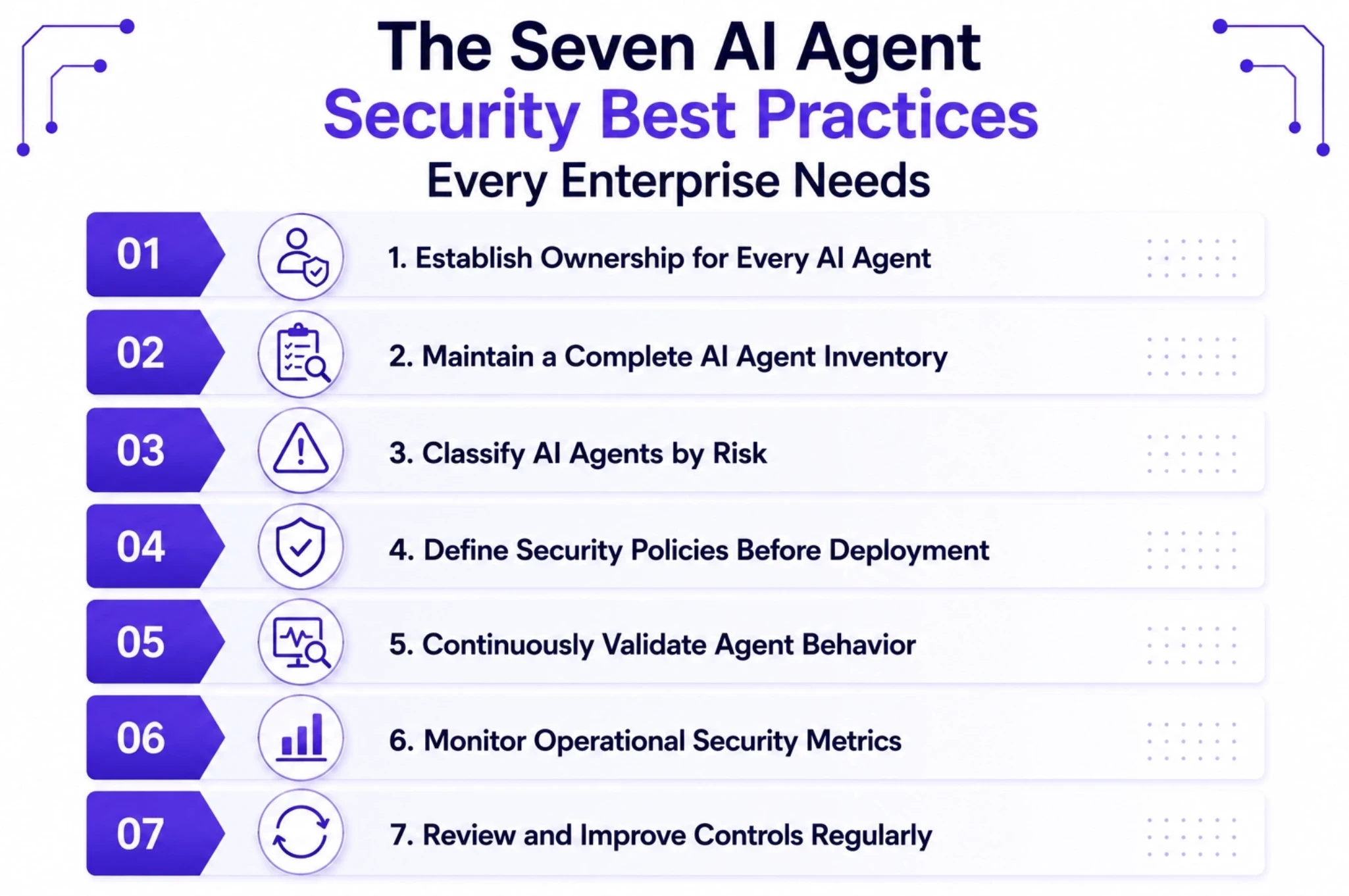
1. Establish Ownership for Every AI Agent
All agents require owners before they are live. Clear AI ownership is the only control that allows everything else to happen, as policies, reviews, and incident response require a person to take action. It is covered by three roles.
The business owner is responsible for the existence of the agent and what the agent does. It is up to them to determine if its function is still worth its use. The technical owner has the accountability of building the agent, connecting it to the tools, and managing its behavior in production. The security owner takes responsibility for the risk, establishes the guardrails, and assumes the responsibility for the consequences of the agent's misbehavior. If they are all named, then the agent is held responsible, and it gets noted against their name.
2. Maintain a Complete AI Agent Inventory
If you can't see it, you can't protect it! Having a complete AI asset inventory is what sets a security program apart from a guess. The inventory needs to cover four categories.
Those agents that have owners and have been reviewed are the approved agents. Internal agents are agents that are developed in-house, like the experiments that engineers create without informing anyone. Third-party agents are introduced via vendors or SaaS products, and often without our express consent. The one that hurts the most is shadow AI; agents and MCP tools running on employees’ laptops and in browsers and within workflows that security never sees. Sticking to platforms such as Akto to discover and catalog AI agents, MCP servers, and connected tools in the cloud, endpoints, and internal infrastructure, to keep the inventory in sync with reality and not what was announced.
3. Classify AI Agents by Risk
Not all agents are created equal, and not all are to be judged equally. Distributing an equal amount of effort over all of them is a waste of attention on not-so-dangerous tools and a deprivation of dangerous tools. Rather, Sound AI agent risk management classifies agents into four categories.
Low risk includes internal users who do not have sensitive access, such as an assistant to the meeting notes user. Medium risk refers to agents accessing internal data, for example, a knowledge assistant asking questions of company documents. High risk includes any agents that come in contact with customers, and anything with regulated or personal data. Consequential actions, such as transferring money or switching production processes, are only considered critical risks for autonomous agents. When this is documented in an AI risk register, the program has a common language to determine where to invest effort.
4. Define Security Policies Before Deployment
After-the-fact policy is post-mortem. Prevention is a policy written prior to deployment. There are three types of policies that define the boundaries within which an agent can act.
Data access policies determine what an agent is allowed to read and write and are based on "least privilege" rather than convenient, wide-open grants. There are usage policies that specify what can be done, or whether it needs a human in the loop, and what it cannot do at all. The access control policies control who can deploy, modify, and invoke the agent. With strong AI policy enforcement, these become runtime controls, with actions that are left out of the boundaries being blocked rather than just logged afterward.
5. Continuously Validate Agent Behavior
Agents are volatile, and a test at launch time is little evidence a month later. The picture is kept up to date by three habits of continuous validation. In addition to when something breaks, security reviews are conducted on a schedule on the agent against its policies. Adversarial testing and red teaming the live agent to determine its reaction to prompt injection, tool abuse, and privilege escalation. Whenever the agent's access level, model, or connected tools change, a risk reassessment updates the agent's tier. It's with regular AI security reviews that it can be caught before an attacker that the slow slide from safe to exposed occurs.
6. Monitor Operational Security Metrics
In the case of a deployed agent, the same care must be taken as with any production system. AI agent monitoring provides you with an alert before the little problem turns into an incident. Observe agent activity to find out what the agent is doing, what tools it's calling, and what data it's interacting with. Log violations, so that every time someone is blocked or attempts an out-of-bounds move, it will show up. Document security incidents sufficiently to investigate and learn. These artificial operational controls make a 'black box' into a security team that can actually run it.
7. Review and Improve Controls Regularly
Controls decay as the environment changes. They are kept up to date by a schedule of improvement. Ownership, policies, and inventory coverage are reviewed quarterly for drift. As new threats and agents emerge, risk assessments revisit the threat picture. Governance updates incorporate learning from incidents and audits into policy. This loop is the difference between a one-time hardening effort and a long-term AI security program.
AI Agent Security Lifecycle
Best practices fit better with the steps an agent takes. AI agent lifecycle management takes its shape from the lifecycle below, from discovery to review. It is a regular occurrence that keeps AI agents safe. Each stage has its own set of controls, and tooling like Akto's agentic security platform aligns to these stages, meaning visibility and enforcement is always present from the agent's entry at each stage.
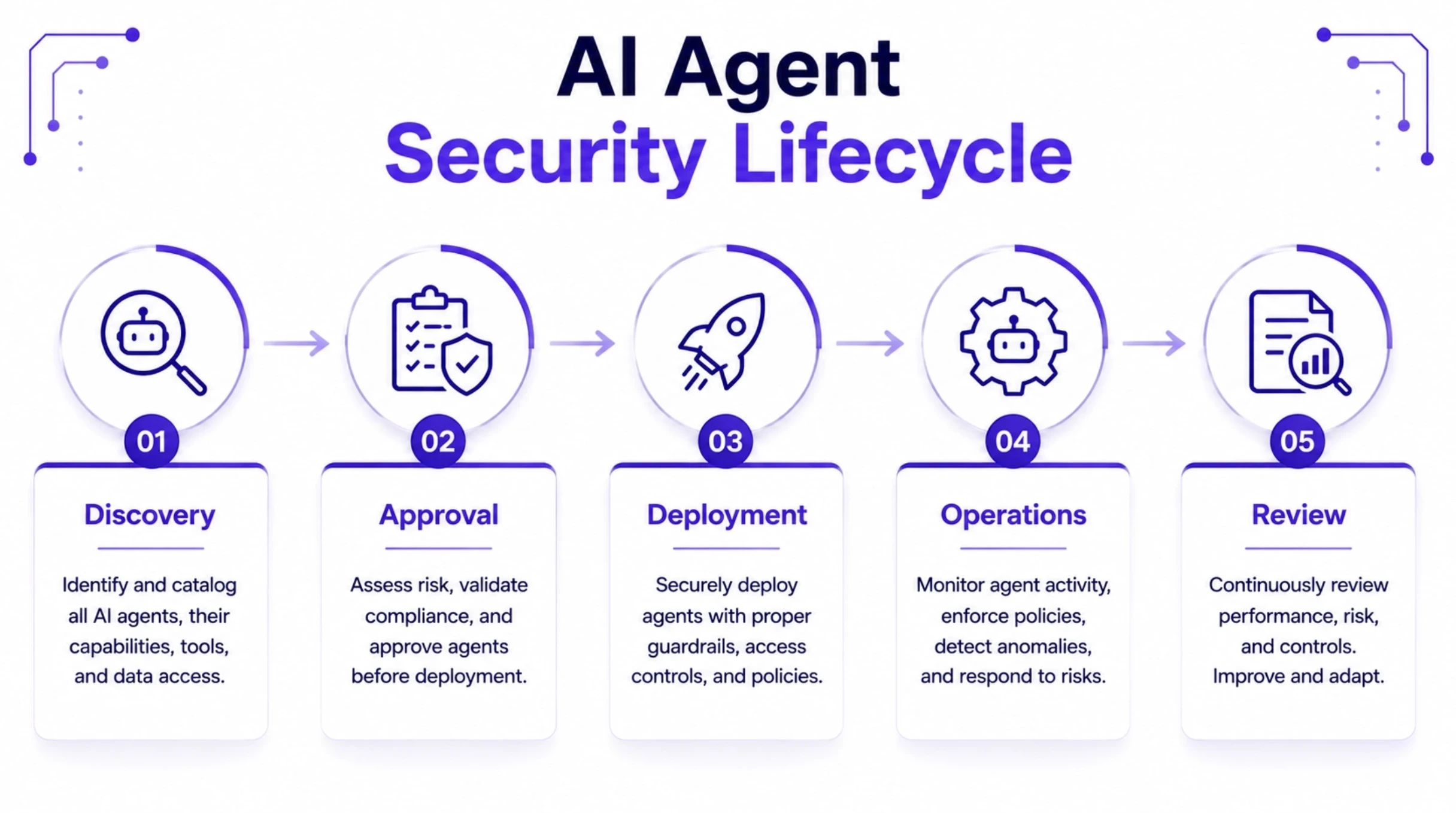
Discovery: Building a Complete AI Asset Inventory
The life cycle begins with the discovery of what is already there. Discovery exposes all of the agents, MCP servers, and tools deployed across cloud environments, employee devices, and internal systems, including unannounced shadow AI. This part is automated in Akto's agentic discovery and relates agents, tools, and resources they interact with, allowing you to see the inventory not only as the resources they're running, but as the relationships between them.
Approval: Assigning Ownership and Risk
Once one is identified, an agent will proceed to go through the approval process. Assignments, risk classification of the agent, and definition of the policies are done before it goes to production. This is the gateway where the adoption of AI is governed, where an experiment becomes an asset with a record of it.
Deployment: Enforcing Policy at Launch
Policy is on the ground in deployment. The agent lives inside the boundaries, and data access and usage/access control policies are enforced as runtime guards. With secure AI deployment, the controls are included with the agent and not as a secondary task that will never be completed.
Operations: Monitoring Behavior in Production
The agent works, and the program observes. Activities, policy violations, and incidents are constantly tracked, and guardrails prevent out-of-bounds activities. This is the longest phase of the lifecycle, and the time when AI security operations prove their worth.
Review: Revalidating and Reassessing Risk
Review "closes the loop" and "reopens the loop". The agent is re-tested, risk class re-classed based on any changes, and results are passed back to the policy. So the cycle repeats – an agent is never done when it is still going.
AI Agent Risk Classification Framework
A common set of criteria ensures that risk decisions are consistent throughout teams, rather than relying on the individual decision of each team member. The following table matches each tier of risk to a representative example and the controls that are suitable for each type of risk, to provide security and engineering with a common set of reference points when they classify a new agent.
Risk Level | Example | Recommended Controls |
|---|---|---|
Low | Internal productivity agent | Basic governance, ownership recorded, inventory entry |
Medium | Knowledge assistant querying internal data | Access reviews, defined data policies, periodic checks |
High | Customer-facing agent handling personal data | Continuous validation, runtime guardrails, active monitoring |
Critical | Autonomous operational agent taking consequential actions | Enhanced controls, strict least privilege, human-in-the-loop, frequent red teaming |
The concept of the framework is scale. A low-risk note taker should not perform the same review as an agent that could carry money, while a critical agent should never have light-touch controls. These tiers are also useful to map AI compliance controls, making audits easier, as the level of evidence expected is in proportion to the level of risk.
AI Agent Security Operating Model
Practices and lifecycles outline what to do. Operating model: Who does it? A sound security operating model ensures that there is no blind spot between teams by distributing responsibility among four groups. This is the architecture that can make enterprise AI agent security more than just one team's side project.
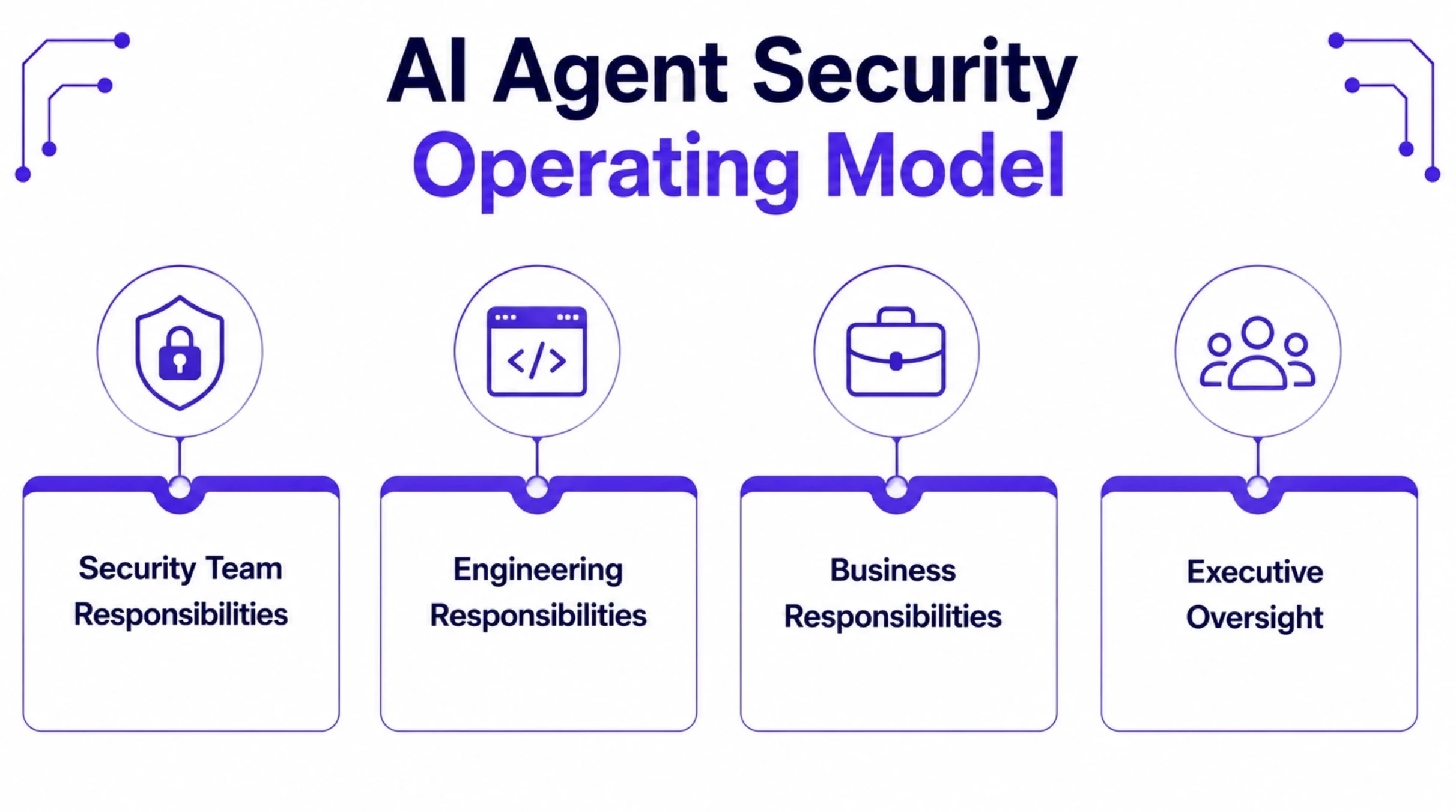
Security Team Responsibilities
The framework is owned by the security team. They establish policies, manage risk classification scheme, conduct security reviews and red teaming, and handle incidents. They set the standards all agents are measured against, and they have the discretion to put a stop to an agent deployment that doesn't meet them. This is their job to ensure the default is secure and not to have to manually check every agent by hand.
Engineering Responsibilities
Engineering constructs and operates agents within the guardrails that the security team sets. They use least-privilege access, only connect the tools an agent needs to use, and instrument agents to make their actions visible. If a violation of the policy is discovered, engineering is responsible for fixing it. They're the mechanics that maintain agents in production.
Business Responsibilities
The purpose and risk acceptance are owned by business teams. They explain the purpose of an agent, validate that it is still performing its duties, and determine if the value outweighs the remaining risk. They are the business owners listed in the inventory, and they are liable if an agent's use is no longer approved according to its original guidelines.
Executive Oversight
Appropriate and sufficient funds are allocated by executives to establish a risk appetite. They monitor enterprise-wide AI security metrics at a portfolio level, enforce enterprise-wide governance commitments, and decide on enterprise-wide policy. Their involvement lends the security team the authority to enforce controls among teams that may not be compliant with them. This layer is crucial for strong AI agent governance and cannot be overlooked.
KPIs for Measuring AI Agent Security
If you can't measure a program, then you can't defend it in a budget meeting. It is the AI security metrics that provide insight into the effectiveness of controls and where to invest in the future. The five KPIs provide a balanced view of the program's health and, combined, of AI security maturity over time.
Inventory Coverage
The inventory coverage question is the most fundamental question: what proportion of agents in use are in your inventory? If 40% of an agent can be cataloged, the program is blind by a large margin. The best first indicator of whether visibility is increasing or not is covered over time, and the speed with which newly discovered shadow AI gets governed.
Policy Compliance
The Policy Compliance is a ratio of the number of active agents that comply with the defined policies to the number of agents that do not have policies. It indicates the level of AI policy enforcement, whether it be real or aspirational. In most cases, the falling compliance is an indicator that the program is outpacing the adoption, and this is a warning you should heed before an incident makes that message stronger.
Security Review Completion Rate
This KPI measures the percentage of agents reviewed on time compared to the percentage that is late. A backlog of overdue reviews is a backlog of unknown risk, as risk agents tend to drift. Validation is not getting behind the fleet, as evidenced by a healthy completion rate.
Risk Reduction Metrics
Risk reduction metrics assess if the program is reducing exposure. Valuable metrics include the number of agents that can be removed from over-permission status and whether there are critical-risk agents that are corrected by adding additional controls, or whether there are critical-risk agents that are not corrected at all. Other metrics include the time it takes to remediate findings from red teaming. These relate security activity with outcomes, not effort.
Incident Trends
Incident trends are used to assess the frequency of agents causing or contributing to security events, the severity of events, and the trend of events across quarters. The rising number doesn't always mean a worsening situation because it could simply be an increase in detection, so it is important to consider the severity and time-to-resolution as well as the number. When taken in conjunction with the other KPIs, this is what will indicate whether or not the program is on track to bend the curve.
Common Mistakes Organizations Make
AI agent security failures are the same few mistakes over and over again. It is less expensive to identify them early than to learn them through an incident. Each of these five recurs throughout enterprises deploying agents at warp speed.
Treating AI Security as an Engineering Problem Only
The most prevalent approach is to give AI security to engineering and declare it resolved. Though engineering can create secure agents, it cannot establish risk appetite, accountabilities on the business side, or governance within an organization. If security is perceived only as a technical function, then the policy, ownership, and oversight levels are lost, and the program is not grounded.
No Agent Ownership
If agents are deployed with no name, they turn into orphans. If the incident occurs with an orphaned agent, nobody is responsible for responding, and time is wasted figuring out who is supposed to be in the room. Absence of ownership is the silent killer that transforms a manageable issue into a long-term issue.
Missing Risk Reviews
Teams that only test once at launch are getting a current snapshot of an agent that will not be around for the next test. Model changes, new tools are added, and behavior evolves. If the program skips the periodic reviews, it only gets the wrong idea of an agent each and every week.
Lack of Governance
If there's no governance, everyone creates his or her own rules. One set thinks in terms of least privilege, another set thinks in terms of convenience, and there isn't a standard to audit against. Not only does the lack of AI agent governance lead to risk, but without it, there is no way to measure risk across the organization.
Poor Visibility Into AI Usage
The most grievous mistake is to be unaware of the fact that agents exist at all. Shadow AI is transmitted into browsers, laptops, and SaaS tools at a faster rate than most security teams realize, and an agent unseen by anyone gets no controls, reviews, or monitoring. The rest of the practices in this guide are all dependent on the ability to see, and poor visibility will ruin the rest of the program.
AI Agent Security Checklist
This checklist summarises the guide. Perform a run-through of each of those areas and for the program overall, categorized by the four areas that sustain the effectiveness of AI agent security.
Governance
✓ Assign ownership: for each agent, have a business owner, a technical owner, and a security owner.
✓ Define policies: define before deployment policies about data access, usage, and access control
✓ Approval workflows – have all agents go through review prior to production.
Visibility
✓ Ledger of inventory: inventory that involves a full inventory of approved, internal, third-party, and shadow agents.
✓ Active discovery of agents and MCP tools on endpoints and browsers to be alerted on shadow AI.
✓ Review Integrations: map all of the tools and systems that each agent has access to
Risk Management
✓ Categorize risks; prioritize them as low, medium, high, or critical level risks
✓ Review permissions: restrict access to what an agent needs and deny access when it isn't needed anymore
✓ Reassess periodically: change risk tiers as access, tools, or models change
Operations
✓ Ensure monitoring of activity: tracking of agent behavior, tool calls, and data access in production.
✓ Review incidents: capture, investigate, and learn from all security incidents
✓ Monitor KPIs: inventory coverage, compliance with policy, inventory reviews, and trends in incidents
Turning Best Practices Into a Working Program
Getting enterprise AI agents is not just about a single control; it's about being able to operate visibility, ownership, and operations as a program. The successful organizations see all agents as a governed asset, with owners, a risk tier, enforced policies, and continuous validation, not a successful hack that has gone astray. Akto brings that operating layer to one place: automatic discovery of all MCP and agent tools, ongoing red teaming against real agent attacks, posture management, and runtime AI guardrails throughout the entire agentic attack surface. If you are prepared to find out what's in your AI agent inventory and the dangers that reside there, book a demo and implement a working program behind your AI adoption.
Frequently Asked Questions on AI Agent Security Best Practices
What are AI agent security best practices?
AI agent security best practices are the measures that ensure the security of autonomous agents at scale: Ownership of each agent, complete inventory of all AI agents (including shadow AI), categorization of agents and risks, policy establishment prior to deployment, continuous validation of AI agent behavior, monitoring of operational metrics, and regular review of controls. They are not a hardening exercise, but are together a program.
How do enterprises secure AI agents?
Organizations gain control of AI agents by creating visibility for all agents deployed, defining ownership, establishing runtime boundaries and limits, and performing consistent validation and monitoring. It's carried out by security, engineering, business, and executive teams following a unified operating model, with tooling that automates discovery, testing, and policy enforcement throughout the lifecycle.
How often should AI agents be reviewed?
Reviews should be held periodically as models, prompts, and linked tools evolve and drift, not just when they are launched. Standard practice is to review the entire fleet's security quarterly, and to re-review upon changes to an agent's access, model, or integrations. More frequent validation and red teaming are needed for higher-risk and critical agents.
Who should own AI agent security?
Ownership is spread between 3 agency roles; Business owner (who is responsible for purpose and risk acceptance), Technical owner (who is responsible for how the agency is built and run), Security owner (who sets guardrails and leads incident response). The framework is owned by the security team, and risk appetite and funding are owned by the executives at the program level.
How do organizations measure AI security maturity?
Metrics used to assess AI security maturity include inventory coverage, policy adherence, security review completion rate, incident trends, risk reduction, and policy adherence. Increased coverage, compliance, and decreasing unremediated risk suggest a maturing program. Maturity is also demonstrated in practice – in processes of ownership, governance, and ongoing validation, for example – rather than in exception.
What should an AI agent security program include?
A complete program consists of a full asset inventory for AI, named ownership for all agents, pre-deployment policies applied and enforced at runtime, ongoing validation and red teaming, monitoring during operation, an agreed-upon operating model for teams, and measurable KPIs. The discovery review process links all these elements together into one continuous process.
Important Links

Experience enterprise-grade Agentic Security solution